
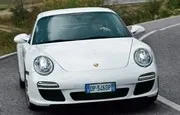
The second generation of the model with the index 997 confirms our assumptions. Take, for example, the flat engine — outwardly it seems only slightly modernized, but in essence it is a completely new unit, working in tandem with the latest dual-clutch transmission. And is it really because of such changes that the designers from Zuffenhausen had to reshape the appearance of the 911, which is recognizable even in complete darkness?
TWO SIDES OF CHARACTER
To truly understand the Carrera, a simple glance is not enough. Only after several hours behind the wheel do you realize how flexibly it adapts to any situation. One could call it versatility, if that word were not associated with minivans. The 911 equally easily flatters the ego of an experienced racer and makes a beginner, who has sat in a Porsche for the first time, feel at home. It does not matter whether you are stuck in traffic or pushing it to the limit on the track. The driver's seat is thought out to the smallest detail — from seating position to button placement. The only surprise is the traditional Porsche ignition lock on the left of the steering column. The new ventilated seats and touchscreen navigation are taken for granted.
HOW TO SHIFT GEARS
Seats and navigation are nice additions, but the arrival of the PDK robotic dual-clutch gearbox is a much more significant event. It has finally sent the old Tiptronic torque-converter automatic to rest. The same fate probably should have befallen the manual, but then we would have had to deal with an army of purists convinced that real driving is only possible with three pedals.
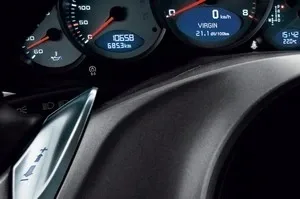
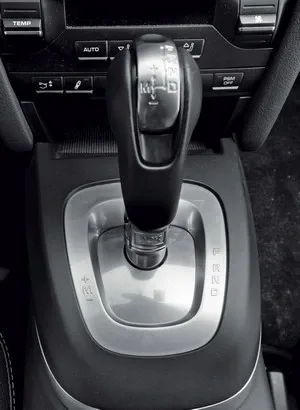
PDK (Porsche Doppel Kupplung) can show both sides of a sports car. In Drive mode, the gearbox works smoothly, shifts gently, and responds instantly to accelerator pedal inputs. When you need to accelerate sharply, shifts become faster but do not lose smoothness. Only the controls disappoint. The engineers decided to stand out and placed a pair of buttons on the steering wheel: the thumb for upshifts, and the index or ring finger, pulling the button towards you, for downshifts. Getting used to this scheme takes a long time. We never fully mastered it: in a calm rhythm, shifting with the buttons is not difficult, but on a race track, the lack of full-fledged paddle shifters is acutely felt.
 |  |
BUTTONS AND SWITCHES
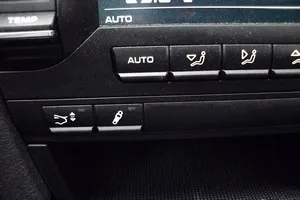
You get used to the gearbox buttons on regular roads, but on the track they are inconvenient. The button for adjusting suspension stiffness and forced rear wing lift is at the bottom of the center console.
|
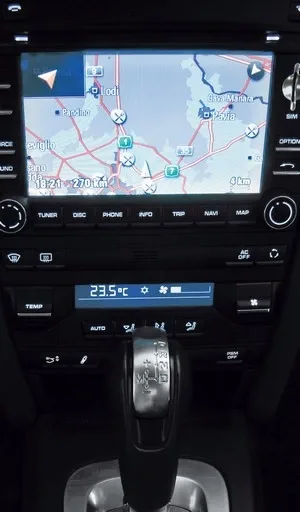
TRADITIONS AND INNOVATIONS The ignition lock is still on the left, and in front of your eyes are the five familiar instruments that give a complete picture of all systems. The navigation is completely new: the screen has grown and become touch-sensitive. There are fewer buttons, and maps are stored on a hard drive, which has sped up access to them. |
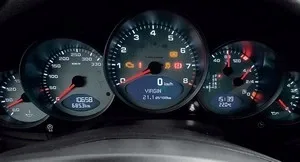 |
OPTIONS THAT WOULD NOT HURT
A couple of laps on the track — and you remember the Sport Chrono Plus package. If our car had it, the gearbox in manual mode could be called ideal. At the presentation a few months ago, we drove exactly such a car and managed to appreciate how quickly upshifts occur — the pause between pressing and changing gear is almost imperceptible. In our test, the Carrera showed a sprint to 100 km/h in 4.39 seconds. With the launch control function from the same Sport Chrono Plus package, we could have gained another 0.2 seconds. But even without it, the result is excellent, and the credit goes to the new six-cylinder flat engine with direct injection. It pulls confidently from low revs and responds to the throttle with astonishing eagerness.
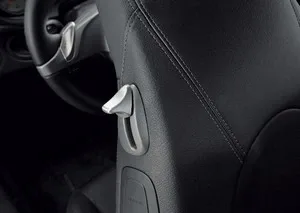 |
LIKED On the inner side of the seat backrest, there is a handle for folding it. It seems like a small thing, but it is nice that the engineers thought about those who need to get out of the back row. |
|
DID NOT LIKE
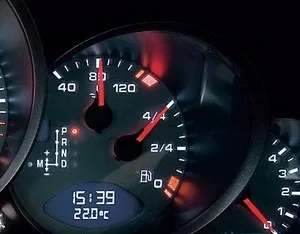
The PDK control buttons are not flawless, and here the display showing the engaged gear is too small. At speed on the track, it is difficult to read information from it. |
 |
THE CONVERSATION HAS BECOME EVEN CLOSER
The fact that the flat engine has become noticeably more efficient is eloquently shown by fuel consumption figures — this is not at all the appetite of a sports car capable of accelerating to 300 km/h. The consumption is so moderate that the 64-liter tank does not seem insufficient. Of course, if you do not constantly unleash the entire herd of 385 horses.
It is hard to resist the temptation — the engine revs too eagerly: angry, furious, with a unique deep voice, it interacts so perfectly with the chassis that you quickly forget about the extra kilograms at the rear...
Compared to the first generation, this Carrera has become even more balanced and obedient: on a regular road, you will not feel the difference, because the car's limit is unreachable without breaking the rules — all differences manifest on a high-speed track. The front axle does not conflict with the rear, but conducts a calm dialogue, body roll is minimal, and you do not have to choose between understeer and oversteer in every corner. With experience, you can apply the throttle earlier and exit the corner with the wheels already straight...
Yes, this is still the same 911 — a little more driver-friendly, but no less vivid for that.
Technical specifications provided by the manufacturer
Porsche 911 Carrera S
• Engine: rear, longitudinal, 6 cylinders flat, cylinder bore — 102.0 mm, piston stroke — 77.5 mm, displacement — 3800 cm3, compression ratio — 12.5:1, max power — 385 hp at 6500 rpm, max torque — 420 Nm at 4400 rpm, cylinder block and cylinder head made of light alloy, 4 valves per cylinder, 2 overhead camshafts per cylinder head, variable valve timing system (chain), dry sump, direct injection
• Transmission: rear-wheel drive, dual wet clutch with electro-hydraulic actuation, robotic gearbox, 7 speeds
• Tires: front — 235/35 ZR 19, rims 8J, rear — 295/30 ZR 19, rims 11J, repair kit
• Body: 2 doors, 4 seats
• Suspension: front — independent, wishbones and telescopic struts, trailing links (MacPherson scheme), coil springs, anti-roll bar, rear — independent, multi-link, coil springs, anti-roll bar, pneumatically interconnected electronically controlled dampers
• Brakes: ventilated, ABS and stability control system
• Steering: rack and pinion with power assist
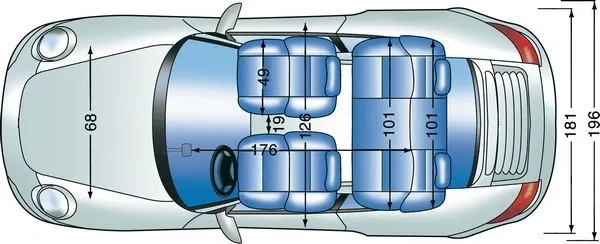
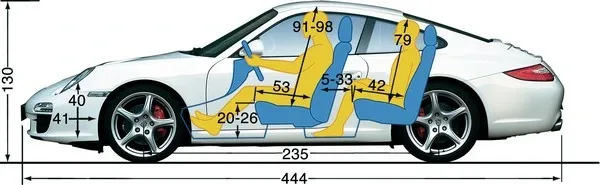
• Dimensions and weight: wheelbase — 2350 mm, front track — 1486 mm, rear track — 1516 mm, length — 4435 mm, width — 1808 mm, height — 1300 mm, curb weight — 1425 kg, maximum weight — 1830 kg, trunk — 135 dm3, tank — 64 l
• Place of production: Zuffenhausen (Germany)
Technical progress
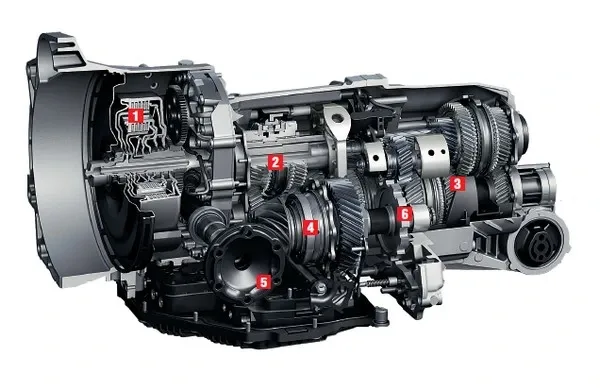
If you get to the essence, the PDK design is not that complicated: instead of the usual single clutch, there are two here, and each is responsible for its own set of gears — one for even, the other for odd. This whole scheme is hidden in a single housing. In essence, the driver gets two perfectly synchronized gearboxes at once. The principle of operation is easy to understand with an example: when you accelerate in second gear, third is already in full readiness, and to shift to it, you do not need to perform the usual actions. It is enough to just disengage one clutch and engage the other — this saves time and makes shifts smoother, even when the tachometer needle is already approaching the red zone.
In the cars of the second release, engineers seriously worked on the time-tested six-cylinder boxer engine. It was equipped with direct fuel injection, which gave an increase in power and at the same time reduced appetite and harmful emissions. But the modernization did not end there — the engine underwent a much deeper rework. To maintain the same displacement, the piston stroke was reduced, and the cylinder diameter, on the contrary, was increased. The compression ratio also increased, which, combined with direct injection, gave an increase in efficiency. They also worked on reducing weight: the new engine became 6 kg lighter than its predecessor. It would seem a little, but if you add to this another minus 10 kg from replacing the old Tiptronic automatic with PDK, the savings are quite noticeable.
MIRACLE SCHEME
The illustration shows the key elements of the PDK:
- 1) two clutches located concentrically;
- 2) two input shafts on one axis;
- 3) output shaft;
- 4) power drive of the differential;
- 5) half-shaft flange;
- 6) locking mechanism in the Parking position
Who are the competitors?
THE MAIN THING ON THE TRACK IS MANEUVERABILITY
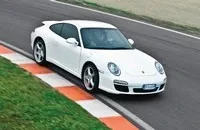 | 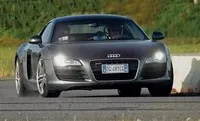 | 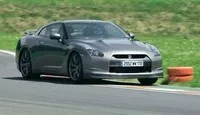 |
You can argue as much as you like about the engine being located in the rear overhang, but after just a few laps on the test track, all doubts disappear without a trace. Even with the boxer engine in such a "wrong" place and only with rear-wheel drive, the Carrera S managed to show a lap time almost comparable to the results of all-wheel-drive rivals — the R8, which is more powerful by 35 hp, and the Nissan GT-R, whose power advantage reaches almost 100 hp. Compared to the previous generation car, progress is obvious: the lap became faster only slightly, but noticeably less effort is required for this result. It seems that engineers finally managed to tame the "historical" disease of the model — an acute reaction to weight redistribution. Controlling understeer and oversteer is now much easier. On the track, the new PDK behaves very decently. When shifting up, it may hesitate a bit, but on downshifts it reacts instantly and accurately, and this is much more important in a racing rhythm. The brakes, as before, do not let you down: they are powerful, balanced, and do not give up even under serious loads. And if you want extreme, the options list includes carbon-ceramic brakes, which are even better suited for the track.