
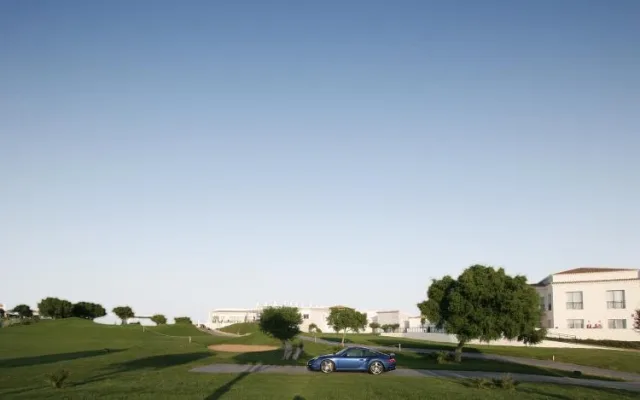
Southwest Spain is a true province. Local beauties in the form of cacti and olive groves are unlikely to attract wealthy tourists. Even more surprising is the line of fifteen Porsches near a modest hotel. Red, blue, yellow, silver... And all of them are 911 Turbo. The freshest model!
However, we can no longer be surprised by the most powerful 'nine-eleven' — the technical content of this Porsche was shown a couple of months ago. But now there is an opportunity not only to appreciate the perfection of its engineering thought, but also to examine, touch, and most importantly — take a ride. On your own or in the company of Walter Röhrl: a few kilometers next to the legendary racer have long become a tradition at presentations of new Porsches.
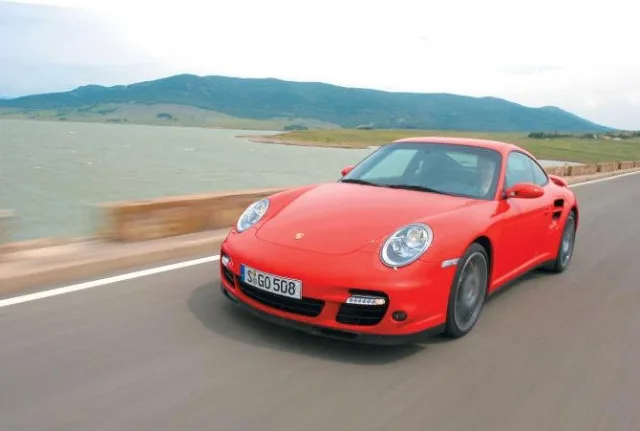
 The acquaintance program, of course, also included a 'brief recap of previous episodes.' Before handing journalists the keys and road books with a 250-kilometer route, Porsche engineers gave a lecture on their achievements, not ignoring financial successes. They talked about progress in aerodynamics, reminded about aluminum doors, an electronically controlled multi-plate clutch transmitting torque to the front axle, and the organization of brake cooling for all wheels... They did not forget the 'main dish' of the most powerful production Porsche 911 — a turbocharger with variable geometry, which not only raised power to 480 hp (60 more than the previous 911 Turbo), but also provided peak 620 Nm in the widest range — from 1950 to 5000 rpm! However, Mikhail Podorozhansky already wrote about this after the technical presentation (see AR No. 7, 2006). But I was luckier — the keys to the 911 Turbo are already in my hands.
 |  |
| The type of brakes on the Porsche 911 Turbo is easy to determine by color: red — standard, yellow — 'ceramic.' Plus the diameter of the front ceramic discs is 380 mm, and metal ones — 350 mm. In both cases, there are 6-piston calipers at the front and 4-piston at the rear | |
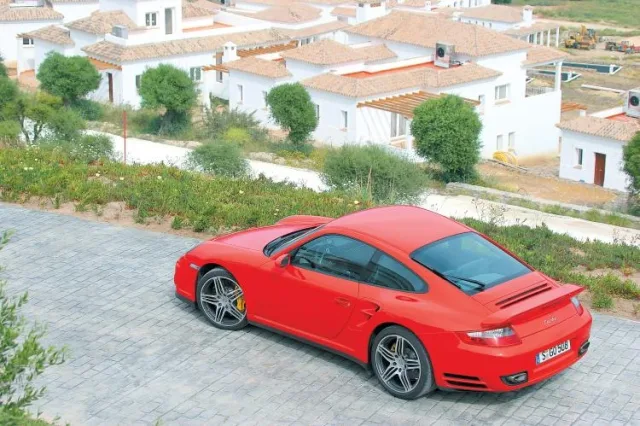
I suppress my impatience — before jumping into the cabin, I try to look at the car impartially, give it a face check. And I started not with the 'face,' but with... Well, in general, with the rear. I'll try to find differences from the turbocharged Porsche 996 series without hints. Different exhaust pipes plus a wider rear wing, which, as before, rises at 120 km/h, minus one slat in the grilles on the rear bumper that divert hot air from the intercoolers. The lights and the slope of the bumper-to-rear-fender joint line have slightly changed... So far, the differences fit on the fingers of one hand. Not enough. So I want to walk around the car and look into its 'eyes': did they remain 'lined' as on the 996 series, or did they become round? That's it, doubts are cast aside! At the front, the new 911 Turbo cannot be confused with its predecessor or with the naturally aspirated siblings of the 997 series. The inflated air intakes have pushed the 'fog lights' to the periphery, and the 'turn signals' have narrowed to fashionable LED strips — the powerful engine needs additional cooling. In total, through three radiators (the 'regular' Porsche 911 has two), at a speed of 300 km/h, about 4000 liters of air pass every second. Another 1000 liters cools the intercoolers through the air intakes in the rear fenders. At the same time, the drag coefficient Cx of the coupe is 0.31. For competitors, this is an excellent result, but the 'regular' rear-wheel-drive Carrera resists air better — its Cx is ten percent lower (0.28), and the cross-sectional area is smaller: the Turbo version, like all all-wheel-drive 'nine-elevens,' is based on a wider body. But, as aerodynamicists claim, they managed to finally defeat the lift force that previously acted on the 911 Turbo.
 |  | |
| The variable geometry turbine (VTG) not only smoothed the torque curve but also allowed the most efficient use of exhaust gas energy. On the 911 Turbo, you can safely turn off the engine even after hard driving: the turbine rotor bearings are water-cooled, and an additional electric pump circulates the fluid even after the engine stops | The Porsche 911 turbo engine became 60 hp more powerful than its predecessor (from 420 to 480 hp), and it's not just about the new turbocharger. The dimensions of the cylinder block remained the same, but the design became stiffer. Forged pistons work in aluminum cylinders with a Nikasil coating. The cylinder heads have been modernized — the compression ratio due to high boost has been reduced from 9.4 to 9 units, and the VarioCam Plus system has expanded the adjustment range of intake valve timing. Their lift has also been increased. The new intake system offers less resistance and is three kilograms lighter than the old one. Another four kilograms were saved on the exhaust by using mufflers made of thinner steel. The dry-sump lubrication system has been redesigned — a second oil-water heat exchanger was added for better cooling, and the total number of oil pumps has been increased to nine! One creates pressure, the rest pump oil into the accumulator tank: two from each cylinder head, two more from the turbochargers, one from the crankcase. The ninth pump is a new feature; it is located at the front end of the crankshaft and prevents oil starvation during long, intense braking | Compared to the 911 Turbo of the previous generation, the cross-section of the intercooler cooling channels has increased by almost 10 percent |
But in the cabin, it is almost impossible to distinguish the most powerful 'nine-eleven' from the naturally aspirated versions. The same panel, the same white (or rather, light gray) instruments, the same stopwatch from the Sports Chrono package, the same buttons on the center console. And only on the screen under the tachometer, whose red zone begins a couple of marks earlier, can you display the boost pressure indicator.
The 911 Turbo starts the same way as its naturally aspirated siblings — with a jerk and a clang of metal. Anyone who has ever sat behind the wheel of a 'nine-eleven' will smile knowingly — and forgive me for the car jerking at launch as if a novice from a driving school was at the wheel. The clutch pedal with a long travel and noticeable effort gives the driver an exam in precision and coordination of foot movements.
 |  |  |
| On the screen under the tachometer, you can display the boost pressure indicator — digital (on the right) or as a bar. The maximum pressure I managed to achieve was 1.1 bar | The interior of the 911 Turbo is the same as in the naturally aspirated versions — expensive, high-quality, and comfortable | |
 |
| Walter Röhrl: 'In terms of handling, the new Turbo reminds me of the Porsche 959' |
However, in reality, the "boost" seemed to me more of a fun toy. Anyone who needs to accelerate really quickly will simply downshift and send the tachometer needle into the red zone. And there it doesn't matter whether Overboost is activated or not. Walter Röhrl himself admitted that on the Nürburgring this very "overboost" was not needed for him. By the way, the 7 minutes 49 seconds that Röhrl set on the Nordschleife in the 911 Turbo is only ten seconds worse than the result of the 612-horsepower supercar Porsche Carrera GT (see AR No. 9, 2006). Of course, that one is lighter and stiffer, but the naturally aspirated V10 also has less torque, with the peak of 590 Nm reached at higher rpm. And if the asphalt is wet, then the Carrera GT loses to the Porsche 911 Turbo without any reservations: the advantage of all-wheel drive, despite losses in the transmission, cannot be offset even by an extra one hundred and thirty horsepower on a slippery winding road…
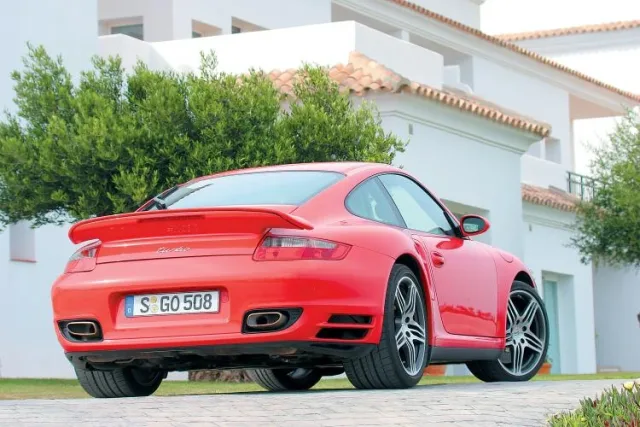
From the rear, the new Porsche 911 Turbo is easiest to distinguish by the exhaust pipes exiting through the bumper, not under it
What the turbo engine of the "nine-eleven" really lacks is character. The sound is partly to blame. There is no acoustic resonator on the intake — it is useless for this engine. And on the exhaust, the variable-geometry turbines "grind" the exhaust, depriving the engine's voice of those very flat-six overtones and pressure that are so dear to Porsche fans. Plus the extremely wide torque plateau, due to which the engine revs up without noticeable surges. As a result — although it's madness, it's somehow measured, mundane. Only a glance at the instruments brings you to your senses: the speed is already about forty kilometers higher than assumed, and the tachometer persistently advises shifting to the next gear: in a moment the engine will hit a rather rough limiter. But if you flip the somewhat heavy but precisely moving lever in time, then just over twelve seconds after the start, the Porsche easily passes the "200" mark and continues accelerating with the same ease: the car reaches 280 km/h without visible strain. To be honest, I did not dare to go faster. I got scared. Not of myself or the car — even on the not perfectly smooth Spanish autobahn it is stable and obedient. But who can guarantee that there is no radar in this outback? And if I got caught by law enforcement, I could lose the right to visit Schengen countries for five years…
 |  |  |
| The Turbo version is assembled in the body of the all-wheel-drive coupe, which is wider than that of the rear-wheel-drive 911 — the difference from the Carrera 4 model is only in the outer body panels. Instead of steel doors, lighter aluminum ones are installed. But the rear suspension subframe, on the contrary, became not aluminum but steel, yet more compact — otherwise the turbocharged engine would not fit | The automatically rising rear wing on the new Turbo has become 60 mm wider and is mounted 35 mm lower. As a result, at maximum speed the aerodynamic load on the rear axle has increased by 27 kilograms | |
And how do the "active" PASM suspension and all-wheel drive with an electromagnetic clutch work?
"In its character, the new 911 Turbo is close to the Porsche 959. Of course, it is faster, responds more precisely to the pilot's commands, and is more sensitive in handling, but it drives similarly. All-wheel drive allows you to stabilize the car in a drift and press the gas more boldly, especially on corner exit," says Walter Röhrl. It was he who let me feel how stable the Porsche can be in corners.
We did not have a race track at our disposal, so for the runs with Röhrl, the organizers simply closed off a section of a secondary road. Just a few turns there, a U-turn, and the same — in the opposite direction. But what corners they were! I am sure this road has no chance of being included in the route of some rally. FIA rules set a strict limit on the average speed on a special stage of 130 km/h, but here every turn is 190, 200, 230 km/h! And Röhrl rushes along the track, using the entire width of the road to the centimeter. And most narrow roads in southern Spain have no shoulder at all: right behind the edge of the asphalt is a knee-deep ditch. It's terrifying not so much from the speed "over two hundred" or lateral G-forces, but from the thought of the consequences of the slightest mistake by Röhrl. Forget a mistake! If a pebble or sand gets under the wheel — and we'll tumble head over heels, without helmets, in a car without a roll cage. And it's unlikely that Porsche's passive safety, no matter how high it is, will be enough for us.
 |  |
| The Tiptronic S has been modernized — the planetary gears are reinforced, and shifts have become faster. So much so that now the Porsche 911 Turbo with the "automatic" accelerates faster than with the "manual" | Even in Drive mode, the current gear number of the "automatic" is displayed on the panel. If Sport mode is not activated, the Porsche starts in second gear |
 |  |
| If you grip the steering wheel above the spokes, you can't reach the "minus" button | The Sport button activates the eponymous mode of the "automatic" and the Overboost mode of the engine. Simultaneously with it, the neighboring button is also activated, switching the active suspension to sport mode. But it can be turned on/off separately from the "boost" |
But Walter, who has studied every centimeter of this track, is calm and confident. With short, precise steering movements, he builds a classic circuit trajectory — outside-inside-outside, countering, it seems, even hints of sliding. Where necessary, he brakes before entering the corner, and then goes through almost the entire turn with acceleration, not fearing a drift. And only in the last corner, slowing the car before the finish, does Röhrl allow himself a bit of mischief — he turns the steering wheel while still braking, causing the rear axle to slide, and then corrects it with a light movement of the wheel.
— Walter, are you driving at full capacity now?
— No, about eighty percent of the car's capabilities, after all, we are not at a race, we have to think about safety too.
I, to be honest, lacked the imagination to imagine how we would drive "at full speed" here. But I had enough sense not to try to drive "like Röhrl" on the winding roads around Jerez, although I can also chalk up a few corners "over two hundred" to my account.
However, I had no time to look at the speedometer — for all its obedience, the 911 Turbo does not let you relax. Slightly exceed the speed at the corner entry — and the Porsche responds with a slight understeer, but if you ease off the gas, it obediently tucks into a smaller radius. Slow corners can be taken differently: a short steering movement while still braking, and the car passes the apex with a slight rear-axle slide — when pressing the brake, the multi-plate clutch in the transmission disengages, and the 911 Turbo becomes a rear-wheel-drive car. And then you need to turn the steering wheel into the slide and… add gas! The traction transferred by the clutch to the front wheels extinguishes the slide — and the car, with increasing speed, rushes to the next corner. The main thing is to do everything "at small angles" and be more careful with the throttle: in second gear, even on clean dry asphalt, this engine can easily break the rear axle off the trajectory even without provocative steering movements.
I also took a ride in a car with the "automatic". On the Porsche 911 Turbo with its furious torque, the Tiptronic S gearbox can only be faulted for the fact that using the "manual" mode is still inconvenient. The buttons on the steering wheel spokes (you can only shift with them) are positioned so that even with a "quarter to three" grip, you can't reach the "minus" button. And taking one hand off the wheel while braking intensely before a corner, to be honest, was a bit scary.
However, for the Porsche 911 Turbo, the Tiptronic manual mode is not really that important. The automatic gearbox works flawlessly even without driver hints; the main thing is to give it time to get used to aggressive driving style. In this case, upshifts occur right at the redline of the tachometer, and so promptly that the coupe with the "automatic" reaches both 100 and 200 km/h even faster than the version with a manual gearbox. New transmission algorithms, which engineers named Fast-Off and Fast-Back, also help conquer corners.
The first algorithm works as follows: if the driver sharply releases the gas pedal, interrupting acceleration, the gearbox does not rush to engage the next gear. As for Fast-Back, it is designed to quickly provide torque reserve, say, before entering a corner. Just briefly press the brake after releasing the gas, and the Tiptronic instantly downshifts. In addition, the automatic transmission smooths out torque jerks on the wheels, allowing you to press the gas more boldly when exiting a corner.
The brakes deserve special mention. Both standard and carbon-ceramic ones demonstrate high efficiency in any mode, including the most extreme, and, importantly, perfect feedback. The pedal has a short travel and provides error-free deceleration. On Spanish roads, where instead of shoulders there are ditches and the corners are unfamiliar, it was not possible to really warm up the brakes, and perhaps this explains the only difference noticed between the "ceramics" and regular discs: ceramic ones require a slightly harder press on the pedal. However, there is no doubt that they will not let you down on a race track, because these discs with six-piston calipers at the front and four-piston at the rear were inherited from the Porsche Carrera GT supercar.
After the GT was discontinued, the 911 Turbo becomes the brand's flagship. Now it has to fight with Italian, English, and American supercars. Even though Porsche has fewer horsepower, the 911 Turbo is quite capable of giving battle to formidable rivals both on the autobahn and on race tracks. On the downside, oddly enough, is its relatively low price and, as a result, mass appeal. For cars of this class, exclusivity is a weighty argument, and the previous generation Porsche 911 Turbo outsold almost all supercars combined. On the other hand, Porsches have always been cars for those who love and know how to drive fast, not for those who buy an ultra-fast car as a status symbol.
 |
| LED "turn signals" allowed increasing the air intakes and at the same time made the Porsche's face more "fashionable" |
In Russia, the prospects for the Porsche 911 Turbo, which is more practical, has all-wheel drive, and a better-developed service network, look brighter than for other supercars. Although official sales in our country, as in the rest of Europe, start at the end of June, those wishing to purchase the new model will have to be patient at least until autumn — the six cars that dealers are to import in the summer have already found their buyers, ready to pay 172,300 euros for the version with a manual gearbox or almost 176,000 for a car with an "automatic". Plus 1,900 euros for the Sports Chrono Turbo package with a stopwatch and "overboost" function, and almost 11,000 for ceramic brakes. Total — almost 190,000 euros for a fully equipped car. The sum is, of course, insane. But by supercar standards, it is quite ordinary, moderate madness. Within the bounds of decency.
| Porsche 911 Turbo (manufacturer's data) | |
| Body type | coupe |
| Number of seats | 2+2 |
| Trunk volume, l | 105 |
| Curb weight, kg | 1585 (1620)* |
| Gross weight, kg | 1950 (1980) |
| Engine | petrol, with distributed injection and turbocharging |
| Location | rear, longitudinal |
| Number and arrangement of cylinders | 6, flat |
| Displacement, cm3 | 3600 |
| Cylinder bore/piston stroke, mm | 100/76.4 |
| Compression ratio | 9 |
| Number of valves | 24 |
| Max power, hp/kW/rpm | 480/353/6000 |
| Max torque, Nm/rpm | 620/1950–5000 (680/2100–4000)** |
| Gearbox | manual, 6-speed (automatic, 5-speed)* |
| Gear ratios | |
| I | 3.82 (3.59)* |
| II | 2.14 (2.19) |
| III | 1.48 (1.41) |
| IV | 1.18 (1.00) |
| V | 0.97 (0.83) |
| VI | 0.79 (–) |
| reverse | 2.67 (3.17) |
| final drive | 3.44 (rear), 3.33 (front) |
| Drive | all-wheel, with automatic engagement of front axle |
| Front suspension | independent, coil spring, McPherson |
| Rear suspension | independent, coil spring, multi-link |
| Front brakes | disc, ventilated, diameter — 350 mm (metal)
or 380 mm (ceramic) |
| Rear brakes | disc, ventilated, diameter — 350 mm |
| Tires front/rear | 235/35 ZR19 / 305/30 ZR19 |
| Maximum speed, km/h | 310 |
| Acceleration time 0—100 km/h, s | 3.9 (3.7)* |
| Fuel consumption, l/100 km | |
| urban cycle | 18.8 (19.8)* |
| extra-urban cycle | 9.5 (9.6) |
| combined cycle | 12.8 (13.6) |
| Fuel tank capacity, l | 67 |
| Fuel | AI-98 |
| * In parentheses — data for version with automatic transmission | |
| ** When Overboost mode is activated | |