
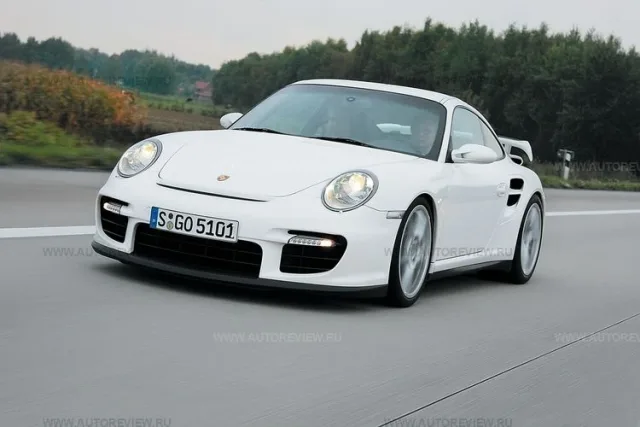
I press the clutch, engage first gear, and floor the accelerator. However, the tachometer is frozen at five thousand rpm. I release the left pedal — and the Porsche GT2 launches, with the wheels not even breaking traction. All thanks to the Launch Assistant. You can do without it, but then you'd get more of a spectacular show than a quick acceleration: the 530-horsepower turbo engine easily spins the huge rear Michelin Pilot Sport Cup tires sized 325/30 ZR19. Moreover, the tires are special — with reduced tread depth, designed for 329 km/h… This is the most powerful and fastest production Porsche.
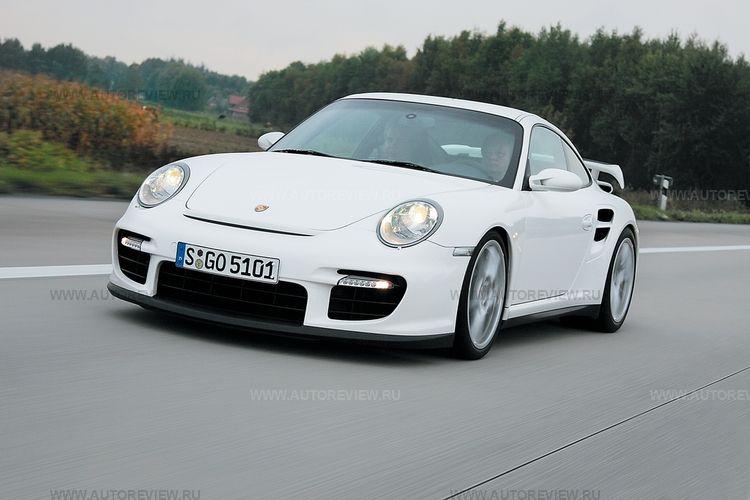
Just a year and a half ago, the flagship of the Porsche model range was the Carrera GT supercar — essentially a road-going race car based on a racing prototype for the 24 Hours of Le Mans. Carbon monocoque, naturally aspirated V10, 612 hp, and a price of around half a million euros. Only 1,270 such cars were built, and production was halted in April last year. But the vacant flagship position didn't stay empty for long: the Porsche GT2, based on the nine-eleven, reaches 100 km/h even a tenth faster — in 3.7 seconds, and its top speed is only one km/h behind the previous leader: 329 versus 330. However, the GT2 is three times more affordable: in Germany, it costs 159,100 euros.
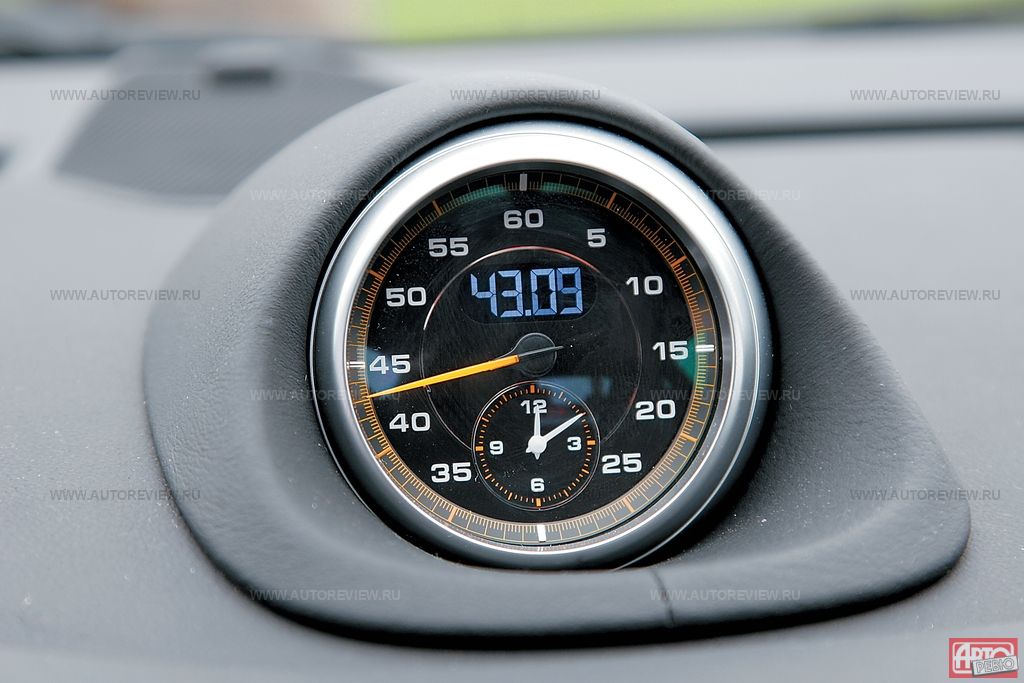 | 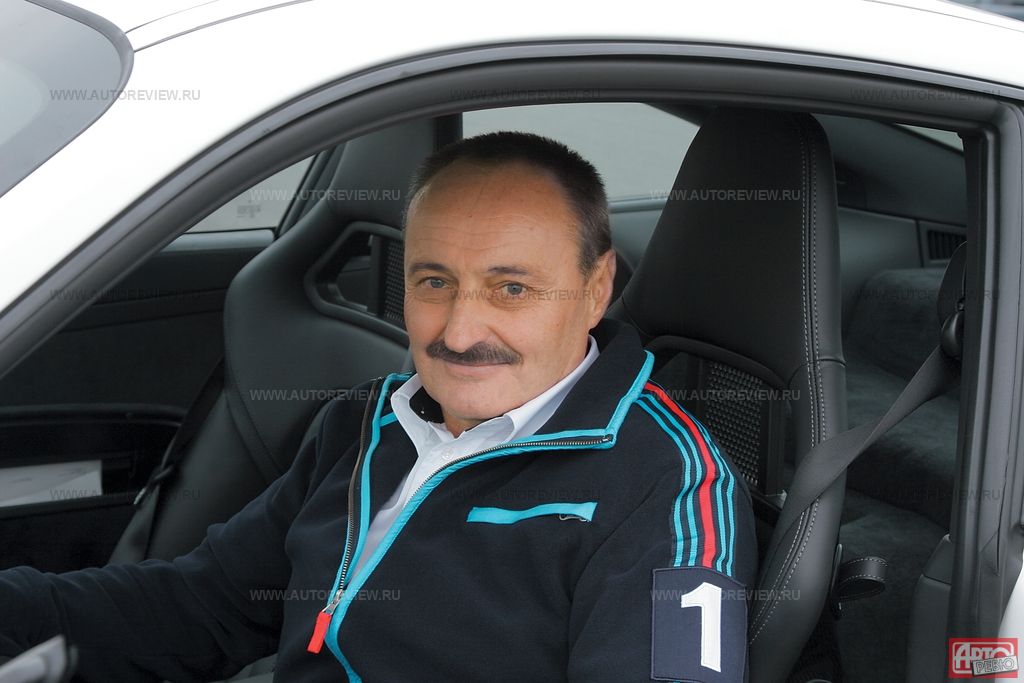 | 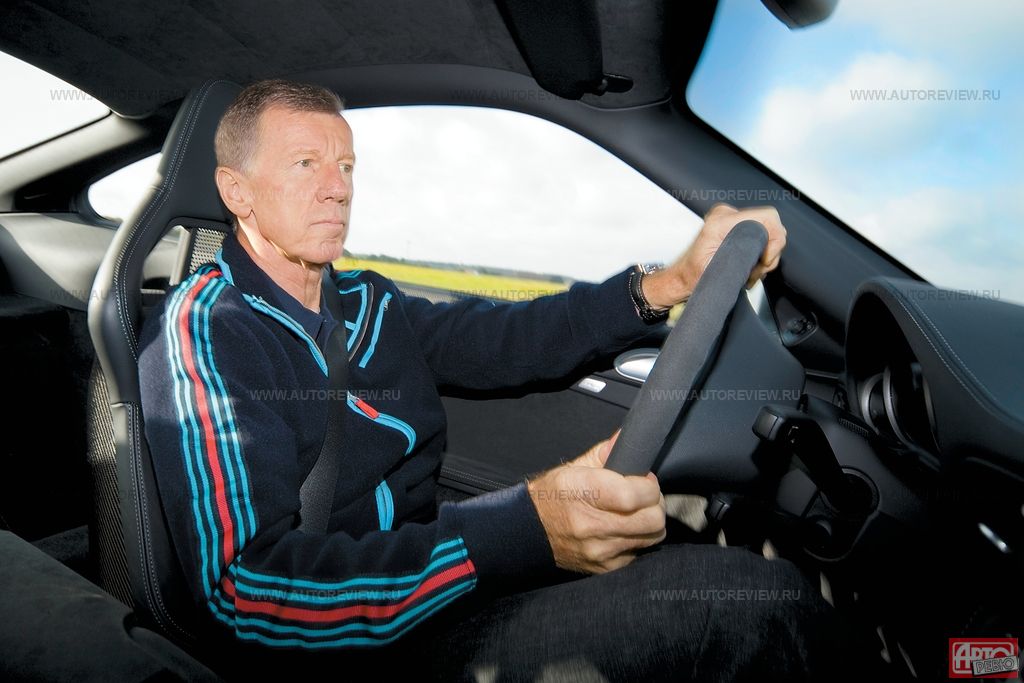 |
| The stopwatch is an assistant in the fight for seconds on the track | Alan Levin, GT2 project manager: "Previously, we sold about 1,300 Porsche 911 GT2 coupes of the 996 series per year. We hope the new version will be no less popular…" | Legendary Walter Röhrl laps the Nordschleife in the GT2 in 7 minutes 32 seconds |
Alan Levin, who heads the GT2 project at Porsche Motorsport, claims the secret lies not only in the engine but also in aerodynamics — the drag coefficient is just 0.32, one of the best in its class.
Why couldn't they achieve, say, 0.3? Take BMW, for example: the third-series sedan has a Cd of 0.27… Levin explains that the best specialists worked on reducing drag, and it's not just about the bare body. Numerous radiators stand in the path of the airflow — they cool the engine, the gearbox oil, and the air that two turbochargers pump into the six flat cylinders at a pressure of 1.4 bar. Plus the brakes, which also need constant airflow. And to prevent the car from taking off at three hundred kilometers per hour, it needs to be pressed to the ground. On a regular nine-eleven, an automatically extending spoiler handles this, but the GT2 has a fixed "bookshelf." It certainly increases Cd, but at top speed it presses the rear wheels down with an additional 75 kg.
The powertrain is essentially the same as in the Porsche 911 Turbo: 3.6 liters of displacement and a pair of turbochargers. But the output has increased from 480 to 530 hp — thanks to raising the boost from 1.0 to 1.4 bar and a specially developed intake tract for the GT2. Its feature is alternating elements with large and small cross-sections, which improves air cooling.
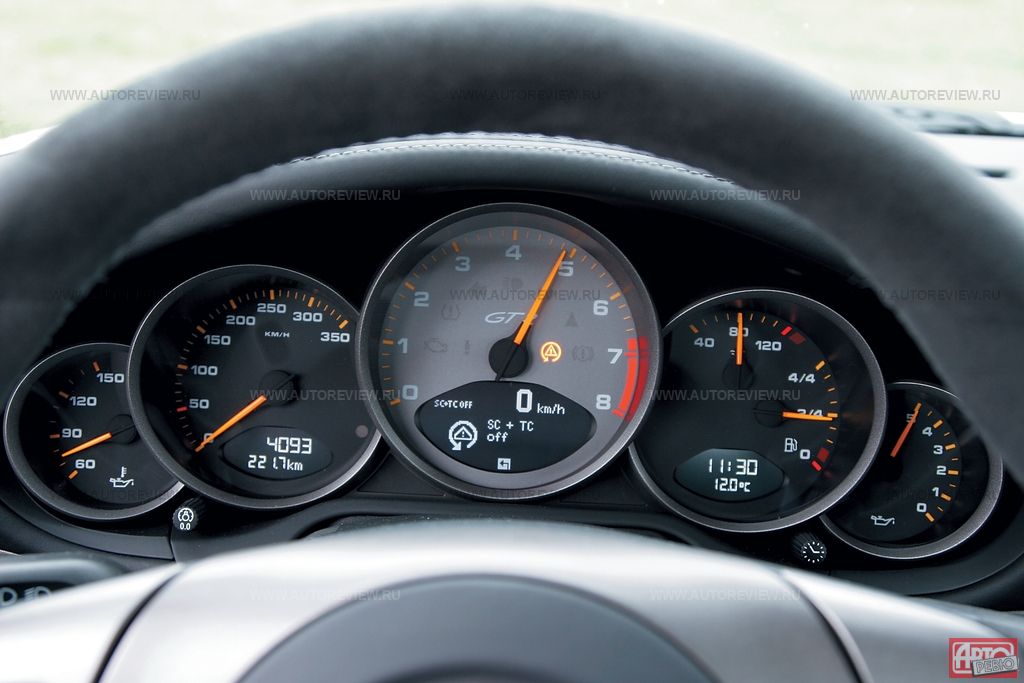 | 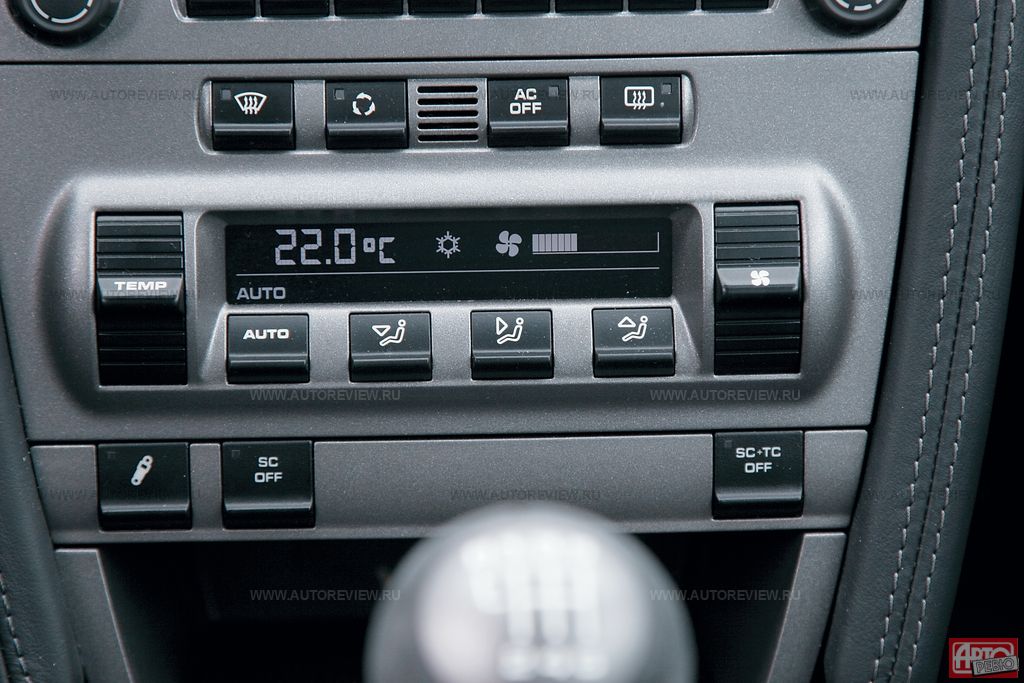 | 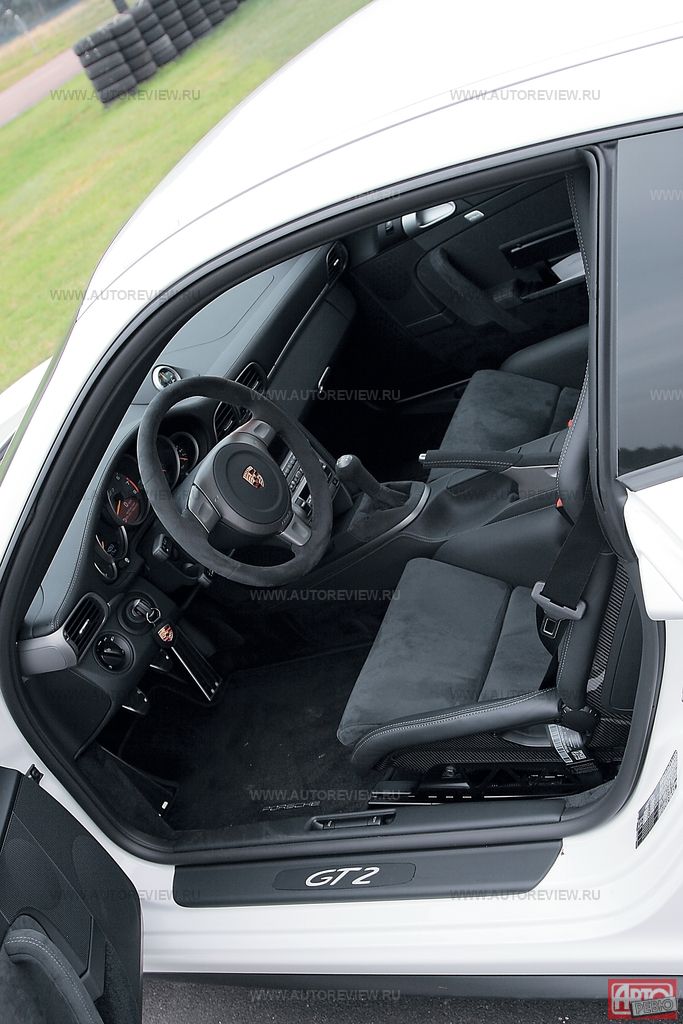 |
| The accelerator pedal is floored, but Launch Assistant limits the revs to 5,000 rpm — that's all that's needed for an effective start | Below the climate control unit are buttons for the "stiff" damper mode, stability control off (SC off), and full electronics off (SC+TC off) | The steering wheel and gearshift knob are trimmed in Alcantara — beautiful and hands don't slip |
Following German rules, I calmly drove 50 km/h in populated areas, slowed to 30 at some turn, then accelerated to 60… And all this in fourth gear! As if driving an automatic! The engine pulls effortlessly from the very bottom, and enters its working range by 2,000 rpm — when the boost gauge needle approaches 1.4 bar. At that moment, my blood pressure also rises… Let's get to the autobahn!
There it is, the crossed-out white circle — the end of all restrictions! The speedometer needle incredibly quickly passes 100, 200, 250 km/h… You just have time to work the short-throw lever. The effort on it is noticeably greater than on a regular nine-eleven. The reason is that the GT2 has a gearbox with steel synchronizer blocking rings — they are more reliable than traditional brass or bronze ones. And — no automatics! That's how it should be.
A yellow triangle flashes on the tachometer — a pull towards me, fifth gear. On the autobahn near Bremen in the morning, there are few cars. The tachometer needle approaches the red zone — 7,000 rpm, the digital speedometer shows 290 km/h (there's no time or desire to look at the analog gauge), another yellow triangle, the lever — and sixth. Again confident acceleration, but a Mercedes appeared in the left lane. 313 km/h. Too bad. Judging by the acceleration pace, the GT2 would have easily reached the remaining 16 km/h to the claimed 329 km/h…
Yes, this is a projectile. But a controlled projectile: I deliberately changed lanes, braked — everything was under control. The car's reactions are exactly what I expected: quick but not frighteningly sharp. Only one thing bothers me: at high speed, the steering effort in the near-zero zone drops, and road irregularities cause slight nudges to the side — as if driving on an invisible rut. Later, I shared these observations with Walter Röhrl — the famous Porsche test driver.
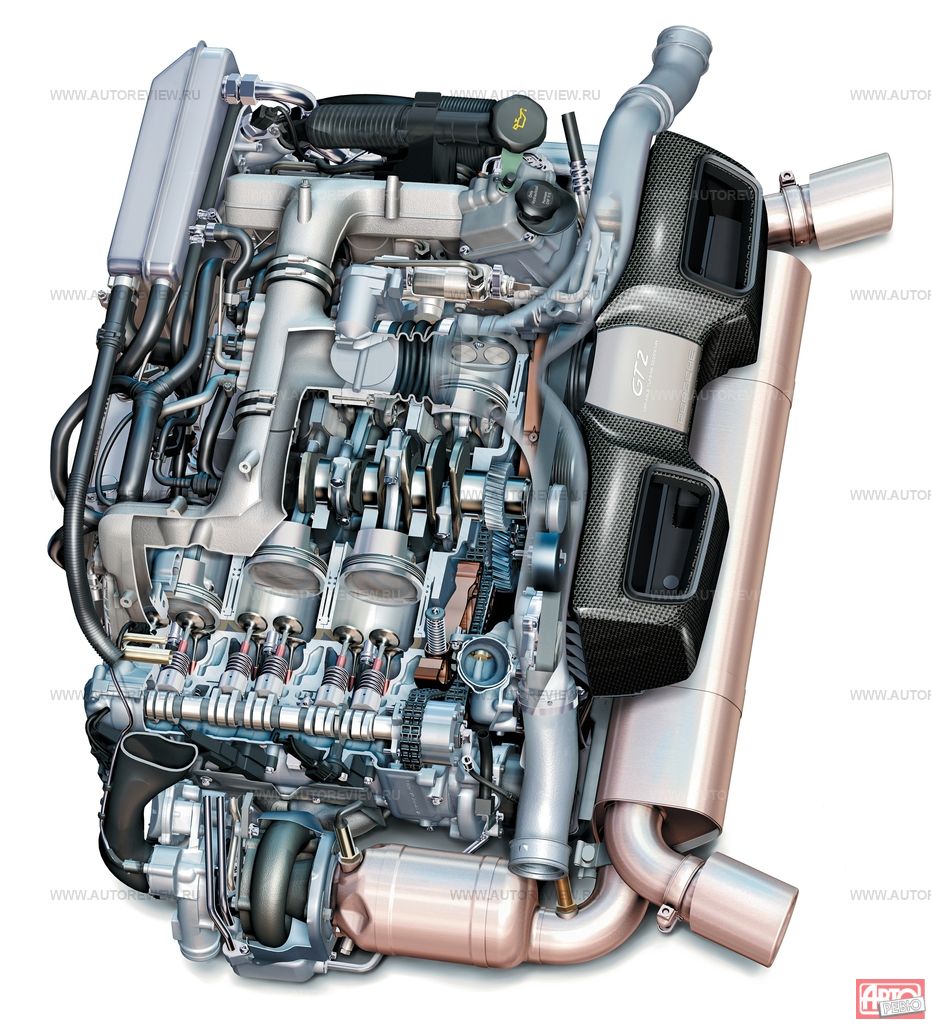 | 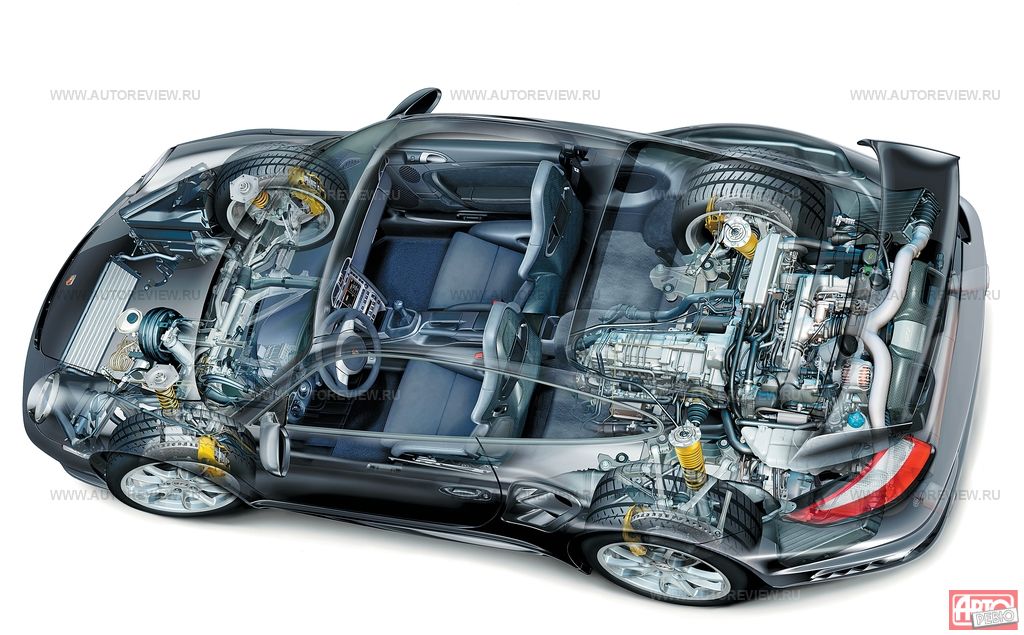 |
| The 530-hp flat-six is equipped with two variable-geometry turbochargers, maximum boost increased from 1.0 to 1.4 bar, and the "expansion" intake system uses pressure pulsation between the throttle valve and intake valves to cool the air entering the cylinders. Lubrication is with a dry sump: nine pumps supply oil to the turbos, crankshaft, and both cylinder heads. The system circulates almost eleven liters of 0W-40 synthetic oil. For the first time on a road Porsche, the exhaust pipes and muffler are made of titanium, which is twice as light as stainless steel | The GT2 is 145 kg lighter than the base Porsche 911 Turbo (including due to the abandonment of front-wheel drive), the suspension is lowered by 25 mm, the rear wheels are an inch wider (12Jx19), and the tires are 20 mm wider. All Bilstein dampers, as on sports cars, have adjustable stiffness and height. The anti-roll bars are also adjustable: four levels at the front, three at the rear. The inter-wheel differential has a disc pack providing locking from 28% during acceleration to 40% during braking |
— Most likely, it's because as speed increases, the dampers automatically become stiffer, — Röhrl replies. — You can switch them to "stiff" mode even at low speed, but I almost never do that — even on the Nürburgring Nordschleife, I drove in the normal, "soft" mode.
Walter Röhrl lapped the Nordschleife in the GT2 in 7 minutes 32 seconds — just four seconds slower than in the Carrera GT supercar and 17 seconds faster than in the all-wheel-drive Porsche 911 Turbo. It's clear that those 17 seconds come not only from power and ceramic brakes. The ground clearance is reduced by 25 mm, and the weight by 145 kg. The GT2 body has more high-strength steel parts, the trunk lid and doors, as on the 911 Turbo, are aluminum, and the hood along with the spoiler is made of plastic reinforced with fiberglass and carbon fiber. The carbon fiber seat shells are 9 kg lighter than regular ones, and there are no rear seats at all. The fight was for every kilogram. But they didn't skimp on safety — the GT2 is equipped with six airbags. That, admittedly, warms the soul when you're flying down the autobahn at 300 km/h. Although if something happens at such speed…
I didn't fully get to feel the handling — screeching tires on interchanges isn't the norm here, and on a closed track, journalists weren't allowed behind the wheel of the fast Porsche. But they trusted Röhrl, and I, in turn, trusted him, settling into the right seat. He started with the stability system on: — Look, full throttle out of the corner — and no oversteer. Very simple. And indeed, no sliding! Although the Porsche GT2 goes through esses with such lateral forces that the carbon-fiber seats creak. Or maybe it was the joints... — Now we turn off the stability system and traction control (here they are switched off with two different buttons). More difficult, but not by much. Good chassis, — Walter states with a smile and deliberately calmly, correcting the slide with a preemptive steering input. That's easy for him to say. Had he turned the wheel half a second later — and you'd pray to God to stop on the grass without flying into the barrier. No, it's still good that the stability system is standard on the GT2 (unlike, by the way, the homologation version GT3 — see AR No. 9, 2006). And if on dry asphalt I turned it off with a clear conscience, then on wet, perhaps, I wouldn't risk it. Especially with these tires: on dry they hold almost like racing slicks, but in heavy rain they'll aquaplane sooner than regular ones. Porsche people made this compromise based on the idea that the GT2 is a car you can drive to work on weekdays and to track days on the circuit on weekends. Drive to work? And why not? Comfortable seat, good ergonomics, decent visibility for a coupe, quality music, navigation with a large display... The ceramic brakes are easy to manage not only on the autobahn but also in the city. The suspension is, of course, stiff, but still not bone-jarring. Recalling the Mercedes SLR McLaren (see AR No. 15, 2007), I can say that driving the Porsche GT2 in the city is both more pleasant and simpler. Even despite the fact that the Mercedes SLR has an automatic. — The Porsche GT2 is, perhaps, not the best exhibit for a garage collection. It certainly deserves to be admired, but you'll get even more pleasure behind the wheel, — Alan Levin summed up our conversation. And I didn't argue with him. P.S. The first GT2 cars will appear in Russia in February 2008, but you can order them now. Price (including VAT) — 239,250 euros.Specifications
| Porsche 911 GT2 | ||
| Body type | coupe | |
| Number of seats | 2 | |
| Dimensions, mm | length | 4469 |
| width | 1852 | |
| height | 1285 | |
| wheelbase | 2350 | |
| track front/rear | 1515/1550 | |
| Trunk volume, l | 105 | |
| Curb weight, kg | 1440 | |
| Gross weight, kg | 1750 | |
| Drag coefficient Cd | 0.32 | |
| Engine | petrol, with two turbochargers | |
| Location | rear, longitudinal | |
| Number and arrangement of cylinders | 6, flat | |
| Displacement, cc | 3600 | |
| Number of valves | 24 | |
| Max power, hp/kW/rpm | 530/390/6500 | |
| Max torque, Nm/rpm | 680/2200—4500 | |
| Gearbox | manual, 6-speed | |
| Gear ratios | I | 3.15 |
| II | 1.89 | |
| III | 1.40 | |
| IV | 1.09 | |
| V | 0.89 | |
| VI | 0.73 | |
| reverse | 2.86 | |
| final drive | 3.44 | |
| Drive | rear-wheel drive | |
| Front suspension | independent, coil spring, McPherson | |
| Rear suspension | independent, coil spring, multi-link | |
| Front brakes | disc, ventilated (diameter 380 mm), ceramic, with 6-piston calipers | |
| Rear brakes | disc, ventilated (diameter 350 mm), ceramic, with 4-piston calipers | |
| Tires front/rear | 235/35 ZR19/325/30 ZR19 | |
| Top speed, km/h | 329 | |
| Acceleration 0—100 km/h, s | 3.7 | |
| Fuel consumption, l/100 km | urban cycle | 18.8 |
| extra-urban cycle | 8.9 | |
| combined cycle | 12.5 | |
| Fuel tank capacity, l | 90 | |
| Fuel | petrol AI-98 | |
Series No. 997
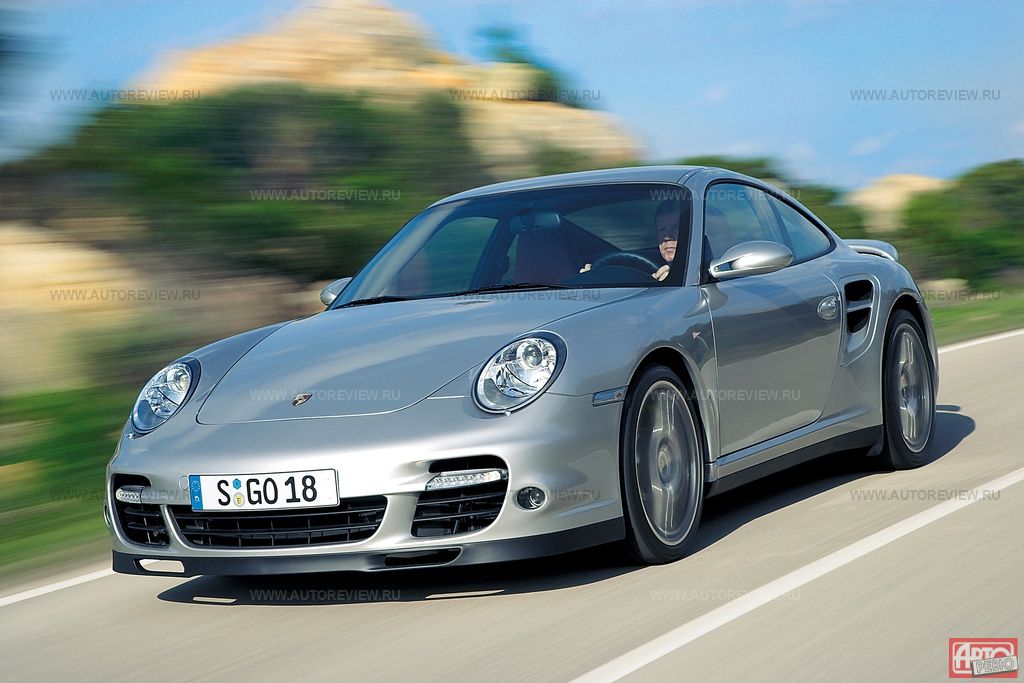
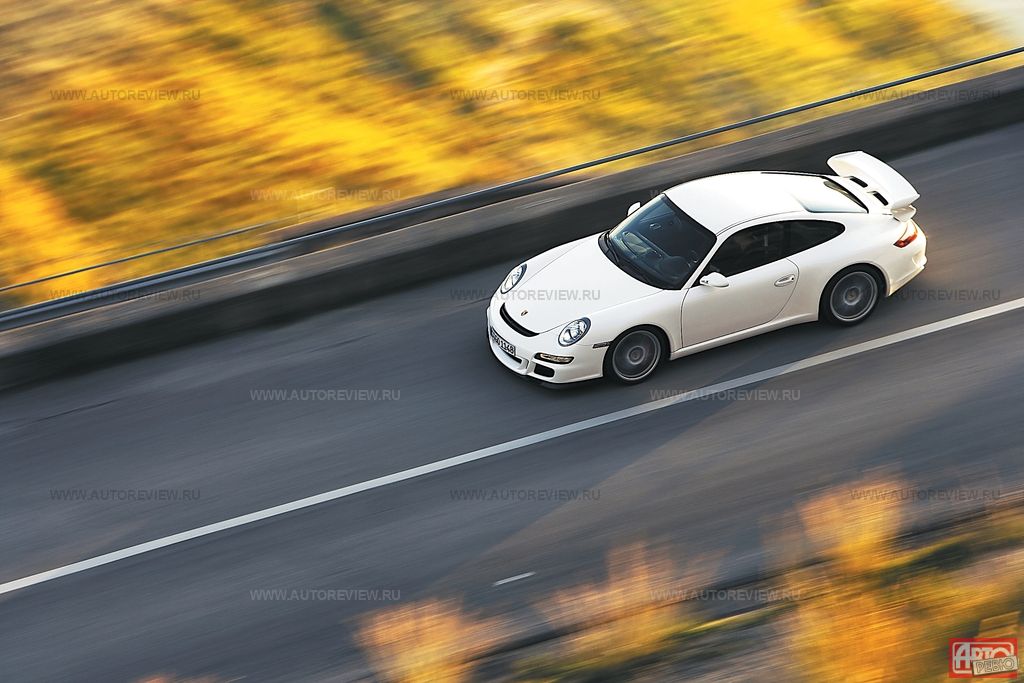
Igor VLADIMIRSKY The Porsche 911 of the 997 series saw the light of day in mid-2004. Since then, a total of 14 modifications have appeared, the last of which was the GT2 coupe. First, as usual, came the base Porsche 911 Carrera coupe and its modification with the letter S (see AR No. 12, 2004). Under the hood of the plain Carrera is a slightly modified naturally aspirated engine from the previous generation car (996 series) with a displacement of 3.6 liters and 325 hp. The displacement of the flat-six in the Carrera S version was increased to 3.8 liters, and power to 355 hp. Both modifications are rear-wheel drive and both come standard with a six-speed manual, while the five-speed Tiptronic S automatic is available for an extra charge. In Russia, prices start from 99,600 euros for the base Carrera and from 112,860 euros for the S version. At the end of 2004, the 997 series convertibles were presented (see AR No. 4, 2005) with the same engines. The soft folding top of the open Porsche 911 retracts electrically in 20 seconds, and, as before, a removable aluminum roof is offered as optional equipment. Open Carreras cost 13,270 euros more than the coupes. In the spring of 2005, all-wheel-drive modifications appeared — Carrera 4 and Carrera 4S (see AR No. 12, 2005). Drive to the rear wheels is permanent, and to the front via a viscous coupling. Under normal conditions, only 5% of the supplied torque is sent to the front, but when the rear wheels slip, this value can reach 40%. Both coupes and convertibles got all-wheel-drive versions, and externally, all-wheel-drive versions, besides the number "4" in the name, are distinguished by wider wheel arches. The surcharge for front drive wheels is 7,740 euros. In 2006, three more modifications debuted one after another. First, the all-wheel-drive Porsche 911 Turbo coupe (see AR No. 7, 2006 and No. 11, 2006) with a petrol engine equipped with a supercharger with variable geometry of the guide vane. The power of the 3.6-liter engine was brought to 480 hp — that's 60 hp more than the Porsche 911 Turbo of the previous 996 series. The viscous coupling in the front-wheel drive gave way to a multi-disc clutch with electromagnetic control. Price in Russia — 172,600 euros.Following it came the GT3 modification (see AR No. 9, 2006), which was created with an eye on the FIA GT and American Le Mans Series racing series. The rear-wheel-drive coupe was lightened, and the naturally aspirated 3.6-liter engine was refined — the FIA homologation conditions did not allow increasing the displacement. As a result, the engine produces 415 hp, which is 115.3 hp per liter. The starting price of the GT3 is 142,100 euros.
 |
 |
|
| Porsche 911 Turbo |
Porsche 911 GT3 | Porsche 911 Targa 4 |
In the summer of 2006, the Porsche 911 Targa 4 version was released (see AR No. 19, 2006) — a coupe with a large sliding glass sunroof instead of a solid metal roof. Unlike the Targa of previous generations, the 997 series car has only all-wheel drive. Technically, the Targa repeats the Carrera 4 and Carrera 4S, and the price starts from 119,090 euros.
A year later, the Porsche 911 Turbo Cabriolet was presented (see AR No. 13-14, 2007) — an open version of the 480-horsepower all-wheel-drive car, which was priced in Russia at 190,450 euros.
And now this autumn, when the GT2 modification appeared, the Porsche 911 lineup of the 997 generation can be considered fully complete.
In our country, the Porsche 911 is the most sought-after supercar: in the first half of this year, 105 units were sold. Interestingly, almost a third fell on the then most expensive Turbo version. Next comes the Targa, and the top three are closed by the all-wheel-drive Carrera 4 and Carrera 4S — together they sold 20 cars. The racing GT3 found two buyers, but the least expensive base Porsche 911 Carrera coupe turned out to be the most unpopular in Russia — not a single one was sold through the official dealer network! It is indicative that the base Porsche Cayenne with a V6 engine also has the least demand here…