
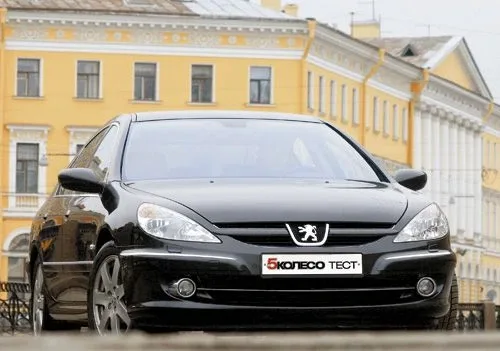
The Peugeot 607 has been in production since 1999, but on our roads this model is a real rarity. To understand why this happened, we took this car for a test drive.
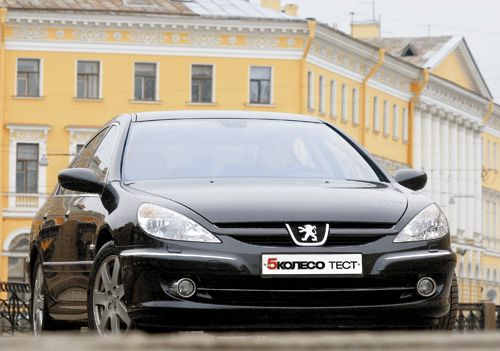
2005 Peugeot 607 3.0 V6
© Photo: 5 Koleso
2005 Peugeot 607 3.0 V6
© Photo: 5 Koleso
Although the silhouette of the "six hundred seventh" was born in the last century, today it does not look outdated. It's all about its memorable appearance: it's impossible to confuse this car with any other. Thanks to its unique look, the car invariably attracts attention — whether in the city center or in a residential area. Of course, no crowd of onlookers gathered around, but few passers-by did not look back at it. The model, as they say, catches the eye, although it's hard to call it truly beautiful. After the restyling, the appearance became more interesting, but questions still remained.
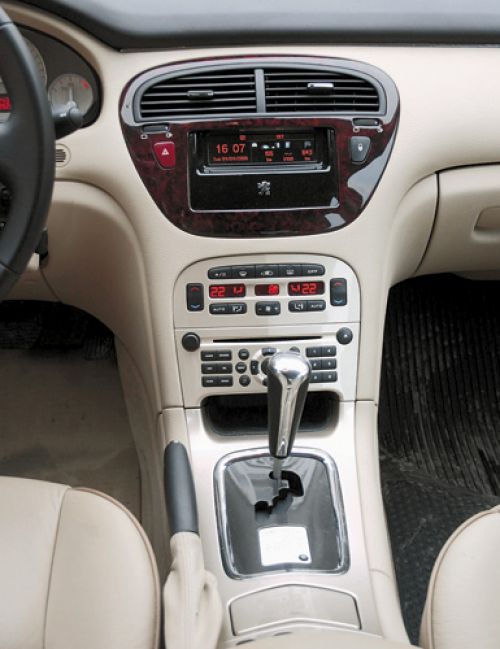
The interior also does not impress with design delights. Everything is simple and concise, but with a touch of luxury — as befits a business class. True, some finishing solutions raised questions. For example, it's strange to see "wooden" inserts and aluminum side by side on the center console. It would be more logical to choose one thing. But mixing styles is in the French blood, so arguing with this is useless.
No less surprising is the oil temperature gauge on the dashboard. Why is it needed in a car of this class? Usually such instruments are found on SUVs and pickups, where operating conditions are truly harsh. Here, its purpose remains a mystery.
2005 Peugeot 607 3.0 V6
© Photo: 5 Koleso
By the way, about the instrument panel: it is calibrated not with the "even" tens usual for Europe, but with "odd" values. At first, this is confusing — to drive at the 60 km/h allowed in the city, you have to keep the speedometer needle between the 50 and 70 marks. At the same time, the instruments themselves read perfectly, despite the silver needles on white dials. In the evening, with the side lights on, the backlight becomes pinkish, which is pleasing to the eye.
Behind the wheel of the "six hundred seventh" you settle in comfortably. The seat has many adjustments that allow you to tailor it to yourself with high precision. The steering wheel also adjusts without problems. The central armrest can be raised, making the seating even more comfortable. It's nice that the front passenger seat is equipped just as richly as the driver's seat, except for the memory settings.
The rear row also pleased. The seats here are not adjustable, but you can sit on them for a long time: the height of the cushion, its size, and the backrest angle are well chosen. To prevent the sun from bothering passengers, a sunshade is provided on the rear window. True, the front passenger has to control it — the power drive button is hidden in the front part of the central armrest.
The trunk lid opens and closes with an electric drive — this adds comfort. To open the trunk, just press the center of the zero in the "607" emblem. If the car is dirty and your hands are in white gloves, you can use the button on the key fob. The lid also closes automatically — by pressing a button on its end. Convenient: even in slush, your hands stay clean. The trunk itself holds 481 liters. This is not much even by the standards of cars a class lower, but hardly anyone would carry bags of potatoes in such a car, and there's no need to weigh it down with ballast for smoothness.

2005 Peugeot 607 3.0 V6
© Photo: 5 Koleso
The "six hundred seventh" really doesn't need ballast. On any surface, and we had the chance to drive on various roads, the ride smoothness remained at a height unattainable for many competitors. The car seemed to float, confidently holding the road. In corners, some roll is felt, but on a good road, the suspension can be "tightened" with the sport mode button. However, even in this position, it caused no inconvenience to either the driver or passengers.
We also note the excellent operation of the four-speed Tiptronic automatic paired with the 3.0-liter V6. The power of 211 hp, as long-term operation has shown, is quite enough to confidently move one and a half tons of curb weight. Without embellishment: during active driving, the Peugeot does not "shoot" like a bullet from a gun, but it accelerates confidently enough. The first 100 km/h are especially easy for the car, then the dynamics drop off a bit, but there is no doubt about the correctness of choosing this combination. The gearbox willingly goes into kickdown mode — just press the gas pedal harder.
Fuel consumption turned out to be quite acceptable. In the city with calm driving, it was possible to keep within 12 liters, on the highway — 7.0–8.5 liters. With dynamic driving, there are no miracles: the V6 requires fuel. Fortunately, the tank holds 80 liters, so you don't have to stop for refueling more often than once every 500 kilometers.
Someone might note that in this material we hardly mentioned any drawbacks. But there really are none. The only inconvenience is parking due to poor sense of dimensions: neither the front nor the rear is visible from the driver's seat. Therefore, the 607 should be ordered only with parking sensors. In our case, they worked properly, warning in advance of obstacles with sound and a picture on the central display, which allows you to change not only the brightness but also the color scheme.
Why this car remains in the shadow of its classmates remains a mystery to us. It's clear that Mercedes, BMW, and Audi have long established themselves in this class. But we shouldn't be so biased. There are many truly good cars that cost less and give no less, and perhaps more, pleasure from ownership. Of course, when reselling the "six hundred seventh" due to the same stereotypes, you will lose more than, say, on a BMW 5 Series. But, you must agree, sometimes by losing, we gain much more.
Technical characteristics of Peugeot 607 3.0 V6
Curb weight, kg – 1560
Gross weight, kg – 2140
Dimensions (length/width/height), mm – 4870/1835/1460
Wheelbase, mm – 2800
Trunk volume, l – 481
Maximum speed, km/h – 232
Acceleration time to 100 km/h, s – 9.9
Control fuel consumption, l/100 km:
- city cycle – 14.7
- suburban – 7.7
- combined – 10.2
Fuel tank volume, l – 80
Engine:
- type – V6
- displacement, cm3 – 2946
- power, hp at rpm – 211/6000
- torque, Nm at rpm – 285/3750
Transmission – automatic, 4-speed
Tire size – 225/55R16
Wheel suspension (front and rear) – independent
Brakes:
- front – disc, ventilated
- rear – disc
Steering – rack and pinion, with power steering
Price, euros – from 47,530.
Advantages and disadvantages
+ Spacious interior, good sound insulation, comfortable suspension, torquey engine.
– Poor sense of dimensions, significant loss of money on resale.
© 5 Koleso