
 Comments (1)
Peugeot decided to please Russian car enthusiasts with an unusual offer for our roads — a four-seat coupe. Due to its impressive dimensions and two huge doors, this model is often called a car for egoists, and at one time it was in high demand in the West. But traffic jams in megacities and the eternal parking problem forced manufacturers to switch to more practical and modest three-door hatchbacks.
The "mouth" of the air intake will leave few people indifferent
Even the Peugeot 406 Coupe, which debuted in 1996 and was repeatedly awarded the title of the most beautiful car of the year, despite all its external attractiveness, although it made a splash, could not boast of a large circulation. In eight years, only about 100,000 copies were produced. However, the French, famous for their refined taste, decided to take a risk — the new Peugeot 407 Coupe remained true to traditions and clearly aims for the laurels of its predecessor.
The shape of the rear resembles a Ferrari
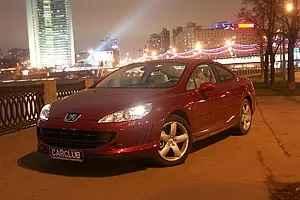
Although externally the coupe echoes the 407 sedan, it will not be difficult to distinguish them from each other. It's not just about details like the "gills" on the sides of the front bumper that cool the brakes, but also in the proportions themselves. The coupe is 140 mm (!) longer, 57 mm wider, and 55 mm lower than the sedan. In appearance, the car resembles a huge flat predatory fish, opening its toothy mouth to swallow any gaping fry. The 407 Coupe looks especially impressive at dusk, when the massive radiator grille with chrome trim is complemented by the blue glow of xenon headlights. In profile, small triangular windows at the front and incredibly long doors catch the eye. From the rear, the coupe strongly resembles a Ferrari — the same massive rear and tapering roof. The glowing round stop lights and powerful exhaust pipes add charm. True, operating an Italian stallion on our roads is a troublesome and not always realistic task. But in the Peugeot coupe, you can safely go on any trip, as long as there is at least some asphalt under the wheels. The main thing is to be careful when parking: the length of the front overhang exceeds a meter.
The coupe is 140 mm longer than the sedan of the same name
Inside, the difference between the coupe and the sedan is almost not felt. Everything is familiar: chrome bezels of the dials and the overly intricate interface of the on-board computer, which can only be figured out after several hours of careful study. There is enough space in the back — a couple of large friends can easily fit. And the trunk did not disappoint — 400 liters is enough for several large travel bags, though the loading height turned out to be somewhat too high.
The handling of the 407 Coupe is magnificent
Peugeot will be supplied to Russia with two petrol engines, although there is also a diesel version. The base 2.2-liter unit with 158 hp is combined only with a six-speed manual, while the 211-horsepower 3.0 V6 engine can be ordered with either a manual or an automatic. For the first acquaintance, we chose a good option — the 407 Coupe with a 2.2-liter engine. Even with the driver and three passengers, the car accelerates very briskly, at least on the first three gears. After 130 km/h, the small displacement and considerable mass begin to take their toll — for confident acceleration, you have to work the lever more often, fortunately there are six gears, so there is plenty to choose from. By the way, the engine turned out to be quite quiet. In the heat of an active assault on the Caucasian serpentines, where the tests took place, a couple of times I managed to rev the engine to the limiter, simply not hearing its "voice." Of course, if you drive with the windows closed and quiet music, it is impossible not to notice the engine's song at high revs, but when the windows are wide open and the speed has long exceeded a hundred, such an oversight is quite real. By the way, Peugeot painlessly forgives mistakes — after all, this is a coupe created to drive and live life to the fullest.
At the front, A-arm levers are used,
and at the rear — multi-link elastokinematics
The 407 Coupe with a three-liter engine and an automatic turned out to be not much more dynamic. And it's not about pure speed — the V6 engine is beyond competition — but in the feeling of acceleration. The six-speed automatic smoothly shifts gears, and even with the gas pedal pressed to the floor, you have to wait a second for the gearbox to find the right gear, or switch to manual mode in advance. On long straights, the 407 Coupe easily reaches 200 km/h and is clearly capable of more. At the same time, the car is easy to control even on not the highest quality Russian asphalt. The feeling of complete control consists of several factors. Firstly, it is electronically controlled shock absorbers that change stiffness depending on road conditions, and secondly, the "honest" power steering with variable performance (the higher the speed, the heavier the steering wheel). In the version with the 2.2 engine, it is replaced by a more economical electric power steering, and although it also changes the boost ratio, at high speed the car feels worse.
The interior is completely borrowed from the sedan...
The suspension of the 407 Coupe deserves a separate discussion. For the French, this aspect has always been a strong point, and the coupe is no exception. Peugeot surprisingly combines comfort and handling. The increased track compared to the sedan helps reduce body roll. The double-wishbone front suspension swallows all asphalt joints, and the wheels hold the road perfectly. Thanks to the rear multi-link suspension with a steering effect, the 407 Coupe feels like a fish in water in sharp turns. If the car rolls, the rear wheels slightly turn in the direction of the turn and help better maintain the given trajectory. True, in some modes, the steering effect can seriously scare both the driver and passengers. While there is smooth asphalt under the wheels and adequate drivers around, there are no problems. But if you have to sharply release the gas in a turn or hit a large bump, then in response to the increased body roll, the suspension tries to turn the car a little more, which at first is perceived as a skid. Of course, stability is maintained, but it is not immediately possible to get used to such rear sway. When full adaptation to the car's capabilities sets in, you want to race along mountain serpentines on the "four hundred seventh" until the tires wear down to the cord. The car's stability is such that a feeling of permissiveness involuntarily arises. Fortunately, the stabilization system is always on guard.
...but finished more luxuriously
Two days of testing flew by like one hour. The odometers of the cars added several hundred kilometers, and I came to understand who and why might need the 407 Coupe. Europeans call such cars Grand Turismo (GT). A stylish, swift car stuffed with the most modern electronics is designed not only to cover distances but also to turn trips into comfortable journeys. You can safely go on any trans-European tour in it, for example, from the north of France to the Côte d'Azur, or even more — from Scandinavia to the south of Italy. Of course, such a route can be covered in almost any modern car, but it is highly doubtful that you will get the same pleasure as when traveling in the Peugeot 407 Coupe.
Of course, any coupe is a car for the chosen few, and Peugeot is no exception. The 407 sedan with a 2.2-liter engine costs from $31,700, and the top version with a three-liter engine and an automatic is about $40,000. Prices for the 407 Coupe 2.2 start at $39,000, and the model with a 3-liter engine and an automatic will cost $52,000. It turns out that the coupe is $7-12 thousand more expensive than the more practical and by no means the cheapest sedan in its class. It is unlikely that a queue will form for the Peugeot 407 Coupe, like for the Ford Focus, but that is how exclusive cars differ from mass-produced ones — you have to pay special tariffs for comfort, safety, and pleasure. Well, if you evaluate the Peugeot from the position of exclusivity, it turns out that the 407 Coupe is not so expensive, because prices for the Mercedes CLK coupe with power from 163 hp start from €46,000.
Leonid Pavlov