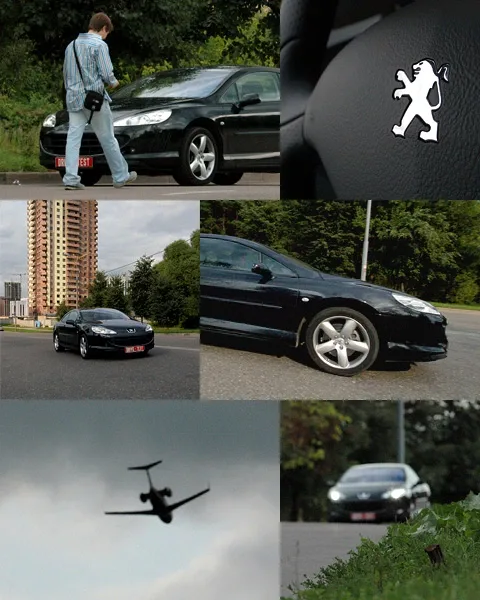
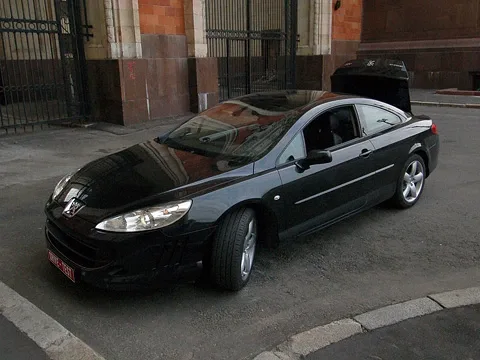
The exterior of this car is a true compositional paradox. It combines a huge, full-width bumper "smile" at the front, mysteriously squinting headlights, moderately restrained but noble side lines, and a neat, laconic rear end. What's surprising is not the abundance of details, but how the French designers managed to assemble them into a single, cohesive image that doesn't get tiresome upon a second glance. From each new vantage point, the car is perceived slightly differently, and after walking away from it after parking, you catch yourself looking back again to notice yet another previously unseen detail. In this regard, the new model has come a long way from its predecessor — the 406 Coupe, which was beautiful but looked the same from any angle.
Inside, the riot of colors and shapes gives way to calm and thoughtfulness. There are no eye-catching accents here, but all elements are very well matched to each other. The comfortable steering wheel has precise geometry, while the center console, on the contrary, is deliberately simple and almost flat, although after getting acquainted with the exterior, you expect some kind of zest from it. Ergonomics are generally excellent, but a couple of remarks couldn't be avoided. For example, the buttons on the center panel are piled up and so similar to each other that you'll have to get used to them at first, and at night, when this "matrix" is illuminated with identical lights, your eyes just wander. However, this is only a matter of time: once you get used to it, you realize that the interior is very comfortable and friendly. The seats delight with an ideal balance of comfort and lateral support in corners, and rear passengers are aided in getting in and out by electric drives that slide the front seats forward.
The quality of materials is pleasantly shocking. You expect this less from Peugeot than from Mercedes. The premium leather here is not limited to the seats and door cards — even the dashboard is upholstered with it. There is surprisingly little plastic in the interior, and what there is, is pleasant both to look at and to touch. The inserts on the dashboard are not imitation but real aluminum. We start the audio system with JBL speakers — and off we go.
But you need to drive out extremely carefully: the huge front overhang, almost a meter long, makes the car very vulnerable to curbs and building corners. Even a regular drive into a car wash or underground parking turns into a mine-clearing operation. Parking sensors help, but they only slightly reduce anxiety, and the "sense of the nose" never leaves you for a minute.
But as soon as the car gets onto the highway, all problems are forgotten. Here, the 407 Coupe feels like a fish in water, regardless of road width or corner complexity. The secret lies in the design: double wishbones at the front, a complex multi-link system with almost horizontal shock absorbers at the rear. Our three-liter version is additionally equipped with adaptive shock absorbers borrowed from the 607 model and reinforced anti-roll bars. The result is impressive: the steering wheel responds to the car with amazing precision, with not the slightest hint of yaw or uncertainty. But here's the paradox: due to this sterile precision and the specifically tuned power steering, you get the feeling that you're not driving a car but playing a computer simulator. There's no real excitement or desire to push the coupe to its limits. Taking a couple of winding roads quickly — sure, but without fanaticism. You don't feel like turning off the stability control, even with the button — it, like a leash, still doesn't give you full freedom, only slightly lengthening its "leash."
So, the car handles superbly, but you get pleasure not from records but from the very process of driving. The character of the engine and transmission combination also doesn't encourage racing. Yes, with the 211-horsepower V6 and six-speed automatic, the coupe is certainly fast, but for some reason you don't want to rev the engine to the redline. Instead, it's more pleasant to lightly press the gas on a straight road, enjoy the noble voice of the engine, let the wind into the cabin through the lowered window, and simply take pleasure. The gearbox also doesn't provoke aggression: to get a sharp jerk, you need to press the gas pedal to the floor, and in calm modes it doesn't fuss or unnecessarily rev the engine.
Now about practicality, if only to clear our conscience. Rear passengers of above-average height will be cramped — due to the low roofline and overhanging glass. The trunk is quite spacious for a coupe, and there's even a hatch for long items. And the loading height? Well, what difference does it make how high it is and how poorly the car handles the role of a truck or minivan, if a buyer of such a car thinks about these parameters last?
So what matters then? Our three-liter version costs a lot — $50,000. For that money, you could get more powerful sports coupes like the Mazda RX-8 or Nissan 350Z. But those are bought for speed and driving excitement, while the Peugeot is bought for the combination of sporty looks, speed, and comfort. This is a car for those who like the appearance of a sports car but don't find its character too appealing. The 407 Coupe is not a direct competitor to them, but rather an affordable alternative to premium coupes. It's not for those who chase every corner on the edge, but at a nightclub parking lot, it will look no worse than any "hot hatch" thanks to its unobtrusive front-wheel drive, excellent sound insulation, and luxurious finish.
Technical specifications
| Specifications | 1,400,000 RUB |
|---|---|
| Body type | coupe |
| Number of seats | 4 |
| Engine | 3.0 |
| Type | petrol |
| Location | front, transverse |
| Number and arrangement of cylinders | 6, V-shaped |
| Displacement, cm3 | 2946 |
| Maximum power, hp/kW/rpm | 211/155/6000 |
| Maximum torque, Nm/rpm | 290/3750 |
| Gearbox | M6/A6 |
| Drive | front-wheel |
| Front suspension | independent, coil spring, double wishbone |
| Rear suspension | independent, coil spring, multi-link |
| Maximum speed, km/h | 243/235 |
| Acceleration 0-100 km/h, s | 8.4/8.7 |
| Fuel consumption, l/100 km | |
| urban cycle | 15.0 |
| extra-urban cycle | 7.3 |
| combined cycle | 10.2 |
| Fuel tank capacity, l | 66 |
| Fuel | AI-95 petrol |
Equipment of the tested car
- Security alarm (volume sensor + external perimeter sensor)
- Fog lights
- Electric adjustment of steering column for height and reach with memory function
- Xenon lamps and headlight washers
- Front side airbags
- Side and window (curtain) airbags
- Front passenger airbag
- Air conditioning with dual-zone automatic temperature control (Bi-zone)
- Passenger airbag
- Radio bi-tuner
- Tire pressure drop sensor
- Dynamic stability system (ESP)
- Floor mats
- Central locking (superlocking)
- Driver's knee airbag
- Rearview mirrors with electric drive, tilting when reversing, folding
- CD changer
- Heated front seats
- Headlight washer
- Adaptive cornering headlights
- Front seats with electric adjustment
- Radio CD RD4+MP3
- Cruise control + speed limiter
- Interior rearview mirror with electrochromic coating
- Alloy wheels, 18"
Spare wheel made of aluminum alloy, 18 inches in diameter Electronically adjustable suspension Parking system with front and rear sensors JBL Hi-Fi audio system Tinted windows
The car for the test was provided by
the company "Peugeot Rus Auto". What remained behind the scenes