
Peugeot 4007. Agent 4007
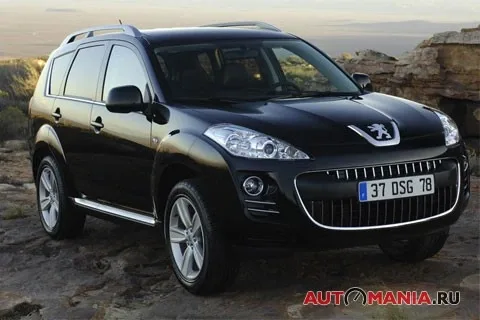
Just a couple of years ago, no one would have believed that Peugeot would get its own crossover. The entire model range of the brand, as well as the entire PSA concern, was tailored for the European market, where demand for such cars only emerged at the end of the last century. But even then, the French dragged their feet until the very last moment.
The company officially states that the two zeros in the name are not just for show: they symbolize the arrival of a new model that expands the brand's familiar lineup. But this is debatable: the word "new" is clearly overrated here. The exterior turned out to be a miss. No, the designers from the brand's style center did try to make the Peugeot 4007 at least somewhat distinctive. They worked hard on the front end, reshaping the headlights and bumper... The main detail of the latter is a huge air intake, above which a formidable lion from the emblem proudly sits. But everything else is the same old good Outlander XL: the silhouette and rear are easily recognizable. However, appearance is a matter of taste, and arguing about it is pointless.
And what about the inside? There's even less individuality here than outside. In fact, Peugeot's stylists decided not to touch the interior at all. Maybe they were satisfied with the ready-made option, or maybe they decided to save money, but the fact remains: the cabin of the 4007 is exactly the same as that of the donor Mitsubishi. And it's good that the Japanese didn't skimp on its finishing back then: it turned out not masterpiece-level, but quite decent.
The main plus of this interior is that it stylistically echoes the exterior. The modern "two-story" front panel looks solid, though without excesses. It's nice that the designers didn't go for kitsch: there are exactly as many metal and silver plastic inserts as needed. Shiny details are only on the door armrests, steering wheel, and the base of the center console. You can't fault the materials either — the developers clearly thought about tactile sensations: touching the panels and doors is very pleasant.
I'd like to speak just as favorably about the ergonomics, but, alas, you'll have to put up with shortcomings here. For example, the steering column in the 4007 adjusts only for height, and this affects the driver's seating position. The seat has a wide range of adjustments, but it will be truly comfortable only for a person of average height. Short drivers will find it hard to reach the pedals, while tall ones will either have to stretch to the wheel or set the backrest almost vertical. This isn't very convenient for a long trip, although you won't have to bend over — the ceiling is high. The front passenger doesn't need to seek such compromises. By the way, the front seats themselves deserve praise. They are, of course, not sporty or space-age like in the Mercedes ML, but with developed lateral support, they hold the body well in corners.
In the back, it's more comfortable to ride with two. The second-row seats slide longitudinally, and the backrests recline. So neither the front seats nor the ceiling will press down. True, depending on the position of the rear seats, the trunk volume changes by more than 100 liters. In principle, you can squeeze three people into the second row — there's enough legroom and shoulder room, but comfort will suffer.
Under the hood of the Peugeot 4007 are the same engines as the Outlander. However, unlike the "Japanese," the "French" won't have a three-liter V6. The gasoline engines are represented by a 2.4-liter unit from the World Engine family, which was created as part of a joint project between DaimlerChrysler, Mitsubishi, and Hyundai. It must be said that with such an engine, the car doesn't shine with dynamics, but it drives very decently: it doesn't provoke, accelerates confidently from mid-range revs — in general, it's just right for an undemanding driver. The proprietary CVT also works excellently. It doesn't "lag" during shifts and doesn't allow jerks during sharp acceleration... If desired, you can engage sequential mode (the transmission simulates six gears). But there's no particular need or practical benefit in this.
Otherwise, the Peugeot 4007 is no different from other "parketniks" — it rides smoothly, without shaking, and obeys the steering well... But that's on asphalt, and good asphalt at that. On rougher surfaces, such as dirt roads, the car handles harshly. In short, this crossover, like its progenitor, is not for conquerors of virgin lands, but for "heroes of asphalt" who only occasionally venture out of town for a light picnic.
When entering the off-road niche, manufacturers usually follow two paths. The first is to build a completely new car with an original design. This is what Nissan (Qashqai), European Ford (Kuga), VW (Tiguan), and BMW (X3) did... It's clear that this requires serious investment. The second path is simpler and cheaper. The manufacturer agrees with another, often partner, company and takes ready-made developments. Or even takes a production car as a base, restyles it both outside and inside, and then releases it under a new name. A vivid example is the Opel Antara, built on the basis of the Chevrolet Captiva "parketnik."
The development of Peugeot's off-road lineup followed exactly the second scenario, but since PSA didn't have such cars of its own, the donor had to be sought externally. The choice fell on Mitsubishi Motor, which was just finishing work on the new Outlander XL. It was this that the French took as the basis for their 4007 model.
Technical characteristics of the Peugeot 4007.
| Length (mm) | 4650 |
| Width (mm) | 1810 |
| Height (mm) | 1670 |
| Wheelbase (mm) | 2670 |
| Ground clearance (mm) | 175 |
| Trunk volume (l) | 185/1685 |
| Engine displacement (cc) | 2359 |
| Max power (hp) | 170 at 6000 rpm |
| Max torque (Nm) | 232 at 4100 rpm |
| Max speed (km/h) | 195 |
| Acceleration 0 - 100 km/h (s) | 10.4 |
| Average fuel consumption per 100 km (l) | 9.3 |
| Price (rub) | from 963,500 |
Source – automania.ru