
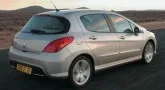
Peugeot 308. Price: not announced. On sale: since spring 2008.
Aggressive sporty looks and solid build of the slightly heavier "Frenchman" — a bet that the newcomer will be able to push aside the leaders of the golf class.
When the Peugeot 308 was first shown at the Frankfurt Motor Show, it immediately caught everyone's eye. The audience was hooked by the bold design with a clear sporty slant. Not a trace remained of the familiar lines of the "307". To avoid looking ordinary against the VW Golf V and Ford Focus, the French stylists didn't stand on ceremony and mixed all the brightest elements from the world of sports cars into one body.
It turned out that a Ferrari-style grille coexists quite well with large slanting headlights and a daring convex hood reminiscent of the contours of the racing Peugeot 908. As befits a modern compact car, the "308" has grown in length and gained weight compared to its predecessor.
Inside, Peugeot engineers also didn't let the side down: the interior has become noticeably more qualitative and attractive. The instruments are adorned with chrome bezels. The panel and knobs of the dual-zone climate control are covered with soft rubberized plastic, pleasant to the touch. But the main trump card of the interior is the feeling of spaciousness: you sit inside, and it seems the car is smaller on the outside than it actually is. There's enough room both in the front and in the back. The only thing to nitpick is the glare on the round transparent covers of the speedometer and tachometer — in the sun they shimmer with rainbow streaks, which is a bit annoying. You also don't immediately get used to the logic of the multimedia navigation (offered in Europe for 2150 euros) with a 30 GB hard drive for MP3 music. The audio and video inputs are hidden in the glovebox — you won't find them on the first try.
But enough beating around the bush. It's time to see what the Gallic lion is capable of, which is why we came to Paris. It's better to tame the predator in its native element. We leave the parking lot at Peugeot's head office on Avenue de la Grande Armée.
The first test for the lion cub was Paris itself. Three hundred meters from the headquarters stands the Arc de Triomphe, and around it — a giant ring of about fifteen lanes with a dozen exits and entrances. The road markings are completely invisible. During rush hour, Place Charles de Gaulle turns into sheer chaos, as if a herd of bison were herded into a tight pen. However, the Peugeot 308 passes this exam with honor. The narrow front pillars with transparent triangles at the mirrors and large, unusually shaped mirrors provide excellent visibility. You don't even need to turn your head — you can see everything happening around the car. But our Parisian test wasn't limited to a stroll around the Arc de Triomphe. We go down the Champs-Élysées towards the Louvre, cross the Seine, and dive into the endless narrow streets between the Luxembourg Palace and Boulevard Saint-Germain. The front seats in the 308 sit 15 mm lower than in the 307, so at first you don't immediately feel the dimensions of the nose. In alleys packed with parked cars, where there's only about three centimeters left on each side, steering feels like trying to thread a needle. Parking, even without parking sensors, turned out to be easy — the rear visibility is simply excellent.
With that, the city part ended. Coffee in the Latin Quarter, a couple of notes in the notebook about first impressions — and we head out to the open spaces beyond Paris. Time for dynamics and handling.
The first thing that surprises on the highway is the engine hum, which clearly tries to emphasize the sporty nature of the newcomer. At first, I even thought they'd given us a diesel version. But you look under the hood — and everything falls into place. The 1.6-liter petrol engine produces 120 hp at 6000 rpm, with maximum torque of 160 Nm at 4250 rpm. That's enough to hit 100 km/h in 10.8 seconds and reach 195 km/h. The engine is quite good, but the 5-speed manual in the Premium trim let us down: it clearly lacks a sixth gear, and with sharp shifts, you can hear a distinct crunch from the synchronizers.
The 308's chassis is inherited from its predecessor: the suspension is a bit stiff, but not excessively so. On a winding road at a brisk pace, the body barely rolls. The handling is strictly neutral, and the steering with the new electric power assist has become sharper than in the 307. You feel it immediately. They also worked on the electronics: the stability program was recalibrated, removing the previous nervousness and intrusiveness. ESP can be turned off if desired, but once you accelerate to 50 km/h, it turns itself back on. The brakes were also improved: on all versions, the diameter of the pistons in the front disc mechanisms was increased.
In general, the Gallic lion turned out to be quite ready for a fight with the VW Golf V. And there's no doubt that in Paris, this "German" is considered Peugeot's main rival in the compact class. It's funny that in Germany, sales of the 308 started even earlier than in France. All's fair in love and war!
308 and company
Along with the regular hatchback, Peugeot also showed other cars on the same platform: the 308 SW Prologue estate, the biofuel 308 BioFlex, the hybrid 308 HybrideHdi, and the sporty coupe concept 308 RC Z. The latter is a true gem of the series: ultra-dynamic design, 19-inch wheels with low-profile Michelin Sport PS 2245/40 tires. Under the hood — a 1.6-liter turbo engine with 218 hp and 280 Nm of torque (300 Nm in boosted mode). Paired with a 6-speed manual, it accelerates the coupe to 100 km/h in 7 seconds, with a top speed of 235 km/h. At the same time, in the combined cycle, the appetite is only 6.7 liters per 100 km.
Driving
The steering is sharp enough, but the five-speed gearbox lacks a sixth gear and smoothness in the synchronizers' operation.
Interior
In terms of trim and interior design, Peugeot's engineers have made a huge leap forward.
Comfort
Sound insulation could be better, but otherwise there's not much to complain about.
Safety
As promised by Peugeot: this model has everything needed, including in terms of safety.
Price
Not announced.
Pros and cons
- + Revolutionary design and excellent quality of interior trim.
- - The engine runs too loudly for a petrol motor.
Specifications
Make and model — Peugeot 308
Dimensions — 4276/1815/1498 mm
Engine — petrol, 1598 cm3, 120 hp/6000 rpm
Transmission — manual, 5-speed
Dynamics — max 195 km/h; 10.8 s to 100 km/h
Competitors — Ford Focus, Toyota Corolla, Volkswagen Golf
Our opinion
The revolutionary-looking Peugeot 308 was clearly created with an eye on rivals. But this in no way diminishes the designers' achievements. The French managed to improve the construction and quality of finish in the compact class and fully live up to their own slogan: "The Peugeot 308 has everything you need." Everything to compete on equal terms in the market with the VW Golf V and company.
February 11, 2008
Author: Vladimir Makkaveev
© 5 Koleso