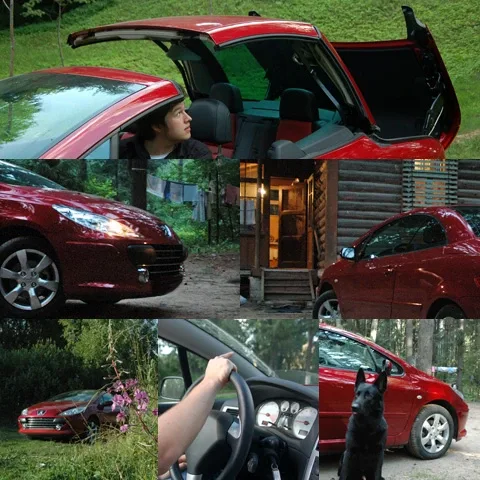
Convertibles have always been cars that warm the soul, not the wallet. Contrary to all logic and modern trends, they remain a model of impracticality, and on top of that, they cost crazy money. True, recently automakers are trying their best to reduce the number of inconveniences associated with a folding top, and at the same time bring down the price of such cars.
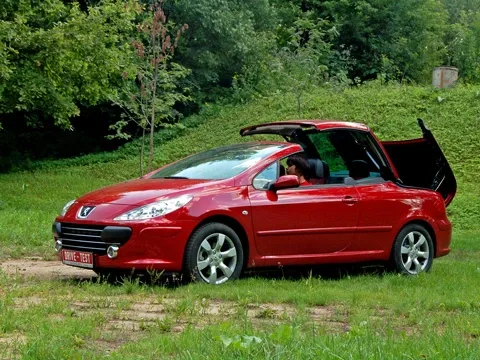
To fold the roof, just press a button. But this can only be done while standing or at very low speeds.
Don't want to bother with manually raising and folding the canvas? No problem — electric drives are installed, and all control comes down to pressing one button. Is there a draft in the cabin? Engineers tilt the pillars and windshield, add a wind deflector at the rear — and you can drive even at top speed. Think a canvas top is only for summer? Then here's a hard folding roof for you. By the way, it was Peugeot back in 1934 on the 401 Eclipse that first used such a design. True, it didn't go into production then — fewer than a hundred units were assembled. Later, the American Ford Galaxie Skyliner in 1959 tried to do the same, but its roof completely hid in a huge trunk. The car was even produced for a while, but constant reliability problems forced Ford to abandon this idea. Europeans, however, couldn't afford oversized bodies, so they had to rack their brains on how to make the roof more compact. Mercedes-Benz was the first to cope with its SLK model, but it was Peugeot with the 206 CC and 307 CC models that brought it to the masses.
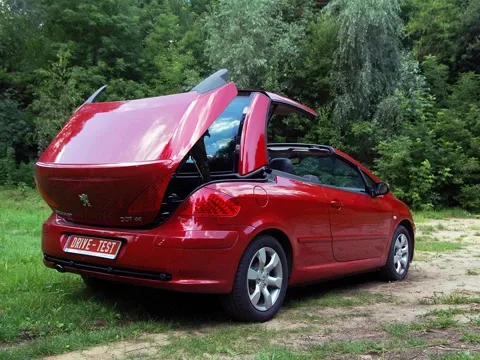
In the version without a roof, you can't put much in the 307 CC's trunk. But with the top up, it's quite possible to go shopping.
Today, coupe-cabriolets, as cars with a hard folding roof are called, no longer surprise anyone. But the most attractive of them is perhaps Peugeot. It has everything you need: a roof that folds at the touch of a button, decent aerodynamics, and even some kind of trunk. And most importantly for such a car, it looks very impressive, especially when the roof is down. What can I say, the restyling that gave the 307 a large "mouth" of a radiator grille in the style of the older 407 model did the car good. True, if you look at the "lion" from the rear as a coupe, it's not so good — to make the roof fit easily into the trunk, it had to be given a far from ideal shape. Because of this, the car's proportions seem a bit strange. However, the French got out of it here too by installing very bright LED taillights on the 307 CC. They play an important role — they distract attention from the long and heavy rear end.
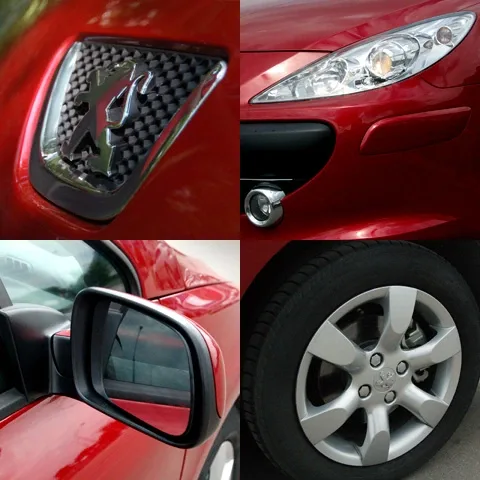
The updated 307 got headlights in the style of the "older" 407 model. You'll have to get used to the side mirrors — they are small and shifted too far back.
And what about inside? "Ugh, what a dump!" — my passengers said in unison. And indeed, the place we were driving past didn't spoil us with pleasant aromas, and the roof was just folded down... I pressed the gas harder to get out of there quickly. No, in a convertible you still need to drive not just anywhere, but selectively: a beautiful and pleasant car needs equally beautiful and pleasant surroundings, otherwise half the pleasure of the trip is lost.
Inside, the Peugeot 307 CC looks no less attractive than outside — high-quality, expensive, solid. True, the price of our 307 CC with a two-liter engine producing 143 hp and an automatic transmission is far from "people's" — a whole $36,800. You can, of course, refuse the automatic gearbox and save $1,400, or, conversely, pay a little extra and (again, refusing the automatic) get a 2-liter 180-horsepower engine and a number of pleasant little things like 17-inch wheels. However, it would be a sin to complain about the equipment of "our" "lion" — it includes a two-tone leather interior with very comfortable seats and dual-zone climate control. For complete happiness, only electric seat adjustments are missing. Everything is done, by the way, very high quality and neatly. White instruments, chrome rims, various trims — all this adds coziness and sophistication to the interior.
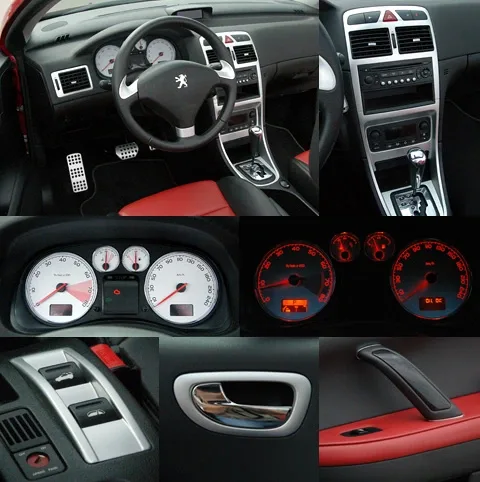
The interior of the 307 exudes a feeling of quality and attention to detail.
Looking at the rear seats, at first you think: are they even needed? After all, only children can fit there. Wouldn't it have been better to make the car a two-seater but with a larger trunk? Or are the seats actually a leather-covered shelf for small items? As it turned out, no: not only children but also quite adult girls can easily fit in the rear seats. But if you climb into the back not "at the call of the heart" but "out of duty," it turns out that only very short people will be comfortable there. True, none of my passengers complained about cramped space or wind (and you can sit in the back only with the wind deflector removed).
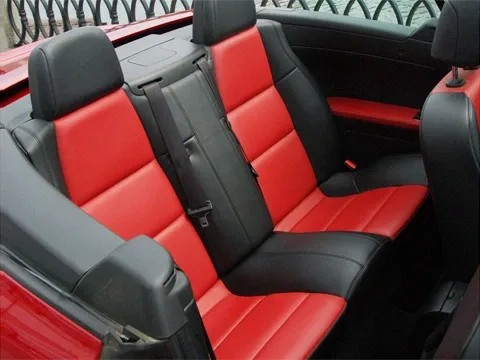
There's little space in the back, of course. But despite this, passengers (especially female ones) sit there very willingly and don't complain.
I didn't complain either: driving the Peugeot with the top down is possible at speeds well over a hundred — of course, if you raise all the windows. The windshield hangs right above your head, and its edge is somewhere out of your field of vision. This is partly why there's no annoying "wind rose" in the cabin. On the other hand, you constantly have to remind yourself that you're driving a convertible — because you can't see the sky above your head until you look up.
However, as soon as you drive next to some sooty KamAZ, the "convertible feeling" will settle in you for at least ten minutes. And if you stand next to this KamAZ in a traffic jam, you might have to wash yourself afterwards.
By the way, I think the 307 CC is equipped with a leather interior already in the "base" not by chance — otherwise the car would burn down if not from thrown cigarette butts, then under the gaze of traffic jam neighbors with an acute sense of social justice. Although, of course, the most typical reaction to any convertible is positive-shock. And some fellow citizens, on the contrary, get an "overdose" of positivity — girls constantly honked and waved at us, not to mention the number of smiles. For this, it's worth enduring envious glances and learning to stay away from exhaust pipes that don't meet Euro-2 standards, isn't it?
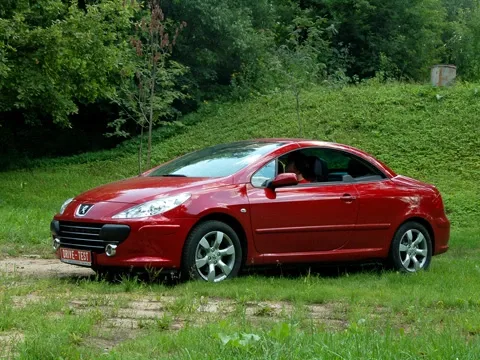
It's hard to say that in the "coupe" version the 307 CC has ideal proportions. But elegant details make you not pay attention to this.
It's also better to stay away from potholes — firstly, the 307 CC has a very low and rather long nose, and secondly, the cabin rattles terribly. Moreover, this rattle is not at all related to the quality of the cabin assembly. This is a common problem of most coupe-cabriolets — the body rigidity with the roof down (and even up) is much less than that of "permanently closed" cars. Therefore, if you crave comfort, it's better not to push it too hard.
The second condition is also significant. Whatever the "combat" 307 CCs demonstrate at the World Rally Championship, don't try to repeat it. After all, the 307 CC, especially with the 143-horsepower engine and automatic transmission, is not a fighter at all, but rather the opposite. So don't try to take corners sideways and do other stupid things — it's better to drive calmly, enjoying the ride. Especially since you won't get any pleasure from active driving, especially with the roof down, when the torsional rigidity of the 307 CC becomes particularly low. In this case, when performing a sharp maneuver, delays become especially noticeable, and the maneuver itself "breaks apart" into two parts — entry and exit. In general, don't. In "coupe" mode, the picture is a bit better, but the desire to race still doesn't appear. Although overall the chassis is good, and the tandem of the two-liter engine and the "automatic" works fine... True, only in "strolling" modes. But isn't this car "tuned" for them?
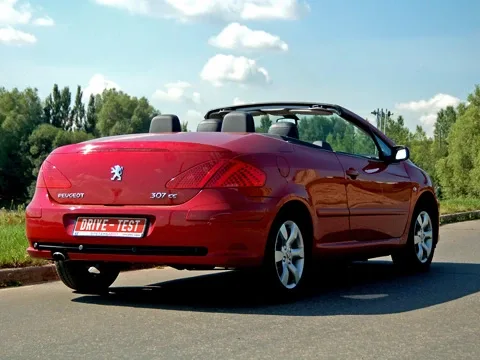
And its main purpose is to bring pleasure to the driver and passengers. On a warm summer evening, go out into nature, take a leisurely drive along narrow suburban highways, breathe fresh air... And, of course, show off to others. So the main quality necessary for a convertible — charm — the Peugeot 307 CC has in abundance.
Technical specifications
| Factory data | |
|---|---|
| Engine | |
| Type | naturally aspirated petrol, with multipoint injection |
| Location | transverse at the front |
| Number and configuration of cylinders | 4, inline |
| Displacement, cc | 1997 |
| Number of valves | 16 |
| Max power, hp/kW/rpm | 136/100/6000 |
| Peak torque, Nm/rpm | 200/4100 |
| Fuel | AI-95 |
| Acceleration and speed | |
| Top speed, km/h | 204 |
| Acceleration 0-100 km/h, s | 12.7 |
| Other details | |
| Transmission | automatic, 4 gears |
| Drive | front |
| Front suspension | independent, coil spring, McPherson type |
| Rear suspension | semi-independent, coil spring |
| Front brakes | ventilated disc |
| Rear brakes | disc |
| Tires | 205/55 R16 |
| Fuel consumption, l/100 km | |
| Extra-urban cycle | 6.4 |
| Urban cycle | 13.1 |
| Combined cycle | 8.9 |
| CO2 emissions, g/km | 211 |
| Dimensions | |
| Body type | coupe-cabriolet |
| Number of seats | 4 |
| Length, mm | 4347 |
| Width, mm | 1759 |
| Height, mm | 1424 |
| Wheelbase, mm | 2605 |
| Ground clearance, mm | 120 |
| Weight | |
| Curb weight, kg | 1488 |
| Gross weight, kg | 1830 |
| Capacities | |
| Fuel tank, l | 60 |
Equipment of the test vehicle
The car for the test was provided by
the company “Peugeot Rus Auto”.
- Fog lights
- ESP
- ABS
- Chrome elements and leather
- Front passenger airbag’
- On-board computer’
- Air conditioning
- Alloy wheels’
- Parking sensors’
- Central locking with super-lock
- Audio system preparation with six speakers
- “Ergonomic pack” package
- “Pack Look” package
- “Electrical pack” package
The car for the test was provided by
the company “Peugeot Rus Auto”.
Behind the scenes