

Peugeot's advertising slogan about cars of this brand being made for pleasure sounds literally everywhere today — from TV screens and radio receivers. We, like many others, could not resist such a massive attack and decided to test the promises in practice by taking the updated "307" for a test drive.
2005 Peugeot 307
© Photo: 5 Koleso
After calling the Russian brand representative office, we got the car at our disposal for a full three weeks. Why such a long period? First, to fully feel that promised pleasure — for our people, there is no greater happiness than driving someone else's car for a couple of weeks. And second, to form a truly objective opinion. After all, what is a test drive at an official dealer? It is fifteen minutes of superficial acquaintance in the presence of a salesperson who reacts to your every action with comments, the meaning of which boils down to one thing: you have never seen and will never see a better car than this one. You are in a state of euphoria, the dealer anticipates profit, and the car remains a stranger to you. It is a completely different matter when a car is placed at your full disposal for a long period. It is like a civil marriage: there is already a relationship, but responsibility and obligations are not sealed with a stamp in documents, so you can calmly take a closer look, reflect, and weigh all the pros and cons.
2005 Peugeot 307
© Photo: 5 Koleso
The fact that we got a car with low mileage turned out to be even better. In a fresh car from the assembly line, it is difficult to find assembly flaws. But when the car has already run a bit on our roads, the interior plastic settles into place under the influence of vibrations, the suspension softens a little, and the engine with transmission are run-in and reach the calculated mode. As a result, we got a car in the condition that a new one only gets after six months. And it is precisely after such a period that an owner can tell something substantive about their car.
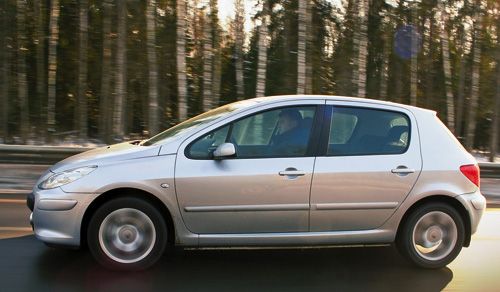
The new exterior of the "307" did not cause a burst of delight in me. Someone might find sportiness and style in it, but I see only freshness, nothing more. Especially since Peugeot has already used similar solutions on the 407 model, and the "face" of the 207 looks about the same. Nothing can be done — corporate style. As a practical person, I was more interested in the effectiveness of this spectacular optics.
Honestly, you expect more from lensed headlights. The low beam turned out to be somewhat dim. Moreover, this is not only my opinion but also that of my colleagues who also used the car. In the city at night, you do not really notice it, but on the highway, you immediately want something brighter. The high beam is beyond praise, but unfortunately, you cannot use it constantly.
2005 Peugeot 307
© Photo: 5 Koleso
The euphoria of owning a new car passed quite quickly. Already after a week, forgetting about the numerous advantages, we began to discuss the disadvantages.
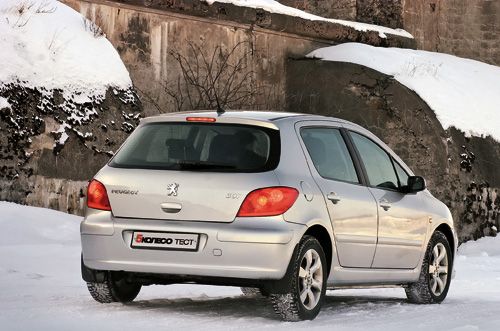
The wide and massive sill is undoubtedly a plus. It makes the body more rigid in torsion, which positively affects both handling and safety in the event of an accident. But with such a "porch," it is impossible to get out of the car or get into it without soiling your trousers. A small thing, but unpleasant.
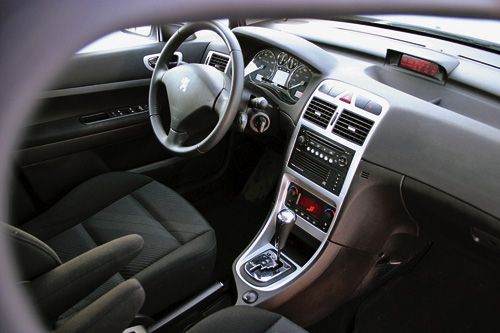
The interior has not undergone changes. Everything remained exquisitely French and at the same time quite practical. Although the shape of the folding armrests of the front seats could have been adjusted — in their current form, they look more like "armpit rests."
The steering column audio control unit is not in its place. You pull the wiper lever, and you hit this unit, and instead of washer fluid on the glass, the music starts playing louder. About the music itself: the system is decent, and the acoustics behave quite tolerably. But at a volume slightly above average, the door trim starts to resonate in time with the bass, which is strange, because on a bad road it does not make a sound.
The climate control is convenient to use. The organization of air flows does not cause complaints. The only thing that seems doubtful is the separate temperature zones for the driver and passenger. With such a cabin volume, this is hardly relevant and is done rather to add exclusivity. I also liked the trip computer. In addition to standard information, it can show not only the distance traveled but also how much is left to the final point of the route. True, for this, you need to enter the known mileage in advance, and then the countdown begins — a matter of technique.
While preparing the material, we also studied the reviews of owners of the pre-restyling version. Many complained that the suspension is prone to bottoming out. During our test, we did not notice anything like that, although we drove on different roads and with different numbers of passengers. It seems that bottoming out is possible only when overloaded. When the difference between the full and curb weight does not exceed 450 kilograms, nothing terrible happens. But if you seat four people and fill the 340-liter trunk to the brim... It is, of course, not that big, but cargo can be different.
2005 Peugeot 307
© Photo: 5 Koleso
Under the hood of our car was a 2.0-liter engine with 140 horsepower. There is also a more powerful version — 180 horsepower, but even 140 is quite enough. First, such an engine has a moderate appetite — 12 liters in the city. And second, it provides decent dynamics.
Fast driving is not hindered by the automatic 4-speed Tiptronic gearbox. It can work both in automatic sport mode, for which there is a special button, and in manual mode. With all its advantages, including the ability to brake with the engine, this "automatic" has one unpleasant feature: shifting from a higher gear to a lower one is accompanied by a strong jolt. This is especially annoying during smooth braking — the car seems to hit something, and passengers throw sidelong glances at the driver.
What is the result? Statistics say that families where everything is smooth and monotonous break up twice as often as those where there are small disagreements. So, dear, get ready: probably soon we will go to the MREO to "sign." We just need to save up money for the bride price.
Technical characteristics of Peugeot 307 2.0
Body – 5-door hatchback
Number of seats – 5
Curb weight, kg – 1293
Gross weight, kg – 1750
Dimensions (length/width/height), mm – 4212/1746/1510
Wheelbase, mm – 2608
Trunk volume, l – 341–1328
Maximum speed, km/h – 200
Acceleration time to 100 km/h, s – 11.1
Fuel consumption, l/100 km:
- city cycle – 11.8
- highway – 6.2
- combined – 8.2
Fuel tank volume, l – 60
Engine:
- type – inline, 4-cylinder
- displacement, cm3 – 1997
- power, hp at rpm – 140/6000
- torque, Nm at rpm – 200/4000
Transmission – automatic, 4-speed
Tire size – 205/55R16
Suspension:
- front – independent
- rear – semi-independent
Brakes:
- front – disc, ventilated
- rear – disc
Steering – rack and pinion, with power steering
Price, $ – from 22,000.
Advantages and disadvantages
+ Good dynamics, spacious interior, good handling.
– Insufficient sound insulation, weak low beam.
© 5 Koleso