
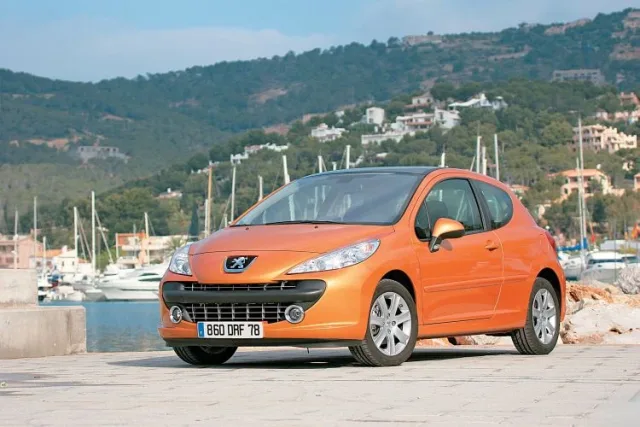
Boris Grebenshchikov is an amazing personality. For so many years he has been singing his seemingly meaningless mantras, and suddenly some phrase unexpectedly becomes an exact quote. Why is it that right now, as I weave through the winding roads of Palma de Mallorca in a Peugeot 207, a song from his latest album keeps running through my head?
"Beauty is a terrible force,
And there are no words to say it.
Beauty is a terrible force,
But I'm no longer afraid, and I want to know."
I'm really not afraid. After all, no matter how much you make the grille look like a Ferrari's, it won't become a supercar. And I want to understand why the Peugeot 207 on the road differs so much from its predecessors...
From 1998 to 2005, the share of small cars in the European market grew from 31% to 33%. And Peugeot during the same time managed to increase sales in the B-segment by 85% — all thanks to the success of the 206 model"...
They have every figure calculated! That's why they are marketers — market professionals. They get paid for it. For example, they already know that in 2007 Peugeot will produce over half a million "two hundred sevenths", with 27% going to France, 48% getting HDi diesels, and 55% being five-door versions.
 |  |  |
| The interior is very bright — the glazing area reaches 3 m³. And if you pay extra for a huge sunroof or a transparent roof... | The front seats are very comfortable — both in shape, moderate firmness, and folding armrests. But in the back it's a bit cramped | |
They also know what matters most for this car. And the most important thing is design.
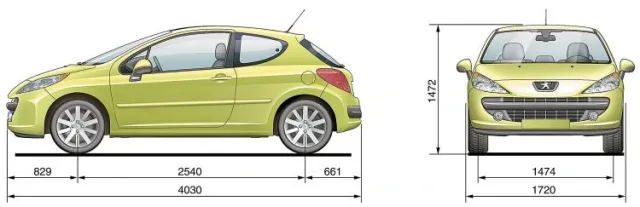
However, at first I doubted this — the Peugeot 207 looked like a simply inflated little "two hundred sixth", grinning with a Ferrari-like grille, like the Peugeot 407 and the restyled 307. So, in principle, that's how it is — the Peugeot 207 hatchback stands on the same "Platform 1" as the Peugeot 206, 107, and 1007. It's just grown up. 200 mm longer, 100 mm longer wheelbase, 30 mm wider track than the Peugeot 206. And the front end is done in the new corporate style.
 |
| The designers' first sketches were much more radical... |
Now everyone does this. But beauty is a terrible force. Looking at the three-door Peugeot 207 in Salamander Orange with the optional glass roof and an interior as light as the future under communism, you don't want to think about platforms, enlargement, or marketers' calculations. You just want to enjoy life, carelessly whistling some simple tune. For example, at least this one from BG: "Beauty is a terrible force"...
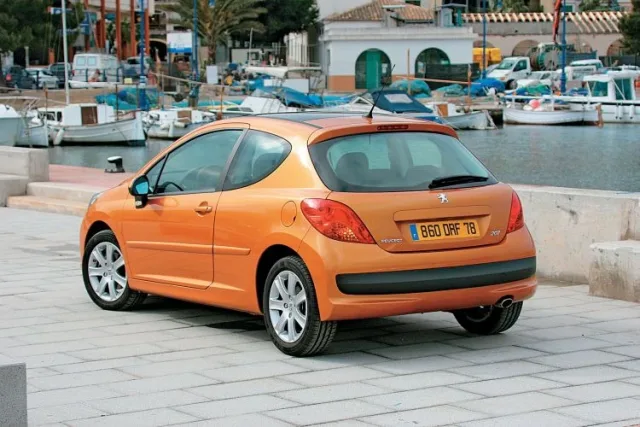
Neither the "Ferrari-like" grin nor the Ford-style chiseled wheel arches — nothing prevents the "two hundred seventh" from being a beautiful car! Of course, not as cute as the Peugeot 206. After all, the Peugeot 207 is a more mature little car. And looking at the "beak" of the hood extension hanging over the black maw of the air intake, you want to say: this little car is more serious.
And the interior has become less frivolous. Up front, it's noticeably more spacious than in the Peugeot 206. The dashboard's architecture slightly resembles the first-generation Mercedes A-Class — here there's the same strictly rectangular central console, T-shaped supporting the curved upper part. The three instrument dials under a short visor are unusually sloped — you want to sit higher to look at them at the "right" angle. And in principle, it's easy to do — the seat rises on a "jack", and the nice steering wheel can be adjusted in two directions over a very wide range: 50 mm each.
 |  |
| The Peugeot 207 can look different depending on the version — with a more sporty (in the foreground) or a "classic" front end. And the headlights can have "cornering lights" that automatically turn on when the steering wheel is turned | The interior is elegant and modern — especially in the light version. It's a pity that the buttons on the central console are a bit small |
 |  |
| There are no interior door handles — only recesses | The instruments feature sloped dials |
The ergonomics are excellent! And there are no visibility problems — especially thanks to the low beltline. It's just a pity that the exterior mirrors are attached almost to the middle of the doors. After all, unlike the 206, not the entire window lowers, but only part of it — the front "triangle" is fixed, like in minivans. Or like in the larger Peugeot 307.
And in general, which model is the 207 closer to — the 206 or the 307? Stylistically, it's something in between — a bit of the playfulness of the Peugeot 206 mixed into the one-box nature characteristic of the Peugeot 307. In size, the 207 is also right in the middle — 200 mm longer than the younger sister, 200 mm shorter than the older brother. But in the back seat it's a bit cramped — there's no talk of the spaciousness of the Peugeot 307, and there's only slightly more knee room than in the "two hundred sixth". The trunk, although more spacious, at 270 "square liters" by the VDA method is not the 340 liters of the Peugeot 307.
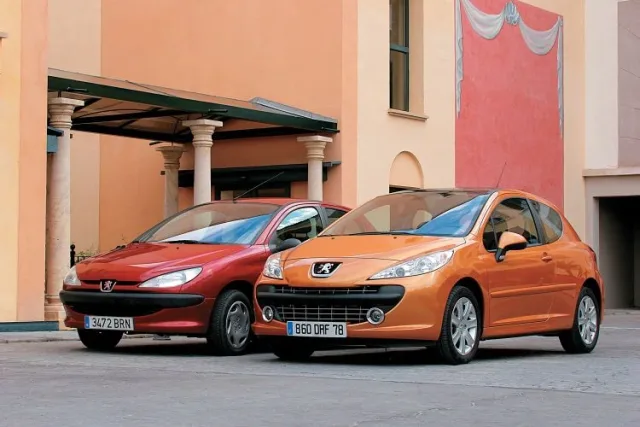
In short, the two in the index of the new model is fully justified — this is not a family hatchback. And the French themselves clearly outline the circle of potential buyers of the 207. "Today there are more and more single people — or those who want to have several cars in the family for greater independence"...
In short, the Peugeot 207 is a kind of lone lion with an engine. And the lion's maw of the front end is a kind of message. Like, look how proud I am, how independent, how aggressive...
But in reality, the character of the "two hundred seventh" is even less sporty than that of the little 206!
For now, the most powerful engines under the short hood are 110-horsepower 1600-cc units: either a petrol sixteen-valve or a 1.6 HDi turbodiesel. But the Peugeot 207 is in no hurry to accelerate with them — even despite the quite "short" transmission (on second gear of the petrol version, the tachometer needle hits the limiter already at 90 km/h on the speedometer).
 |  |
| The Peugeot 207 is built on the PSA concern's "Platform 1", but technically differs from the 206 only in the extended wheelbase, widened track, the design of the semi-independent rear suspension (with a slightly different beam, like the Peugeot 307) and the electromechanical power steering | The body is designed in the image and likeness of the "older" model 407 — note the elongated front subframe, which more effectively redistributes the energy of a frontal impact |
But the nice steering wheel, almost "weightless" during parking maneuvers, fills with pleasant effort as speed increases — the Peugeot 207, unlike its brothers and sisters, has an electric power steering, and it's well-tuned. Of course, it's not a match for the benchmark Volkswagen electric power steering. And the former "transparency" of the steering, when the Peugeot 306 or 406 could be driven literally blind, on the "feel of the wheel" alone, is not here. And in corners, the steering wheel turns out to be even too heavy — you have to hold the wheel with both hands.
But the reactive action is still not as "artificial" as in Renault cars. And in general — as long as you don't approach the limit, everything is fine. The car follows the steering wheel perfectly, pushes moderately when entering a corner. And the ride smoothness of the petrol car seems good. The light ripples of Mallorca's asphalt, small potholes on country roads — everything is "swallowed" silently.
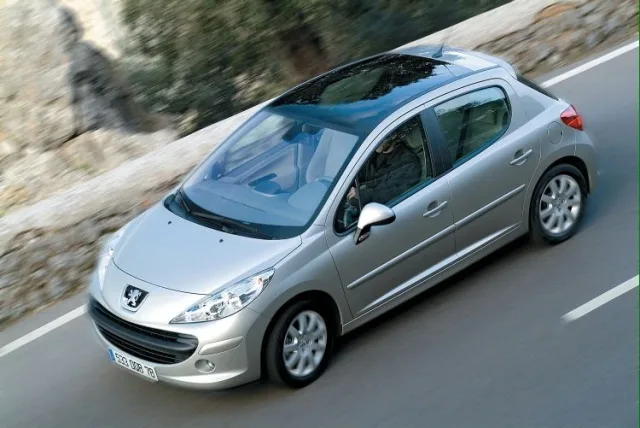
In short, just enjoy life. Look at the mountains and clouds through the transparent roof, listen to music from the speakers of the mediocre JBL audio system. Smell the scent of inexpensive perfume emanating from the vents — for an extra charge, the Peugeot 207, like the Citroen C4, can be equipped with a built-in air freshener...
But as soon as you press the gas pedal, the picture changes. Starting from 4000 rpm, a monotonous engine hum appears in the cabin, disturbing the previous silence. When the speedometer needle passes 110 km/h, noticeable aerodynamic noises join this hum. And the soft suspension on wavy asphalt sometimes unpleasantly surprises with dull thuds when the compression bumpers engage.
 |  |
| Built-in air freshener in a capsule (seven scents to choose from) "refreshes" the air flow from the central vent | Rich equipment: navigation, phone, CD changer — and even dual-zone climate control! |
 |  |
| In simple versions — three knobs for climate control. Bottom right — a card holder | Mirrors are moved back, but they have built-in "turn signals" |
And what happens if you attack a corner at a more aggressive pace?
Under throttle, the Peugeot 207 seems to behave predictably. But if on a fast curve, frightened, you suddenly release the pedal, the car starts to push its front axle outward, and it understeers. Then the hatchback unexpectedly "dips" into a deep oversteer that takes a long time to end.
I was even glad that most test cars had non-switchable ESP. With it, there is no risk — even if you try to disable the system, at speeds above 50 km/h in a slide, the electronics will still take control. The brakes will squeal, the car will slow down and return to the correct trajectory. But what if there is no ESP, as in the budget version with the 1.4 engine? I spent very little time behind the wheel of such a car, but in sharp corners I felt insecure. The car "floats," hangs in slides that are hard to control…
 |  |  |
| The 12-liter glove box is illuminated and cooled | The indicator above the top display reminds you of unfastened seat belts for all five passengers | The trunk has become noticeably more spacious than in the 206 |
But there was a time when everything was different. The Peugeot 205 was considered the benchmark for chassis tuning in its class. And how many vivid emotions the Peugeot 306 gave! What's more — even my editorial Peugeot 406, which had been in two accidents and drove on worn-out shock absorbers, still knows how to "pedigree" through corners.
Everything changed with the arrival of the beauty Peugeot 206. Different times, different priorities. "Beauty is a terrible power"…
The Peugeot 207 in terms of chassis character is another step back compared to the "two hundred sixth." That one, thanks to its low weight (less than a ton), stiff suspension, and decent power steering, held up well in fast corners. But the Peugeot 207 is heavier by as much as 150 kg — it weighs like a much larger "three hundred seventh"!
At the French office, they readily explain where such a difference in mass comes from.
— Firstly, 40 "extra" kilograms compared to the 206 are gained simply from the increase in dimensions. Another 50 kg "weighs" quality — richer equipment and other materials. Only 25 kg went to sound insulation. And the remaining 60 kg is passive safety. Unfortunately, a stiffer body weighs more…
With passive safety, the Peugeot 207 is in full order: five EuroNCAP stars — for frontal impact, four stars — for child protection in Isofix seats, and three stars — for pedestrian safety. And if the car is also equipped with a stability system, then you don't have to worry about active safety either.
Although the brakes did not inspire much confidence in me. During emergency braking on uneven roads, the car "crossed" a couple of times — and this despite the working ABS.
But if anything does happen, the stiff body, belts, and airbags will save you. This is exactly what buyers need today — a sense of security. As well as comfort and design. A "tuned" chassis or proper behavior in fast corners, alas, is no longer on the list of customer wishes.
— Yes, the Peugeot 207 is no longer such a "driver's" car as before, — the old-timers at Peugeot explain with a wise smile. — But for this model, the feeling of comfort and quality is much more important…
The principle of reasonable sufficiency. Give people only what they need most. A car like the Peugeot 207 should be beautiful, convenient, comfortable, and pleasant in normal driving modes. And that's it.
Voilà — all of this is there!
Moreover, when this principle is followed by, say, the Koreans or Opel, the cars turn out bland, boring, and somehow flawed. But you can't say that about the Peugeot 207. This car has so much true French charm, so much appeal… Even despite the inappropriate grin. Which, combined with such sluggish dynamics and ordinary chassis, could be taken as a mockery of metrosexual youths who will be attracted by the front end "like a Ferrari."
But in reality, it's not a grin at all. It's a lion's maw. It's a lion, the totem animal of Peugeot, yawning from boredom.
Everything is fine with it. Sales are growing year after year, the chosen strategy has proven correct. And the Peugeot company has transformed from a manufacturer of reliable, modest, and elegant cars, known among a few connoisseurs for their refined driving qualities, into one of the leaders of the European auto industry. And it even brought Citroen along with it — to the threshold of a bright future. The people at Peugeot themselves call this nothing less than the "second birth" of the company!
And in many ways, the "second birth" was ensured by the sexy beauty "two hundred sixth." It is so successful that it will continue to be produced. How long?
— As long as there is demand, — the people at Peugeot don't speculate. — Keep in mind that in some markets, the Peugeot 206 model has just been introduced. For example, in China, more than 10 thousand orders for the 206 sedan were collected in four weeks after its debut!
So both the Peugeot 206 hatchback and the new sedan based on the "two hundred sixth" (these cars will be supplied to Russia from the Iran Khodro plant) remain with us. And the Peugeot 207 can be considered an expansion of the model range! As the company's flagship model in the B segment, standing on the threshold of the golf class.
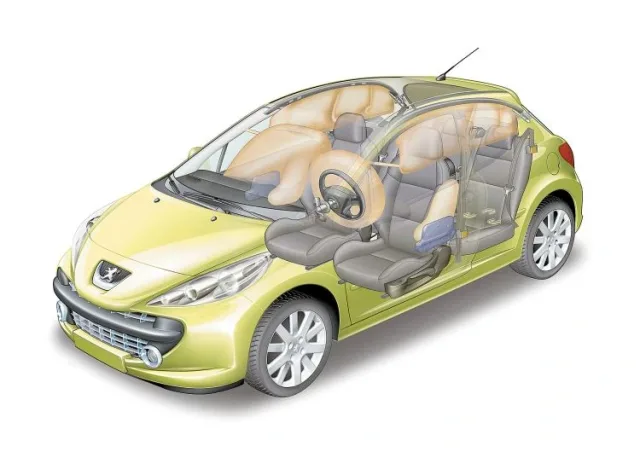
Among the passive safety arsenal — adaptive front airbags, side airbags, window "curtains" with a volume of 23 liters… And of the five inertia seat belts, four are equipped with force limiters
By the way, the Peugeot 207 won't reach us anytime soon. First, all three PSA concern plants where the "two hundred sevenths" are produced (in France, Spain, and Slovenia) will work only for France — the most important market. The gearbox for the cars is so far only manual, with six engines. Petrol engines develop 75 hp (base 8-valve 1.4 L), 90 hp (1.4 16V), or 110 hp (1.6 16V), turbodiesels — 70 hp (1.4 HDi), 90 or 110 hp (1.6 HDi). I didn't test only the most low-powered engines. There's no need to regret that turbodiesel versions are not supplied to us — they turned out to be noisier and more vibration-loaded than before. But the 90-horsepower 1.4 L petrol engine, thanks to variable intake phases, turned out to be decent — it accelerates the Peugeot 207 not quickly, but confidently. But, of course, the most convenient is the 207 1.6 version.
Then the Peugeot 207 will gradually arrive in other European markets. And only then will it be the turn of the "rest of the world" — Japan and Russia will get it only in the first quarter of 2007! After mandatory adaptation to local conditions.
By the way, by that time, under the hoods of PSA concern cars will appear super-technological engines with a displacement of 1600 cc, jointly developed with the BMW Group — with 115 hp in the naturally aspirated version and 150 hp with turbocharging and direct petrol injection. That is, the Peugeot 207 will get the same engines as the new Mini!
Then the "two hundred seventh" will also have automatic gearboxes. With the 1.4 engine, a "robot" will be paired, which we wouldn't wish on our enemies. But with the 110-horsepower 1.6 engine — a real "automatic." But won't such cars, especially with good equipment, be more expensive than the "three hundred sevenths"?
However, it's too early to talk about prices. First, let's live to Monday — that is, to 2007. And who knows — maybe by then the Peugeot 207 will strengthen in terms of engine and suspension, and the lion will change its bored yawn to a real grin?
| Peugeot 207 (manufacturer data) | |||
| 1.4 | 1.4 16V | 1.6 16V | |
| Body type | 3-door/5-door hatchback | ||
| Number of seats | 5 | 5 | 5 |
| Trunk volume, l | 270-923*/310-1195* | ||
| Curb weight, kg | 1138/1148 | 1139/1149 | 1213/1225 |
| Gross weight, kg | 1580/1620 | 1620/1640 | 1670/1680 |
| Engine | petrol, with distributed injection | ||
| Location | front, transverse | ||
| Number and arrangement of cylinders | 4, in-line | 4, in-line | 4, in-line |
| Displacement, cm³ | 1360 | 1360 | 1587 |
| Cylinder bore/piston stroke, mm | 75.0/77.0 | 75.0/77.0 | 78.5/82.0 |
| Compression ratio | 10.5:1 | 11.0:1 | 11.0:1 |
| Number of valves | 8 | 16 | 16 |
| Max power, hp/kW/rpm | 75/54/5400 | 90/65/5250 | 110/80/5750 |
| Max torque, Nm/rpm | 118/3300 | 133/3250 | 147/4000 |
| Gearbox | manual, 5-speed | ||
| Gear ratios | |||
| I | 3.42 | ||
| II | 1.81 | ||
| III | 1.28 | ||
| IV | 0.98 | ||
| V | 0.77 | ||
| final drive | 4.29 | 4.54 | 4.54 |
| Drive | front-wheel drive | ||
| Front suspension | independent, coil spring, McPherson | ||
| Rear suspension | semi-independent, coil spring | ||
| Front brakes | disc, ventilated | ||
| Rear brakes | drum | drum | disc |
| Tires | 185/65 R15 | 185/65 R15 | 195/55 R16 |
| Maximum speed, km/h | 167 | 180 | 194 |
| Acceleration time 0-100 km/h, s | 15.6 | 12.7 | 10.6 |
| Fuel consumption, l/100 km | |||
| urban cycle | 8.4 | 8.5 | 9.3 |
| extra-urban cycle | 5.0 | 5.2 | 5.6 |
| combined cycle | 6.3 | 6.4 | 7.0 |
| Fuel tank capacity, l | 50 | 50 | 50 |
| * With folded rear seats | |||
The two-hundred series
201

The 201 model, which opened Peugeot's "two-hundred" lineup, was produced from 1929 to 1936 and became the first car in the brand's history with a three-digit name with a zero in the middle. In 1931, this model debuted independent front suspension on transverse leaf springs, and it was the first time such a scheme was used in serial production. Over seven years, 142 thousand units left the assembly line.
202

The Peugeot 202, produced from 1938 to 1950, developed the ideas of its predecessor: a new body with streamlined shapes was installed on the previous frame. Headlights hidden behind the radiator grille became its calling card. In 1942, during the occupation, production was halted, but already at the end of 1946 production resumed. The result — 140 thousand cars over eight years.
203
The Peugeot 203 (1948–1960) became the company's first post-war development, created from scratch. The body here was already load-bearing, and the 1300 cc engine received a hemispherical combustion chamber and V-shaped valves. Over 12 years, 686 thousand such cars were assembled.
204

The Peugeot 204, produced in 1965–1976, is the brand's first front-wheel-drive car with a transversely mounted engine. Under the hood was an aluminum engine with a displacement of 1130 cm³ with an overhead camshaft, all wheels had independent suspension, and front disc brakes. Later, a diesel with a displacement of 1357 cm³ appeared in the range. The Pininfarina studio made five different bodies for this model: sedan, station wagon, coupe, convertible, and van. The total production exceeded 1.6 million cars over 11 years.
205

The Peugeot 205 (1983–1999) was remembered for exemplary use of space in the cabin and excellent chassis, especially in the "hot" GTI version. The model stayed on the assembly line for 16 years, with a total production of 5 million 278 thousand units.
206

The Peugeot 206 has been produced since 1998, and its production has already exceeded five million — the cute hatchback is still in demand. By the way, the Peugeot 207 will later have SW (station wagon) and CC (coupe-cabriolet) versions.