
For Peugeot, the second series has always been something more than just another model: the 205 once revived the brand, and the 206 became the best-selling car in the company's history and a global bestseller. This autumn, a new generation is entering the Russian market — the Peugeot 207.
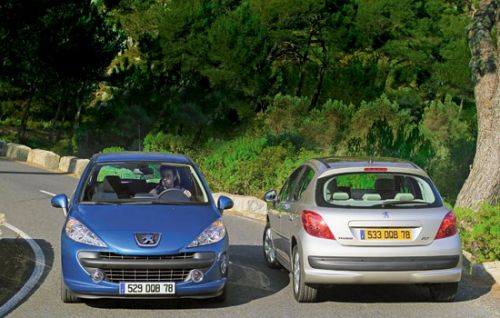
2007 Peugeot 207
© Photo: Peugeot
Palma, the main city of Mallorca, is famous for its seaport, but all the rest of the island's space is occupied by cyclists. Here you have both amateurs and pros, of all ages and stripes. They gather in groups or ride solo, racing along the local serpentines. They don't care about lane markings, they cut corners and behave as if the road belongs to them by birthright. When you encounter such a bike flow, you involuntarily yield not the place prescribed by traffic rules, but exactly where they are heading. And you understand them: when you're on two wheels, slogging uphill is hellish work, and losing speed gained on a descent is sheer waste.
With a car, it's different. We, fortunately, are in no hurry, and lost dynamics are easily compensated by pressing the gas pedal — under the hood is a 1.6-liter petrol engine with 110 horsepower, familiar from the predecessor. Now it's the top version in the lineup, and it climbs uphill quite briskly. Cyclists practically paralyze traffic on narrow mountain roads, not letting you drive fast? Well, fine: on Mallorca, it's generally not customary to fly headlong, and driving the Peugeot 207 gives you true pleasure precisely from measured driving.
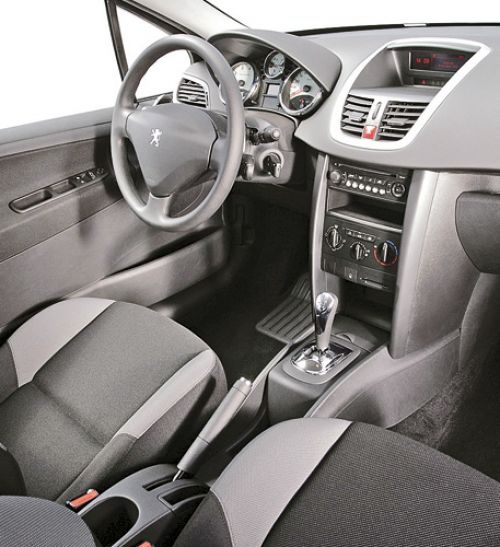
Our test car is equipped with the Cielo panoramic glass roof — an incredibly positive option; unobtrusive navigation, solid trim of a neatly assembled interior, dual-zone climate control, CD changer, decent audio system, and, most importantly, Pirelli P Zero Nero tires! Yes, the "little one" of the second series is shod in such tires — just yesterday it would have been hard to believe.
The 207 is no longer a "little one." The company's strategic course to raise the price status, started with the 307 model, has reached the junior lineup. It's enough to open the door — it's somewhat heavy due to enhanced sound insulation and passive safety elements — to understand that the entry ticket to the world of the 207 will not be cheap.
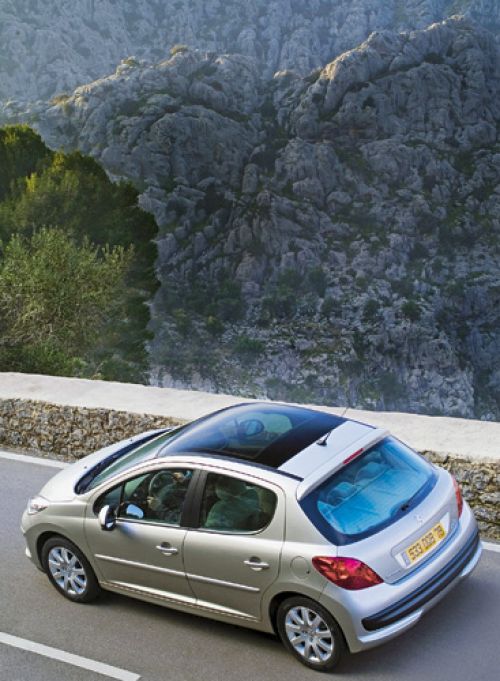
2007 Peugeot 207
© Photo: Peugeot
With the arrival of the second generation, designers did not make revolutions. On the contrary, the car organically continues the current corporate style. But there are a couple of little tricks. The Peugeot 207 is a car with a double face: depending on the trim, the front end design changes. The differences are not striking, but they are fundamental. In both variants, the car looks good, and the choice makes it a true diplomat: this way it can appeal to a much larger number of buyers.
2007 Peugeot 207
© Photo: Peugeot
The body has crossed the four-meter mark, and the wheelbase has grown by ten centimeters. The famous torsion beam rear suspension, which faithfully served Peugeot for the last 23 years, is still living out its life on the old 206 model. The new model uses a twist-beam axle: the engineering design has become simpler and more standard, but at the same time more technological. However, the recognizable ergonomics familiar from the "two" haven't gone anywhere: the mutual arrangement of the steering wheel and pedals still has its peculiarities. The steering column adjusts for reach, but if you are tall with long legs, the maximum reach may not be enough to get truly comfortable. Long arms behind the wheel of the 207 are generally welcome: to open the door from the inside, you have to reach far forward.
There are three petrol engines so far: 1.4 with 75 hp, 1.4 16V with 90 hp, and 1.6 16V with 110 hp. All work with a five-speed manual. These units are already well known. But something interesting is on the way — a completely new engine created by alliance engineers. A 1.6-liter petrol engine developed jointly with BMW Group will exist in two versions: naturally aspirated and turbocharged with low-pressure boost, producing 150 horsepower. Perhaps those dreaming of a fast Peugeot 207 should wait for these progressive engines. An automatic gearbox is also promised soon.
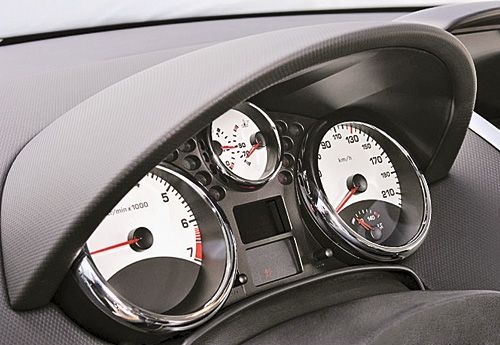
2007 Peugeot 207
© Photo: Peugeot
Of the currently available engines, the most pleasant is the 90-horsepower 1.4. Its torque reserve is enough for confident movement, and its lively nature, requiring revving the engine, makes the trip more fun. The formally more powerful 1.6 behaves smoothly and absolutely dispassionately. The French have never been famous for the precision of the gearshift mechanism, but here the selectivity is quite decent. Special praise deserves the tuning of the electric power steering — feedback is at a decent level. And again, the junior version seemed friendlier to the driver due to a more informative steering wheel. And in parking, the wheel turns literally with one finger.
The chassis conscientiously does its job, providing comfort, stability, and quality handling: the car has become more solid and mature both in road behavior and everything else. The former responsiveness and the debatable tendency of the rear axle to steer gave way to calmer and more predictable reactions. But the stability control system has become less intrusive, yet more advanced than even on the Peugeot 407.
Five stars in crash tests, a full set of electronic assistants, including tire pressure monitoring, equipment typical of cars a class higher, a huge choice of interior trim options, and an appearance that seems familiar and native at first glance. Today, Peugeot is betting on the premium segment of compact hatchbacks, where respectability and solidity reign, and phrases like "Va-banque!" are clearly not in favor here.
Technical specifications of Peugeot 207 1.4 (1.6)
Body – 3-/5-door hatchback
Curb weight, kg – 1139/1149 (1213/1225)
Gross weight, kg – 1620/1640 (1670/1680)
Dimensions, mm:
- length – 4030
- width – 1720
- height – 1472
Wheelbase, mm – 2540
Trunk volume, l – 270–923/310–1195
Maximum speed, km/h – 180 (194)
Acceleration time to 100 km/h, s – 12.7 (10.6)
Fuel consumption, l/100 km:
- city cycle – 8.5 (9.3)
- highway – 5.2 (5.6)
- combined – 6.4 (7)
Engine:
- type – inline, 6-cylinder, 16-valve
- displacement, cm3 – 1360 (1587)
- power, hp at rpm – 90/5250 (110/5750)
- torque, Nm at rpm – 133/3250 (147/4000)
Transmission – manual, 5-speed
Suspension (front/rear) – McPherson/semi-independent
Brakes (front/rear) – disc, ventilated/drum (disc).
Advantages and disadvantages
+ Equipment, design, comfort, quality, list of options.
– Transmission noise, driver ergonomics.