Alexander DIVAKOV, Yuri VETROV | Photos by Yuri VETROV, Mikhail KRYUKOV and Stepan SHUMAKHER
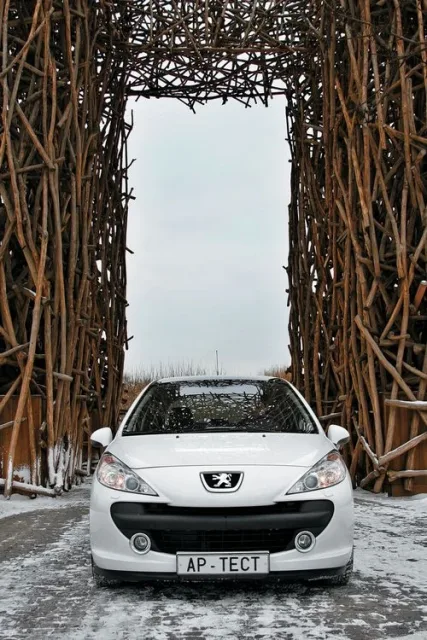
Of course, the Peugeot 207 has grown compared to its predecessor — the "206" — by as much as 200 mm! It also gained in width — 68 mm, and became more expensive: it starts at $15,590. And what about this wide grin of the huge radiator grille? Just a spit in the face of competitors!
Is that so? As soon as the Peugeot 207 reached Russia, we immediately organized a comparative test. The main rival is the new generation Opel Corsa: it has also grown! The tiny Toyota Yaris already won in one of the previous comparisons and will now defend the honor of the Japanese school. And the Ford Fiesta has until now been considered the benchmark of a well-tuned chassis in the B-class. Will it manage to retain this title this time?
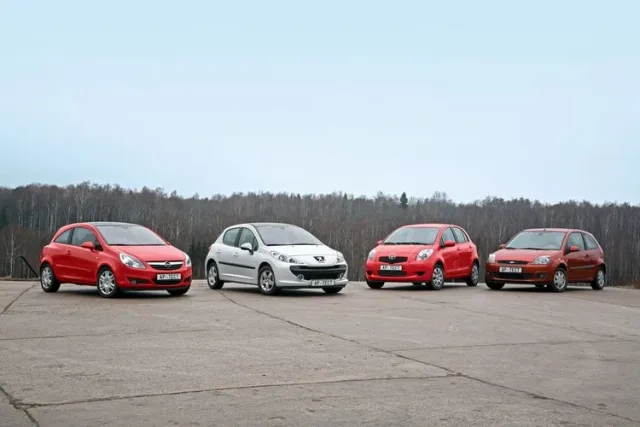
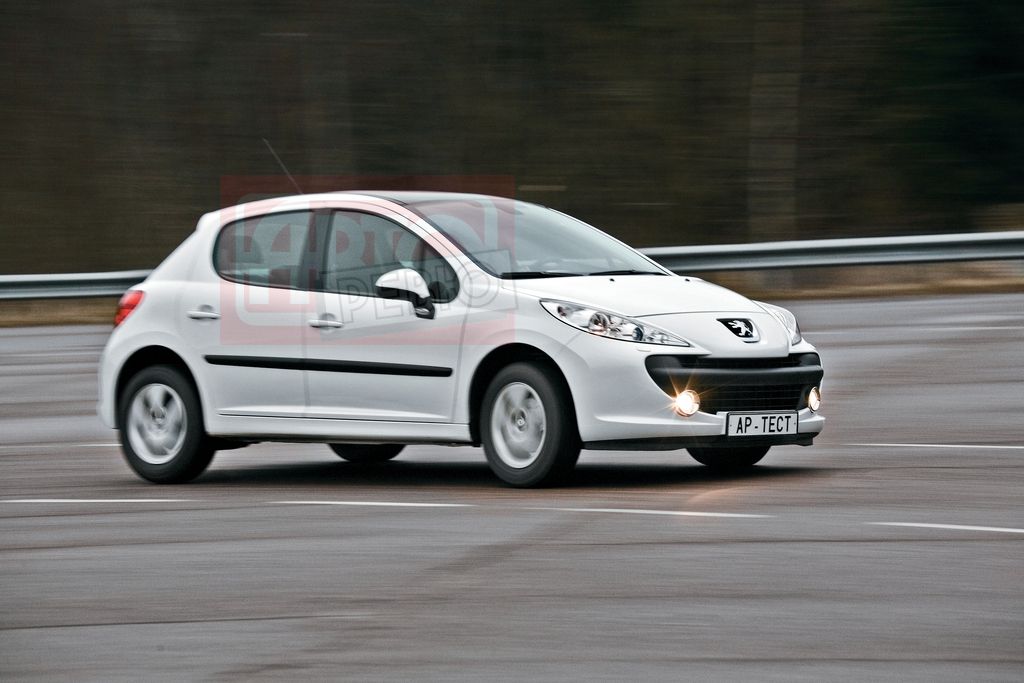
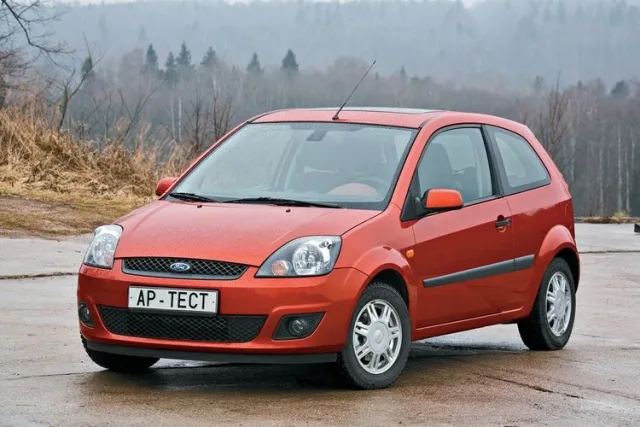
Even despite the increase in mass, the Peugeot 207 remains a model of style and elegance. The plump body, wheel arches with seemingly chiseled cheekbones, a huge mouth with a "Maranello grin" and a chrome lion emblem on the convex nose — all this is surprisingly harmoniously integrated into an impressive composition, emphasized by squinted headlights stretching almost to the windshield. True, we got the Peugeot 207 in the most expensive trim, and in simpler cars the front end looks more modest.
 |
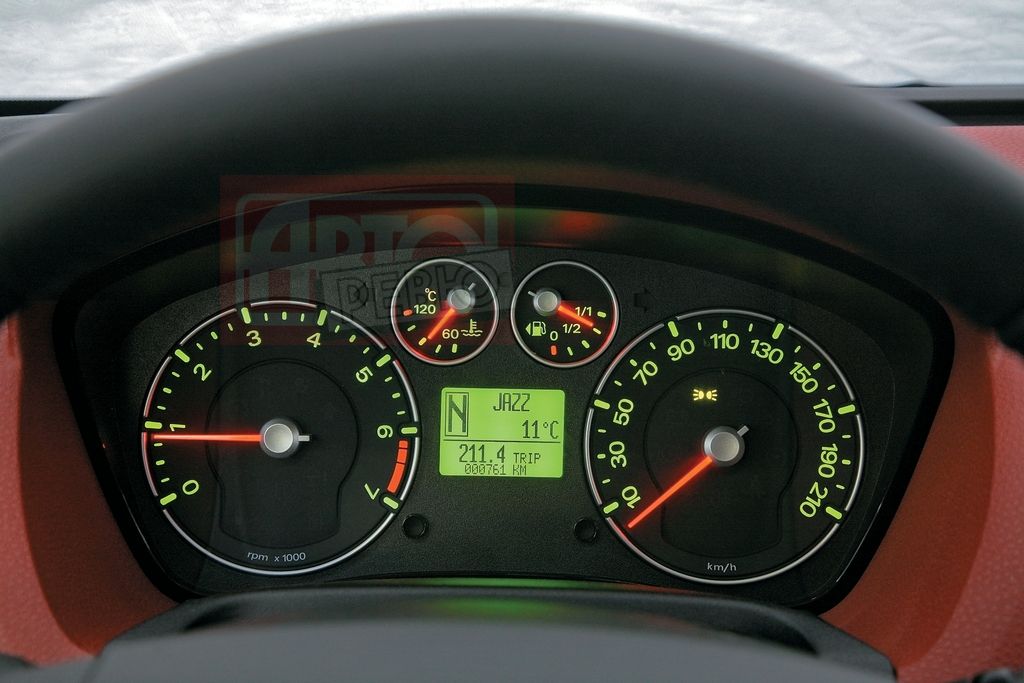 |
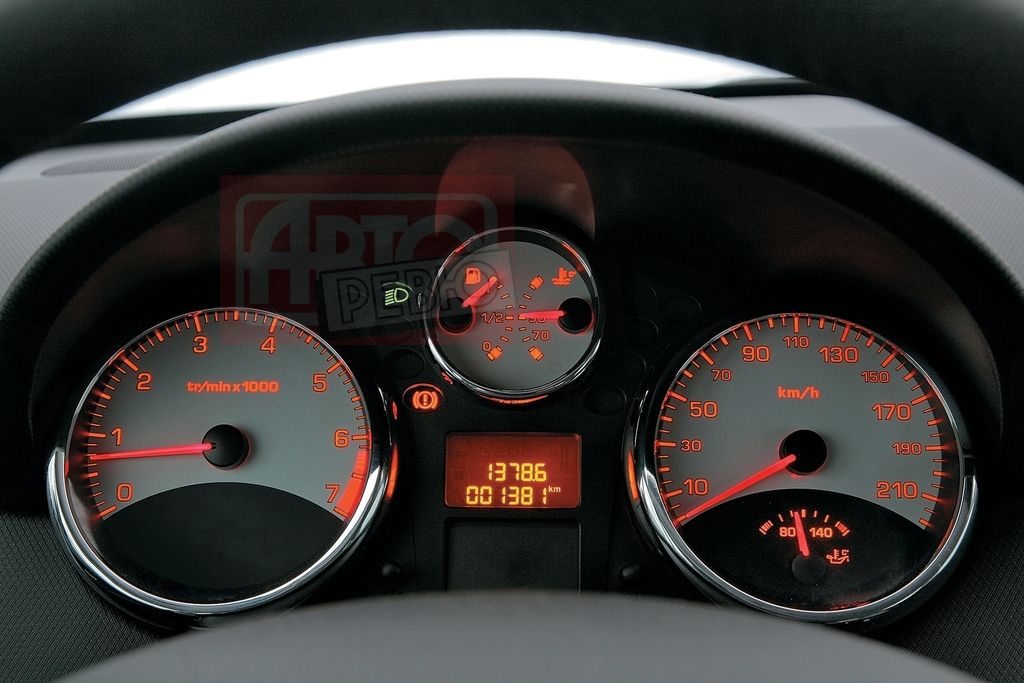
| Red numbers on white scales and an oil temperature gauge — a feature of the Peugeot 207 in the Sport version | Simple and clear Ford scales. A quick glance is enough — and everything is clear |
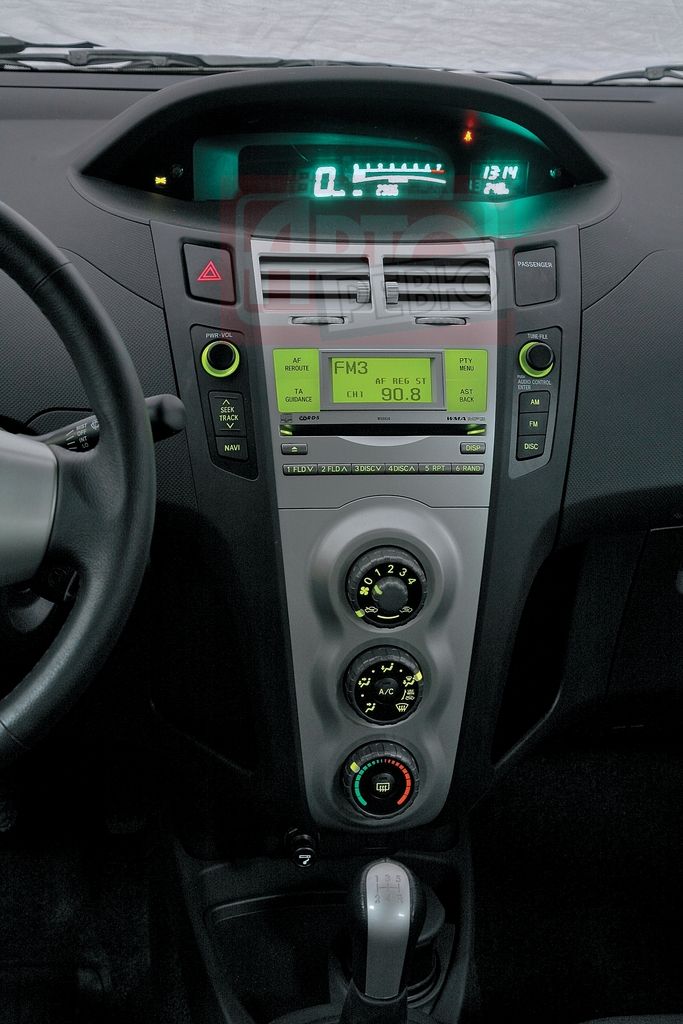
| Three easily readable scales are quite enough for Opel | A display from a seventies computer? No, this is the Yaris instrument panel |
Against the backdrop of French elegance, even the winner of our autumn beauty contest — the Corsa — fades. And the laconic Fiesta and the blunt-faced Yaris, with all their charm, look even more modest…
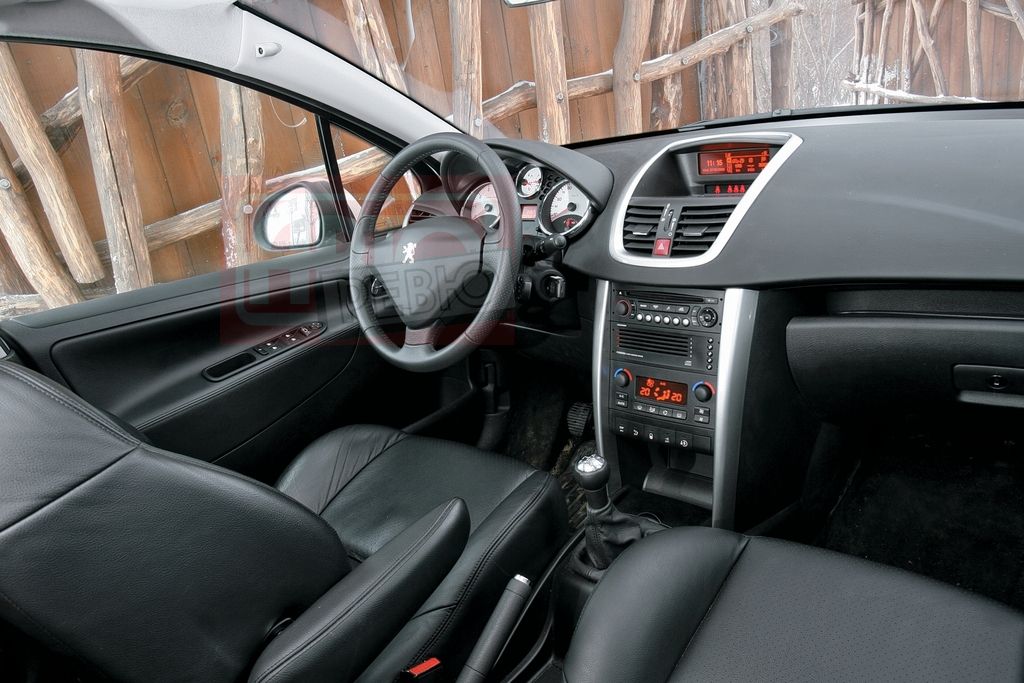
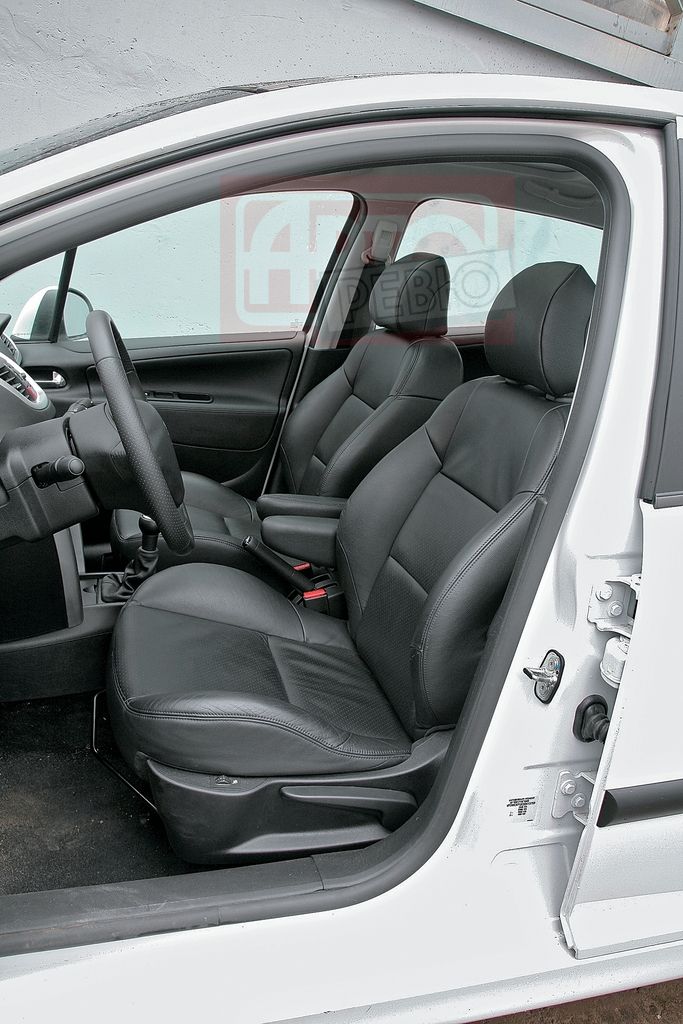
Inside, the Peugeot has noticeably matured. The solid elegance of the smooth curves of the front panel is backed by high-quality finishing. Soft, expensive plastic with a mesh texture perfectly combines with "aluminum-carbon" trims on the console and vents, inserts of the finest leather on the doors, and magnificent white instrument scales in a chrome frame. Wide seats with reliable embrace, soft buttons and knobs… The pedals and gear lever are delightfully "lightweight".
 |
 |
| Peugeot 207: excellent ergonomics, French design and almost German build quality. However, the vent surrounds glare in the glass, and the mirrors are set too far back |
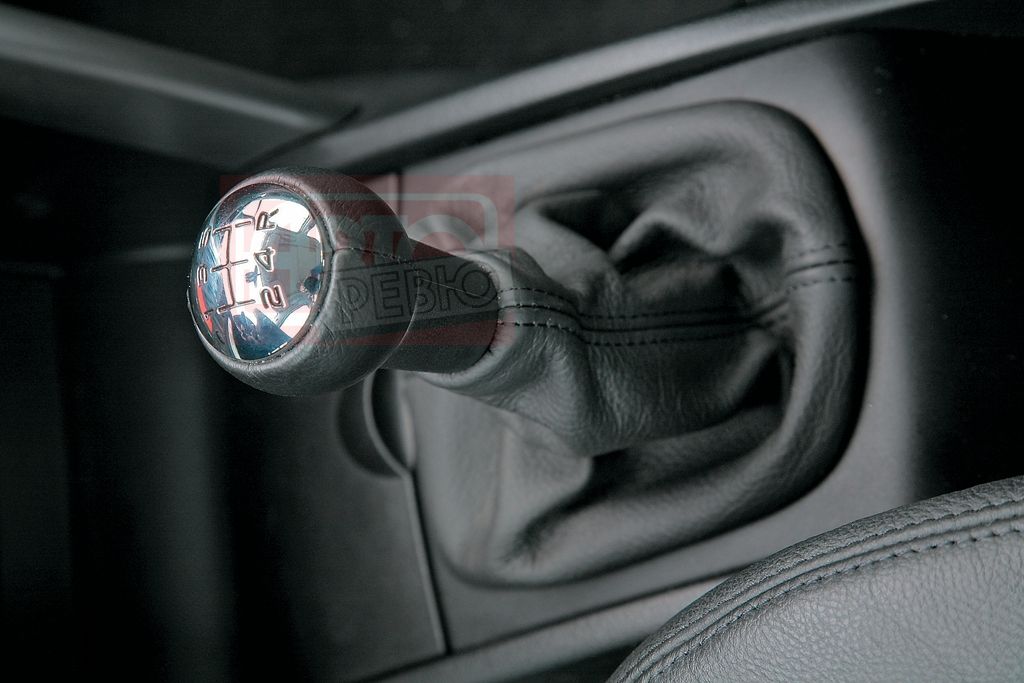
The lever has a long throw, but the effort is minimal. Gears engage clearly |
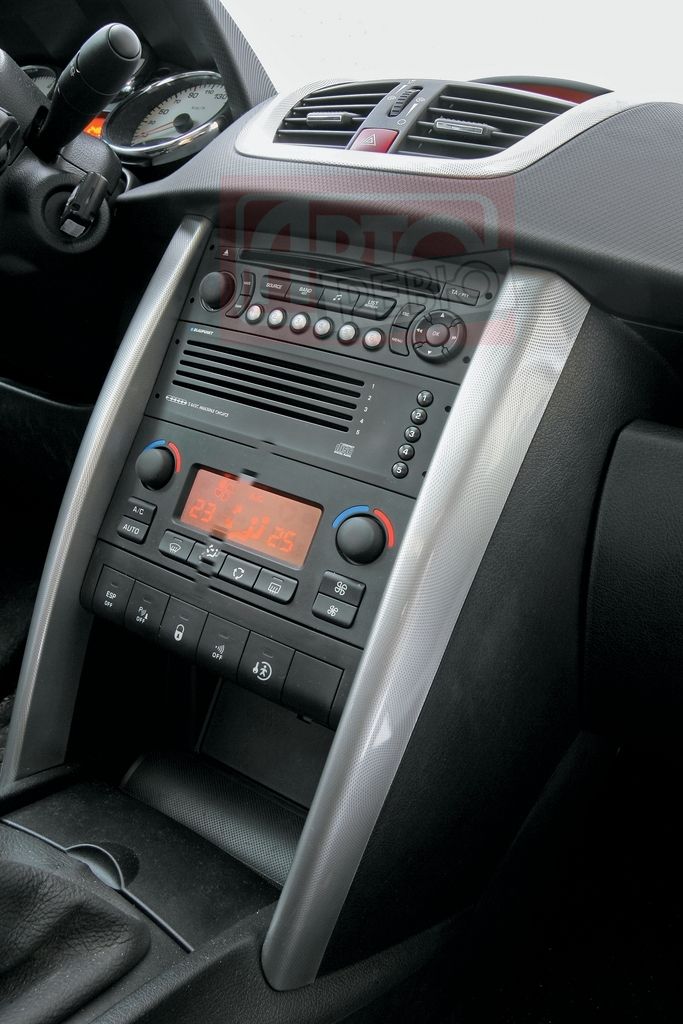
Three moments spoil the impeccable ergonomics. For lovers of a sporty seating position, the low-set steering wheel blocks part of the instrument readings. The air distribution modes of the dual-zone (!) climate control are inconvenient to cycle through with a single button. And the power window control unit is set far back.
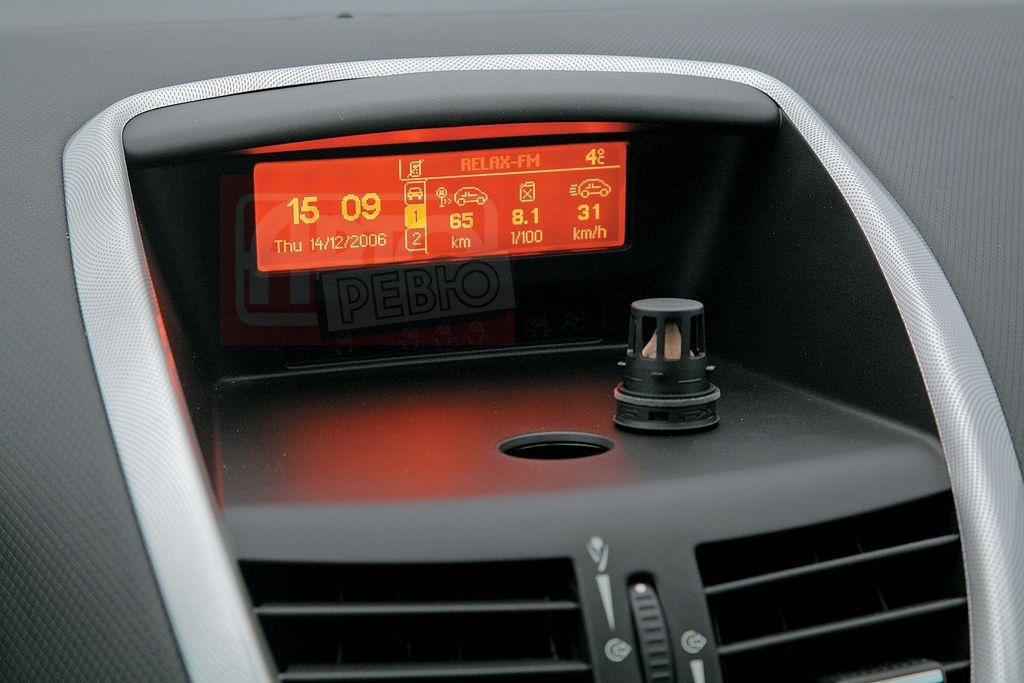
But there is a built-in air freshener here! The French…
 |
 |
|
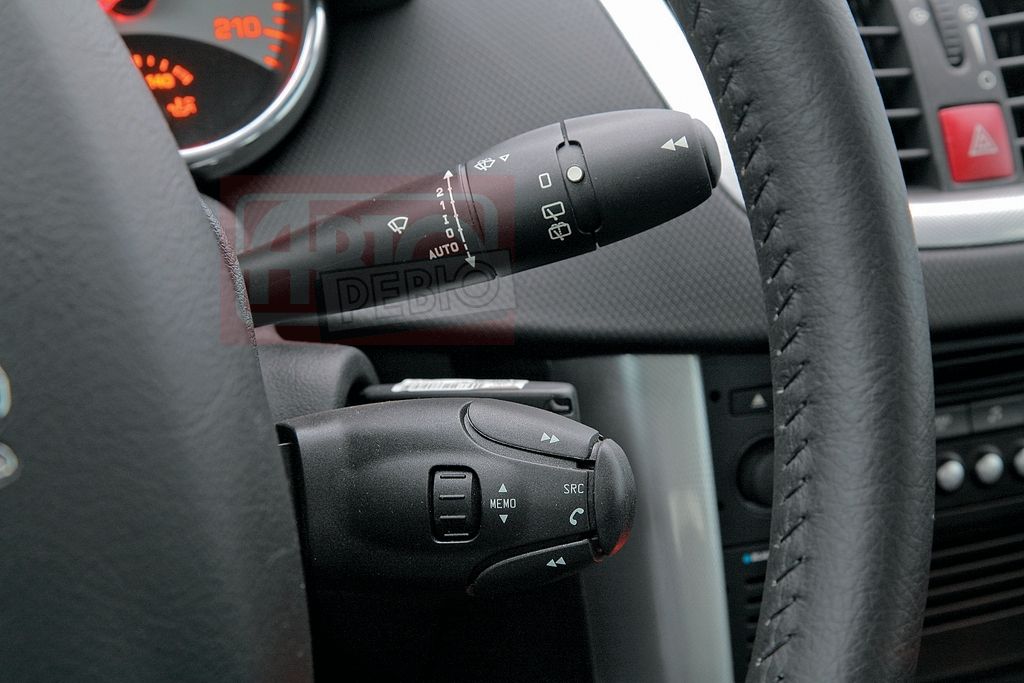
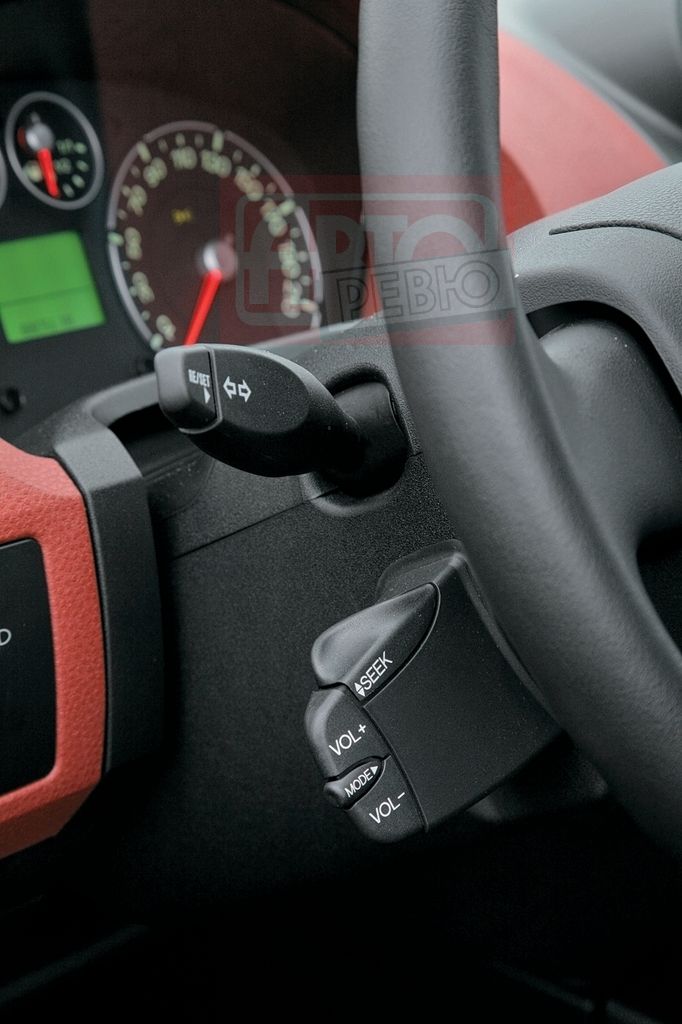
| The turn signal repeaters are not made in the current fashion — they are not in the mirror housings, but built into the brackets | Air freshener — for an extra 1,700 rubles. | The steering column "music remote" is convenient |
The Corsa is also good inside: a striking interior with large vent nozzles, beautiful instruments, and excellent seats. But the Peugeot is more beautiful! Also, the effort on the steering wheel, pedals, and gear lever of the Corsa is much higher than in the "Frenchman" — there is no such airiness. However, Opel offers more convenient climate control: three rotary knobs and symbols "popping up" on the informative display allow you to instantly set the desired mode.
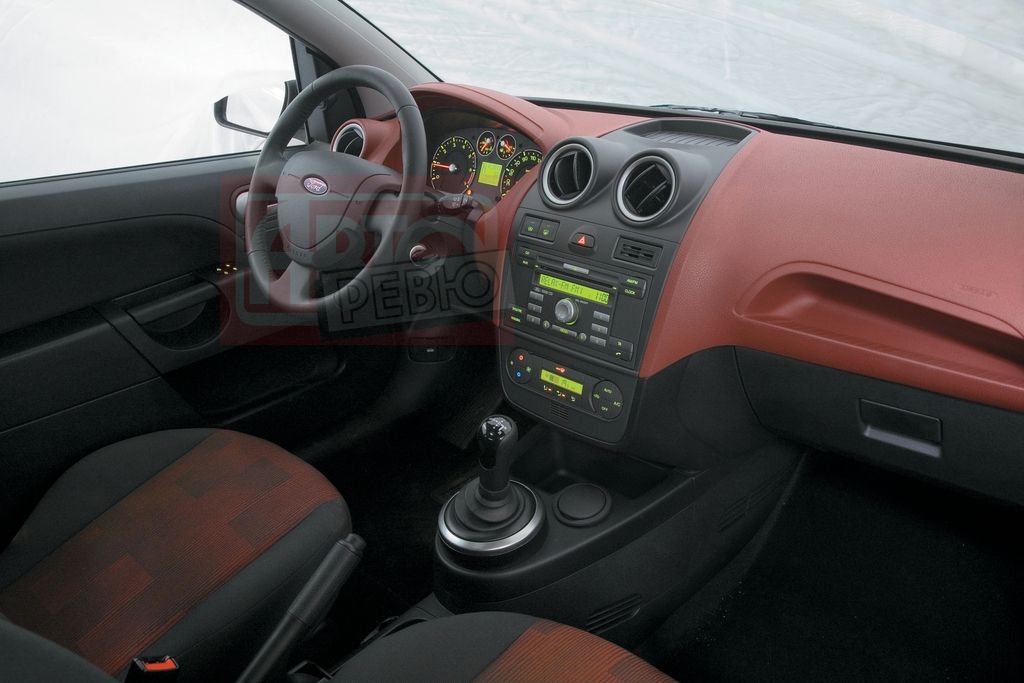
The less refined Fiesta is also pleasant. Ford-style understandable buttons, convenient, clear instrument scales, and a well-proportioned steering wheel please no less than the two-tone front panel with powerful ventilation ducts. The ergonomics are simply exemplary, even despite the fact that the steering wheel adjusts only for height.
 |
 |
 |
| Dual-zone climate control and a CD-changer raise the price of an already expensive car by $875 |
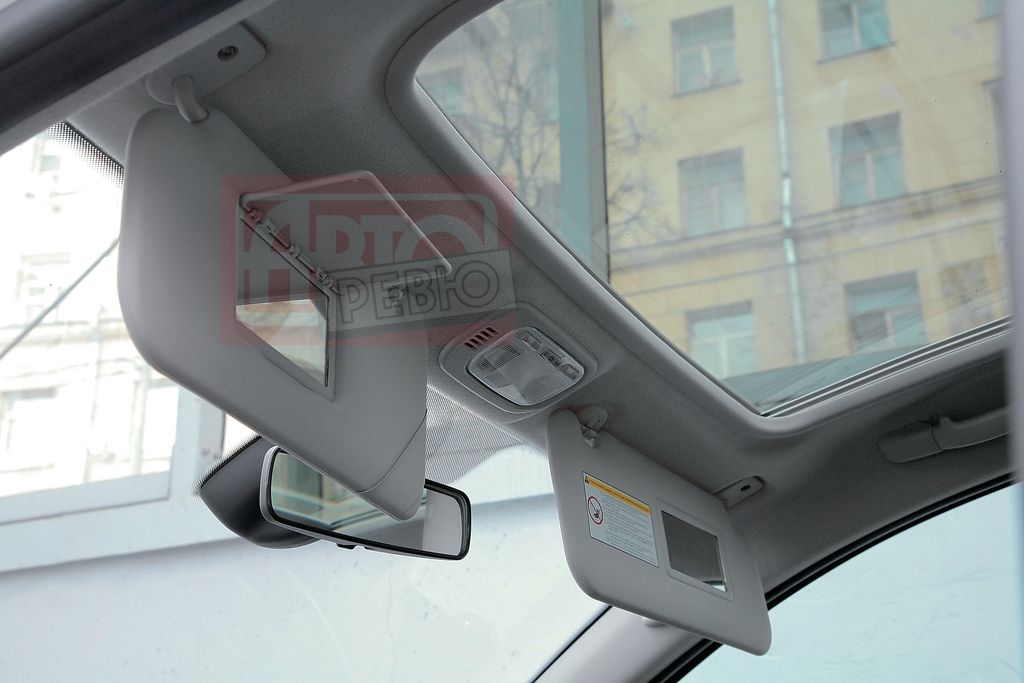
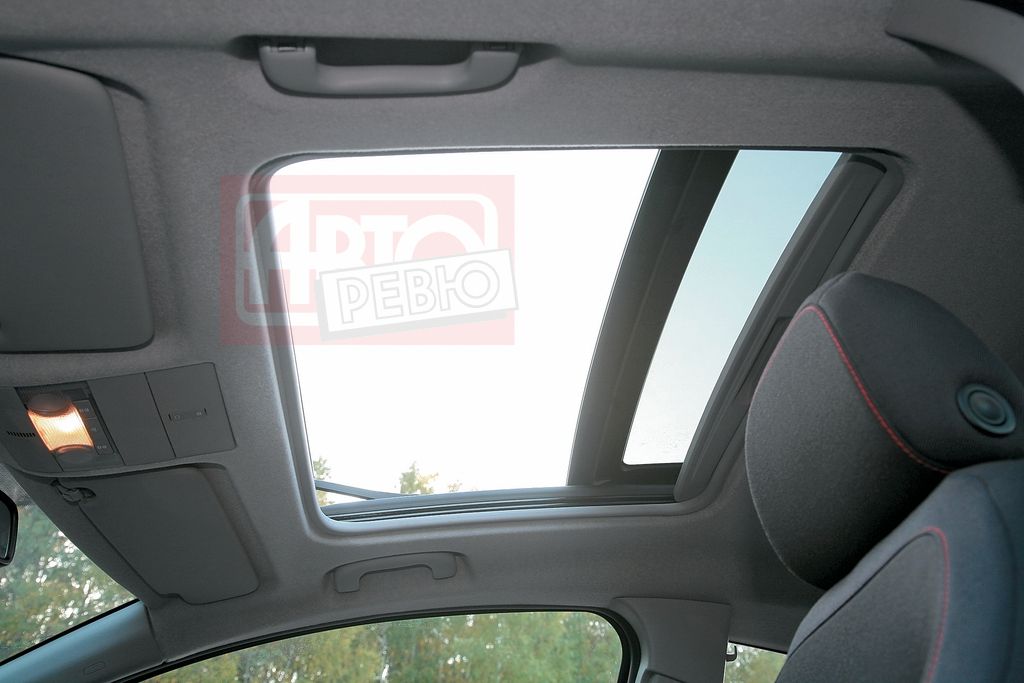
Mirrors in the sun visors are "basic", and the glass roof is an extra $700 |
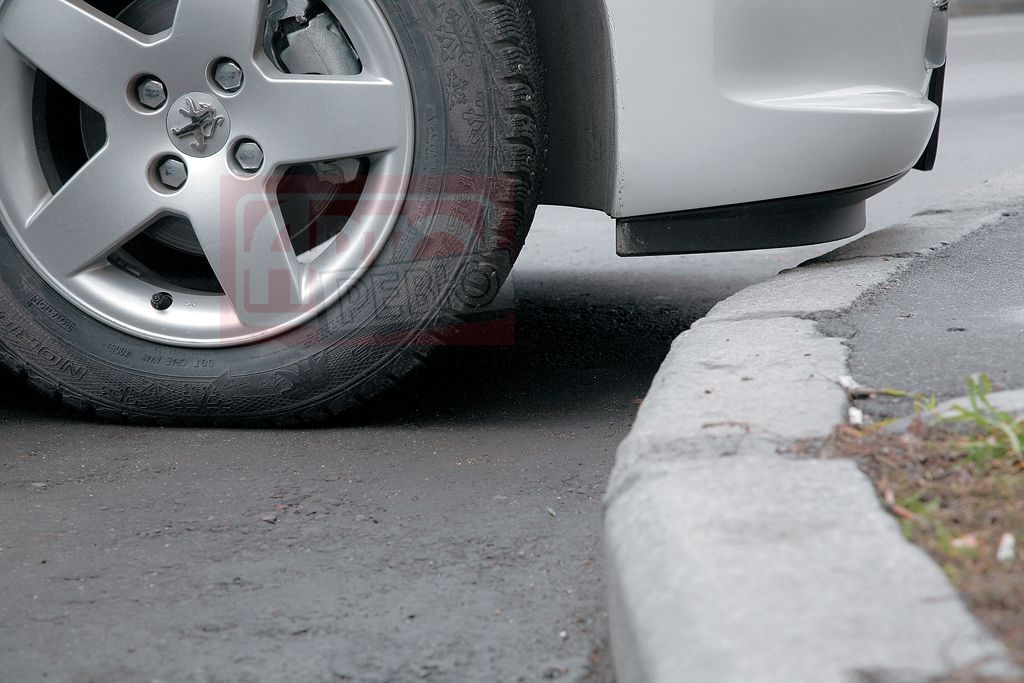
The front bumper needs protection: ground clearance is small |
 |
 |
 |
| The seats have developed lateral support and an excellent profile |
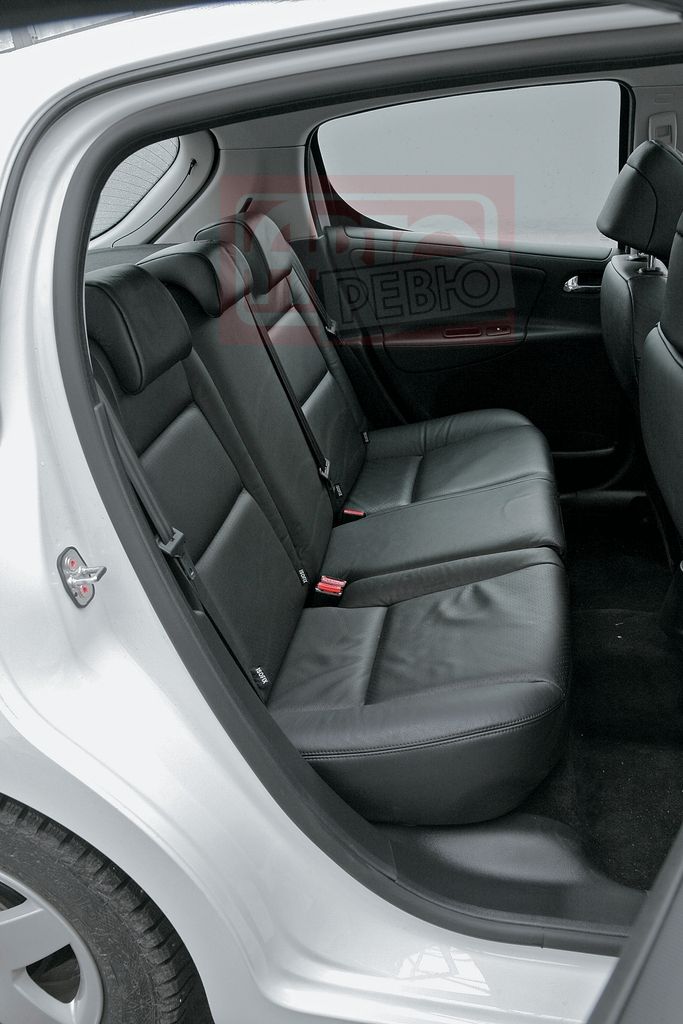
In the back of the Peugeot 207 it is very cramped | The Peugeot playfully steers with elastokinematics, remaining completely under the driver's control. Such a chassis needs a more powerful engine — about one and a half to two times more… |
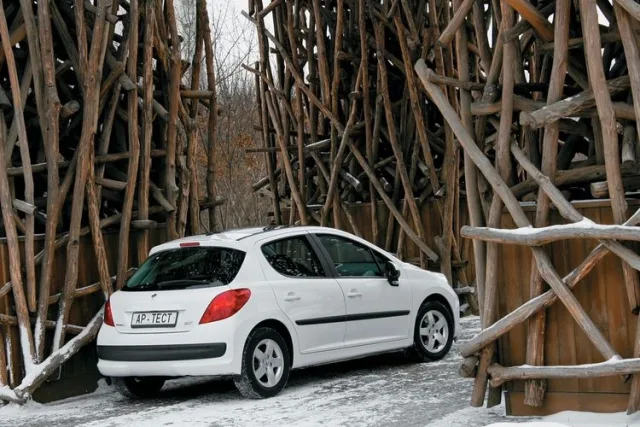
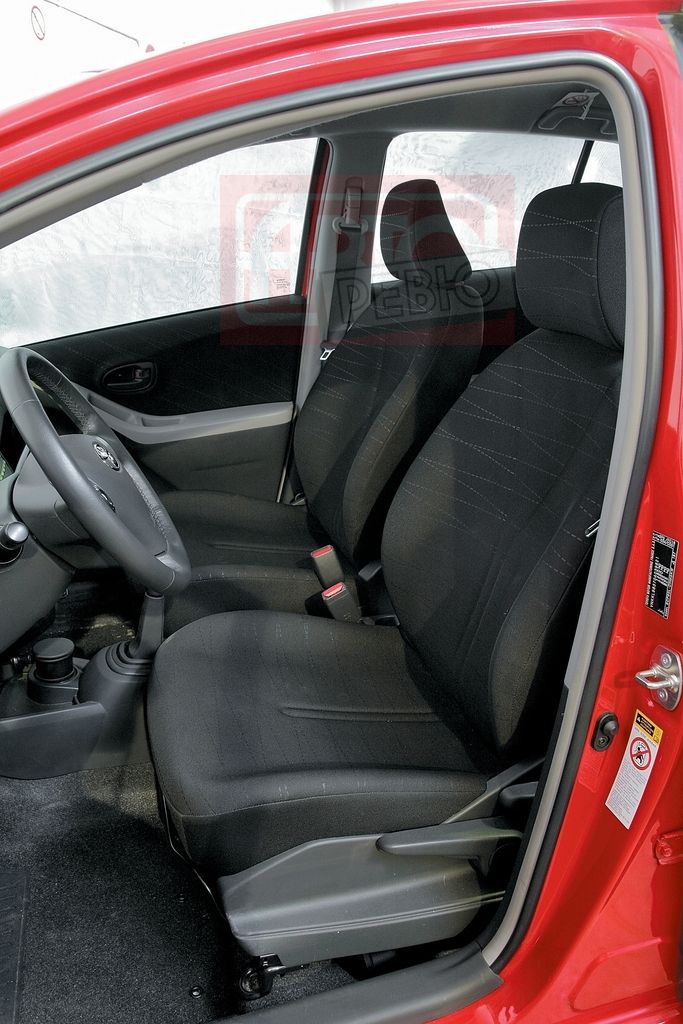
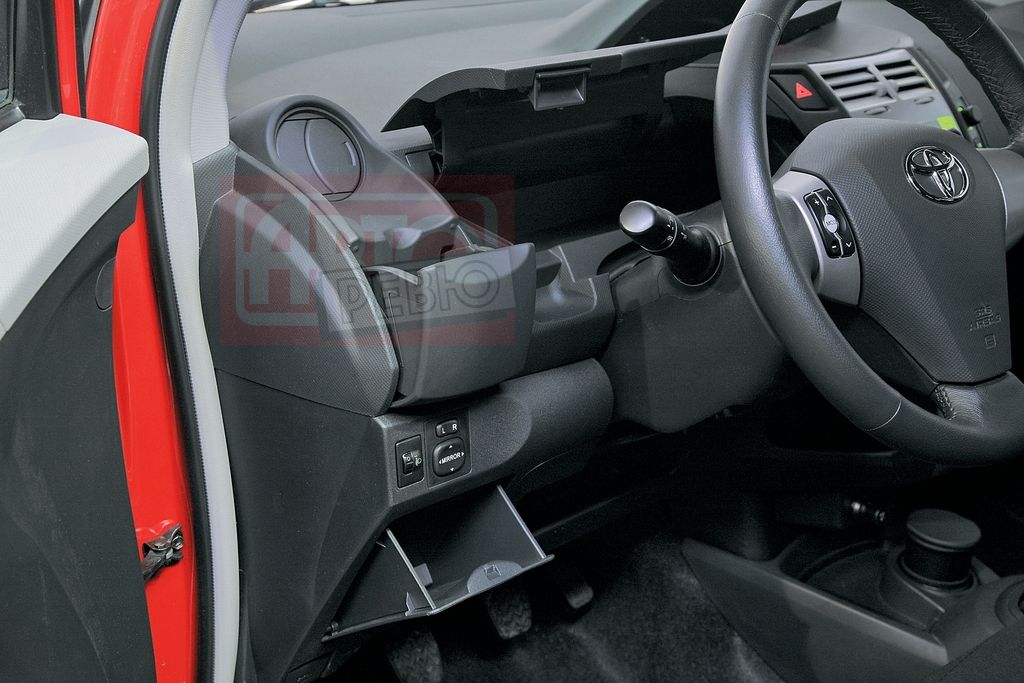
And the Toyota against the background of the "Europeans" looks like a toy, especially in the base Terra version. Here the materials are simpler than in the Yaris Sol version we tried in spring: a bare block of gray plastic in front of your eyes will please few. Only the "traffic light" console with pockets on the sides lifts the mood. But what practicality! There are countless glove boxes, pockets, and recesses — it's time to keep a warehouse inventory to know what lies where. The instruments fell victim to the designers — only the speedometer reads normally. The seat is comfortable, slides far back, the pedals are light, and the steering wheel is not bad.
And the engine…
The engines of all four cars are from 1.3 to 1.4 liters. The gearboxes are manual. Except that the Fiesta is equipped with a robotic version of Durashift EST: there are only two pedals here, and the clutch and gear shifting are handled by electronics with hydraulics. All cars were shod with winter studded tires. But since the roads of the Dmitrov test site were free of snow and ice, we still decided to conduct a series of measurements. And it turned out that…
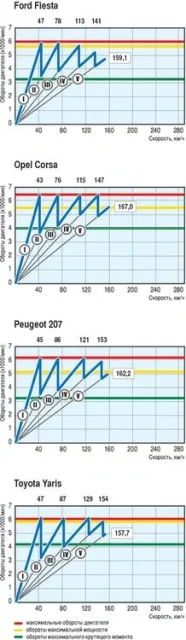
The fastest acceleration is the Opel Corsa — thanks to the closely spaced gears in the gearbox. The second gear only revs up to 76 km/h, the third — up to 115 km/h. But the engine pulls confidently only at speeds above 4000 rpm, so you can be quick only by revving it to the limiter. Also disappointing are the gas pedal, which is as springy as a tennis ball, and the vague gear shift mechanism.
Meanwhile, the feeling of dynamics is given to the driver not so much by the seconds of real acceleration to a hundred, but by how the car "follows the pedal", how predictable its acceleration is. And here the Peugeot 207 is beyond competition.
 |
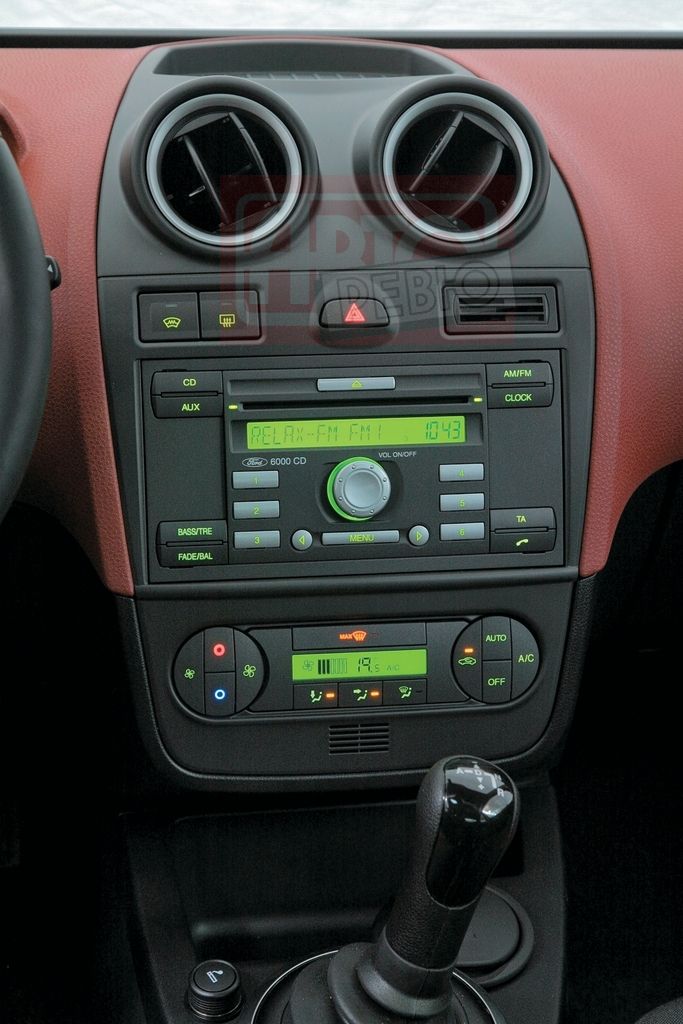 |
| Ford's "music" control is not as convenient as the Peugeot's |
The effort on the gas pedal and the engine's responses allow you to accurately predict at any moment how the car will start accelerating. The gearbox works without complaints, and the engine itself is not bad, although it truly comes alive only after the 3500 rpm mark. Overall, managing the thrust of the "207" is a real pleasure. True, according to our measurements, the Peugeot accelerates to a hundred almost two seconds slower than the Corsa — it is the slowest of this quartet.
In terms of numbers, the Yaris takes second place after the Corsa, but its acceleration is more pleasant to manage. Light gas and clutch pedals combined with a torquey engine that pulls evenly from 1,500 rpm make it ideal for city driving. Even the long gears don't annoy (you can reach almost 90 km/h in second). However, the driving thrill that the Peugeot offers is not provided by the little Toyota. Perhaps it doesn't need it.
 |
|
| The strict interior of the Fiesta is enlivened by terracotta plastic matching the body color | A sunroof with manual drive is a rarity in a modern car. But it's inexpensive — only $350 |
 |
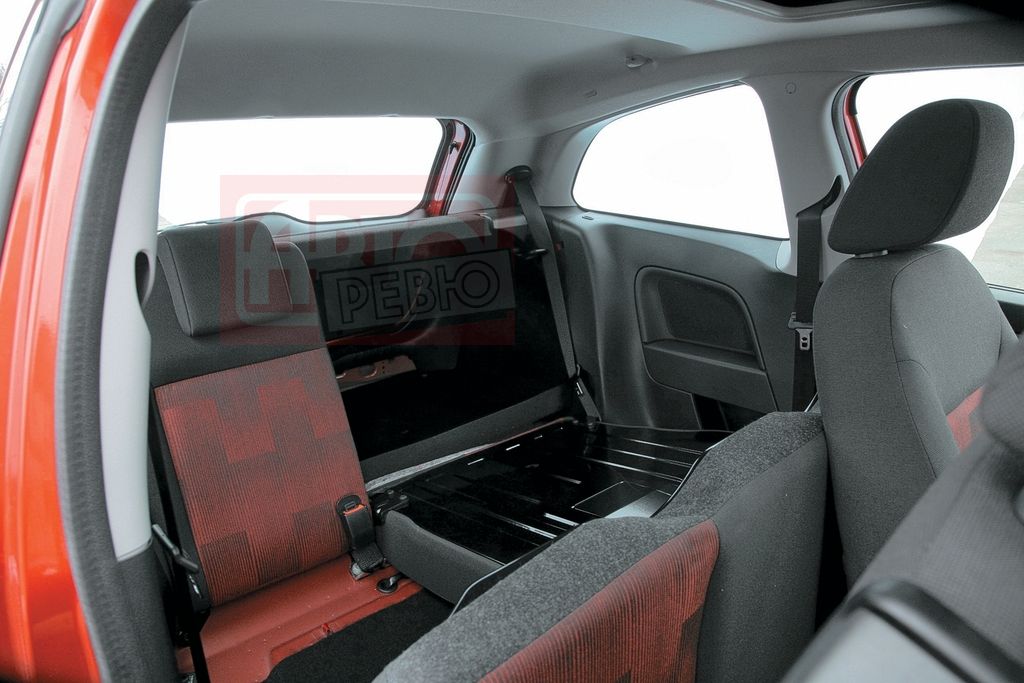 |
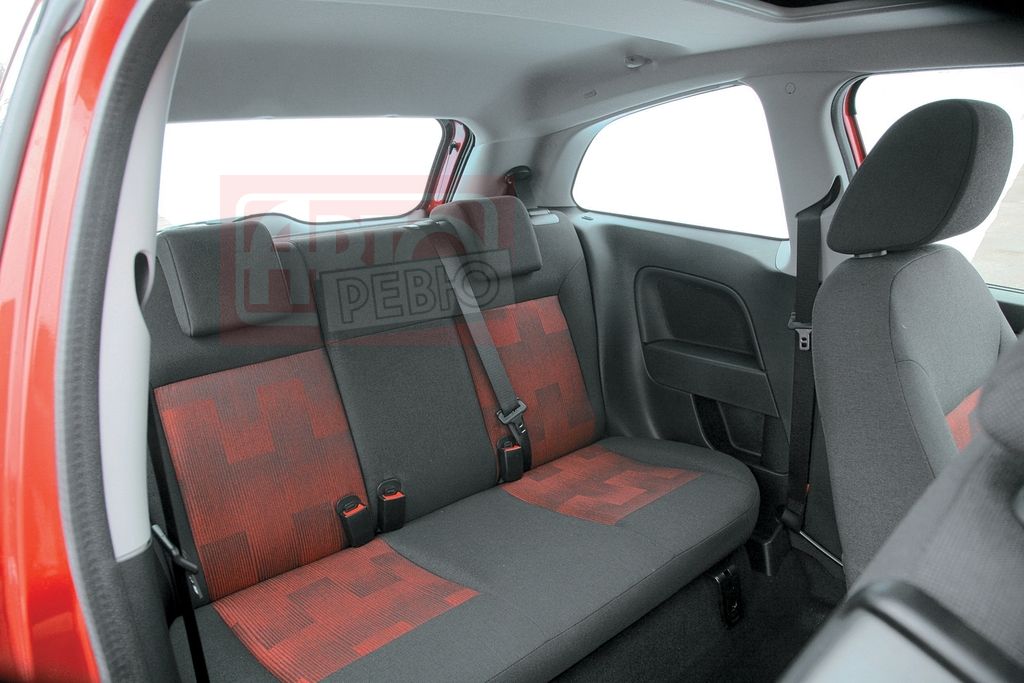
| Sitting on the flat rear bench is uncomfortable. And on the ceiling — only clothes hooks |
The split rear seatback locks open with awkward handles, and the cushion is entirely one-piece |
In our measurements, the Fiesta took third place. The gears are well chosen, but the engine lacks power. Nevertheless, it pulls evenly across the entire rev range. And what about the automated manual transmission? It gives the car slight jerks during shifts, especially on upshifts. However, delays in response to the gas pedal are minimal, and shifts are easy to predict. So this "robot" is one of the best. By the way, the other three cars can also be equipped with automated manuals, but it's better to choose a classic torque-converter automatic.
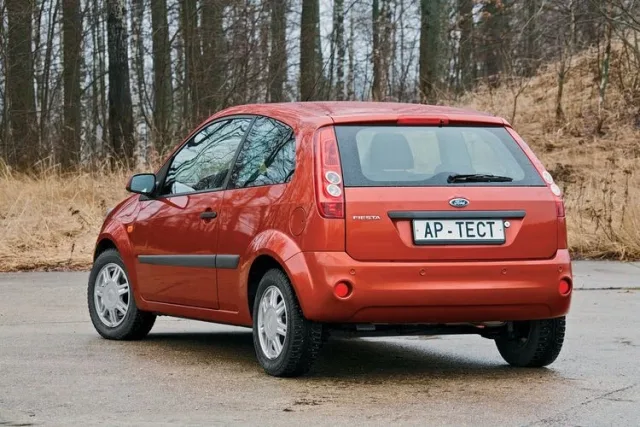
The braking test results were heavily influenced by winter tires: compared to summer tests, the stopping distance from 100 km/h increased by about 20 meters for all cars. At the same time, the Peugeot and Ford were on latest-generation tires — Nokian Hakkapeliitta 5 and Gislaved Nord Frost 5, respectively — which are noticeably more effective on asphalt than their predecessors. Judge for yourself: the Corsa and Yaris on the previous-generation Nokian Hakkapeliitta 4 stop from 100 km/h 5–9 meters later. The difference is huge.
In terms of brake system tuning and ABS operation, the Peugeot 207 looks best — simply magnificent! The Yaris has no problems either, but the same refinement is not felt. During normal braking, the pedal effort in the Fiesta increases faster than deceleration — you lack confidence in the car, although in an emergency situation everything is fine.
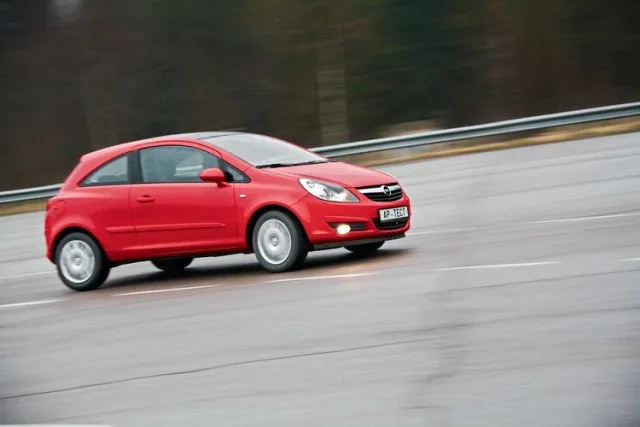
The Corsa reacts too eagerly to turns of the "light" steering wheel, constantly threatening to slide into oversteer
The Corsa is the worst. The pedal is overly sensitive, and during emergency braking with ABS, you feel pulsation of deceleration and longitudinal pitching.
A talented car is talented in everything... That's about the Peugeot 207. Managing the throttle is pleasant, the brakes are ideal. And the chassis is superbly tuned!
| Ford Fiesta | Opel Corsa |
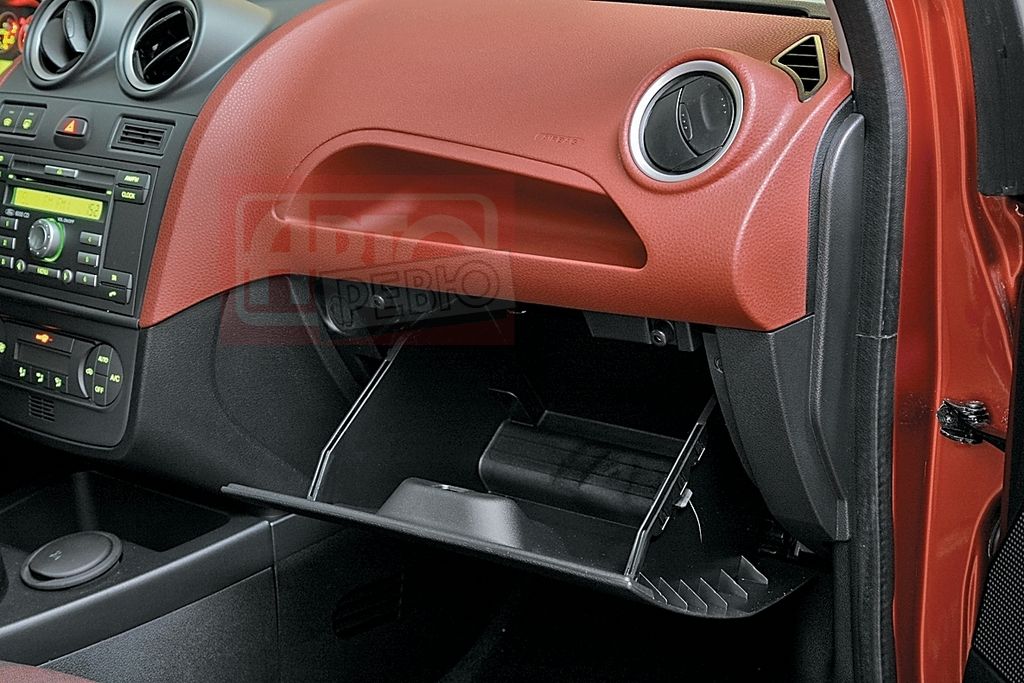 |
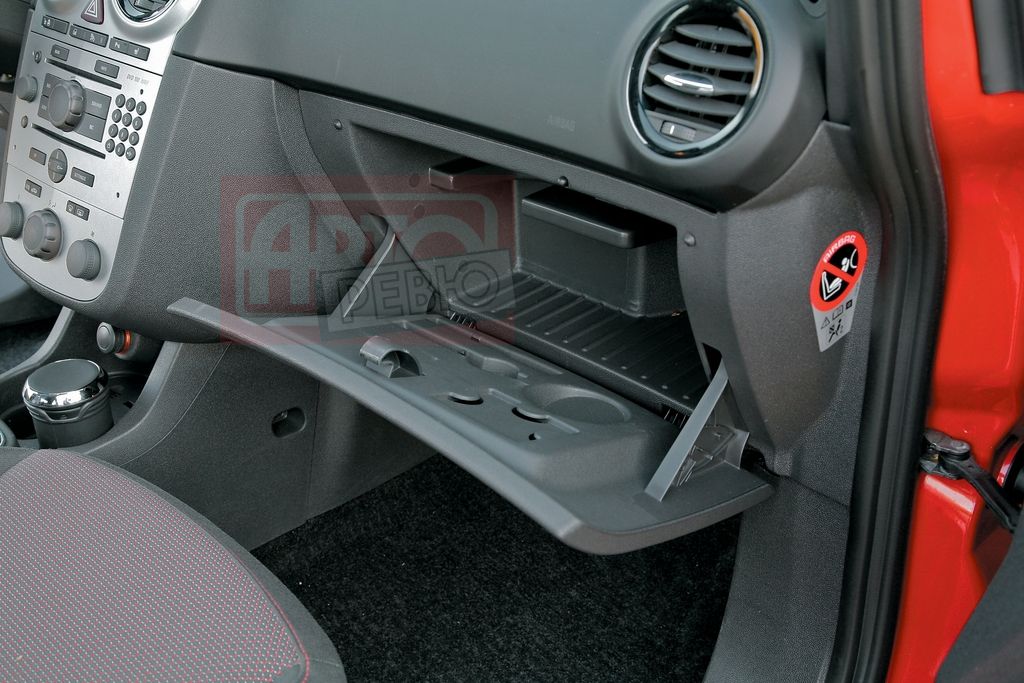 |
| Peugeot 207 | Toyota Yaris |
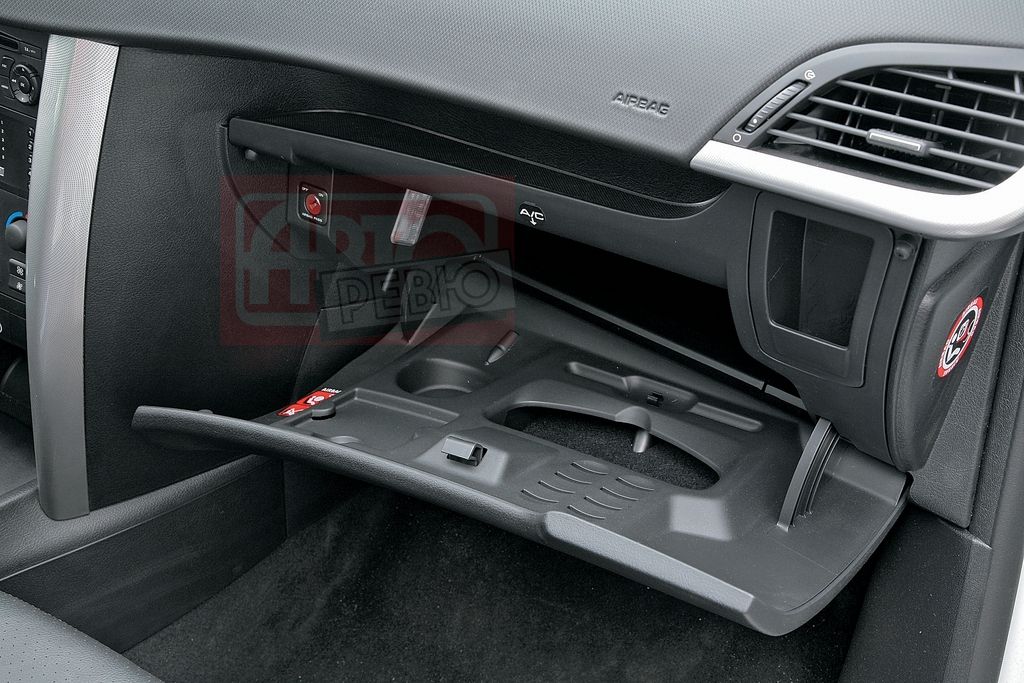 |
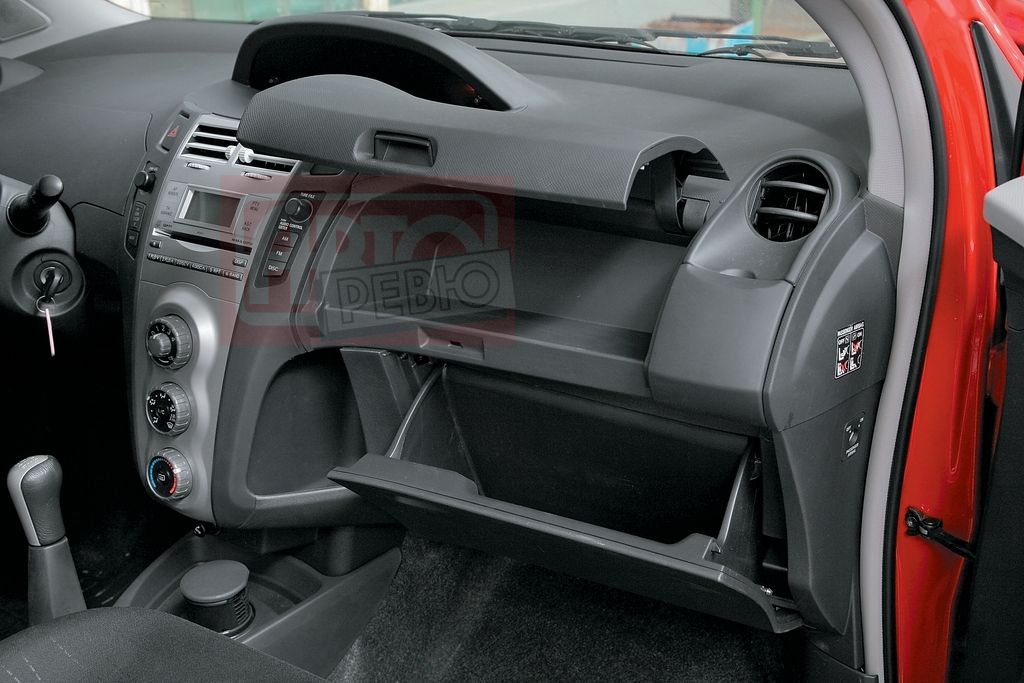 |
| The Peugeot has the most multifunctional glovebox: it has cooling, a passenger airbag switch, and a holder for a notepad and pen. The Fiesta has the largest compartment. The Corsa has a cupholder on the lid and a "clip" for a pen. And in the Yaris, there are countless small cubbies | |
The electric power steering is one of the best: in parking lots, the wheel is weightless, and as speed increases, it fills with pleasant heaviness, allowing you to hold the chosen course flawlessly. Moreover, in the city, you constantly feel a slightly increased effort on the wheel, like in true "driver's" cars. And on a winding country road, the Peugeot lives up to expectations: how easily it dives into corners! The steering effect of the rear suspension's elastokinematics, amplified by the large slip angles of winter tires, is noticeable, but it only makes corner entry easier. A slight oversteer? No problem — a light correction with the steering wheel and throttle is enough. And if needed, ESP will help. Magical handling.
The Fiesta is also sporty "by definition." It is straightforward and honest, like Rambo, agile and nimble, like Lara Croft. Unshakable on straights and instantly responsive to steering inputs, which may seem a bit heavy for ladies but is extremely informative. It traces arcs as if by a template — whether it's a gentle highway curve or a steep serpentine. And only in response to outright provocation will the Fiesta respond with a smooth slide.
In short, if the Fiesta had ESP, which is available only as an option and only on the top 1.6 Ghia version, then the Ford and Peugeot would receive equal handling scores. As it is, the difference is 5 points.
The Yaris does not provide the same feedback and precision of reactions as the Peugeot and Ford. Yes, in the city, the Toyota handles simply and understandably, and on the highway it confidently holds its course, deviating slightly only in gusts of wind. But the steering wheel feels "empty," reactions are sluggish, and when exceeding speed in a corner, the Toyota goes into a somewhat sharp oversteer. Moreover, stability control is not offered even as an option.
 |
 |
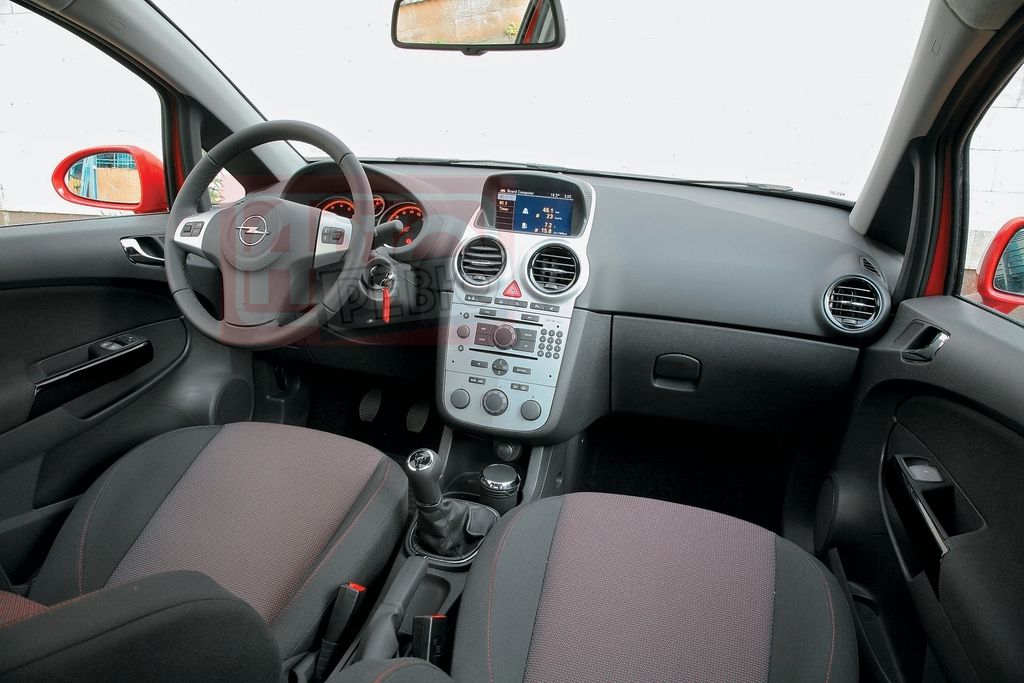
| The interior of the new Corsa is very striking. It's a pity that the silver "trim" reflects in the windshield |
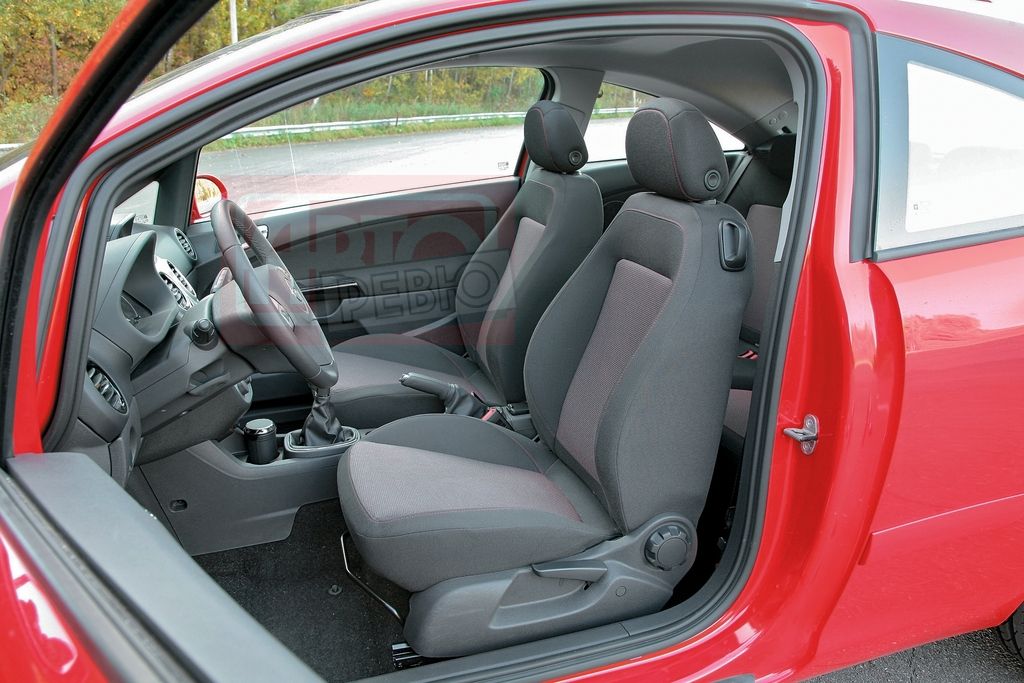
The fabric seats of the Corsa with stepless backrest adjustment hold you firmly in corners |
 |
 |
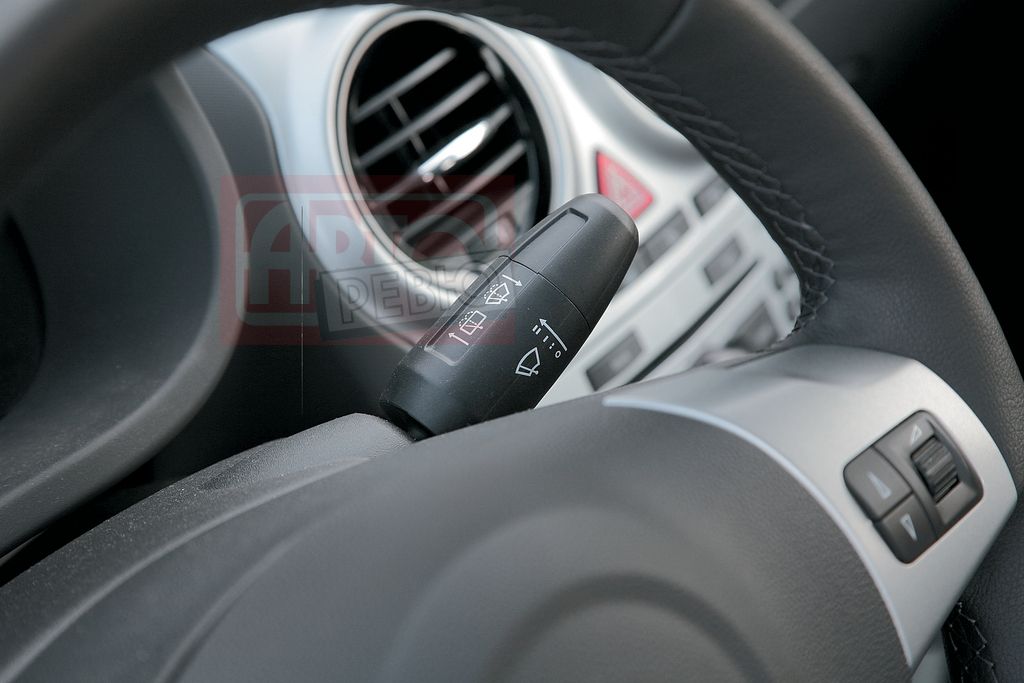
| The non-latching wiper lever is uninformative |
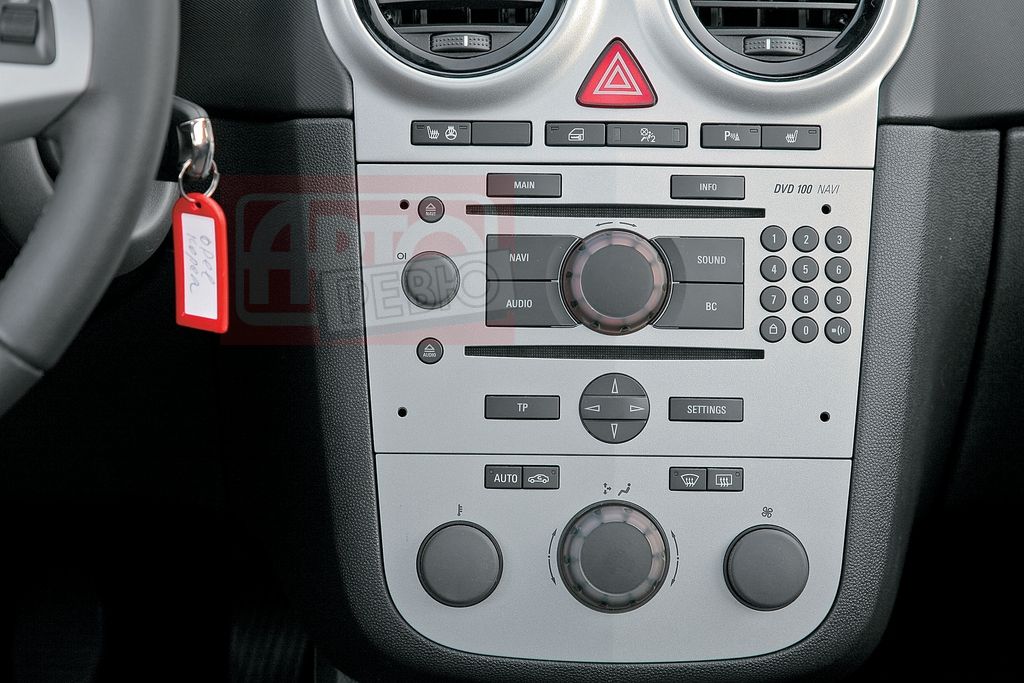
The Corsa has the most convenient climate control and trip computer controls |
We didn't like the Corsa 1.4 on studded tires — on summer tires, it handled much more reliably. On uneven straights, the Opel "floats" — apparently, this is the flip side of its high sensitivity to the slightest steering wheel deviations. The effort on the wheel feels "artificial": on a high-speed straight, the wheel is "stiff," but in sharp corners and transitional modes, it "empties out." Additionally, the Corsa constantly tries to "wag its tail" — its tendency to oversteer is high. But experienced drivers are helped by its lively response to throttle: press the pedal — and the front-wheel drive will help pull the car out. Inexperienced drivers can only rely on choosing the right speed — or on optional ESP, for which you have to pay an extra $390.
The Opel also doesn't shine with a high level of ride comfort: the Corsa manages to find pavement waves where they never existed.
The Fiesta's ride comfort is completely different: instead of measured rocking on waves, it meticulously repeats every asphalt imperfection. It shakes considerably! The sporty nature of the suspension is also revealed by its rally-grade durability: you can fly over our broken roads without particularly choosing a trajectory.
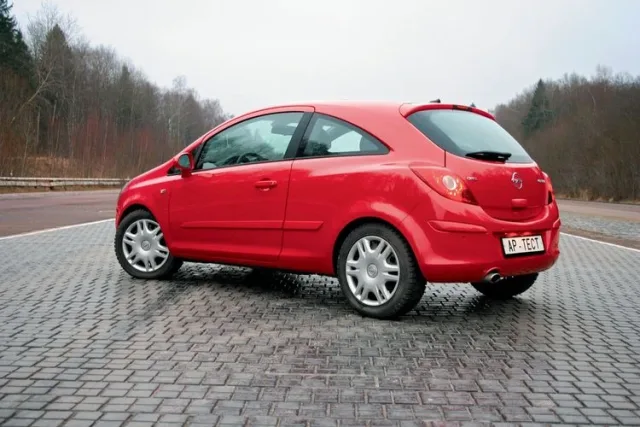
The Peugeot 207's chassis is also tuned in a sporty manner. At low speeds, up to 40 km/h, potholes respond with noticeable jolts. And sometimes you hear a specific squeak: French plastic, even of good quality, still doesn't match "German craftsmanship." But there's no rocking like in the Opel at all. And how nobly and quietly the Peugeot swallows potholes at speed, gently swaying on asphalt waves!
But the Toyota Yaris is beyond competition. The Japanese little one completely ignores potholes and ditches — at least until their size approaches a third of the wheel. Only rough asphalt and short waves cause unpleasant vibration. However, the Toyota Camry behaves exactly the same, and it's three classes higher...
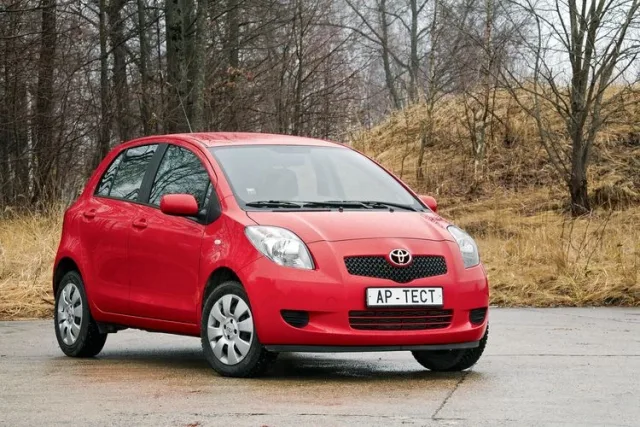
But with sound insulation, the Yaris has a problem. The ringing clatter of studs is joined by the roar of sand and pebbles hitting the underbody and wheel arches. Even the quiet engine doesn't save it. And yet, the Yaris Sol we tried in spring for $20,450 was a model of acoustic comfort.
Even the Fiesta with its weak sound insulation and clearly audible "metallic" body resonance doesn't press on the ears as much. Let the little engine scream hysterically when downshifting, let the studs clatter and the wind whistle — this is nothing compared to the cacophony in the Toyota.
 |
 |
|
| Simple trim materials do not match the price of the Yaris |
The seating position in the Toyota is "bus-like", with a high seat and a sloping steering wheel | The three "climate" knobs of the Yaris can be operated by touch |
 |
 |
|
| Space by B-class standards is simply royal! |
The gearbox is not particularly informative, but the gears engage easily |
There are so many compartments for small items that they deserve numbering |
The Corsa is even quieter. Even the suspension, which is not the best in terms of ride smoothness, operates absolutely silently.
And the quietest turned out to be the Peugeot 207. A French Mercedes! Even the studs' clatter is almost inaudible in the cabin — only the engine snarls after 4000 rpm.
So, does that make the Peugeot 207 the winner?
But let's first look at the rear seats and trunks, and then we'll render a verdict.
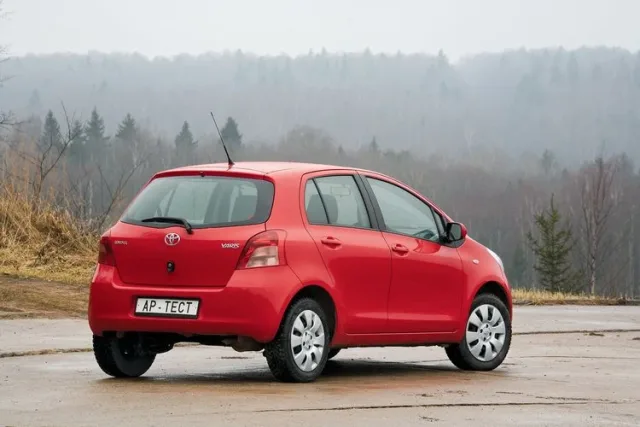
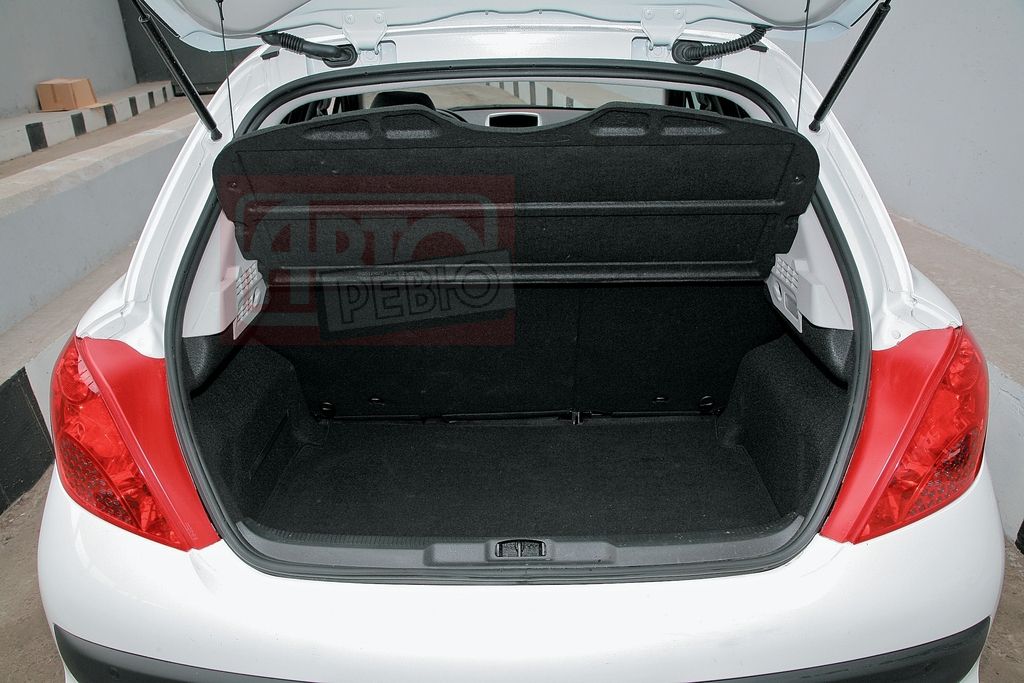
The Peugeot is the longest, just over four meters. But in the back, surprisingly, it's cramped! Knees press against the front seatback, and the head touches the ceiling. A layout miss? However, looking into the trunk, you understand: the Peugeot 207 was created for those who rarely carry rear passengers but often go to the supermarket. The cargo area is the most spacious: 310 liters. Plus good upholstery, flat walls, a large opening, and loops for securing large items.
| Peugeot 207 | ||
| Opel Corsa | ||
| For an extra 3000 rubles, the headlights of the top version of the Peugeot 207 can be equipped with additional side lighting lamps that activate when the steering wheel is turned 90°. A very useful option, especially when driving on unlit country roads and dark courtyards. For the Corsa, adaptive headlights are expensive (7900 rubles) and shine dimmer. But the German car can also turn the main beam up to 15° and activate side lamps in both headlights when reversing (photo on the left) | ||
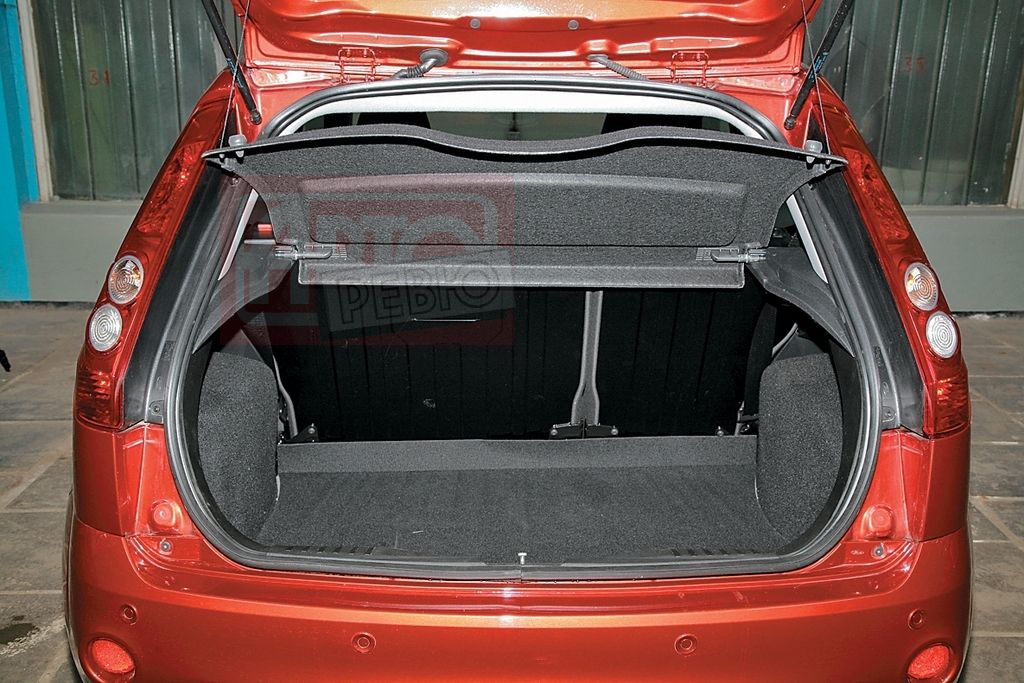
However, the Fiesta's trunk is not much smaller. And loading it is more convenient — the bumper is low and does not protrude. But the main thing is that three people can fit in the back seat without problems.
The Corsa also gives rear passengers enough space, but they will be comfortable only as two. And the modest trunk volume is not saved even by the double floor.
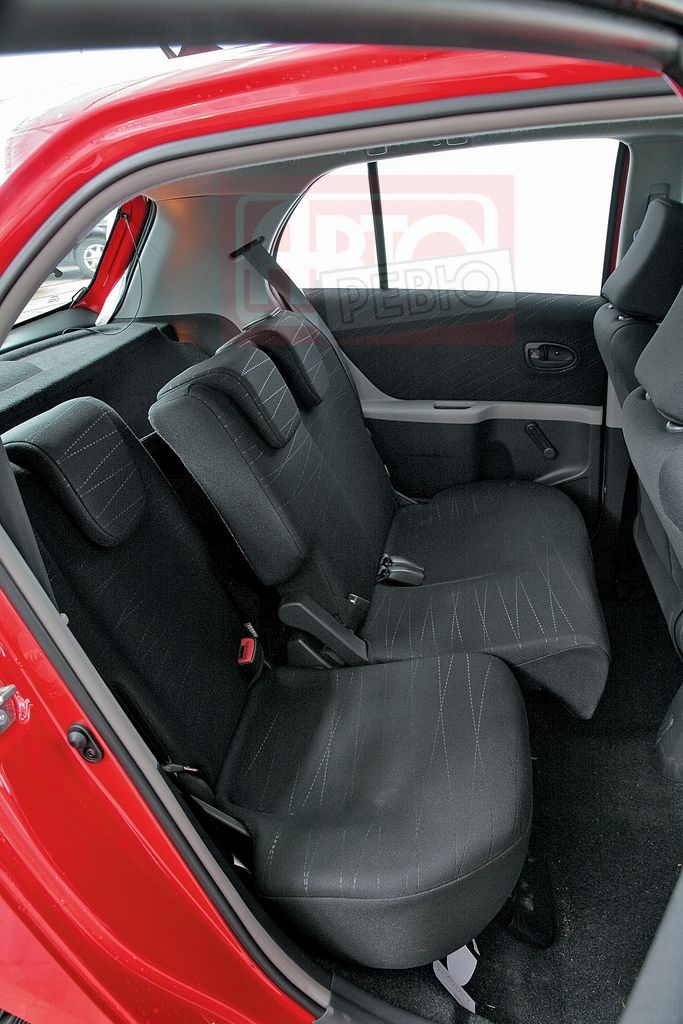
The Toyota Yaris is the shortest. But the rear seats can be slid forward and backward, and the backrest angle can be adjusted. Moreover, even in the "forward" position, there is more knee room in the back than in the Peugeot. And if you slide the sofa back, you sit as in a D-class car! It's clear that this is at the expense of the trunk. And the transformation possibilities here are the widest — thanks to the sliding seats. The other cars offer only a standard set of unequally split folding backrests.
 |
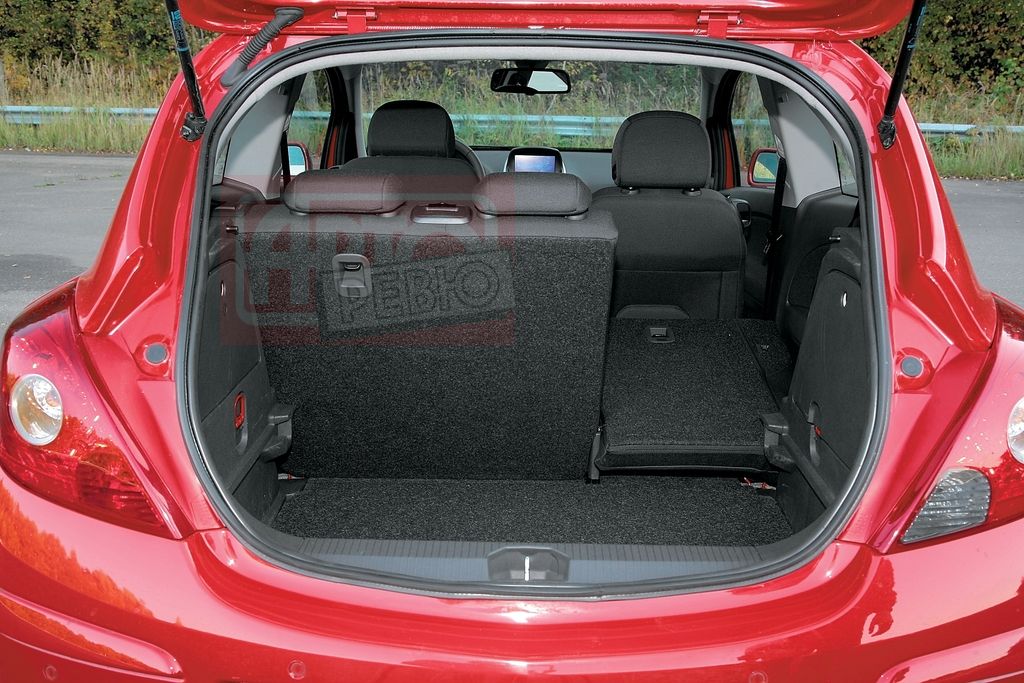 |
| A huge opening and a low bumper make loading the Fiesta easier | The neat Opel trunk with flat walls, cargo loops, and convenient transformation is inconvenient to load — the bumper gets in the way |
 |
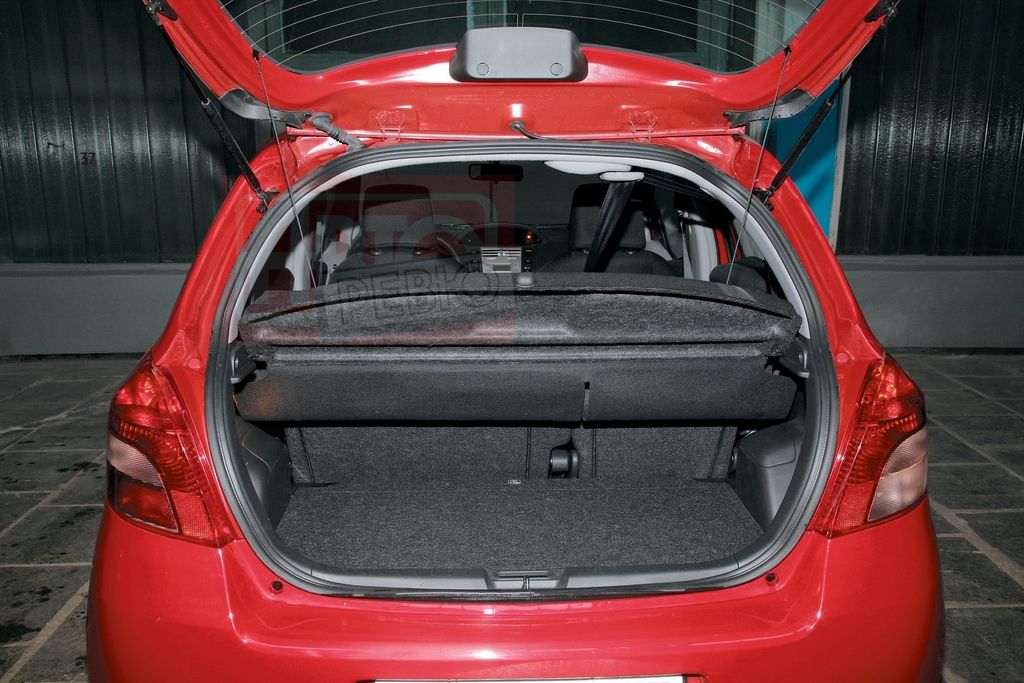 |
| The spacious cargo area of the Peugeot is as well thought out as that of the Opel. And loading is more convenient | Bulk and heavy bags cannot be lifted into the Yaris over the high bumper. And they wouldn't fit there anyway |
So, the Peugeot 207 won. And in all categories except cabin comfort. It wasn't for nothing that it opened its mouth wide!
True, nothing comes for free: the Peugeot 207 1.4 16V Sport costs from $19,510. And "our" "207th" with a bunch of options, including leather and a glass roof, costs almost $24,000. Expensive!
 |
 |
 |
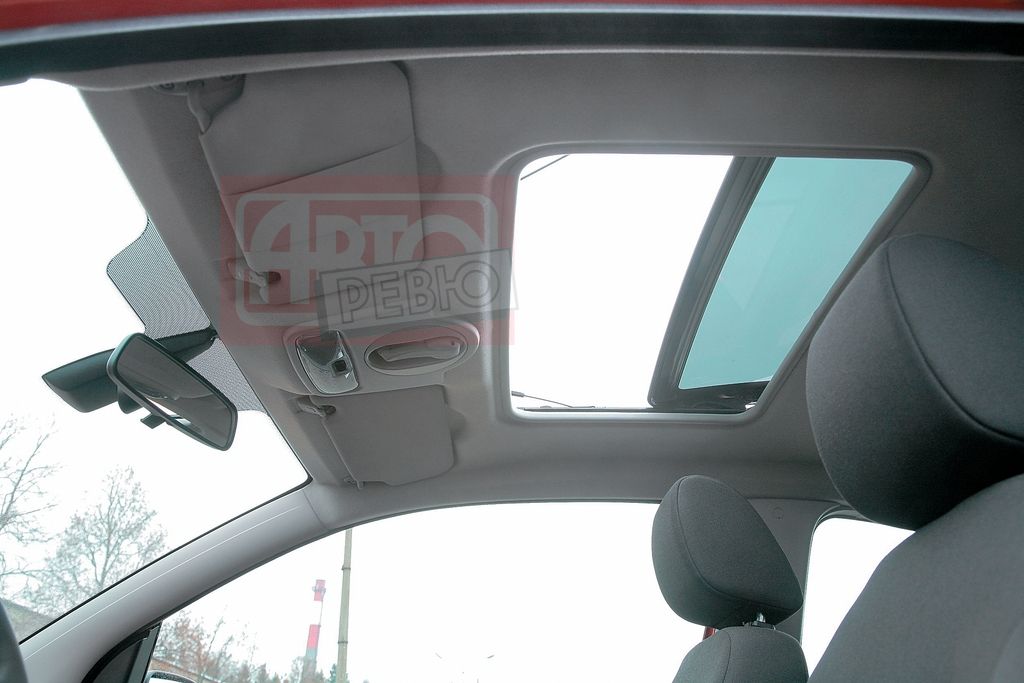
| "Our" Fiesta has a sunroof with a mechanical drive and no overhead handles.. |
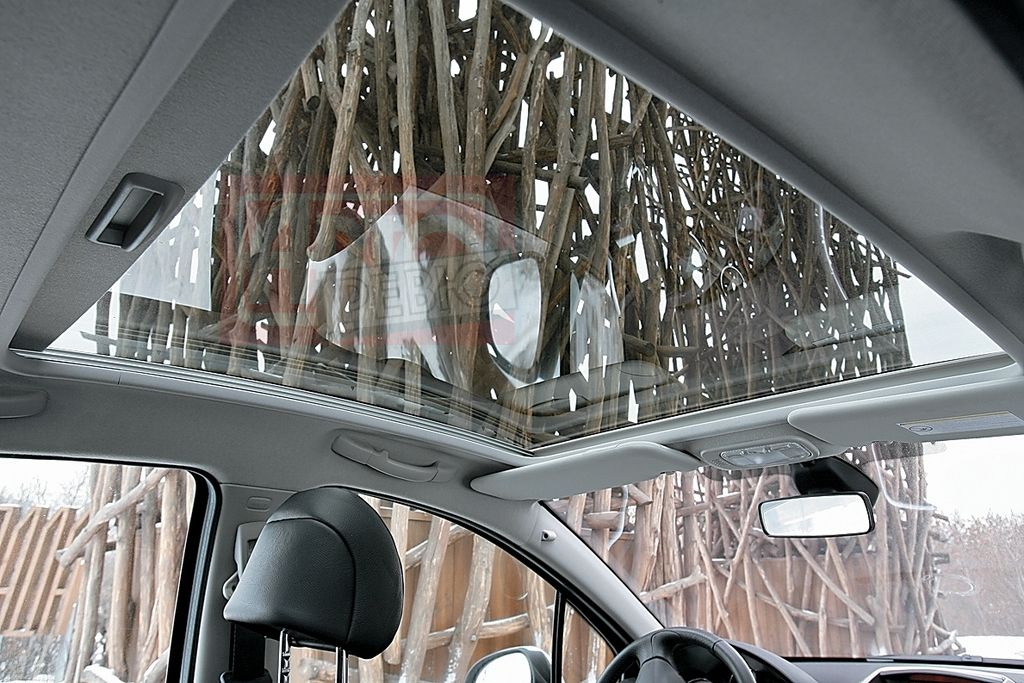
The large power sunroof in the Corsa is good only when parked — at speed it whistles mercilessly | And the best remedy for depression can be ordered for the Peugeot: $700 for a glass roof. None of these options can be ordered for the Yaris |
The Fiesta 1.4 confirmed its fighting character, also pleasing with a reasonable price: $12,590 for the base version will lift the mood of enthusiasts of active driving who are not spoiled by comfort.
The Toyota Yaris, with all its undeniable merits, disappoints with the poor acoustic comfort of the base Terra version. And although Toyota representatives assure that sound insulation is the same for all trim levels, we doubt this and would prefer to pay extra. But $20,450 for a Yaris Sol without a stability control system is too much. After all, for the same money, the Opel Corsa offers swivel headlights, a sunroof, parking sensors, and even a heated steering wheel. And it's better not to skimp on the stability system. And the Yaris doesn't have it at all.
 |
 |
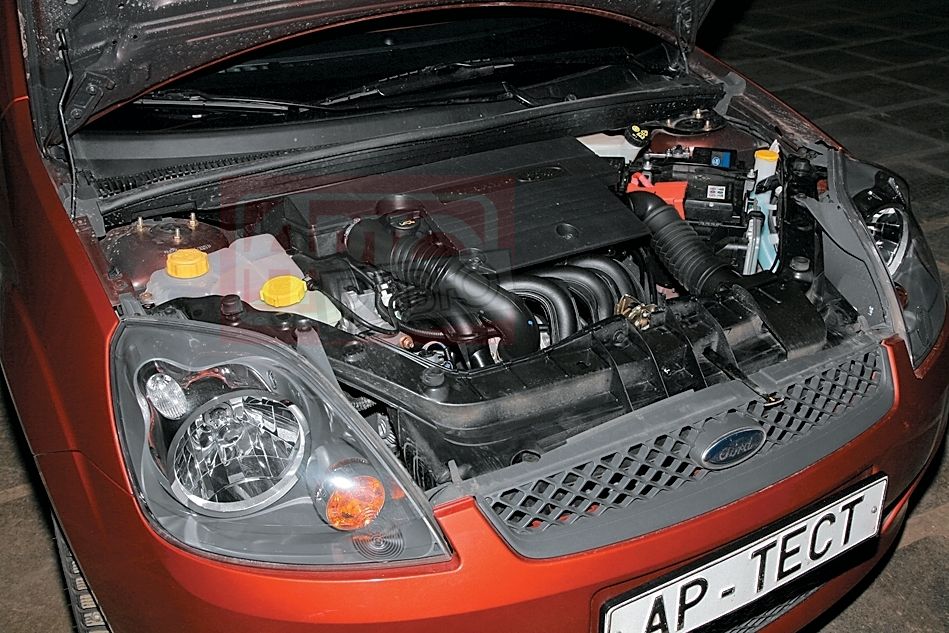
| Ford: the light Fiesta accelerates briskly with the 1.4-liter engine (80 hp). And there is also a 100-hp unit with a displacement of 1.6 liters! |
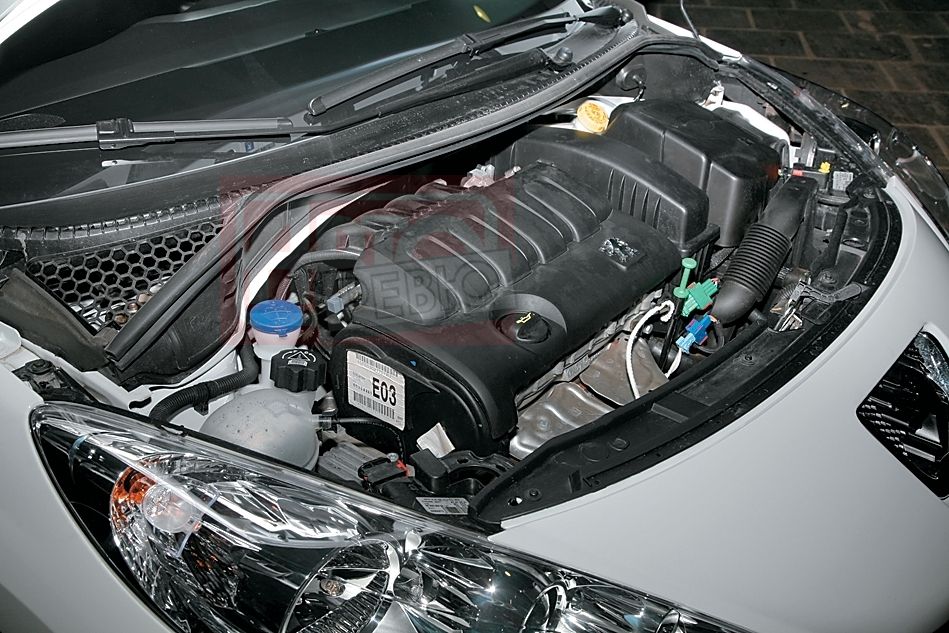
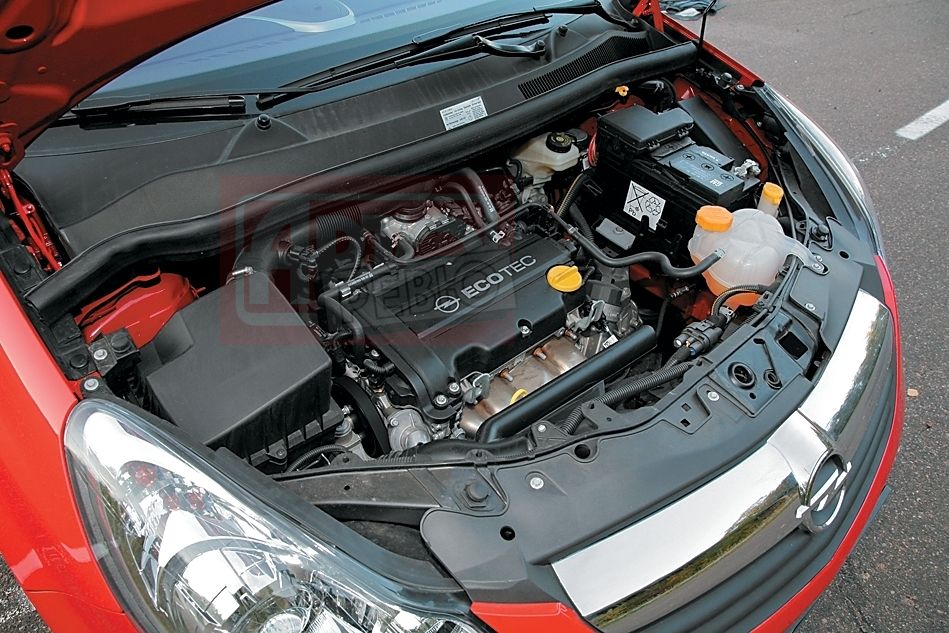
Peugeot: the 90-hp sixteen-valve Peugeot prefers high revs and spins eagerly up to 6700 rpm |
 |
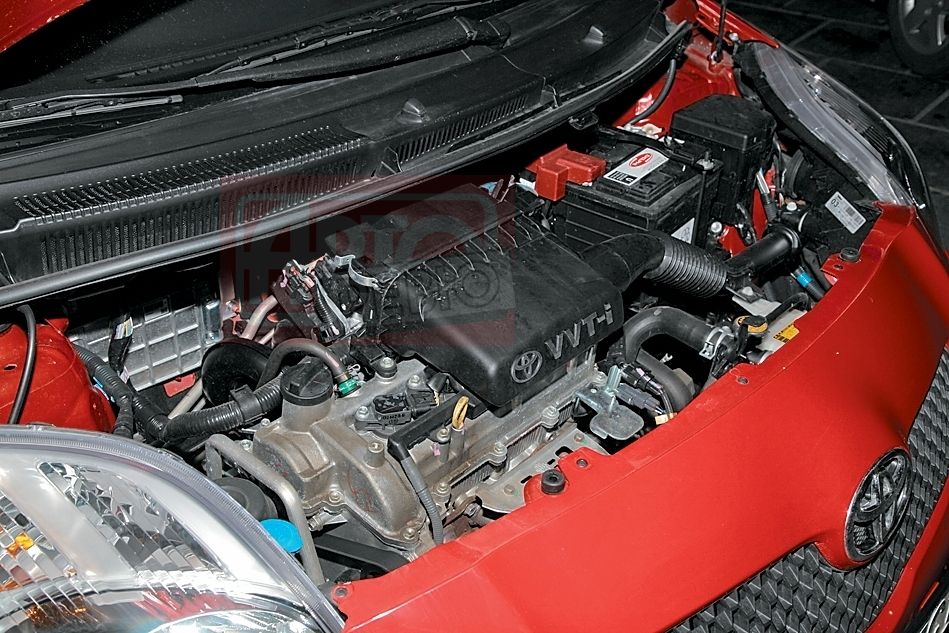 |
| Opel: the 1.4-liter engine (90 hp) is the most powerful for the Corsa |
Toyota: the Toyota's small-displacement engine with 87 hp turned out to be the most elastic |
What's the price?
The base Ford Fiesta in the Ambiente trim (three-door hatchback with a 1.3 engine (70 hp), manual gearbox, one airbag, and power steering) costs only $11,890. The Comfort version (1.4 L, 80 hp, central locking, and front electric windows) starts at $12,590. For the five-door body, the surcharge is $300. The five-speed manual can be replaced with the Durashift EST robotic gearbox, but only in combination with ABS, for $1,000.
The Fiesta in the Trend trim (fog lights, electrically adjustable and heated mirrors) costs from $12,990. The test car with a sunroof, climate control, rain and light sensors, heated seats, and heated windshield is priced at $18,105. The more powerful Fiesta 1.6 (100 hp) is available exclusively in the top Ghia version — at least $13,790. Its equipment includes air conditioning, a leather steering wheel, and a leather gear knob. For this version, a classic "automatic" (for $1,300) and the IVD stability system are optionally available, which, however, can only be ordered together with six airbags and ABS for $885. There is also a Fiesta Ghia with a 1.4 engine, but only with a robotic gearbox — price from $14,490. Some trim levels are available at dealers in stock; a custom-ordered car will take 4–5 months.
The warranty on the car is 2 years or 100,000 km. Ford is sold in Russia by 121 dealers in 78 cities.
Opel Corsa costs a bit more, but the base equipment is richer — a three-door with a 1.0 L engine (60 hp), ABS, two airbags, electric mirrors, and power steering sells for $11,990. The surcharge for two additional doors is the same $300, for the 1.2 engine (80 hp) — $850, for the Easytronic robotic gearbox — another $700. Electric windows, central locking, and 15-inch steel wheels will cost an additional $800. The three-door version in the maximum base trim Cosmo (CD player, side and curtain airbags, air conditioning, heated mirrors, fog lights) costs from $16,040. The most powerful Corsa 1.4 (90 hp) can be bought for at least $14,190, and in the Cosmo trim — from $16,590. The test car was additionally equipped with swivel headlights (for $300), electric heated steering wheel and seats (for $330), climate control ($450), sunroof ($800), and parking sensors ($400), which increased the price to $20,120. The version with an automatic transmission is $1,000 more expensive. A custom-ordered car will have to wait four months.
Warranty — 2 years without mileage limit. Opel is represented by 59 dealers in 31 Russian cities.
Peugeot 207 is noticeably more expensive — from $15,590 for the three-door 1.4 (75 hp) in the Urban version (four airbags, ABS, power steering, central locking, front electric windows). The five-door version costs $420 more. The modification with a 90-horsepower sixteen-valve engine of the same displacement is priced at $16,240. In the Trendy trim, the Peugeot 207 additionally gets air conditioning, curtain airbags, electric mirrors, and a CD player. Price — from $17,030 (75 hp). The Premium trim (from $19,170) is offered only with a five-door body. It includes climate control, leather steering wheel and gear lever, rain sensor, fog lights, rear electric windows, and heated front seats. For $21,180, a version with a 1.6 engine (110 hp) is available. The Sport version (from $19,510) stands out with sporty front seats and different exterior decor. Dealers currently have many cars in stock; a custom order will be delivered in three months. Modifications with an automatic transmission (surcharge $530) will go on sale only in March, as will cars with BMW engines of 1.6 L — the naturally aspirated engine with 115 hp will cost from $21,500.
Warranty — 2 years without mileage limit. Peugeot is sold by 33 dealers in 19 Russian cities.
Toyota Yaris is the most expensive and best-equipped base car in our quartet: $17,390 for the Terra version with air conditioning, leather steering wheel and gear lever, heated electric mirrors, CD player, ABS, four airbags, and central locking. Only one engine is offered — 1.3 L (87 hp), and the body is exclusively five-door. The robotic manual increases the price by $600. The Sol version additionally includes fog lights, climate control, curtain and driver's knee airbag. Price — $20,450. A custom-ordered car will have to wait 3–4 months.
Warranty — 3 years or 100,000 km. Toyota is sold by 29 dealers in 17 Russian cities.
All-round visibility
This time we decided not to limit ourselves to subjective impressions of visibility, but to supplement them with data from an optical protractor — it allows precise measurement of visibility zones.
The best result in the quartet was shown by the Fiesta with a total visibility angle of 2820. Thin pillars cover minimal sectors, the rear window opening is not cluttered with anything, and the mirrors have adequate size and shape. The only remark is the small cleaning sector of the rear window.
The Peugeot 207 is also good — visibility angle of 2800 and thin rear pillars. But the overall picture is spoiled by the exterior mirrors — they are strongly set back and droop limply, like the ears of a Bedlington terrier.
The Yaris is saved only by large and convenient mirrors. The rear window opening is quite small, and the seat belt for the middle passenger constantly dangles in it, and the cleaning zone of the rear wiper is simply laughable. Total visibility angle — 270.50.
The Opel Corsa suffers from another problem — poor forward visibility, and the total visibility angle is even smaller — 2560. The blame lies with the windshield "struts" that block a sector of 170 on the left and 120 on the right from the driver. Rear visibility is also limited: the mirrors are small, with diopters, and the middle pillar completely blocks a huge sector behind on the left — as much as 310!

In winter, "moose" don't sleep!
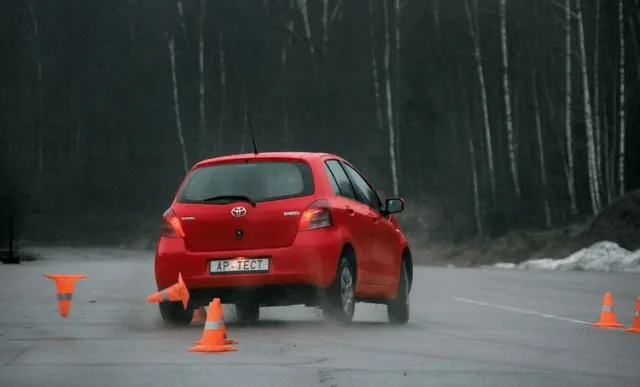
Studded tires, wet road, speed 60 km/h — and only one attempt to avoid a suddenly appearing obstacle. This is exactly the situation, relevant for winter Moscow, that we simulated by inviting five volunteers who got behind the wheel of the test cars for the first time. Usually, the "moose test" is conducted on dry asphalt at a speed of 65 km/h, but this time the conditions had to be changed.
The Peugeot 207 turned out to be the most understandable and safe. Transparent steering and phenomenal stability, supported by the delicate operation of ESP, allowed four drivers to avoid the "moose" — and only one trusted the car's obedience too much and hit a cone.

The Corsa showed a similar result: four out of five avoided the collision. But the drivers had to sweat a lot, correcting skids with the "empty" steering wheel when returning to their lane.
The agile Fiesta loses its liveliness of reactions during emergency maneuvers — two drivers could not predict this and simply did not turn the steering wheel enough.
And the Yaris reacts very sluggishly to a quick turn of the steering wheel, and then breaks into a deep skid when returning to its lane. Nevertheless, three out of five volunteers coped with the unruly Toyota thanks to the absence of "steps" in effort during rapid steering rotation.
| "Moose test" on the first attempt at a speed of 60 km/h* | |
| Car | Maneuver completed |
| Ford Fiesta | 3 drivers out of 5 |
| Opel Corsa | 4 drivers out of 5 |
| Peugeot 207 | 4 drivers out of 5 |
| Toyota Yaris | 3 drivers out of 5 |
| * Five drivers took part in the tests. | |
| Surface — wet asphalt, tires — winter studded | |
Safety packages
Modern B-class subcompacts no longer yield in safety level to cars a couple of classes higher — ten years ago they didn't have such protection at all. The Peugeot 207, Opel Corsa, and Toyota Yaris in recent versions earned five EuroNCAP stars, and even in Russian base trims they have ABS and Isofix anchors for child seats in the rear row. But only the Peugeot 207 has a full set of passive safety features available already in the initial version. Moreover, it is the "two hundred seventh" that showed the best result in crash tests for the protection of child passengers, and the ESP stabilization system can be ordered for any modification for an additional $700. True, the price is steep…
But for the Yaris, ESP is not available at all. Moreover, the car tested by EuroNCAP specialists was in the Sol trim, with side "curtains" and a driver's "knee airbag". This version is $3,060 more expensive than the base Terra.
Opel saved even more on safety — in the starting trim there are only two airbags. To avoid worrying, you'll have to pay an extra $1,000 for the "five-star package" EuroNCAP, which includes two side airbags and "curtains". However, there is a nuance here: in the crash test, the driver dummy pierced the airbag with its head and reached the steering wheel, though experts deemed the contact non-dangerous. But ESP for the Corsa is more modest — only $390.
The Ford Fiesta protects passengers noticeably worse, even if you pay an extra $745 for a passenger airbag and ABS for the base version. The age of the model takes its toll — it debuted back in 2002. Both in frontal and side impacts, the load on the chest of front occupants turns out to be too high. Plus, the ignition lock and steering column adjustment lever can injure the driver's knees. Child protection in a frontal impact is also not all smooth — the loads on the child's chest and cervical vertebrae exceed the norm. In Russia, Isofix cannot be ordered for the Fiesta, and its pedestrian protection is poor. One can only rely on active safety and a package of six airbags with ABS for $920, while ESP is available only for the 1.6 Ghia version.
| Expert assessments of Autoreview | |||||
| Assessed parameters | Max. score | Cars | |||
| Ford Fiesta | Opel Corsa | Peugeot 207 | Toyota Yaris | ||
| Design | 180 | 155 | 160 | 170 | 150 |
| Exterior | 90 | 75 | 80 | 85 | 75 |
| Interior | 90 | 80 | 80 | 85 | 75 |
| Ergonomics | 170 | 150 | 140 | 150 | 135 |
| Driver's workplace | 90 | 75 | 75 | 80 | 70 |
| Visibility | 80 | 75 | 65 | 70 | 65 |
| Dynamics | 280 | 230 | 220 | 250 | 235 |
| Acceleration dynamics | 90 | 70 | 70 | 75 | 75 |
| Braking dynamics | 100 | 85 | 80 | 95 | 90 |
| Handling | 90 | 75 | 70 | 80 | 70 |
| Ride comfort | 200 | 150 | 145 | 165 | 155 |
| Smoothness, vibration protection | 70 | 50 | 45 | 55 | 60 |
| Acoustic comfort | 70 | 55 | 55 | 60 | 50 |
| Climate control | 60 | 45 | 45 | 50 | 45 |
| Interior comfort | 170 | 115 | 110 | 110 | 120 |
| Passenger seats | 70 | 40 | 35 | 30 | 45 |
| Trunk | 60 | 45 | 40 | 45 | 35 |
| Interior transformation | 40 | 30 | 35 | 35 | 40 |
| Total score | 1000 | 800 | 775 | 845 | 795 |
| Specifications | ||||
| Parameters | Cars | |||
| Ford Fiesta | Opel Corsa | Peugeot 207 | Toyota Yaris | |
| Body type | 3-door hatchback | 3-door hatchback | 5-door hatchback | 5-door hatchback |
| Number of seats | 5 | 5 | 5 | 5 |
| Trunk volume, l | 270—950 | 285—1050 | 310—1195 | 272—1086 |
| Curb weight, kg | 1106 | 1130 | 1149 | 980 |
| Gross weight, kg | 1525 | 1555 | 1640 | 1440 |
| Engine | petrol, with distributed fuel injection | |||
| Location | front, transverse | front, transverse | front, transverse | front, transverse |
| Number and arrangement of cylinders | 4, in-line | 4, in-line | 4, in-line | 4, in-line |
| Displacement, cm³ | 1388 | 1364 | 1360 | 1296 |
| Cylinder bore/piston stroke, mm | 76.0/76.5 | 73.4/80.6 | 75.0/77.0 | 72.0/79.6 |
| Compression ratio | 11.0:1 | 10.5:1 | 11.0:1 | 11.0:1 |
| Number of valves | 16 | 16 | 16 | 16 |
| Max. power, hp/kW/rpm | 80/59/5700 | 90/66/5600 | 90/66/5250 | 87/64/6000 |
| Max. torque, Nm/rpm | 124/3500 | 125/4000 | 133/3250 | 121/4200 |
| Gearbox | manual, robotic, 5-speed | manual, 5-speed | manual, 5-speed | manual, 5-speed |
| Gear ratios | ||||
| I | 3.15 | 3.73 | 3.42 | 3.55 |
| II | 1.93 | 2.14 | 1.81 | 1.91 |
| III | 1.28 | 1.41 | 1.28 | 1.31 |
| IV | 0.95 | 1.12 | 0.98 | 1.03 |
| V | 0.76 | 0.89 | 0.77 | 0.85 |
| reverse | 3.62 | 3.31 | 3.58 | 3.21 |
| final drive | 4.25 | 3.74 | 4.54 | 4.06 |
| Drive | front | front | front | front |
| Front suspension | independent, spring, McPherson | |||
| Rear suspension | semi-independent, spring | semi-independent, spring | semi-independent, spring | semi-independent, spring |
| Front brakes | disc | disc, ventilated | disc, ventilated | disc, ventilated |
| Rear brakes | drum | disc | drum | drum |
| Tires | 175/65 R14 | 195/55 R16 | 185/65 R15 | 185/60 R15 |
| Maximum speed, km/h | 168 | 173 | 180 | 170 |
| Acceleration time 0—100 km/h, s | 14.3 | 12.4 | 12.7 | 11.5 |
| Fuel consumption, l/100 km | ||||
| urban cycle | 8.3 | 7.8 | 8.5 | 6.7 |
| extra-urban cycle | 5.2 | 4.8 | 5.2 | 5.3 |
| combined cycle | 6.3 | 5.9 | 6.4 | 5.8 |
| Fuel tank capacity, l | 45 | 45 | 50 | 42 |
| Fuel | petrol AI-95 | petrol AI-95 | petrol AI-95 | petrol AI-95 |
| Equipment of comparison test participants | |||||||
| Options and systems | Models | ||||||
| Ford Fiesta | Opel Corsa | Peugeot 207 | Toyota Yaris | ||||
| Base version price, $ | 12590 | 14190 | 19510 | 17390 | |||
| Front airbags | + | + | + | + | |||
| Side airbags (front row) | O | O | + | + | |||
| Curtain airbags | O | O | + | – | |||
| ABS | O | + | + | + | |||
| Traction control system | – | – | + | – | |||
| Stability control | – | – | + | – | |||
| Power steering | + | + | + | + | |||
| Automatic transmission | O | – | – | – | |||
| Steering wheel controls | –** | + | –** | + | |||
| Tilt steering wheel | + | + | + | + | |||
| Telescopic steering wheel | – | + | + | + | |||
| Leather steering wheel | O | + | + | + | |||
| Heated steering wheel | – | O | – | – | |||
| Heated windshield | O | – | – | – | |||
| Heated front seats | O | O | + | + | |||
| Auto-dimming rearview mirror | – | + | – | – | |||
| Bluetooth headset | – | O | O | – | |||
| Central locking with remote control | + | + | + | + | |||
| Security system | – | – | O | – | |||
| Air conditioning | + | + | + | + | |||
| Single-zone climate control | O | O | – | – | |||
| Dual-zone climate control | – | – | O | – | |||
| Power mirrors and heating | O | O | + | + | |||
| Power folding mirrors | O | – | – | – | |||
| Front power windows | + | + | + | + | |||
| Rear power windows | – | – | + | – | |||
| Split-folding rear seat | + | + | + | + | |||
| Rear seatback recline | – | + | – | + | |||
| CD player | O | O | O | + | |||
| CD changer | – | – | O | – | |||
| Light sensor | O | O | O | – | |||
| Rain sensor | O | O | O | – | |||
| On-board computer | + | + | + | + | |||
| Panoramic roof | – | – | O | – | |||
| Power sunroof | O*** | O | – | – | |||
| Rear parking sensors | O | O | O | – | |||
| Removable rear headrests | + | + | + | + | |||
| Leather interior | – | – | + | – | |||
| Remote trunk release | + | – | – | – | |||
| Remote fuel filler release | – | – | – | + | |||
| Cornering lights | – | O | O | – | |||
| Fog lights | + | O | + | – | |||
| Headlight washers | – | – | + | – | |||
| Alloy wheels | O | – | + | – | |||
| Full-size spare tire | + | + | + | + | |||
| Metallic paint | O | – | – | – | |||
| Test car price, $ | 18105 | 20120 | 23912 | 17390 | |||
| * Robotic manual transmission | |||||||
| ** Controls on steering column | |||||||
| *** Manual drive | |||||||
| (+) Included in base version | |||||||
| (–) Not available in base version | |||||||
| (O) Option on test cars | |||||||
| Costs for scheduled maintenance with materials and parts* | ||||
| Schedule | Models | |||
| Ford Fiesta | Opel Corsa | Peugeot 207 | Toyota Yaris | |
| Labor rate | 42 | 46 | 43 | 61 |
| Mileage, km | ||||
| 10000 | — | — | — | 154 |
| 15000 | — | 186 | — | — |
| 20000 | 150** | — | 142 | 317 |
| 30000 | — | 371 | — | 154 |
| 40000 | 150** | — | 227 | 602 |
| 45000 | — | 186 | — | — |
| 50000 | — | — | — | 154 |
| 60000 | 150** | 608 | 142 | 317 |
| 70000 | — | — | — | 154 |
| 75000 | — | 186 | — | — |
| 80000 | 150** | — | 227 | 711 |
| 90000 | — | 371 | — | 154 |
| Total | 600** | 1908 | 738 | 2717 |
| * Amounts are in US dollars | ||||
| ** Fixed cost | ||||
| Measurement results obtained by the Autoreview editorial team* | ||||
| Parameters | Car models | |||
| Ford Fiesta | Opel Corsa | Peugeot 207 | Toyota Yaris | |
| Maximum speed, km/h | 159.1 | 167.0 | 162.2 | 157.7 |
| Acceleration time, s | ||||
| 0—50 km/h | 4.3 | 4.8 | 5.4 | 4.8 |
| 0—100 km/h | 15.6 | 14.5 | 16.4 | 15.0 |
| 0—150 km/h | 54.4 | 43.3 | 51.7 | 49.1 |
| at 400 m distance | 19.8 | 19.5 | 20.4 | 19.7 |
| at 1000 m distance | 36.7 | 35.9 | 37.5 | 36.4 |
| 60—100 km/h (III) | 9.4 | 9.4 | 9.7 | 10.3 |
| 60—100 km/h (IV) | 12.9 | 13.2 | 13.9 | 14.3 |
| 80—120 km/h (V) | 21.4 | 22.4 | 23.5 | 23.4 |
| 60—100 km/h (D) | 10.4 | — | — | — |
| 80—120 km/h (D) | 14.6 | — | — | — |
| from 50 km/h | 643 | 590 | 614 | 632 |
| 130—80 km/h | 879 | 859 | 922 | 828 |
| Braking from 100 km/h | ||||
| distance, m | 56.1 | 60.8 | 52.3 | 61.6 |
| deceleration, m/s² | 6.9 | 6.3 | 7.4 | 6.3 |
| Tires | Nokian Hakkapeliitta 5 | Nokian Hakkapeliitta 4 | Gislaved Nord Frost 5 | Nokian Hakkapeliitta 4 |
| Total angle of visibility from the driver's seat in the horizontal plane, degrees | 282 | 256 | 280 | 270.5 |
| * On winter studded tires | ||||

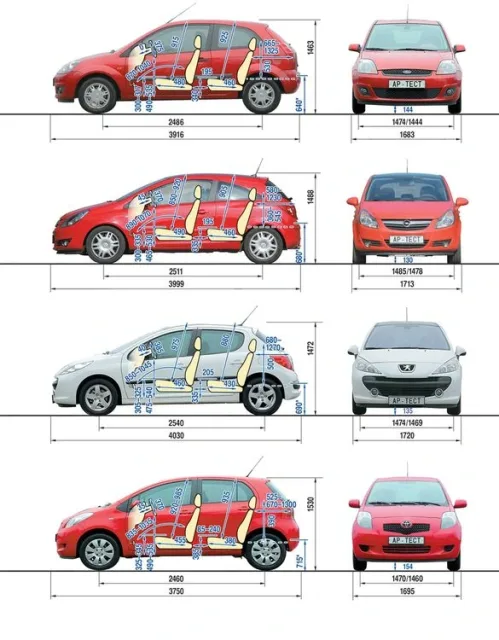
Black indicates manufacturer data, blue — figures obtained by Autoreview
* Loading height
Acceleration graphs