
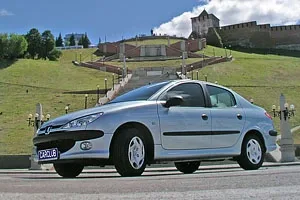
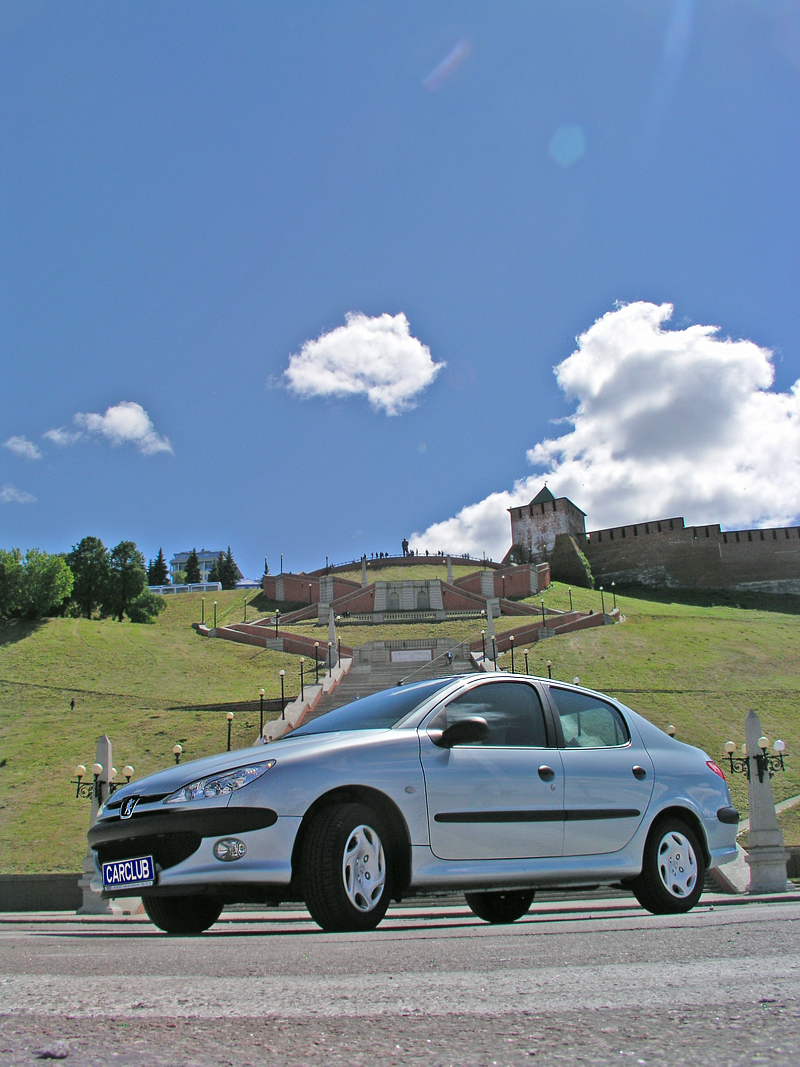
 Peugeot 206 Sedan is a car that literally everyone argues about. We looked at it through the eyes of a man and a woman, because their views on the same car often do not coincide…Comments (4)
Making a car cheaper usually means saving on materials, components, and the production itself. It is thanks to the latter that Peugeot managed to get into the budget car category.
Last year, against the background of other inexpensive models, the Peugeot 206 sedan appeared. It is assembled at the Iranian enterprise Iran Khodro, which has long worked with the French. Previously, they made the Peugeot 405 for the local market, and later its modernized version, the Samand, which is now also produced in Ukraine.
Although the "two hundred sixth" sedan has been made in the Middle East for several years, until recently these cars went only to the domestic Iranian market. And only when the more expensive Peugeot 207 appeared in 2006 did the PSA concern allow sales of the sedan outside the country.
The Peugeot 206 Sedan is built on the basis of the hatchback, which was updated in 2004. From it, the car inherited the engines and the front MacPherson suspension. The rear was slightly modified: they took the torsion beam scheme from the hatchback and added diagonal links to it. The wheelbase did not change, but the overall length increased by 353 mm — to 4188 mm, solely due to the rear overhang.
If you close your eyes and sit in the cabin, you won't immediately understand that this is a sedan, not the familiar hatchback. Inside, everything is familiar: the same materials, the same steering column audio switch, the same instrument panel.
The main difference — and the main trump card — is outside, in the rear of the body.
The Iranian engineers managed to attach a rear end to the compact car, and what a rear end! Due to the elongated tail section, the trunk has almost doubled — from 245 to 402 liters. And if you fold the rear seats, inherited from the hatch, the length of the cargo compartment reaches one and a half meters.
In Russia, the Peugeot 206 Sedan is sold with two petrol engines — 1.4 liters (75 hp) and 1.6 liters (110 hp). There are three trim levels to choose from: XR, XR Premium, and XT.
The base XR is a 1.4 engine, manual transmission, two front airbags, audio system with CD, immobilizer, and central locking.
The XR Premium differs only by air conditioning, for which they ask 21,000 rubles more.
The XT version already includes ABS with emergency braking assist, climate control, full electric package, and 14-inch alloy wheels.
The price of the XT with a 1.4-liter engine and manual transmission is 390,000 rubles. The version with 1.6 is 430,000, and with automatic transmission — 463,000 rubles.
We decided to evaluate the Peugeot 206 Sedan from two positions: male and female, because they are sometimes diametrically opposed. Here's what we got…
Daniil:
At first glance at the Peugeot 206 Sedan, the car seemed frankly ugly to me. The rear end did not match the image of the hatchback, which had been formed for almost ten years — since the model's debut in 1998. This appendage at the back looked alien and destroyed the sleek profile of the original car. But let's take it in order…
The interior, although simple in appearance, leaves a pleasant aftertaste. The plastic of the front panel is hard, but the texture makes it quite decent. The Iranian assembly did not let us down: everything is fitted neatly, nothing creaks.
Getting behind the wheel, I did not immediately find the window regulators — no levers, no buttons in the usual places. It even crossed my mind that the windows here do not go down at all! After about ten minutes of searching, the buttons were found — in an inconvenient place, deep between the front seats.
Then I got to the audio system. The controls turned out to be surprisingly well thought out, especially the steering column lever — an excellent replacement for a multifunction steering wheel, especially given the age of the model. The sound also pleased, although at high volume the speakers began to rattle.
I liked the driver's seat and steering wheel, both adjustable for height. A person 180–185 cm tall will be quite comfortable. But on a long journey, you start to miss the steering wheel reach adjustment. If you try to compensate with the seat, you run into another problem: move closer — your knees hit, move away — your arms don't reach the wheel.
In the city, handling is quite acceptable, and the suspension absorbs potholes and joints with a reserve of energy — one of the main Russian woes. But on the highway, especially over a hundred, the connection with the car is lost: you have to constantly correct the steering to keep a straight line.
I did not like the gearbox. The lever travel is too long, and to engage fifth, you almost have to stretch from behind the wheel. The picture is aggravated by the clutch pedal, which must be pressed all the way to the floor. After a couple of shifts, it ends up under your heel, and your left leg is constantly hanging in the air.
The 1.4-liter engine tries its best and in the city allows you to keep up with the flow. But on the highway, its modest power is not enough for confident overtaking. Even if you rev it to 5000 rpm on every gear, it doesn't get any livelier. Moreover, when revving, fuel consumption noticeably exceeds the official figures, which, however, is logical for such a driving mode.
The tires start to make noise already after 80 km/h, and after 3500 rpm the engine joins them. The optimal mode for the highway seemed to me to be 100 km/h in fifth gear: about 3000 rpm and unobtrusive tire rustling.
Having driven this Iranian sedan for more than 1000 km, I changed my attitude. I got used to its huge, in my opinion, trunk, and the clutch pedal, and the long-throw "stick". And in the end, I realized: the car is good in its own way. The main thing is that it does not adapt to the driver. It is the driver who adapts to it and over time gets used to its shortcomings.
Svetlana:
The appearance of the Peugeot 206 Sedan evokes very different reactions. Some say that the trunk, glued to one of the most stylish European hatchbacks (albeit morally outdated), looks ridiculous. Others, on the contrary, believe that the sedan has gained swiftness and solidity, like the 607 model.
Arguing about tastes is pointless. I'll say one thing: in person, the 206 Sedan looks more elegant and harmonious than in photos. Yes, the kinship with the hatchback is obvious, but the trunk fits into the image quite successfully. Moreover, it has a French character. And given that the "little lion" competes in the budget sedan class, we can say — it is perhaps the most beautiful car in its category. And with all its practicality, the "Peugeot" remains a woman's car.
The interior is also in the French style — cute and cozy, although the plastic is hard, and the glove box is upholstered in fabric. By the way, the box itself is very spacious, but it lacks lighting. The door pockets are also roomy — a phone or glasses constantly fall into them, and then you forget them there. The seats are comfortable, with good lateral support, the driver's seat is height-adjustable. The sedan inherited from the hatchback the inconvenient location of the window regulators — between the seats, slightly behind: it's awkward to reach, and I never learned to find the buttons by touch. The sun visors are small, but with mirrors, though also without lighting. Rear passengers have a bit of a lack of space — however, this is normal for this class. But the absence of headrests on the rear sofa is a clear drawback.
The long free travel of the clutch pedal immediately catches the eye. However, you get used to it quickly, and personally, I even liked it, although most of my colleagues disagreed with me. When starting off, a loud click is heard — this is the automatic door locking. Under the windshield, there is a display with the clock, date, and information about the car's condition — for example, a warning about an open door, though in English.
In the base trim, the 206 is equipped with a CD player, though without MP3 support. But the music control buttons are duplicated on the steering column lever, which is a rarity for the budget segment. However, listening to the audio system at full volume is not appealing: the door cards start to rattle frankly. The engine compartment is well insulated from noise, and the engine rumble breaks into the cabin only at high revs. But the tires hum quite annoyingly if the Frenchman with Iranian registration finds rough or uneven asphalt under its wheels. The gears shift clearly and understandably, just like in the hatchback.
It is clear that 75 hp does not give the right to count on briskness, but in the city rhythm, they are more than enough. And on the suburban highway, the "little lion" does not lag behind. In corners, the sedan behaves confidently, almost without leaning, but the suspension clearly does not like speed bumps — the body shakes and bounces regardless of speed. Ruts also immediately transmit to the steering wheel. The brake pedal is difficult to dose: the response to pressing is too sluggish and thoughtful. But the air conditioner does not overload the 1.4-liter engine and does its job perfectly.
But when parking, the feeling does not leave that you are sitting behind the wheel of a hatchback: neither the hood nor the trunk is visible from the cabin, and the high-raised shelf finally confuses your bearings. In addition, the mirrors do not allow you to properly assess the space for maneuvering — you have to rely on luck or act by ear.
It was a bit sad to part with the Peugeot. The little one evokes persistent sympathy and a feeling that it itself asks to be a reliable companion. By its nature, the car is more suitable for a girl, except for the inconvenience when parking, especially if it is the first car — it does not provoke reckless antics. But the driver will definitely appreciate the cozy interior and cute appearance.
Text and photos: Daniil Sonin, Svetlana Aleeva.