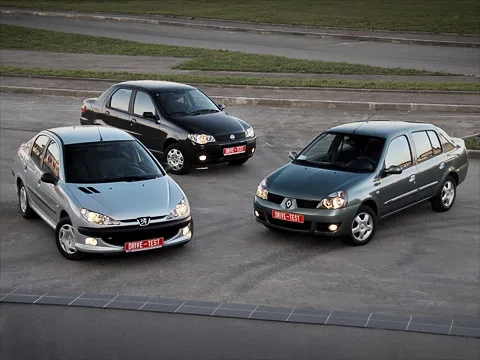
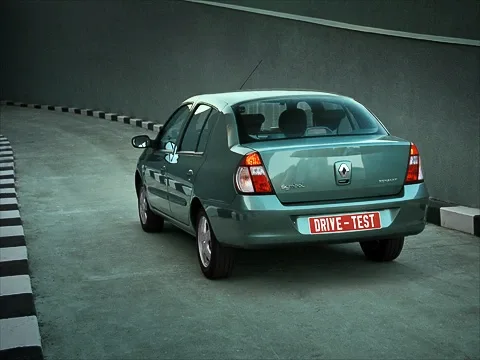
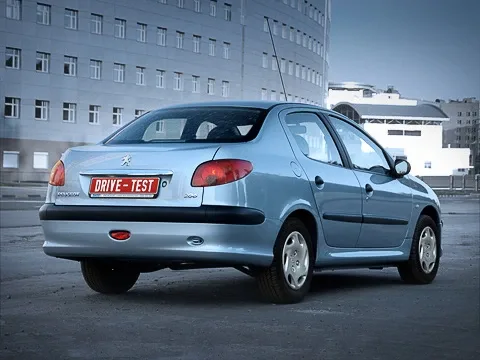
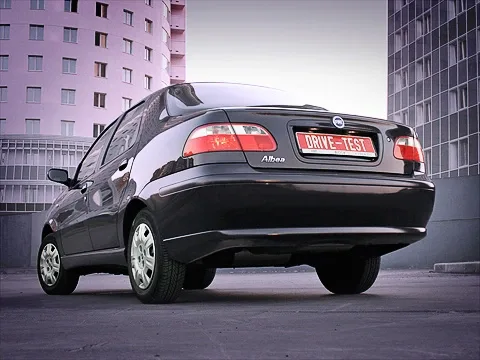
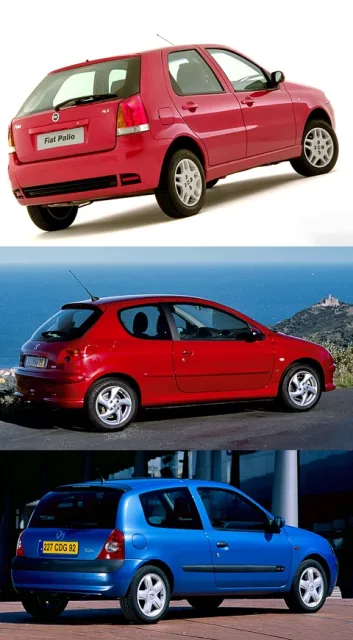
And the blame for this, by and large, lies with us — the buyers. It's because of our love for sedans that the 206 and Clio go unnoticed simply because they are hatchbacks. And we are ready to forgive a car any appearance, as long as there are extra centimeters in the trunk. Manufacturers, of course, did not keep us waiting and responded to such demand by attaching huge metal "backpacks" to compact models.
Fiat Albea survived this operation quite tolerably. The car can hardly be called elegant, but you wouldn't dare accuse it of lacking harmony — of all of them, it's the one where the "third volume" looks organic, not like a foreign appendage. But the Peugeot is a real beauty, but only if you look at it from the front. From other angles... The Symbol is no prettier either. In fact, the Renault looks even scarier. However, it is saved by the fact that, unlike its test opponents, it has been sold here for a very long time. The car has become so familiar that complaining about its rear end has gotten old. So let's not, especially since such cars are clearly not bought for their design.
The price of each participant is about 15 thousand dollars, and for that money each car has air conditioning, front electric windows, two airbags, power steering, an onboard computer, and, of course, a huge trunk. It seems like everything you need for happiness. Or not? Oh yes — you also want all this stuff to drive more or less decently.
Let's start alphabetically — with the Fiat. We get in. Whoa! Hello, "Zhiguli"! The simple interior trim, square vents, tiny mirrors, and a plain "blob" of instruments. If outside our black Albea looks more solid than its competitors, inside you immediately remember its budget origins. But the onboard computer screen is like that of the "older" Fiats. And the steering wheel, though plastic, feels quite pleasant to the touch.
The seats at first glance are not bad — there is decent lateral support, nice upholstery, and lumbar support adjustment. But the profile, despite this very adjustment (which only the Fiat has), is not ideal. No matter how we turned the settings, the back still gets tired.
The Peugeot is not far from the Albea. For the seat upholstery of the 206 Sedan, the Iranians (and it is Iranian assembly!) apparently spent the entire strategic reserve of Soviet soldier's overcoats. Good thing it wasn't canvas tents. The seats themselves, of course, will not please with either sporty "hugs" or the comfort of leather chairs. They are nothing — ordinary.
Otherwise, the interior of the "Frenchman" sent to Middle Eastern exile repeats the cabin of the 206 hatchback, and that's not bad. Except the plastic is made of recycled materials — absolutely everything is made of it. But you can't fault the materials — otherwise, there are no complaints about the cabin. Convenient door pockets, a huge glove box, plenty of places for small items, and fancy instruments. The steering wheel and gear lever deserve special praise — the most convenient in our trio.
After this pair, the Renault is a Rolls-Royce in the making. You sit in it after the Fiat and the "Peugeot" and can't shake the feeling that the car is a class higher. This is undoubtedly thanks to the new dashboard from the Clio hatchback (previously the Symbol had one from the pre-restyling Clio). And overall, there are no obvious flaws in the trim and finish — nothing to fault. And the window buttons have finally moved to the driver's door, where they belong. However, no. There is one thing that annoys, and its name is the instrument cluster. During the day it is completely unreadable, and the garish backlighting doesn't help. But the owner will surely be pleased to look at the speedometer marked up to 250 km/h.
Naturally, this speedometer in no way reflects the Symbol's capabilities, although it does drive a bit more briskly than its competitors. After all, "our" Renault had a 16-valve 1.4-liter engine with 98 hp, while the 8-valve engines of the same displacement in the Fiat and Peugeot develop 77 and 75 "horses" respectively. And if they accelerate about the same, the Symbol easily pulls ahead. And once up to speed, it pleases with a fairly comfortable and energy-intensive suspension. It enters corners confidently, but without fanaticism. The gear lever is quite precise and convenient, although the clutch settings are inconvenient and require getting used to. Inside it's relatively quiet. The standard CD stereo can satisfy the needs of people without a musical ear — six speakers thump decently, and the steering wheel remote allows you to keep your hand on the wheel.
The Peugeot has two fewer speakers (no sound in the back), but the remote is more convenient. And it can even provoke! Yes, yes, despite the puny engine and stupid tires, you can "cut loose" on the Iranian sedan. Within its capabilities, of course. The good chassis and decent steering settings endow the 206 Sedan with obedience and agility. Its steering wheel is the lightest, but informative, and the reactions are the liveliest. You enter a corner, and it seems the car weighs half a ton less than it actually does. A very light and obedient car, and its body roll is the smallest. The suspension, of course, is stiffer than the Renault's, but the noise insulation is quite decent. However, the gear lever here is far from being as precise, and reverse gear doesn't always engage on the first try.
And what about the Fiat? I buckle up and engage first gear. Oh, my, what lever travel! It's huge! And the problem isn't just that. There's no talk of any informativeness — you can only tell if the right gear is engaged "after the fact." And when engaging reverse, you hit the passenger seat cushion with your hand. But, credit to the Fiat, we never once made a mistake in gear selection. The clutch engages abruptly, but not like the Symbol's. And the engine's response to the gas pedal is perhaps even too sharp. You can spin the wheels at low speed with one careless movement! Although, of course, it's not about the monstrous torque of the 8-valve monster engine, but the poor Goodyear GT2 tires, which start whining and squealing at any excuse and even without one.
In a straight line, the Albea drives excellently. But it's afraid of corners, especially long ones! The car sways and reluctantly traces an arc, constantly trying to deviate from the trajectory. The situation is complicated by the completely "empty" steering wheel. In general, the Fiat Albea's suspension is a true Italian know-how. After all, with all its softness and looseness in corners, it manages to compete with the Subaru Impreza WRX STI. The Albea hits joints and speed bumps just as hard! And on other types of bumps, the car simply floats. Amazing.
But only the Albea has ABS and brake force distribution — the other test participants do without them. So if the Fiat takes second place in acceleration, it takes first in braking. And the Peugeot 206 (in addition to lacking ABS) also has a very strange brake pedal. You press it a little — and nothing happens. Press harder — the car starts to slow down slightly. And only then, if you press the pedal further, will normal deceleration begin. The Renault is much better — the pedal is informative, and the locking point is easy to predict, so you can't really fault it.
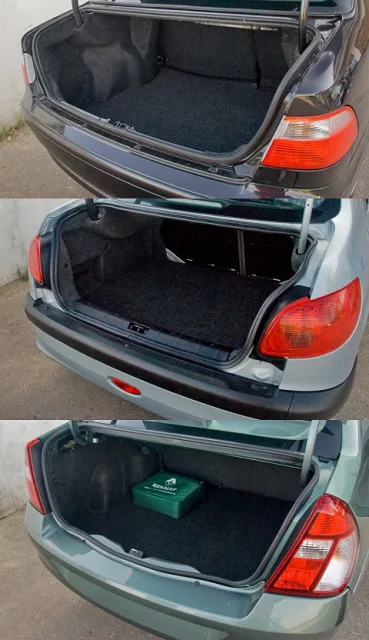
The largest cargo area is in the Fiat Albea, but the loading opening is not the most convenient. The Peugeot's is also far from ideal, and the volume is more modest, but the walls of the "hold" are flat. And the Renault's trump card is that its trunk opens not only with a key but also with a separate button.
But the Fiat can take revenge when it comes to cargo-passenger capabilities. It has 515 liters for all sorts of luggage — a huge figure, you can only imagine how much stuff will fit there. The Symbol is not far behind with its 510 liters, but its compartment is better organized, and it opens with a button. The Peugeot clearly loses in this comparison: a "measly" 402 liters. The rear seatbacks in all three fold in parts, but the resulting opening is small. So transporting large household appliances, despite all this space, will most likely have to be forgotten.
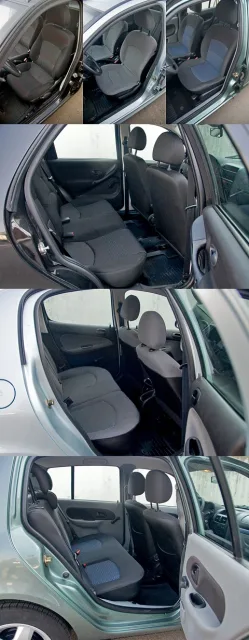
The Fiat's front seats (left) boast better lateral support, but on a long journey, they make your back ache. In the Peugeot (center) and Renault (right), sitting is about equally comfortable — the backrest profile is decent, but the hold leaves much to be desired. But for rear passengers, the Albea is out of competition, while in the 206 Sedan and Symbol, it's frankly cramped in the back.
In terms of second-row space, the Albea is also a leader — only here can you sit more or less decently in the back. The Peugeot and Renault are almost identical in this aspect, or to put it bluntly, equally hopeless. There is catastrophically little free space! Although the Symbol is still slightly preferable: the ceiling doesn't press so hard on tall occupants' heads, and the door opening is a bit wider.
So what's the verdict? The undisputed winner, with a couple of small exceptions, is the Renault Symbol. It's the most comfortable, with trim that looks decent against the competition, and a calm, unstrained character. It's just a pity that it's so cramped in the back. But the Symbol is also the most expensive: in our configuration — with alloy wheels and a 16-valve engine — it costs 402,500 rubles.
The Peugeot 206 Sedan is more than fifty thousand cheaper, and that's a serious justification for its lag behind the Renault in trim, engine, and equipment — because overall, the 206 is only slightly worse. But the Peugeot handles quite spiritedly and is a joy to drive. It's not for nothing, oh not for nothing that it has such predatory headlights!
Well, the Russian-assembled Albea gets the bronze. In too many disciplines this car loses to its rivals. It doesn't even help that it looks more harmonious than all of them, that tall passengers can fit in the back seat, and that you could load an elephant into the trunk. The plain interior and mediocre driving performance—alas, none of this matches the price. And it's not small, by the way: for the tested Comfort trim, dealers want 374 thousand rubles. So today we have to suppress our sense of beauty (or at least of what's not scary) and recommend what's scarier on the outside but kinder on the inside.
Technical specifications
| Specifications | Fiat Albea | Peugeot 206 Sedan | Renault Symbol |
| Body |
| Number of doors/seats | 4/5 | 4/5 | 4/5 |
| Length, mm | 4186 | 4188 | 4171 |
| Width, mm | 1703 | 1655 | 1639 |
| Height, mm | 1490 | 1452 | 1437 |
| Curb weight, kg | 1120 | 1069 | 1050 |
| Gross weight, kg | 1605 | 1567 | 1500 |
| Trunk volume, l | 515 | 402 | 510 |
| Engine |
| Type | Petrol, with distributed injection | Petrol, with distributed injection | Petrol, with distributed injection |
| Location | Front, transverse | Front, transverse | Front, transverse |
| Number and arrangement of cylinders | 4, in-line | 4, in-line | 4, in-line |
| Number of valves | 8 | 8 | 16 |
| Displacement, cm3 | 1368 | 1361 | 1390 |
| Max power, hp/rpm-1 | 77/6000 | 75/5500 | 98/6000 |
| Max torque, Nm/rpm-1 | 115/3000 | 120/3400 | 127/3750 |
| Transmission |
| Gearbox | Manual, five-speed | Manual, five-speed | Manual, five-speed |
| Drive | Front | Front | Front |
| Chassis |
| Front suspension | Independent, McPherson | Independent, McPherson | Independent, McPherson |
| Rear suspension | Semi-independent | Independent, torsion beam | Semi-independent |
| Front brakes | Disc, ventilated | Disc, ventilated | Disc, ventilated |
| Rear brakes | Drum | Drum | Drum |
| Tires | 175/70 R14 | 175/65 R14 | 175/65 R14 |
| Performance characteristics |
| Maximum speed, km/h | 162 | 170 | 186 |
| Acceleration time from 0 to 100 km/h, s | 13.5 | 14.6 | 11.2 |
| Fuel consumption, l/100 km |
| Urban cycle | 8.2 | 8.8 | 9.9 |
| Extra-urban cycle | 5.0 | 5.0 | 5.4 |
| Combined cycle | 6.2 | 6.4 | 7.0 |
| Fuel tank capacity, l | 48 | 50 | 50 |
| Fuel | AI-95 | AI-95 | AI-95 |
Trim levels of tested cars
| Trim level | Fiat Albea Comfort | Peugeot 206 Sedan XR | Renault Symbol Expression+ |
| Base version price, rubles | 315000 | 329000 | 324600 |
| Driver airbag | + | + | + |
| Front passenger airbag | O | + | O |
| Side airbags | - | - | - |
| ABS | O | - | - |
| Power steering | + | + | + |
| Air conditioning | O | O | O |
| Height-adjustable steering column | + | + | O |
| Leather steering wheel and gear knob | - | - | - |
| Heated front seats | - | - | + |
| Front fog lights | O | + | O |
| Power-adjustable and heated exterior mirrors | O | - | O |
| Front power windows | O | + | O |
| Split-folding rear seat | O | + | O |
| CD audio system with steering wheel controls | - | + | O |
| MP3 playback capability | - | - | - |
| On-board computer | O | - | + |
| Full-size spare wheel | + | + | + |
| Alloy wheels | - | - | O |
| Tested car price, rubles | 374000 | 350000 | 402500 |
Cars for the test provided by
OJSC "Severstal-auto", LLC "Peugeot Rus Auto", OJSC "Avtoframos". What was — what became
Behind the scenes
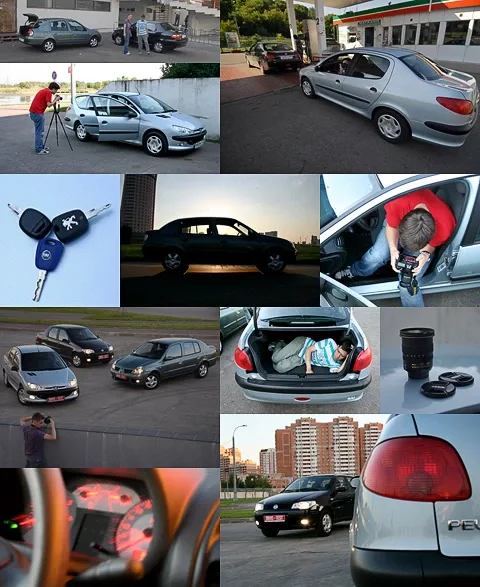
By the way, our sedan test dragged on longer than usual. The Peugeot 206 Sedan came to us almost two weeks before the competitors arrived, so we had plenty of time to get acquainted with the car.
But during the shoot, as usual, everything went haywire. Not only did we waste a lot of time, but we also managed to lose the license plate from the Peugeot 206 — though we've already told you about that in our blog.