
City traffic jams today are a common sight in almost any large populated area in Europe, and in Russia too. Public surface transport gets stuck in the same congestion, and in the metro there are already crushes among passengers. The way out of this situation is subcompact cars: they allow you to deftly maneuver in traffic and not rack your brains over finding a parking spot.
No matter how much our drivers love sedans and generally larger cars, the Russian market is increasingly being filled with A-class models. This spring, sales of the Peugeot 107, the smallest model in the French brand's lineup, started here.
The car was developed as part of a joint project between two concerns — PSA Peugeot Citroen and Toyota Motor Company. From this union of West and East were born the twins Peugeot 107 and Citroen C1, as well as their half-sister Toyota Aygo, which differs noticeably from its French relatives. All three models are assembled at the Czech TPCA plant in Kolin, which was built by the Japanese company.
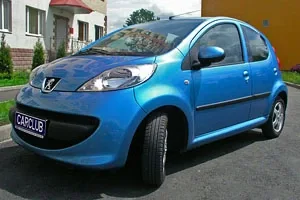
The mini-Peugeot greets you with a wide, good-natured "smile" across the entire bumper. Friendly bulging headlight-eyes combined with a huge Peugeot emblem under a tiny hood immediately endear it to you. Despite five doors, the hatchback's profile looks swift and daring. The secret is that the rear doors are disguised as fenders and extend to the vertical rear lights — it looks unusual.
Inside the Peugeot 107, everything is modest and without excess, but even here there are French design finds that rhyme perfectly with the toy-like appearance of the hatchback.
Outside, the car seems tiny, but inside the space is perceived as almost huge. The seats, with no hint of lateral support, adjust over a wide range, and the steering wheel adjusts for height, so it's easy to get comfortable. A passenger behind an average-height driver will also have enough legroom.
The hard plastic panels of the interior are fitted neatly and do not annoy with squeaks. True, in some places the plastic was clearly skimped on: on the doors there are areas of bare painted metal. And a clear victim of space-saving were the vent windows in the rear doors — the kind found in old minivans and SUVs of the last century.
The instrument panel is made simpler than in the MINI Cooper, but no less original for that. A huge speedometer, resembling a Soviet "Slava" alarm clock, is placed right on the steering column. The tachometer, an option for 4500 rubles, is smaller and is piled up as a second tier of this pyramid, like a tilted snowman's head. In the center of the speedometer live various indicators, and on the right side is a small but clear monochrome display with data on fuel consumption, mileage, and the engaged gear.
Design touches have also reached the center console, which resembles a chicken egg in shape. Climate control is managed by two "washers" on the sides, and the air supply intensity is adjusted by another round knob on top.
There are plenty of containers and recesses in the cabin, but a full-fledged closed glove box seems to be missing — and this is slightly annoying. True, upon closer inspection it was still found, but in an extremely inconvenient place: to get to it, you need to get out of the car and open the fifth door. But compared to classmates, and even to cars two or three classes higher, the Peugeot 107's glove box is truly gigantic — a whole 139 liters, even a couple of small bags will fit there! It's just called the "trunk".
The little "Peugeot" doesn't have to blush for its dynamics. The 1.0-liter engine with 68 hp is more than enough for a 900-kilogram minicar. With the ringing squeal of the three-cylinder engine, the little car takes off like scalded, leaving clumsy giants at the traffic light. Up to 90 km/h, only two gears are enough, and the dynamics don't give up until 140 km/h. And then, up to the maximum 160 km/h, the speedometer needle crawls slowly and with obvious reluctance.
The robotic gearbox "2 Tronic" on the test car can work in two modes — automatic and sequential. At first, the transmission noticeably braked and pushed during shifts. But once you get used to it a bit and play with the gas pedal, the shifts become almost imperceptible.
The suspension is moderately stiff and does its job perfectly. Large potholes don't cause trouble, it can't be pushed to the bump stops, and small irregularities go completely unnoticed.
I liked the informative steering wheel, which fills with effort as speed increases, but at the same time, the feel of the road is lost. Grip on the asphalt remains excellent: the "lion cub" holds onto the surface with its little "paws" Continental 155/65 R14, like a real lion. The main enemy on bends is the side wind, which keeps trying to blow the light "Peugeot" off the lane and the set trajectory.
At first glance, the price of the Peugeot 107 looks attractive. The base version costs $10,092 (80,730 UAH) — for this money you get a bare three-door with a manual, driver and passenger airbags, ABS with electronic brake-force distribution EBDF, and the CSC stability control system.
But a three-door hatchback with air conditioning, that same optional tachometer, a radio with CD, alloy wheels, side and curtain airbags — that is, with greater comfort and safety — will cost 412,500 rubles. And this is not a budget option at all... although you have to pay for image.
Text and photo: Daniil Sonin