
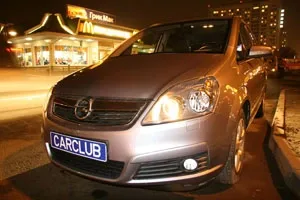
 A two-liter turbocharged engine producing 200 horsepower, a six-speed manual gearbox, and adaptive dampers — such a set of characteristics is usually expected in the description of a hot hatch or a small sports coupe. But before us is the compact van Opel Zafira, and it is these figures that make its test drive truly thrilling.
However, this is not the limit. For the most daring heads of families, there is a Zafira OPC version with 240 horsepower, which holds the title of the fastest and most powerful compact van on the planet. Our car has essentially one competitor — the Mercedes B200 Turbo. True, it costs noticeably more, weighs more, and, importantly, seats only five. The Zafira, on the other hand, takes seven on board and can carry them to a speed of 240 km/h.
Describing the Zafira's exterior is quite simple and even boring: the body shape is entirely subordinated to practicality. Straight pillars on the sides, a long roof flowing into a large vertical door at the rear — this is how maximum interior volume is achieved. The windshield, in contrast, is heavily raked and pushed far forward, improving visibility and adding a sense of spaciousness.
The spacious cabin is styled in Opel's new corporate design with sharp edges — it looks neat. If you compare the new model with the previous-generation Zafira, the silhouettes, despite the increased wheelbase to 2703 mm and a larger body, are very similar. The exterior is slightly enlivened by an optional relief roof with additional shelves on the ceiling.



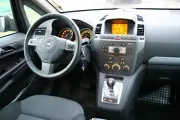
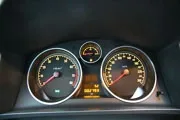
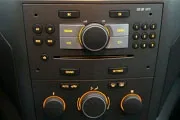
On the center console there is a silver insert with a built-in radio and a small screen. The steering column switches have no fixation and always return to neutral. You quickly get used to the turn signals, but not to the wiper control: you don't find the right position the first time. The rain sensor partially helps, but it is on the options list.
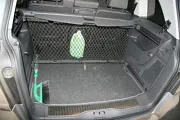
Most comfort is created for second-row passengers: the sofa slides longitudinally over a very wide range. This allows flexible distribution of space between the middle and rear rows, and no one has to be disadvantaged — the cabin length is enough for everyone. The only condition is that third-row passengers should not be too tall: the seat cushion is almost at floor level. On a long journey this is not very comfortable, but such seats fold flush with the floor, forming a trunk volume of 645 liters. The wide middle sofa does not fold; it can only be pushed forward all the way and the cushion raised vertically. In a two-seat configuration, the Zafira carries up to 1820 liters of cargo.
But these are all trifles. The main thing is hidden under the hood. The two-liter turbo engine is borrowed from Saab, which, like Opel, belongs to General Motors. A similar unit with 210 horsepower is installed on the Saab 9-3 Aero, but here it was placed in a family compact van.
Despite all its power, the Zafira can stall on careless starts — the culprit is the soft and uninformative clutch pedal. You either start by feel or with a slight wheelspin, and then the car behaves perfectly, especially since spinning the front wheels is quite easy. Peak torque is available from 1800 rpm and holds up to the highest revs. There is no turbo lag at all. If you don't let the tachometer needle drop below 1500 rpm, a reserve of thrust is guaranteed in any situation. And after 3500 rpm, a second surge occurs, which on lower gears can again spin the wheels. Fortunately, the stability control is set quite freely and allows continued acceleration without intervention.
The gearshift lever is located close to the driver, and gears engage sportily quickly. The only thing that hinders active driving is the weak vestibular apparatus of passengers, among whom, given the car's purpose, there may well be children. On gear changes and even simply when changing throttle, the Zafira noticeably noses over. Body roll in corners is unexpectedly small, but stability comes at the cost of a harsh reaction to small bumps and longitudinal body pitching. I believe that it is simply impossible to better tune the handling of a tall seven-seat compact van on the relatively narrow platform of the Golf-class Opel Astra hatchback. After all, you need to simultaneously combat the roll of a tall body, ensure passenger comfort, and maintain load capacity.
The situation is somewhat saved by switching the CDC (Continuous Damping Control) dampers to "Sport" mode via a separate button on the center console. Rolls in corners become even smaller, but it is not possible to completely get rid of the annoying nosedives. Even my fairly trained vestibular apparatus periodically signaled that such driving was not to its liking.
It seems that for a family compact van, 200 horsepower is clearly overkill. Moreover, the significant dimensions do not contribute to active maneuvering in traffic. There are no complaints about visibility, but the long body is not easy to control during frequent lane changes. As a result, the impressive acceleration dynamics are lost in city bustle, providing no real speed advantage in a metropolis. So, the powerful Zafira is not very suitable for the city, but then why does it need such a "heart"? The answer is obvious: for long highway trips. Here the powerful and torquey engine fully unfolds, and all six gears help optimize fuel consumption. On good asphalt, the Zafira confidently reaches 200 km/h — highways are its element. It's just a pity that we have few good roads.
The brakes match the engine's power: they are quite sufficient to stop the heavy car. The main thing is not to pay attention to the body nosedives, just keep the pedal pressed, and the Zafira will stop even sooner than you expect.
I returned the Opel Zafira to the dealership with mixed feelings. The 200-horsepower turbo engine gives the compact van impressive dynamics, but the chassis cannot fully realize such potential. If a seven-seat cabin is a must, and gasoline runs in the driver's veins, the Zafira is one of the few truly fast and affordable cars. The only alternatives are large SUVs like the Mercedes-Benz GL-Class or Audi Q7, but they cost several times more than the Opel.
If the number of seats is not critical and you just need a spacious car, it is worth looking at the Opel Vectra station wagon or the prestigious Signum hatchback. At a similar price, they have less powerful engines, but a higher class guarantees better interior trim and confident road behavior, especially on long trips when the Zafira's tall body noticeably reacts to crosswinds.
If you need a moderately powerful and very spacious seven-seat compact van, the Zafira with 1.8 or 2.2-liter engines will be a profitable purchase, especially since Opel prices, despite European origin, remain in dollars and affordable.
The base Zafira with a modest 1.6-liter engine (105 hp) costs $19,990. The version with a 1.8-liter engine (125 hp) and manual transmission will cost $22,450, and for the robotic Easytronic gearbox, dealers will ask for only $450 extra. The Zafira 2.2 (147 hp) is available only with an "automatic" and in the top Cosmo trim, priced at $31,000. The 200-horsepower version that we tested, in the same Cosmo trim with a six-speed manual, sells for $31,900. You must agree, quite reasonable money for an impressive cabin and a powerful engine.



Leonid Pavlov