
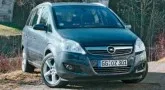
Next year, Opel will celebrate the tenth anniversary of its Zafira. The model has clearly been a success — it continues to be modernized to this day, which in itself speaks to its success. Soon, the two-millionth unit will roll off the assembly line, and in the past year alone, about 194,000 such cars were sold in Europe. To not lose its hard-won position, interest in the model needs to be constantly fueled. That is why in December the updated Zafira was shown in Bologna, and already in January European journalists were invited to Switzerland to get acquainted with the third generation of the popular compact van.
The first meeting with the car took place at Zurich airport. The updated Zafira has become more muscular than its predecessor, but not bulky, rather fit and sporty. Chrome inserts emphasize the pattern of the radiator grille, and the fog lamp niches seem to be smeared by the oncoming airflow. Dynamic, but without aggression — after all, it is a family car. At the rear, there are voluminous lights with transparent blocks at the level of the turn signals, which visually rest on a chrome strip. Strict and tasteful. The interior used to be often criticized for being boring, so the designers worked here too: chrome trims appeared on the climate control and audio system knobs, and new touches were added to the finish of the front panel and door cards.
But the main thing is not cosmetics. The engine lineup has been expanded with three units at once: one gasoline and two diesel. The gasoline one is a 1.6-liter ECOTEC with a Cam-Phase system that changes the valve timing on intake and exhaust depending on load. Thanks to this, the engine has become noticeably more responsive to the gas pedal. It produces 115 hp and replaces the previous 105-hp unit. Torque has increased to 155 Nm (plus 3.3% compared to the predecessor), while average fuel consumption, on the contrary, has dropped by 4.3% — to 7.1 liters per hundred.
The diesel range has also been updated: instead of 1.9-liter 100-hp turbodiesels, versions 1.7 CDTI with 110 and 125 hp are now offered, which meet the Euro 5 standard. These 16-valve engines use direct injection and a common-rail system. Their appetite has decreased to 5.7 liters per 100 km, and CO2 emissions are 152 g/km. However, the new turbocharger initially disappointed: the engine grumbles displeasedly if you start from a standstill at low revs, and it is better not to let the tachometer needle drop below 2500 rpm. Both diesels are paired with a 6-speed manual, and on mountain serpentines constantly working the gear lever was not particularly fun. But over time, you find the algorithm and start to get along with the engine. Alas, such versions will not be supplied to Russia.
Switzerland was chosen for the test not by chance. GM CIS PR manager Agnese Rona explained it simply: it is easiest to gather European journalists here. But as it turned out, on Swiss roads the Zafira looks very harmonious. And the Flex7 interior transformation system, which has not gone anywhere, makes the car maximally functional. You can go with the whole family to a ski resort, with six friends to a party, in the five-seat version with a 490-liter trunk to the supermarket, and by folding all seats except the first row, get 1700 liters of volume and a cargo area 2.8 meters long — even for carrying building materials to the dacha. But even when driving alone, no complexes about unused capabilities arise.
With a new heart
Opel marketers highlight five reasons why a buyer chooses a one-box vehicle that requires no compromises. But in this case, one is enough — to enjoy driving. Adaptive chassis contributes to this in many ways. The perfect Swiss road surface did not allow us to fully appreciate the "smart" suspension, but the handling on mountain passes fully corresponded to the principle "relax and enjoy." The updated Zafira can already be bought in Russia, though so far in a single specification — Cosmo with a 150-hp 1.9 diesel and 6-speed manual. The full engine lineup includes ten versions, including the 1.6 CNG ECOTEC on natural gas. The main task in developing new units was to increase fuel efficiency.
Driving
A rare combination of qualities: pragmatism, functionality, and driving pleasure.
Interior
The designers worked here too, which is a great addition to the main trump card — the Flex7 system.
Comfort
The front seats lack developed lateral support.
Safety
Equipment includes 8 airbags, active head restraints, a crash-safe pedal assembly, and ISOFIX mounts.
Price
Competitive.
Our opinion
Three trim levels, plus the Zafira OPC for families with sporting ambitions. Seven engine options, including the 1.9-liter turbodiesel, which will be available in Russia. The price range is from 549,000 to 790,000 rubles (for the OPC version they ask 962,000). Agree, there is plenty to choose from if you have already decided on the type of car.