
 In essence, this is a spacious cinema hall for five seats, to which you can add a couple more chairs if desired — apparently, in case of a premiere screening. The interior looks quite nice, but too strict and monotonous: there's nothing for the eye to catch. Broken lines, huge plastic surfaces in a "techno" style, everything is very monumental. On the other hand, nothing irritates; the interior is cohesive and organic.
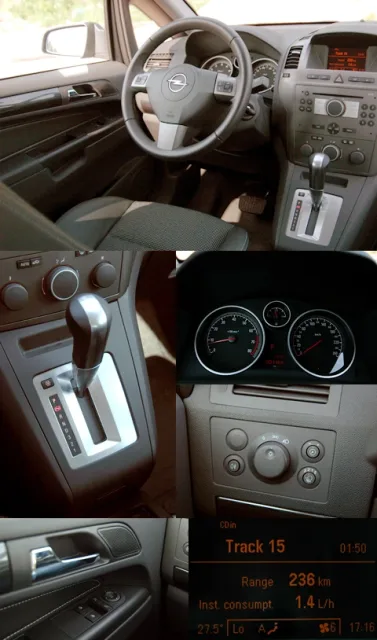 Complete "Ordnung" reigns here. Combined with the gray colors, the interior can't be called cheerful.
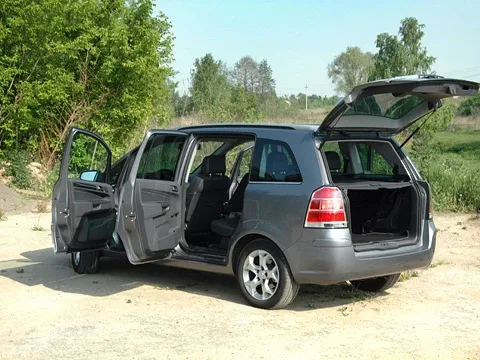
Since I can choose any seat, I decided to try them all. I start with the back row. The doors open wide, the openings are large — you can get inside without fear of getting dirty, and the ceiling is high, so there's little chance of hitting your head.
The first feeling is comfortable and spacious. There are even cupholders for popcorn and cola! That's a big plus: you won't have to hold all that appetizing paraphernalia in your hands. Your legs also have plenty of room. True, if you slide the front seats all the way back, legroom becomes less, but it's livable. The central tunnel under the middle passenger's feet is low, so they won't curse the Opel but can calmly enjoy the ride.
Complete "Ordnung" reigns here. Combined with the gray colors, the interior can't be called cheerful.
Since I can choose any seat, I decided to try them all. I start with the back row. The doors open wide, the openings are large — you can get inside without fear of getting dirty, and the ceiling is high, so there's little chance of hitting your head.
The first feeling is comfortable and spacious. There are even cupholders for popcorn and cola! That's a big plus: you won't have to hold all that appetizing paraphernalia in your hands. Your legs also have plenty of room. True, if you slide the front seats all the way back, legroom becomes less, but it's livable. The central tunnel under the middle passenger's feet is low, so they won't curse the Opel but can calmly enjoy the ride.
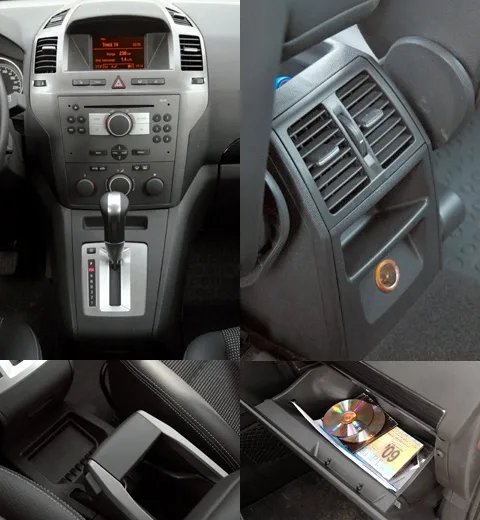 Zafira has no problems with functionality. The quality of the trim is also decent.
It turned out pretty good in the back. But what if we climb even further? To do this, you need to perform a few simple but slightly tedious operations. First, slide the second row forward, lift its cushion vertically, then, taking two third-row seats from the trunk floor, pull the handles and install them. After that, all that remains is to climb inside — and that's not so easy either. However, most likely, children will be seated in the third row — there's not much space there. Of course, an adult will fit too, but on a long trip, their legs might go numb to the point of complete loss of sensation.
Zafira has no problems with functionality. The quality of the trim is also decent.
It turned out pretty good in the back. But what if we climb even further? To do this, you need to perform a few simple but slightly tedious operations. First, slide the second row forward, lift its cushion vertically, then, taking two third-row seats from the trunk floor, pull the handles and install them. After that, all that remains is to climb inside — and that's not so easy either. However, most likely, children will be seated in the third row — there's not much space there. Of course, an adult will fit too, but on a long trip, their legs might go numb to the point of complete loss of sensation.
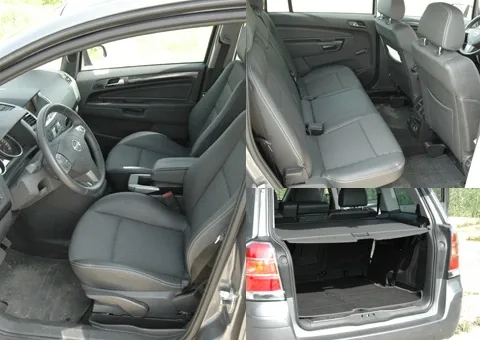 The front seats please with a good, well-calibrated profile. The second row with space, and the third — simply by the fact of its presence.
After all these manipulations with folding and unfolding seats, I want to say: the Flex7 system, which turns the cabin into anything — from a seven-seat "minibus" to a truck with a single driver's seat — will appeal to those who need a car for all occasions.
That's enough jumping around the rows — it's time to choose my place. Traditionally, I sit in the front left. I adjust the mirrors and realize they could be a bit larger. But the mirrors, the seating position, and the entire interior don't try to remind you that you're driving a compact MPV. The ergonomics are well thought out, everything is German-correct. Even too correct. Yes, the Zafira is a passenger car, golf class, no more. Although the far-reaching front panel and thick pillars in the front side windows (they annoy in long turns) bring thoughts back to reality. Plus, the large glazing area plays its "compact MPV" role.
I close the door, the light gradually dims, the movie begins. I remember that when I opened the trunk, I noticed a "2.2 Direct" badge — that's encouraging. The 2.2-liter four-cylinder gasoline engine, according to official brochures, should pull the car with excellent agility while remaining economical (the claimed average consumption is 8.5 liters, although the onboard computer showed 11.7 liters of 95-octane). Still, 150 horsepower for a family one-box is a good indicator. So, the movie will be, if not dynamic action, then certainly not a sappy melodrama.
The front seats please with a good, well-calibrated profile. The second row with space, and the third — simply by the fact of its presence.
After all these manipulations with folding and unfolding seats, I want to say: the Flex7 system, which turns the cabin into anything — from a seven-seat "minibus" to a truck with a single driver's seat — will appeal to those who need a car for all occasions.
That's enough jumping around the rows — it's time to choose my place. Traditionally, I sit in the front left. I adjust the mirrors and realize they could be a bit larger. But the mirrors, the seating position, and the entire interior don't try to remind you that you're driving a compact MPV. The ergonomics are well thought out, everything is German-correct. Even too correct. Yes, the Zafira is a passenger car, golf class, no more. Although the far-reaching front panel and thick pillars in the front side windows (they annoy in long turns) bring thoughts back to reality. Plus, the large glazing area plays its "compact MPV" role.
I close the door, the light gradually dims, the movie begins. I remember that when I opened the trunk, I noticed a "2.2 Direct" badge — that's encouraging. The 2.2-liter four-cylinder gasoline engine, according to official brochures, should pull the car with excellent agility while remaining economical (the claimed average consumption is 8.5 liters, although the onboard computer showed 11.7 liters of 95-octane). Still, 150 horsepower for a family one-box is a good indicator. So, the movie will be, if not dynamic action, then certainly not a sappy melodrama.
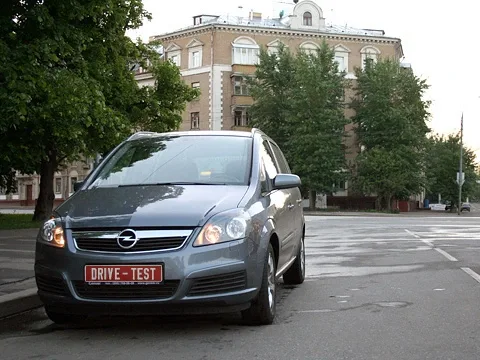 A lonely Zafira waits for many, many passengers.
That's it, I'm driving. The Zafira accelerates smoothly, but immediately I start to doubt whether someone is sitting in the back. I look around — no one. And the trunk is empty. Why doesn't the acceleration dynamics make you applaud, but rather resembles a cheap soap opera? Apparently, it's about fuel economy. Smooth accelerations and clear gear shifts, albeit with slight delays, but without going into the red zone, don't contribute to furious acceleration. But they also don't drain the tank at the same furious speed.
But since the editorial office pays for the gasoline, I switch to sport mode — to hell with economy! And it gets better. Gears shift when needed, the suspension becomes a bit stiffer, and the gas pedal more informative. The body rolls, which were already small, almost disappear. For those who like to drive fast, there's also a manual mode of the gearbox, but that's for enthusiasts. It's relatively convenient but quickly gets boring.
A lonely Zafira waits for many, many passengers.
That's it, I'm driving. The Zafira accelerates smoothly, but immediately I start to doubt whether someone is sitting in the back. I look around — no one. And the trunk is empty. Why doesn't the acceleration dynamics make you applaud, but rather resembles a cheap soap opera? Apparently, it's about fuel economy. Smooth accelerations and clear gear shifts, albeit with slight delays, but without going into the red zone, don't contribute to furious acceleration. But they also don't drain the tank at the same furious speed.
But since the editorial office pays for the gasoline, I switch to sport mode — to hell with economy! And it gets better. Gears shift when needed, the suspension becomes a bit stiffer, and the gas pedal more informative. The body rolls, which were already small, almost disappear. For those who like to drive fast, there's also a manual mode of the gearbox, but that's for enthusiasts. It's relatively convenient but quickly gets boring.
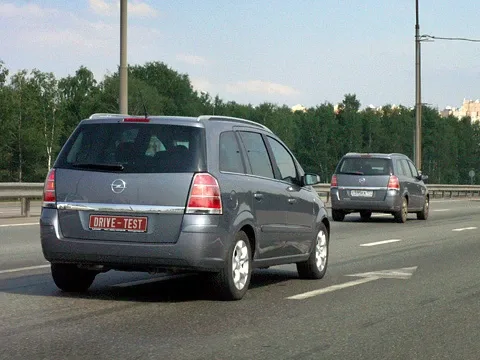 For a family car, the dynamics will be more than enough. Of course, our 2.2-liter is far from the "charged" Zafira OPC version, but quickly taking kids to kindergartens and schools will be quite decent, I thought, and immediately remembered that I don't have children. All the better — I won't be late for work. But before I could properly accelerate, I smoothly merged into the city traffic of central Moscow streets. And I noticed that I wasn't nervous as usual. The Zafira seems to stop time: everything happens smoothly and measuredly. The idyll is disturbed only by music coming from somewhere below — the acoustics aren't the best. Otherwise, it's bliss: nothing strains, the sound insulation is excellent, the engine is almost inaudible, and neither are the traffic neighbors tired of jams.
That's how I imperceptibly reached my destination. It, by the way, was in the city center, so it's clear that I couldn't park right at the target — I had to leave the car within a radius of a couple of kilometers. Fortunately, parking the Zafira isn't so scary — you feel the dimensions after the first minutes of the trip, no difficulties arise. I only disliked the steering wheel, which becomes heavy at very low (parking) speeds, and the fact that when I walked to the destination, there were two free spots right there.
For a family car, the dynamics will be more than enough. Of course, our 2.2-liter is far from the "charged" Zafira OPC version, but quickly taking kids to kindergartens and schools will be quite decent, I thought, and immediately remembered that I don't have children. All the better — I won't be late for work. But before I could properly accelerate, I smoothly merged into the city traffic of central Moscow streets. And I noticed that I wasn't nervous as usual. The Zafira seems to stop time: everything happens smoothly and measuredly. The idyll is disturbed only by music coming from somewhere below — the acoustics aren't the best. Otherwise, it's bliss: nothing strains, the sound insulation is excellent, the engine is almost inaudible, and neither are the traffic neighbors tired of jams.
That's how I imperceptibly reached my destination. It, by the way, was in the city center, so it's clear that I couldn't park right at the target — I had to leave the car within a radius of a couple of kilometers. Fortunately, parking the Zafira isn't so scary — you feel the dimensions after the first minutes of the trip, no difficulties arise. I only disliked the steering wheel, which becomes heavy at very low (parking) speeds, and the fact that when I walked to the destination, there were two free spots right there.
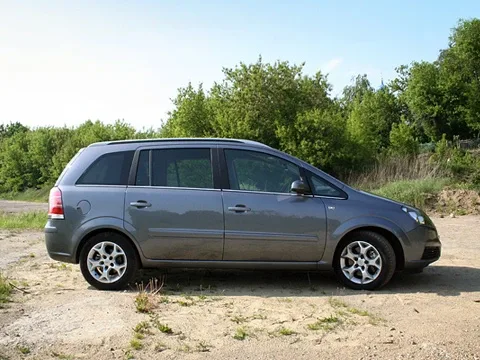 Okay, we've dealt with the city, now — onto the expanses of broken suburban roads! Surprisingly, the road to my dacha, lost in the Moscow region forests, doesn't take any effort. Driving straight at high speeds isn't stressful: the Zafira confidently holds the road, allows calm overtaking, and even pointless lane changes in search of a faster lane. The suspension handles road imperfections well. But at low speeds, you start to feel small and large bumps, although it doesn't cause indignation. The ride is good, smooth, but a bit stiff, even sporty-stiff, if that can be said about a family compact MPV.
On a winding road with plenty of turns, the Zafira again tries to convince me that it's close in spirit to a passenger car. The comfortable, plump steering wheel fits perfectly in your hands; on bumps, the car doesn't try to choose its own direction and even allows the driver to do silly things like fast cornering — the car goes exactly where you want. In general, it feels like sitting in a tram, only a very fast one.
Okay, we've dealt with the city, now — onto the expanses of broken suburban roads! Surprisingly, the road to my dacha, lost in the Moscow region forests, doesn't take any effort. Driving straight at high speeds isn't stressful: the Zafira confidently holds the road, allows calm overtaking, and even pointless lane changes in search of a faster lane. The suspension handles road imperfections well. But at low speeds, you start to feel small and large bumps, although it doesn't cause indignation. The ride is good, smooth, but a bit stiff, even sporty-stiff, if that can be said about a family compact MPV.
On a winding road with plenty of turns, the Zafira again tries to convince me that it's close in spirit to a passenger car. The comfortable, plump steering wheel fits perfectly in your hands; on bumps, the car doesn't try to choose its own direction and even allows the driver to do silly things like fast cornering — the car goes exactly where you want. In general, it feels like sitting in a tram, only a very fast one.
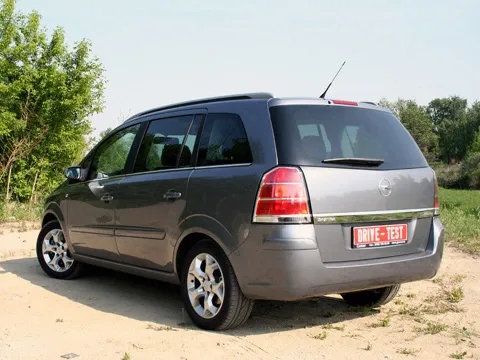
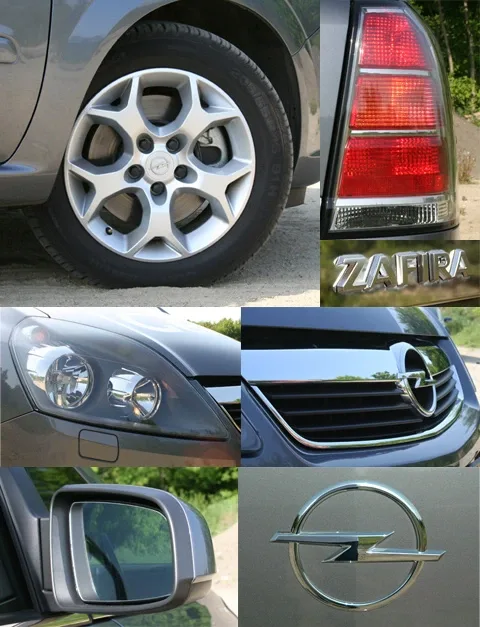 New design from Opel — modern but a bit cold.
Excessive speed is the only case when you feel that the rear slightly lags behind the front axle. But a person who bought a car for the family should think about loved ones, not try to demonstrate virtuoso steering skills. Your wife and mother-in-law won't appreciate such talents anyway, and children, if they haven't inherited your passion for gasoline, most likely won't be delighted either. The only consolation is that passive safety is in perfect order here: in the EuroNCAP crash test, the Zafira earned the maximum five stars (33 points) in a frontal impact.
In other situations, the electro-hydraulic power steering helps out. Its settings are such that the effort on the steering wheel changes depending on the speed you're driving and the angle of the wheels. And yet, one must admit: the Zafira handles like a passenger car, just like its predecessor.
However, for all these pros and cons, you'll have to shell out a tidy sum. The base version with the 2.2 Direct engine is priced at a minimum of $30,000. True, in the initial configuration, you won't find a luxurious panoramic roof or electric rear door windows — you'll have to crank them manually. But under the hood is a fairly powerful and at the same time economical engine. And the transparent roof and MP3 stereo can be added for an extra charge, especially since Opel's additional equipment is quite inexpensive.
The car for the test was provided by
the "Genser" dealership — official Opel dealer. 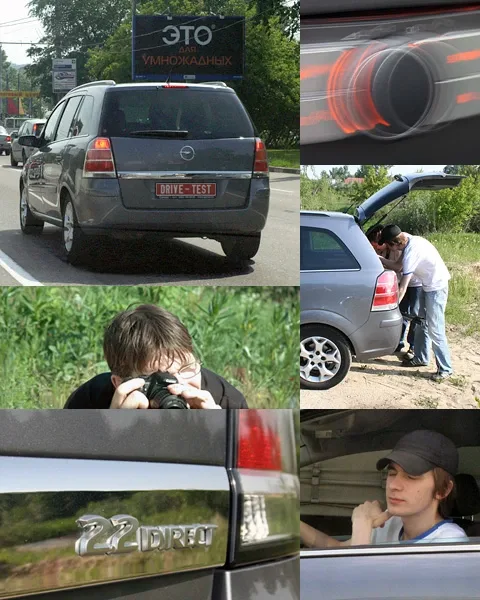
So, the final credits, let's sum up. The movie was a success, and it's even a bit sad that it ended so quickly. The Zafira is remembered as a very practical and functional car that will be an excellent option for those who aren't ready to trade passenger car handling for versatility. Even if you have to put up with a stiff suspension and a rather dull interior. Only I would advise such buyers to look not at the version with the 2.2-liter naturally aspirated engine, but at the more spirited modification with a two-liter turbo engine and a six-speed manual gearbox.
P.S.: I'll be completely honest: in reality, the Zafira showed me a completely different movie. Not at all family-friendly and heartfelt. Rather documentary, about harsh reality. If my memory serves me right — another episode about the quality of Russian roads…
Technical specifications
| Specifications | |
|---|---|
| Model | |
| Body type | Wagon |
| Number of seats, persons | 7 |
| Engine | |
| Engine displacement, cm3 | 2198 |
| Engine power, hp | 150 |
| Maximum torque, Nm/rpm | 215/4000 |
| Number/arrangement of cylinders | 4/inline |
| Number of valves per cylinder | 4 |
| Recommended fuel | AI-95 |
| Dynamic characteristics | |
| Acceleration time 0—100 km/h, s | 11.6 |
| Maximum speed, km/h | 190 |
| Fuel consumption — combined cycle, l/100km | 8.5 |
| Fuel consumption — urban cycle, l/100km | 11.6 |
| Fuel consumption — suburban cycle, l/100km | 6.7 |
| Dimensions and weight | |
| Overall length, mm | 4317 |
| Overall width, mm | 1742 |
| Overall height, mm | 1684 |
| Curb weight, kg | 1520 |
| Gross weight, kg | 2175 |
| Wheelbase, mm | 2703 |
| Trunk volume, l | 140/1820 |
| Fuel tank volume, l | 58 |
| Transmission | |
| Gearbox type | A/T |
| Number of gears | 4 |
| Drive wheels | front |
| Drive type | Front-wheel drive |
| Chassis | |
| Front suspension | Independent, MacPherson |
| Rear suspension | Semi-independent |
| Front brake mechanisms | Ventilated disc |
| Rear brake mechanisms | Disc |
Equipment of the tested car
- Lighting package — reading lamps front/rear, battery discharge prevention system
- Anti-lock braking system (ABS)
- Battery discharge prevention system
- Alloy wheels 16×6.5 5-spoke, Dynamic; Tires 205/55 R16 — 91 H
- Five-point wheel fastening
- Full-size spare wheel
- Mechanical driver's seat height adjustment in two directions
- Two rear adjustable headrests (with XXLo/XXVX/ XXWR)
- Central rear headrest (with XXLo/XXVX/ XXWR)
- Ashtray
- Metal sill plate for trunk
- Electrical outlet located in the trunk
- Trunk mat
- Sun visors with mirrors and lighting
- Three-spoke leather steering wheel with three black inserts
- Side airbags
- Radio with CD Radio CD30
- On-board computer (if UAG present)
- Climate control
- Interior lighting for rear passengers
- Door handles in body color
- Exterior mirrors in body color
- Manual folding of exterior mirrors
- Chrome radiator grille
- Roof rails, silver
- Manual folding of exterior mirrors
- Folding ignition key
- Dust package
- Cold climate package
- Air conditioning with automatic control
- Floor mats with colored trim
- MP3 radio "Radio CD30 MP3" (if UAG present)
The car for the test was provided by
the "Genser" dealership — official Opel dealer.
Behind the scenes