
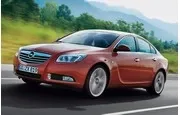
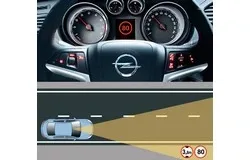
Opel employees struggle to hide their pride — and it's no wonder. As they claim, the Insignia, which replaced the Vectra on the assembly line, is the best creation in the company's history. Its very appearance, with its solidity, speaks volumes. But when you get behind the wheel and hit the road, you realize: the Germans' boasting is not without merit. The Insignia is comfortable in every respect. It's not just about the unusually quiet engine and soft suspension. The new Opel wins you over from the first minute with its thoroughness and gives the impression that you're in a car a class higher. Just slam the door or drive over a stretch with potholes — and you're surrounded by silence! You gladly realize that engineers managed to turn thousands of parts into a single whole. There's also a unique feature here that no other car has. The Opel Eye system, which uses a camera behind the windshield, can recognize and remember road signs. True, not all of them, but only those that limit speed or prohibit overtaking. As soon as a sign comes into view, it immediately appears on the instrument panel display. It's a useful thing: if the driver is distracted for a second, the system will remind him of missed information. We tested Opel Eye on a track prepared by brand specialists — everything worked flawlessly. However, you can truly appreciate it only on regular roads, where there are many signs and not all of them are in perfect condition.
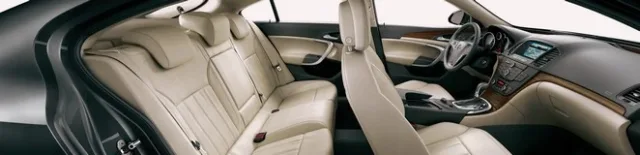
The new 2.0-liter turbodiesel with 160 hp stands out for its quiet operation and excellent elasticity. The Insignia fully meets expectations in terms of dynamics and matches its status. No one expects explosive agility from it, but the torque reserve always comes in handy.
Of course, the fresh turbodiesel in both versions — and the 130-hp "twin" is also two-liter — like all gasoline engines, meets Euro 5 emission standards.
Of the pair of gasoline turbo engines — 1.6 with 180 hp and 2.0 with 220 hp — we got the senior one, working in tandem with a six-speed automatic transmission. The gearbox shifts easily and effortlessly, and with this responsive and smooth engine it forms an ideal duo. The suspension didn't disappoint either. The car can boast a reliable all-wheel drive — though it's only an option and only for the gasoline version with a 2.0-liter engine — and the FlexRide system, which changes the stiffness of the shock absorbers. Once you activate it, the Insignia's character changes dramatically: from measured and touring to outright sporty — it all depends on the road and the driver's mood. Although in Sport mode you won't feel the sharpness that even short trips in Bavarian rear-wheel-drive cars provide, it still brings pleasure.
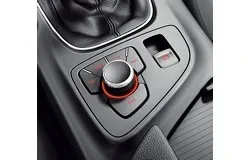 | ALL SIGNS TRACKED The Opel Eye system displays road signs on the instrument cluster display. Using the joystick on the center tunnel, the driver controls the stereo and navigation system |
 |
THREE FORMS AND CONTENT
Buyers have access to three body types: sedan, hatchback, and wagon, which bears the sonorous name Sport Tourer. Even in the base trim, there's air conditioning, a set of airbags, and other useful options.
Manufacturer's data
ENGINE
1956 cm³,
4 cylinders, diesel,
160 hp at 4000 rpm,
380 Nm 1750–2500 rpm
TRANSMISSION
Manual, 6 speeds,
front-wheel drive
DIMENSIONS (mm)
length — 4830
width — 1860
height — 1500
DYNAMICS
maximum speed — 218 km/h,
0–100 km/h — 9.5 s