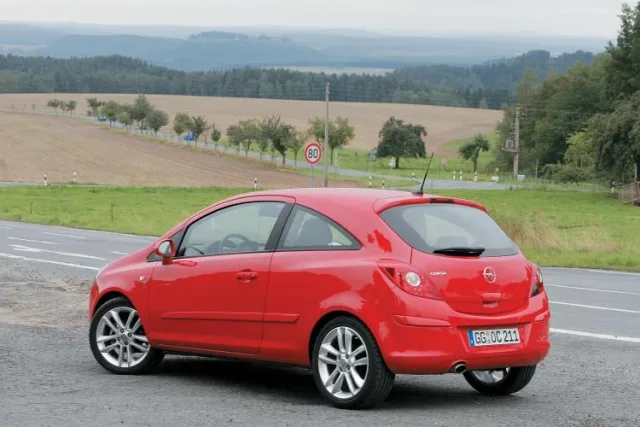
The new Corsa won me over at first sight — and bicycles are to blame. More precisely, a special rack for transporting them that slides out of the rear bumper. Of course, you'll have to pay extra for this option, but the solution is simply brilliant! This rack includes not only various locks and fasteners, but also additional lights — because the standard lights can be obscured by bicycle wheels.
However, even without bicycles, the new Opel Corsa hatchback leaves a pleasant impression. At least at first glance…
 |
| Instruments — like in Astra |
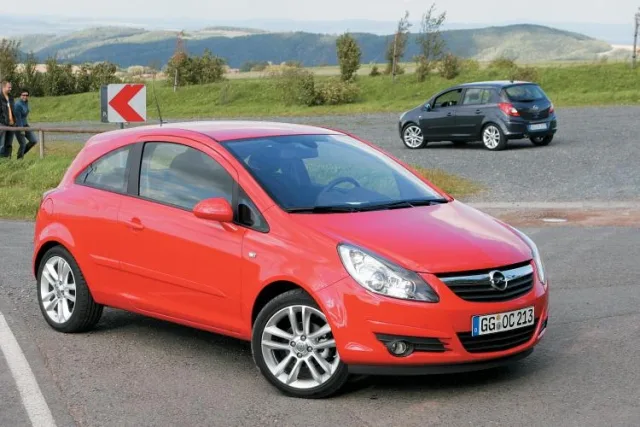
Now Corsa has serious competitors — fresh Peugeot 207, Renault Clio, Fiat Grande Punto… But, honestly, the new Opel looks no worse than these rivals. Especially the three-door version — with an arched window line and expressive stampings above the wheel arches. The five-door is also attractive, although the window line had to be changed for full rear doors. And the "face" of the Corsa is successful regardless of the number of doors: striking headlights, a noticeable protrusion on the hood, and the signature Opel "smile" on the front bumper, already familiar from Astra and Zafira.
By the way, pedestrians deserve much credit for the design of the new Corsa. It is for their safety that the hood now flows into the windshield almost without a break. True, because of this, small "minivan-style" triangular windows had to be added in the corners in front of the doors. But the high hood can soften the impact of a head in a collision — it's no wonder the new model has already received three out of four stars in the EuroNCAP pedestrian rating. And standard safety is also top-notch — the maximum five stars.
The Corsa's interior is cozy, but inside it's not as emotional as outside. Among the decorations are round air vents and translucent button-knobs. And only in certain versions is the interior enlivened by colored inserts — red, blue, or black "piano lacquer".
 |  |
| Lacquered plastic is solid. But you can also order a more "fun" interior — with red or blue trim | Among the buttons on the center console, there is also one responsible for the heated steering wheel |
 | |
| The thumb wheels on the steering wheel are convenient, which cannot be said about the non-latching paddle shifters | Among other modes, automatic headlight activation is also provided (option) |
With my height of 190 cm, I easily settled into the Corsa — I even had to move the seat slightly closer to the steering wheel. The seat is firm, in a German way, and height adjustment is already standard. The options list includes not only parking sensors, adaptive headlights, a panoramic roof, or that same sliding bicycle carrier, but also a heated steering wheel! True, unlike BMW, here not the entire rim is heated, but only the grip zones. But even base cars are well equipped: two airbags, front power windows, air conditioning, a CD stereo, and a trunk with a DualFloor double floor. The rigid shelf can be installed at two levels — lower or higher, to free up a spacious niche for small items underneath. In European specification, there is no spare tire, but an exception will be made for Russia — a full-size spare wheel will be standard.
The rear row in the new Corsa is perhaps one of the most spacious in its class: I sat "behind myself," only slightly touching the front seatback with my knees. True, getting in and out is not ideal — the opening between the seat and the pillar is a bit narrow. And in the three-door, the roof also presses down — beautiful design demands sacrifices.
Technically, unlike the design, there are few changes. The suspension is the same (McPherson struts in front and a semi-independent beam from Astra in the rear), and the engines are also… There are still three Twinport Ecotec petrol units: a 1.0-liter three-cylinder with 60 hp and two four-cylinders — 1.2 and 1.4 liters (80 and 90 hp). The diesel lineup has expanded slightly — 1.3 CDTI (75 or 90 hp) and 1.7 CDTI (125 hp).
I started my tests near Dresden with a five-door with a 1.2-liter engine and a five-speed manual.
The engine is weak! Even if you rev it to the maximum 6500 rpm, you can barely keep up with traffic. And what about the 1.0-liter version, which accelerates to 100 km/h in 18.2 seconds, like the Oka?
Gear changes are stiff, the gearbox's selectivity is not pleasing, and the accelerator and clutch pedals are vague. The steering wheel with electric power steering is "empty." And although the Corsa holds confidently in corners and takes them with high lateral g-forces without tire squeal, you don't want to do it — you have to steer by guesswork.
Maybe the Corsa 1.4 will please more? Sport versions with this engine get not only "sporty" seats with developed lateral support — there's also a stiffer suspension with reduced ground clearance (by 18 mm in front and 15 mm in the rear), a heavier electric power steering, and a rack-and-pinion mechanism with variable ratio. That is, when turning the steering wheel more than 90°, it becomes "sharper," and from lock to lock — only 2.3 turns instead of 2.7 in regular cars.
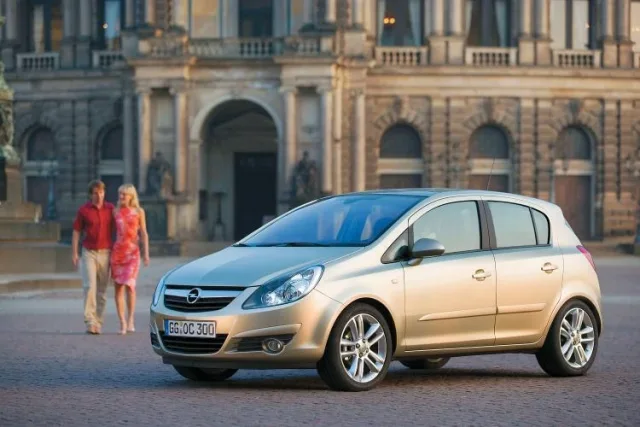
The five-door is not as expressive in profile, but it is good in front — as is the three-door
The Corsa 1.4 Sport is indeed a bit more responsive. But managing acceleration is not easier: gear changes are just as vague. Handling is better — the steering effort is higher, which helps you feel the car better in corners, but it's far from ideal. There's no talk of "sport." And comfort… No, the Opel is moderately quiet — if you don't rev the engine to the limit, the cabin is quiet. But the suspension of the "sporty" version is too stiff. Moreover, even a regular Corsa on 195/55 R16 tires too meticulously follows the profile of German roads. And what will it be like on our roads? Hope rests on higher-profile tires (the Corsa will come to us on 14- and 15-inch wheels) and on a bad-road package that will be offered optionally for Russia.
Finally, I took a ride in the top version 1.7 TDCI. An excellent diesel! With such torque, the stiff suspension is justified, the steering effort is maximal here, and the six-speed gearbox works much more precisely than the five-speeds on petrol versions… But even in Germany, the Corsa 1.7 TDCI costs 8000 euros more than the base 1.0-liter version. And we won't have diesels at all.
The only consolation: now the Corsa can be bought not only with a five-speed manual and the Easytronic robot, but also with a proper four-speed automatic — paired with the 1.4 engine (for an extra $1000).
 |  |
| In addition to the glovebox, a sliding tray under the passenger seat is offered | The trunk floor can be installed at the lower level (pictured) or raised to the loading height |
 |  |
| Sport trim: almost sporty seats | Compressor and sealant — for Europe, but cars for Russia will come with full-size spare wheels |
By the way, Russian prices are already known. The new Corsa will be available in October, and it is not much more expensive than its predecessor — the three-door with a three-cylinder engine starts at $11,990 versus $11,090 before. The five-door is $300 more expensive. However, as before, the most popular version will likely be the one with the 1.2 engine — from $12,840. And for the top 1.4 Sport, you'll have to pay $15,900.
Expensive? Well, not really…
The current Corsa is already the fourth generation; the model first appeared in 1982. The previous three sold 9.4 million units. The new Corsa will be assembled at two plants — in Eisenach, Germany, and Zaragoza, Spain. By the end of the year, 75,000 cars are planned to be produced, and next year — to reach full capacity of 375,000 per year. That's a lot, but… Compare: the Peugeot 206 in its best years sold 800,000 per year!
And in Russia, the Corsa is completely in the shadows. The market is growing rapidly, but sales of these Opels are falling: in 2004 — 2,279 cars, in 2005 — 1,984. Can't the striking appearance and expanded options list reverse this trend?
| Opel Corsa (manufacturer data) | ||||
| 1.0 | 1.2 | 1.4 | 1.7 CDTI | |
| Body type | 3/5-door hatchback | |||
| Number of seats | 5 | 5 | 5 | 5 |
| Trunk volume, l | 285—1050*/ 285—1100** | 285—1050*/ 285—1100** | 285—1050* /285—1100** | 285—1050*/ 285—1100** |
| Curb weight, kg | 1130—1160 | 1130—1160 | 1130—1160 | 1130—1160 |
| Gross weight, kg | 1555—1585 | 1555—1585 | 1555—1585 | 1555—1585 |
| Engine | petrol, with distributed fuel injection | diesel, turbocharged | ||
| Location | front, transverse | |||
| Number and arrangement of cylinders | 3, in-line | 4, in-line | 4, in-line | 4, in-line |
| Displacement, cm³ | 998 | 1229 | 1364 | 1686 |
| Cylinder bore/piston stroke, mm | 73.4/78.6 | 73.4/72.6 | 73.4/80.6 | 79.0/86.0 |
| Compression ratio | 10.5:1 | 10.5:1 | 10.5:1 | 18.0:1 |
| Number of valves | 12 | 16 | 16 | 16 |
| Max. power, hp/kW/rpm | 60/44/5600 | 80/59/5600 | 90/66/5600 | 125/92/4000 |
| Max. torque, Nm/rpm | 88/3800 | 110/4000 | 125/4000 | 280/2300 |
| Gearbox | manual, 5-speed | manual, 5-speed (robotic, 5-speed Easytronic) | manual, 5-speed (automatic, 4-speed) | manual, 6-speed |
| Drive | front-wheel drive | |||
| Front suspension | independent, coil spring, McPherson | |||
| Rear suspension | semi-independent, coil spring | |||
| Front brakes | disc, ventilated | |||
| Rear brakes | drum | drum | disc | disc |
| Tires | 185/70 R14 | 185/70 R14 | 185/65 R15 | 185/65 R15 |
| Maximum speed, km/h | 150 | 168 (168) | 173 (166) | 190 |
| Acceleration time 0—100 km/h, s | 18.2 | 13.9 (15.4) | 12.4 (14.8) | 10.1 |
| Fuel consumption, l/100 km | ||||
| urban cycle | 7.3 | 7.7 (7.6) | 7.8 (8.7) | 6.2 |
| extra-urban cycle | 4.6 | 4.7 (4.6) | 4.8 (5.7) | 4.0 |
| combined cycle | 5.6 | 5.8 (5.8) | 5.9 (6.8) | 4.8 |
| Fuel | petrol AI-95 | diesel fuel | ||
| * With rear seats folded in three-door hatchback | ||||
| ** With rear seats folded in five-door hatchback | ||||