
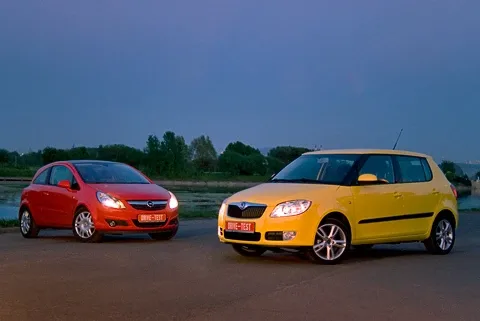
Nope! The cute little thing in flashy yellow stands there without flinching. And it prepared thoroughly for the comparison. Look at the equipment: climate control, adaptive headlights, 16-inch alloy wheels, sport seats, parking sensors, cruise control, and so on. Inside, there are six airbags, and under the 'blanket' — a whole bunch of electronic safety systems: ABS, ESP, EBD.
Did the competitors get scared? Possibly. However, as for equipment, our Fabia seems to have overdone it a bit and might scare not only competitors but also showroom visitors. No joke — a price tag of 23,850 dollars. If that doesn't make you run out of the showroom, it will at least cool the ardor of those hooked by the pretty looks.
The Corsas are simpler. Both in equipment and, most importantly, in price. The three-door in the Sport version, which includes climate control, sunroof, rain sensor, parking sensors, sport seats, and 16-inch wheels, costs just $17,200. And the five-door version with air conditioning, two airbags, and front electric windows is practically given away for about the initial loan payment on the Fabia — for $16,565. Well, okay, we'll sort it out on the spot — time to meet the guests of our DRIVE test.
For the Skoda Fabia, I decided to walk, since it's about a 15-minute walk from the editorial office to the representative office. I picked up the car, sat down, and drove. Yes, exactly that. The Skoda Fabia is a car from that series. Of course, I had to adjust the seat, steering wheel, and mirrors to fit me, but there's nothing to get used to. The interior looks like it's been put in all Skodas for the last thirty years. No, not in the sense that it's old-fashioned (though it doesn't shine with originality), but in terms of ergonomics. All buttons, except for two or three, are placed so clearly and logically that you can only make a mistake on purpose.
It's unlikely that inspiration often visited the designers when creating the Fabia's interior. But you can't fault the comfort. The Skoda has two glove boxes (one of them cooled), large door pockets, and a line-in for the audio system.
The effort on the steering wheel and pedals is exactly what you'd expect. Visibility, seating position, shift precision — there's absolutely nothing to fault. Everything is very correct and, I dare say, exemplary. Excellent 'chairs' (in our Sport version) with reliable lateral support, from which you won't fall in a sharp turn, and sufficient adjustment ranges. And even the dullest green instrument lighting, reminiscent of mid-nineties mobile phones, looks like 'eternal classics' here, though it's more fitting to say — 'a real bore'.
In just a measly forty minutes, I arrived at the editorial office, where my colleagues were already waiting, having managed to bring the three-door Corsa. Taking the keys from them, I go to inspect its interior. And it's also quite good. Nice trim materials, interesting design. True, there's no feeling of quality like in the Skoda. But you can feel that Opel has finally got that attention to detail that the Astra and Vectra lack.
The Corsa is much livelier inside, but it can't boast polished ergonomics. Controlling the main functions, fortunately, raises no questions, but there are problems with fine adjustments. And when driving over bumps, something constantly rattles in the cabin.
Unlike their cold tech interiors, the Corsa's innards look good not only at a glance but also in detail. Although, for controlling the central console, you'd still need to publish a book from the 'For Dummies' series. Working with the climate control raises no complaints, but dealing with the onboard computer or advanced 'music' settings is tough. By the way, I suspect that after these words, many of the happy (I hope) Opel Corsa owners will want to throw a tomato or something heavier at me and say that you can get used to the interface in just two months. Yes, you can. And to the non-latching steering column switches too. But, in my opinion, the ergonomics you don't need to get used to are better. Like in the Skoda Fabia, for example.
And overall, in terms of ergonomics, the Corsa looks less convincing. The seats from the sport version in the Opel are no worse than their counterparts in the Fabia, and there seem to be enough adjustments. But the seating position is still not quite what you'd want. You settle in comfortably — and your head is already pressing against the ceiling. Or rather, the large sunroof, which has eaten up quite a few centimeters of space beneath it.
Visibility is also not great: you sit, and in front of you stretches a huge field of the dashboard, above which the windshield looms, and in it, all that panel reflects very intrusively. And on the sides, all this is propped up by stupid 'double' pillars with mocking triangular windows (as if anyone would look through them). But rear visibility is good — both the side mirrors are normal, and you can see everything through the interior mirror. We'll assess the 'rear ends' of the cars a bit later, when the five-door Corsa arrives. For now, without waiting, let's go!
The Skoda Fabia's engine is already familiar to me — the Skoda Roomster in our test had the same power unit. This 1.4-liter motor hides 86 full-fledged horsepower and 132 Nm of torque. The three-door Corsa has a more powerful engine — 90 hp, but less torque — 125 Nm. Of course, the 1.2-liter Corsa with Easytronic will be an outsider, but we didn't take it to measure agility. So it will be out of the running.
In terms of dynamics, the cars are roughly the same. However, the Skoda's engine is duller — it starts pulling unhurriedly from almost the very bottom, and spins to the limiter with the enthusiasm of a stopwatch. Smooth, clear, boring. And the reactions to the gas pedal are, perhaps, overly stretched. We don't need these theatrical pauses. But these are subjective nitpicks, and objectively, you can't 'find fault' with this engine. And the shift precision is good.
The Corsa's engine starts showing all its agility only after 3500–4000 rpm, and before that, it's slacking off — at low revs, it's 'choked' by Euro-4 norms no less than the Fabia's engine. Therefore, to overtake the Fabia, the driver has to constantly kick the gas pedal, revving it 'to the redline'. And the gearbox's shift quality isn't the best.
While we were driving back and forth racing, the five-door joined us. It's clear, of course, that the Corsa with the 1.2 engine and Easytronic gearbox has no chance against the Fabia or its three-door 'sister'. But the 80-horsepower engine isn't that sluggish. Yes, the gearbox jerks during shifts and sometimes thinks too long, especially on lower gears. And that's inconvenient when starting from a standstill, for example, when you need to merge into traffic. One second — two, three. Catch! Thank God, we're moving!
But to be fair, it's not the worst 'robot' I've driven, and for calm city driving, it'll suffice. And on the highway, it allows you to hold your position in traffic very confidently. The engine has little power and torque, but in 'Sport' mode, there shouldn't be a lack of dynamics. In this mode, the crankshaft speed doesn't drop below 4000 rpm. It's clear that with this setup, fuel consumption increases significantly, and all the economic advantages of the 1.2-liter engine are negated. But when you press the gas, the car lunges forward almost immediately without any delays (since the engine operates at maximum output). The need for 'extra' downshifts and their sequential 'clicking' during further acceleration also disappears. And the acceleration time is significantly reduced.
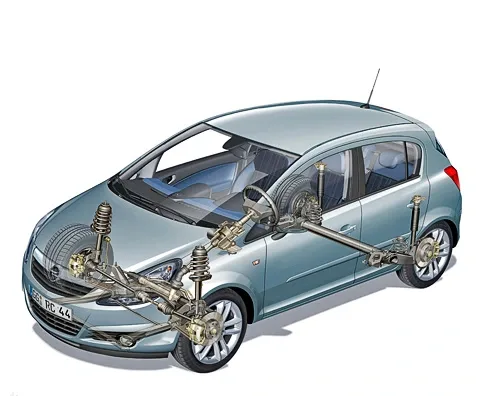
It must be admitted: in Sport mode, the jolts transmitted to the body are noticeably more aggressive than in the standard mode. Well, you asked for dynamics — you get it. But you still shouldn't get carried away with speed in the Corsa: the suspension too meticulously voices every surface imperfection. And here, no matter how you look at it, the main speed limiter becomes the car's own behavior: on gentle bumps at high speed, the Corsa seems not to notice them, but bounces like a ball, sometimes noticeably drifting off course. Against this background, the Fabia is the very picture of calm. By the way, an interesting point: after driving the five-door Corsa, I was left slightly disappointed with its character. The steering wheel seems responsive, but at the same time it's too light and "empty" in corners. The brake pedal is the same story: press a little harder, and the car, exceeding the deceleration plan, dives nose-first. But the three-door in the Sport version is a completely different story! The same drawbacks — the uninformative steering wheel and pedals — are also present here, but they manifest themselves much more softly and are almost unnoticeable. And driving such a car is much, much more interesting. It's not just about the power steering settings, but also the stiffer, 15 mm lowered suspension, as well as the shortened steering rack with progressive characteristics. The three-door's steering wheel makes 2.7 turns from lock to lock versus 3.5 for the five-door version. It's logical: the calm five-door suits city settings better, but a car with a 1.4-liter engine and manual gearbox can be "revved up" a bit. True, just a little. The price for this is not the most ideal straight-line stability, especially on broken roads and during braking. And the ride smoothness is strange: the suspension is stiff, but on "waves" the body noticeably rocks. The Fabia is simpler and more understandable. Both the electric power steering and brakes are excellently tuned. The handling is very balanced and — how many times have I said this word during the test? — correct, albeit not as thrilling. Reactions to the steering wheel are not as sharp and quick, but stability on any surface is amazing. The suspension, like the Opel's, is somewhat stiff and works loudly, but the car barely notices either "waves" or ruts. Excellent. The only thing that alarmed me: if you brake sharply in a steep turn, the car tends to break into a skid. And finally — practicality. Here the Fabia is again ahead. Its trunk wins not only in volume but also in the convenience of the opening. In the Corsa, it's somewhat narrow, so large items can be problematic, even despite the folding rear seats. For example, the 75-kilogram Robin-Subaru generator of 4 kilowatts, which we used during filming, wouldn't fit into the Corsa under any pretext, but we managed to stuff it into the Skoda. But the Corsa's trunk also has its own highlight — a double floor. Below, you can store all sorts of things that are needed rarely but aptly — say, a compressor or a first aid kit. And groceries from the supermarket (unless, of course, you're stocking up for six months) will easily fit on the second "floor." What about rear passengers? Not bad in both. But in the Skoda, there's still a bit more space for both legs and head — thanks to the flat roof and recesses in the seatbacks. Plus, the Fabia has a very convenient rear door opening and adjustable seatback angle. What's the bottom line? Fabia, Fabia, and Fabia again. Even two Opel Corsas failed to defeat it. And although the Fabia's advantage is not that big, it's clear. Dynamics are roughly at the same level. Cabin space? Skoda. Ergonomics? Skoda. Comfort? Also, perhaps, Skoda. Design? A matter of taste. So, an absolute and unconditional victory? It turns out, yes. But what's its price… $23,850 — that's how much a car costs whose equipment, although good, doesn't exactly amaze the imagination. And even if you refuse most options, equating the equipment with the Corsa, the price difference will remain huge. And you can't call the Corsa a bad car. And how much will a Fabia with an automatic cost — after all, in this class, the lion's share of sales falls on such versions? Add another couple of thousand dollars. And for many, such a price tag will negate all its advantages. Yes, the Skoda Fabia defeated the Opel Corsa. But isn't this a Pyrrhic victory?| Equipment | Skoda Fabia 1.4 Sport | Opel Corsa 1.4 Sport | Opel Corsa 1.2 Enjoy Easytronic |
|---|---|---|---|
| Price of base version, dollars | 17390 | 16190 | 14990 |
| Front airbags | + | + | + |
| Front side airbags | O | + | - |
| Inflatable "curtains" | O | + | - |
| ABS | O | + | + |
| ESP | O | O | - |
| Power steering | + | + | + |
| Adjustable steering column (height and reach) | + | + | + |
| Leather steering wheel and gear lever | + | + | - |
| Heated front seats | O | O | - |
| Headlight washer | - | - | - |
| Air conditioning | + | + | O |
| Climate control | O | O | - |
| Adaptive headlights | O | - | - |
| Fog lights | + | + | + |
| Power and heated exterior mirrors | + | + | + |
| Front electric windows | + | + | + |
| Rear electric windows | + | n/a | - |
| Power sunroof | - | O | - |
| Sports seats | + | + | - |
| Split-folding rear seat | + | + | + |
| CD audio system | + | + | + |
| Rain sensor | - | O | - |
| On-board computer | + | + | + |
| Rear parking sensors | O | O | - |
| Full-size spare wheel | + | + | + |
| Cruise control | O | - | - |
| Alloy 16-inch wheels | O | O | - |
| Price of tested cars, dollars | 23850 | 17200 | 16565 |
Cars for the test provided by
LLC "General Motors",
"LLC Volkswagen Group Rus" Skoda division,
car dealership "Genser" — official Opel dealer.
Buyers of the Corsa and Fabia, as is known, quite often choose versions with automatic transmission. In the conditions of modern megacities with their endless traffic jams, this decision looks quite logical. But what exactly can our heroines offer to those who are not ready to put up with three pedals?
The Opel Corsa has two "automatics" in its lineup. The first is a five-speed robotic gearbox Easytronic. In essence, it's the same manual, only servos are responsible for the clutch and shifting. The usual P,R,N,D scheme is absent here — only neutral, as well as automatic and manual modes are available. Such a gearbox can be ordered exclusively with the 1.2-liter engine, paying an extra $700. In addition, Opel also offers a classic four-speed automatic — it's paired with the 1.4-liter engine and is priced at $1000.
The Skoda Fabia cannot boast such a choice — it only has a traditional automatic gearbox, which is installed on top versions with a 1.6-liter engine. But it has as many as six gears! True, the surcharge compared to the manual gearbox is considerable — $2000.
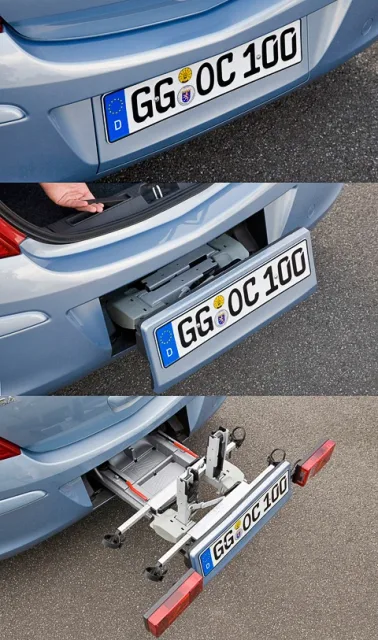
The equipment of modern cars, even the most compact ones, has already reached such a level that it's quite difficult to surprise anyone with a list of options. But manufacturers still try!
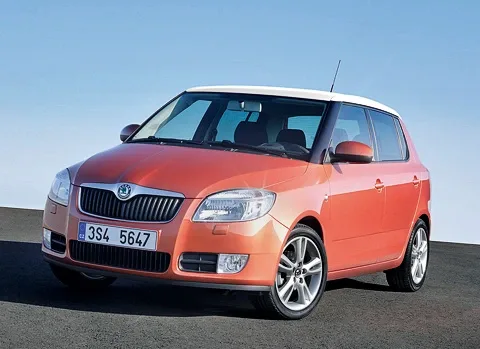
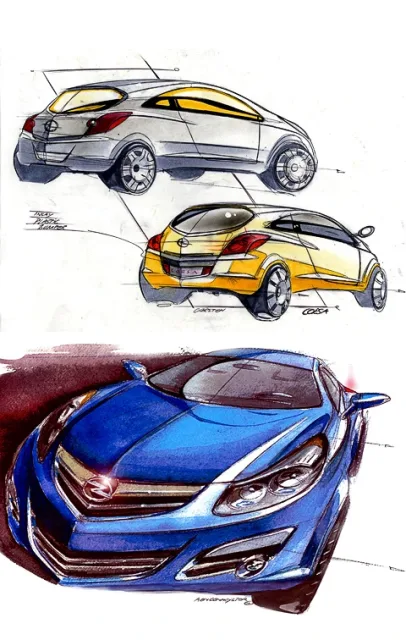
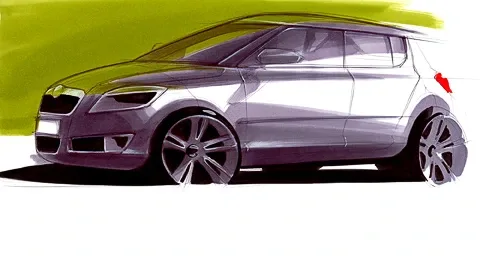
To be honest, we expected to pit the new Fabia in this test not only against the Corsa, but also against the Suzuki Swift — these cars look very similar. Although, as a designer working at Skoda told me, there can be no talk of any plagiarism: it's just that the development of the Fabia's design dragged on. But, alas, we never got the Swift — the dealers simply didn't have a free car.
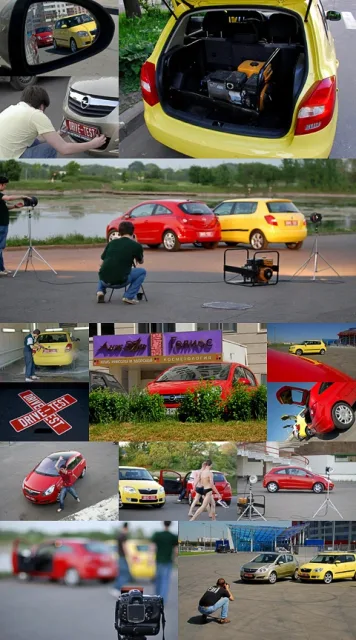
We did the shooting in two sessions. In the morning we went to Khodynka Field and shot the mandatory program there. And in the evening there was an "additional" part: we brought not only cars, but also a couple of kilowatt floodlights with a generator. True, the five-door Fabia did not come this time, but even without it there was plenty to do.
The next day after the shooting, we arranged a meeting with readers, where all three cars were standing — anyone could freely get inside and feel everything.
By the way, attentive ones could notice that in the trim table of the three-door Corsa, 16-inch alloy wheels are indicated, but in the photo the car is on regular stamped wheels. It's simple: just before the test, one of the colleagues "killed" its alloy wheels, so standard ones were quickly put on the car.