
Opel Astra Caravan. Wagon-transformer
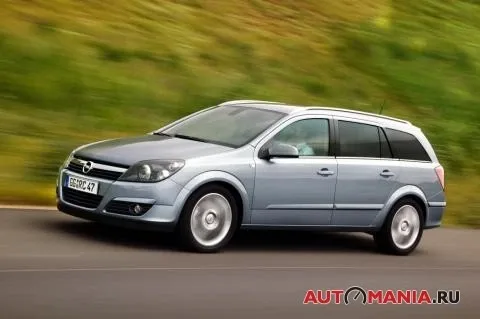
I confess honestly: for many years I considered myself a staunch fan of sedans. In my circle — among relatives and friends — a similar point of view prevailed. Hatchbacks, of course, were encountered, but were perceived rather as an exception to the rule. However, over the past year and a half, something strange has happened: about a dozen of my acquaintances, one after another, switched from classic three-box sedans to station wagons. Moreover, they had no urgent need for such a change of preference. What is the secret? The answer was found quickly — it was enough to spend a week behind the wheel of an Opel Astra Caravan.
From the hatchback that appeared a few years earlier, the Caravan differs externally only in its characteristic body profile. Otherwise, the "family ties" with the Astra family are unmistakably readable. At the front — the same recognizable face with embossed stampings on the hood, a massive radiator grille, voluminous transparent optics, and teardrop-shaped taillights at the rear. There is also the signature feature of all Opels — a longitudinal rib running through the entire body. True, in the station wagon it is no longer as pronounced at the rear. As with the hatchback, this line visually unites not only the exterior details but also the interior elements — you notice it even with a quick glance at the cabin. However, those who get into the Caravan for the first time are usually least concerned with such design subtleties. Russian drivers accustomed to the domestic auto industry evaluate the interior of a new car not so much by sight as by touch, and here the Astra gives plenty of reasons for pleasant impressions. The solid, textured plastic of the front panel, as befits a "German," pleases not only tactilely but also with high build quality. The same can be said about the assembly — all joints and gaps are flawless.
The Caravan's interior is styled with German pedantry: strict graphic Hi-Tech with horizontal "carbon-look" inserts, a center console with polished aluminum... The overall picture is successfully complemented by two-tone fabric upholstery of the seats. The instrument panel deserves special mention — its deliberately rough pseudo-sporty look and scales recessed into deep bezels, contrasting against the black background, perfectly harmonize with the car's athletic appearance. Nothing superfluous — information is read instantly. The seating position is also good, although it is far from the refined ergonomics of Recaro sports seats (which, by the way, are standard on the "hot" OPC versions) for the standard Caravan seats. However, the wide range of adjustments of the driver's seat (including the cushion lift) and the steering column with height and reach adjustment allow even a person of solid dimensions to sit comfortably behind the wheel. True, the rear passenger in such a case will get not so much space — but if he is short and of slim build, he will not feel cramped. Another plus of the cabin is that all controls are at hand, they work clearly and intuitively, so even a beginner can handle adjusting mirrors, power windows, or the audio system. But the air conditioning adjustment wheels, in my opinion, are placed too low: they are constantly blocked by the gear lever, forcing the driver to be distracted from the road — extremely inconvenient, especially at speed. To sum up: from the inside, the Astra Caravan is the same five-door hatchback, but only up to the second-row seatbacks. And then the trunk begins...
And here the Germans did their best: the Caravan's cargo area turned out to be more than decent. For those accustomed to loading the car to the brim, the "barn's" trunk will please not only with its capacity (just over 500 liters in standard condition) but also with excellent geometry. If necessary, the useful volume can be more than tripled. There are many options for transforming the cabin, but most of them will have to be paid extra. So, in the base version, the rear seat backrest folds in a 2:3 ratio, and for an extra charge it will be replaced with 40:20:40 sections — this will allow transporting long items in the center while retaining two full passenger seats. In general, the list of options is quite wide. For example, you can equip the trunk with the Flex Organizer system borrowed from the Opel Vectra Caravan: special guides and nets will allow dividing the cargo compartment into several independent zones. Another notable plus is the absolutely flat floor. This was achieved thanks to the compact rear suspension: the engineers did not abandon the proven semi-independent design with a torsion beam (the fuel tank was placed between the wheels, which saved space and allowed the cargo platform to be lowered as much as possible).
From a technical point of view, the Astra Caravan is a complete copy of the hatchback, but in terms of dimensions, the station wagon is noticeably larger. The body is larger in all parameters, and the wheelbase is increased by almost 10 centimeters. All this naturally affected not only the cabin volume but also the car's character: the Caravan rides much smoother and calmer than the hatchback. The energy-intensive suspension still adequately handles potholes and bumps. The sharp steering also does not let down, but sharp lane changes and high-speed corners are better not to provoke. The station wagon has a decent ground clearance of 16 centimeters (by the way, it is constantly maintained by the optional air suspension), which means the center of gravity is quite high — the car rolls noticeably. Moreover, after such a maneuver at speeds above 100 km/h, the car has to be "caught up" — and it's good that it stays within its lane.
Under the hood of the test Opel is the 1.6-liter 16-valve Twinport Ecotec engine already familiar to Russian drivers. Its technology is based on exhaust gas recirculation: at partial load, their share in the mixture reaches about 25%, which ensures efficiency and environmental friendliness. As on the hatchback, to get driving pleasure, the engine has to be actively revved. At low revs, the engine is, to put it mildly, boring, but after the 2500 rpm mark, it seems to get a "second wind." No, don't expect super-dynamic pickup, but the station wagon begins to accelerate much more confidently.
Overall, there are no serious complaints about the power unit. The Ecotec is exactly the engine a good station wagon should have: unpretentious, economical, honestly delivering all its 105 "horses" and providing the Opel with decent dynamics... But there is one "but": all of the above is true for a test drive when the car is not loaded. But the main purpose of the Caravan is to periodically take on board, in addition to passengers, also cargo. And in that case, the 1.6-liter engine no longer has enough power. With a full load, more intelligible low-end torque would also not hurt. However, the Caravan is not a racing projectile, but an ordinary station wagon that is not designed to conquer the track at the limit of its capabilities. The test Opel proved this repeatedly. And the point here is not at all in the modest engine characteristics (they fully correspond to the car's needs), but in the automated 5-speed Easytronic gearbox paired with it. This gearbox combines the functions of a "manual" and an "automatic"; it is more compact, lighter, and faster than a traditional torque-converter automatic. Shifting takes only 0.3 seconds, because, unlike an "automatic," Easytronic shifts gears using electric motors controlled by electronics. However, the "automatic" still works much smoother. Even with calm driving, the transition to a higher gear is accompanied by a noticeable "nod" of the body, and in sport mode, when the shift point shifts to the high-rev zone, the driver risks "nodding" into the steering wheel. The same symptoms appear in "manual" mode, although here much depends on whether the driver can find that very golden mean between dynamics and comfort, which, by the way, is not easy at all. In any case, I would definitely prefer a station wagon with a regular manual gearbox. However, the transmission's operation is almost the only serious drawback of the Caravan. In everything else, it will clearly not disappoint its owner, because the car has far more advantages than disadvantages. So, after spending a week in the role of "caravan-bashi," I seriously thought: isn't it time for me to switch from a sedan to a station wagon?..
Technical characteristics:
The appearance of this car is ambiguous — some are hooked at first sight, while others will remain indifferent. But in any case, it's hard to pass by such a design calmly.
Inside, everything looks quite simple, but at the same time assembled solidly. The instrument panel pleases the eye with pleasant lighting, but the seats, in my opinion, could be softer. However, in the back, passengers live quite comfortably: there is enough legroom, and the headroom reserve is not small.
On the move, the car behaves predictably. The steering wheel is quite informative, although at high speeds you want more resistance on the arc. The suspension turned out to be somewhat stiff — this is felt on small bumps, but in corners, body roll is minimal. The engine, despite its modest displacement, pulls well in the mid-range, but at low revs it clearly lacks elasticity. The gearbox works clearly, although the lever could be shorter.
Fuel consumption pleased: even with active driving, it does not greatly exceed the figures declared by the manufacturer. Sound insulation is average — on the highway you have to raise your voice when talking. The trunk is spacious, and if you fold the rear seats, you get an almost flat platform for transporting bulky items.

The price for such a car seems quite adequate, especially considering that the base trim already has everything necessary. As a result, we get a practical and economical car with a non-standard appearance, which is suitable for those who want to stand out from the crowd without overpaying for the brand.
