
I had long dreamed of pulling off this trick right while driving. Press a button, without braking or reducing revs — and have the sky open up above my head. True, for most convertibles, the folding mechanism works only after a complete stop…
Most — but not the Opel Astra TwinTop: its rigid three-section roof retracts into the trunk in half a minute, as long as speed does not exceed 30 km/h. And for that, a single press of a button is enough.
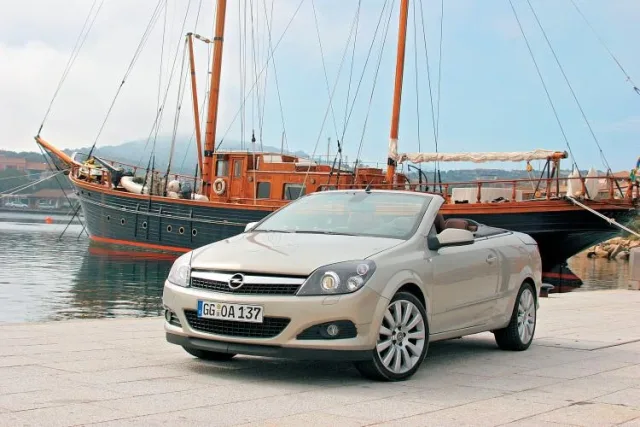
I press the button, and… Instead of the whistle of wind in the open cabin, a disappointed buzzer sounds: ding-ding-ding. I forgot to secure the protective cover in the trunk — without it, the roof won't budge. I'll have to stop. I get out, open the trunk, stretch that cover — and out of 440 liters of usable space, only 205 remain…
And so we're on our way again — and I finally do what I planned. Wake up, thirteen sensors, turn on, eight hydraulic cylinders and five electric motors! The four windows slid down. The trunk lid, suspended on parallelograms, lifted against the direction of travel — and the roof folded in three places at once. Behind the seat backs, a decorative panel sprang up, waved its little wing-plugs — and lay down, covering the slots of the folded rear pillars. German engineers for some reason dubbed this dance the “lambada” — an association, to say the least, unexpected. The trunk slammed shut — the windows rose again. And above my head floated the soft island air of Sardinia.
 |  |  |
| The interior is exactly like the hatchback's. The rear seats are better given to bags — and covered with a wind deflector | The roof control button is located above your head — holding it pressed for half a minute is uncomfortable. Especially while driving | Don't pay extra for leather upholstery. The leather is not of the best quality, and its friction properties are almost zero. The combined fabric upholstery has no drawbacks |
Great! But there's a noticeable draft in the cabin, so it's worth installing a wind deflector behind the front seats. It hides under the trunk floor, and to get it out, you need to raise the roof again, stop again, pull out the cover, unfold it, lower the top, and insert the deflector into the mounting slots. How complicated everything is in this world…
The Astra TwinTop coupe-cabriolet is built on the platform of the three-door Astra GTC hatchback — one of the most striking cars in its class. Hence the swift hood and boldly raked front pillars. Moreover, the TwinTop looks even lower than the “three-door” — it is 186 mm longer, 37 mm wider, and 21 mm lower. A beautiful car!
 |
| The Opel Astra TwinTop is one of the first cars with a three-section folding roof. The top retracts into the trunk in 30 seconds at speeds up to 30 km/h. The kinematics are mesmerizingly complex. It's especially amusing to watch the flaps of the delicate wing-plugs (bottom left). But the Germans assure that the system is absolutely reliable and designed for about 7,500 open-close cycles — that's 12–15 years of operation. They say that during testing, the mechanism withstood 20,000 cycles |
Similar “transformers” have long been sold by Peugeot and Renault, and Ford has just shown the pre-production Focus CC — but they all have two-section roofs. And, as a result, visually overweight rear overhangs. But since the Astra TwinTop was “conceived” quite recently, two years ago, the company CarTopSystems (CTS — a joint venture founded in 1995 by DaimlerChrysler and Porsche) proposed a fresh solution for it — a three-section design. Its main trump card is compactness. And that means freedom for designers — and harmony of image. After all, hardly anyone would call the open Astra heavy on the rear.
True, the three-section scheme also has a significant drawback. The folded roof “sandwich” turns out to be too thick — the remaining liters in the Astra's trunk are practically unusable. Through the gap between the folded roof and the trunk threshold, only a thin briefcase can fit. Therefore, the Germans came up with the Easy Load function: a servo drive lifts the glass-metal “sandwich” by 25 cm — so a small travel bag can be pushed under the roof.
The roof module weighs about 110 kg, which, together with additional body reinforcements, has made the Astra almost 300 kilograms heavier. But on the move, the Astra doesn't feel massive. Especially if under the hood there's a 200-horsepower turbo engine. According to official data, the one-and-a-half-ton TwinTop accelerates from standstill to 100 km/h in 8.9 seconds — it loses to the three-door hatchback by just over a second. But in reality, you hardly feel the loss! Plus good ergonomics, good efforts on the controls, clear feedback from the steering, precise gearbox operation… Only visibility is terrible: because of the low-mounted rearview mirror, in right turns you practically have to lie on the dashboard to see anything.
In press releases, the Astra TwinTop is presented as a full-fledged four-seater. In fact, the seating formula of the “transformer” is 2+2. Moreover, the second pair is with a minus. You can seat adults in the back only by moving children to the front. And of course, with the wind deflector installed, the Astra becomes strictly two-seater.
Sometimes test routes during presentations are laid only on roads with perfect asphalt — not a pothole, not a crack. How can you tell how the suspension works, what the ride comfort is? But for the premiere of the coupe-cabriolet, the organizers chose the most ordinary roads of Sardinia — insanely beautiful, but sometimes frankly bad. And the patched Italian asphalt immediately revealed the car's main drawback — insufficient body rigidity. With the roof closed, the windows quietly creak, and with it stowed, the steering column vibrates on small bumps. The steering wheel “wanders” in your hands even in the transverse direction. Insufficient body rigidity? But the TwinTop project manager, Klaus Reuter, blamed it on the peculiarities of pre-production assembly.
— Body rigidity? I can't give an exact figure — it's enough that it has increased by 30% compared to the previous Astra convertible. The rigid roof, sensitive to distortion, requires this.
 |  |  |
| Opel 18C Moonlight Roadster (1932) and Opel Super Six (1937) | Opel Olympia (1951) | Opel 4/12 PS (1928) |
| In addition to the Astra convertibles of the last three generations, Opel brought several rare cars to Sardinia | ||
The next day I managed to drive the open Astra with a more relaxed 140-horsepower 1.8 engine (almost the full range of Astra engines is intended for the coupe-cabriolet). A perfectly balanced car! The thing is that this car had a regular “passive” suspension, while the turbo version is equipped with the IDS Plus system with stiffer active shock absorbers. It turned out that the “soft” suspension willingly “swallows” bumps and does not transmit them to the steering wheel. As a result, driving the car is much more pleasant. Especially since the engine doesn't seem sluggish: the control unit here is tuned more interestingly than on regular “family” Astras. Responses to the accelerator are livelier, and it's easier to control acceleration. Only the motor is still a bit noisy...
 |  |
| To somehow use the remaining 205 liters in the trunk, the Germans came up with the Easy Load function (load simply): press the red button on the trunk threshold — and the servo drive lifts the roof “sandwich” by 25 cm. But in the “coupe” configuration, the Astra's trunk volume reaches 440 liters. However, this is still noticeably less than competitors | |
The Astra TwinTop is not a cheap car. Even in Germany, prices start at 23,650 euros for the version with the 105-horsepower 1.6 engine — that's 150 euros more expensive than the 110-horsepower Peugeot 307CC coupe-cabriolet. Given that for a two-liter Peugeot 307CC with 143 hp and a manual transmission in Moscow they ask no less than $34,000, it can be assumed that the most popular model, the Opel Astra TwinTop 1.8 with an automatic, will be at least not cheaper...
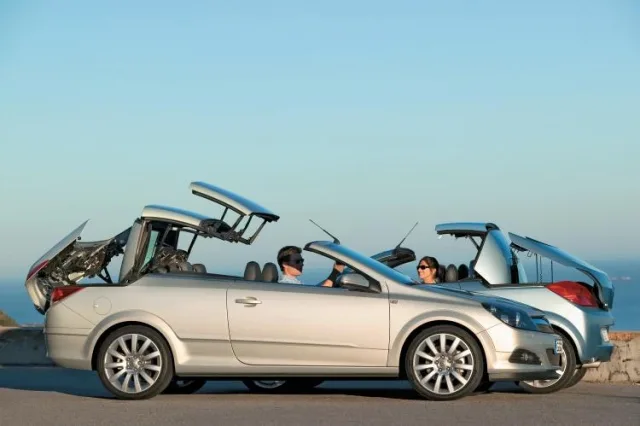
Now two Opel models at once sport rigid folding roofs: the kinematics of the two-section top of the mini-roadster Tigra are no less original
By the way, returning the key fob of this cute coupe-cabriolet, I caught myself on gloomy thoughts. Astra TwinTop is already the second Opel with a folding hardtop, not counting the little Tigra, which was recognized as "Cabriolet of the Year" in Europe in 2004. Looking at these cute trinkets, it's hard to believe that the company making them is not in its best shape right now. Opel has noticeably rejuvenated: for the sake of a new image, they moved mountains, even started producing niche models like the beautiful GT coupe shown in Geneva. But mass sales are stalling. And still, Opel remains part of the giant and sluggish GM concern, which today is balancing on the brink of a financial cliff. In American tech centers — in Warren and at the Milford proving ground — they have already started laying off engineers. Will the cuts reach Europe?
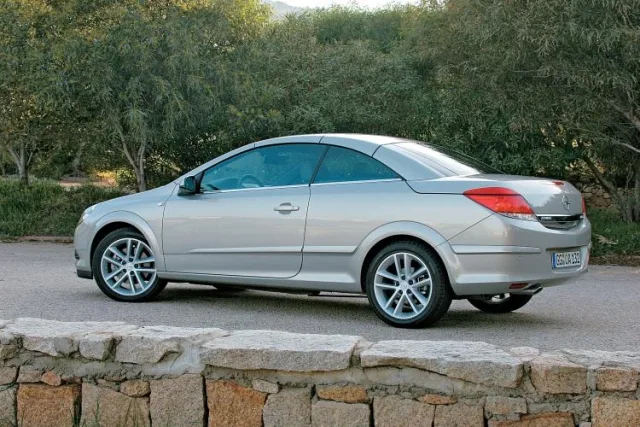
I bet it's not easy to answer in which form the Astra TwinTop is better — open or closed. And also take a look at the small braces along the underbody to the rear semi-independent suspension. They are not on the body reinforcement diagram, nor in the factory photos. It seems Opel engineers fought for rigidity to the last. But it's still slightly lacking. Or is this just a special version for the press?
— Maybe they are cutting in America, but it definitely won't affect us, — Reuter confidently stated. — Look for yourself: we have just completed the new Astra lineup. Hatchback, station wagon, three-door, and now — a coupe-cabriolet with a hardtop. The Astra is in its prime. So everything is great with us!
 |  |
| If the electronics decide that the car might roll over, powerful springs will instantly deploy the roll bars from behind the rear seat backs. They also deploy in some accidents without a rollover — even when the roof is up | The body reinforcement of the cabriolet is done according to the same scheme. Reinforced front pillars and a horizontal strut between them, thick metal of the side sills and floor, reinforced door frames, a cross member behind the rear seats. And at the rear, the Germans installed diagonal struts and a clever damper supporting the rear cross member between the longitudinal beams |
I didn't delve into this topic. I just thought that before the storm, the sun shines especially brightly…