
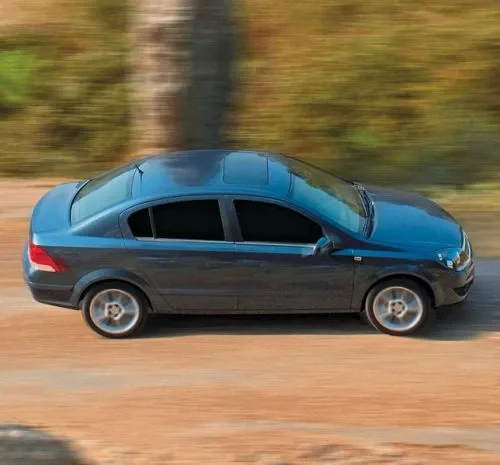
The Opel Astra family could already boast a variety of body types, and now a sedan has joined it. The reason for this version's appearance is simple — this form factor is traditionally in highest demand on the Russian market. Guided by this feature, many European brands have already adapted their hatchbacks, turning them into classic sedans.
Now the Astra lineup includes seven body variants! Along with the familiar hatchbacks, coupes, station wagons, and commercial modifications, a sedan comes to help in the fight for customers. Despite such diversity, all versions are executed in a unified style. In the sedan, designers bet on classic features: the elongated window line and negative rake of the rear pillars give the silhouette a traditional and recognizable look.
The dimensions of the new model are also impressive. The sedan reaches 4587 mm in length, 1753 mm in width, and 1458 mm in height. Considerable attention was paid to practicality: the minimum trunk volume is 490 liters, and with the rear seats folded, it grows to 870 liters. Moreover, you can transport items up to 1721 mm long — an excellent indicator for this class.
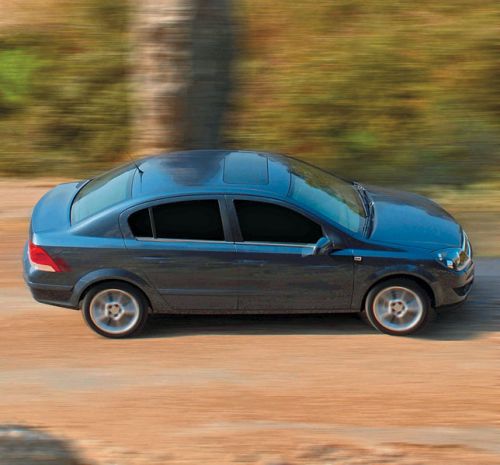
2008 Opel Astra
© Photo: Opel
Inside, everything is familiar from other Astras — nothing radically new was found. Ergonomics remain at the same high level: the instrument panel is easy to read and not overloaded with unnecessary data, only the speedometer, tachometer, and fuel gauge. On the move, the car surprises with comfort. Driving on high-speed highways is a pleasure: any irregularities, whether small joints or large potholes, are handled quickly, clearly, and absolutely silently.
But on winding roads, the sedan feels less confident. The IDS chassis includes McPherson struts at the front and a torsion beam at the rear. The combination is decent, but in corners when lifting off the throttle, the rear axle starts to drift. This can be avoided in two ways. The first is to order the car with the ESP Plus stability system. The second is to wisely choose the powertrain and gearbox. The engine range is modest: two petrol engines of 1.6 and 1.8 liters and one 1.7 diesel. The latter can be immediately crossed off — it is not planned for delivery to Russia. The petrol 1.6 works in tandem with a 5-speed manual or a robotic gearbox, which will appear later. For the 1.8, either the same 5-speed manual or a 4-speed automatic is provided. During the test, it turned out that for this suspension — comfortable but not tolerating sharp maneuvers — the best options are the 1.6 with a manual gearbox and the 1.8 with an automatic.
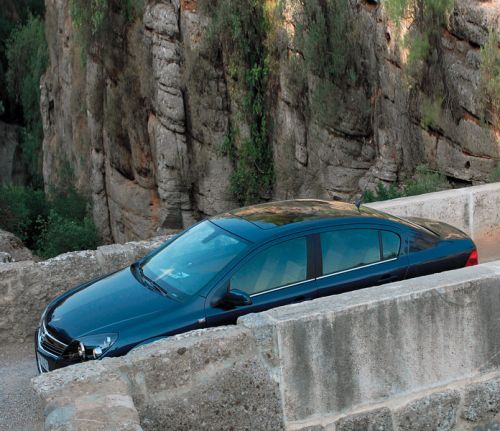
2008 Opel Astra
© Photo: Opel
Despite the difference of 25 hp, the engines' characters are similar. Acceleration to 100 km/h takes just under 12 seconds for each, with peak torque at 4000 rpm. At low revs, traction is mediocre, but at high revs — in the range of 6000–6500 rpm — the engines come alive. This slightly reduces the risk of accidentally overdoing the throttle in a corner and causing the car to slide. However, on the version with the 1.8 and manual, such chances still exist. You can drive quite fast, but it's important to remember that this is not a sports car.
The Astra sedan will be available in three trim levels: Essentia, Enjoy, and Cosmo. Prices will be $600–800 higher than for the familiar hatchbacks. Thus, the minimum cost will be $19,880, and the top version will cost $24,880. The price is largely justified by the equipment, but there are plenty of competitors in this segment, so the fight for customers promises to be serious.
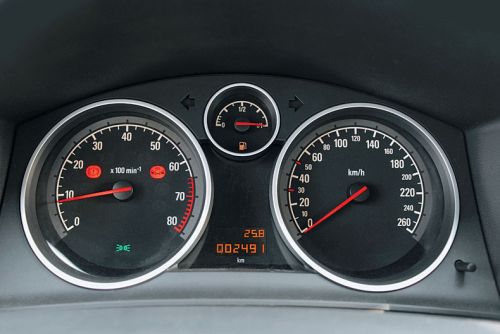
2008 Opel Astra
© Photo: Opel
At home in the sedan
The trim materials pleasantly surprise. Soft plastic creates the feeling of being in a car of a higher class. True, in some places the quality of panel fit leaves much to be desired, but overall the interior deserves a solid four. A new detail is the lacquered black inserts on the center console and steering wheel. However, for the steering wheel trim, officially called "piano-type coating," you will have to pay extra — it's an option. The suspension of the Opel Astra sedan is tuned for maximum comfort: on straight highways, the car pleases; on winding roads, it requires caution. Sound insulation is excellent: external sounds barely penetrate the cabin. The idyll is occasionally disturbed only by the engine hum, which becomes noticeable closer to maximum revs.
Driving
The sedan is comfortable, the suspension is well-tuned and balanced, but, alas, not designed for active driving.
Interior
Attracts with material quality, although assembly flaws are noticeable in places.
Comfort
It is based on the station wagon platform, not the hatchback, which made it possible to make the cabin and trunk as spacious as possible.
Safety
The installed safety systems meet modern requirements.
Price
At this cost, choosing among competitors becomes difficult.
| Dimensions, mm | 4587x1753x1458 |
| Engine | petrol, 1598 cm3, 115 hp/min-1 |
| Transmission | manual, 5-speed |
| Dynamics 0-100 km/h, s | 11.7 |
| Maximum speed, km/h | 191 |
| Competitors | Ford Focus, Mitsubishi Lancer, Honda Civic, Mazda3, Toyota Corolla |
Advantages and disadvantages
+ Spacious cabin, good quality of trim materials.
- "Strangled" engines, uninformative steering wheel.
Our opinion
The car turned out to be decent, but given the asking price, it will have a hard time. For this money, the choice is very wide, and the new model has no advantage of affordability. It will have to win customers with something else — perhaps the classic body shape.