
— Look at these children's drawings. — Bill Mott, responsible for promoting the Astra family at Opel, shows the press images of cars drawn by children from different countries. — What unites them? They are all sedans!
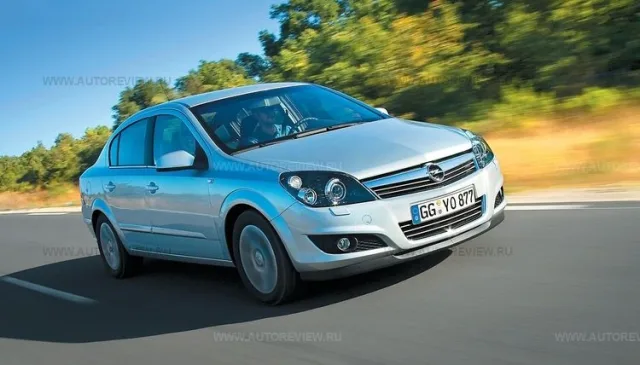
The conversation takes place at the Turkish resort of Antalya, and the occasion is a driving presentation of the Opel Astra sedan.
Indeed, why is it that almost always, when we ask a child to draw a car, we get the same result — wheels and a boxy three-box body? Why is a "car" in a child's perception still a sedan?
But when European children grow up, they prefer completely different cars — hatchbacks, crossovers, compact vans... In Western Europe, sedans in the golf class account for only 5%. In Poland and Southern Europe — already 15%. And only Russians and Turks remain loyal to sedans — the share of such bodies in the C-class reaches 67%!
A similar picture, by the way, is in Latin America. That is why the four-door version of the Opel Astra was developed, among others, for Brazil, where it has been produced since 2005 under the name Chevrolet Vectra. And at the end of this summer, sedan production started at the Opel plant in Gliwice, Poland (see AR No. 18, 2007): they plan to produce 40 thousand cars annually here — for the markets of Greece, Finland, Spain, Central and Eastern Europe. And 30% of the total volume, according to the plan, will go to the two most "sedan-loving" countries — Turkey and Russia.
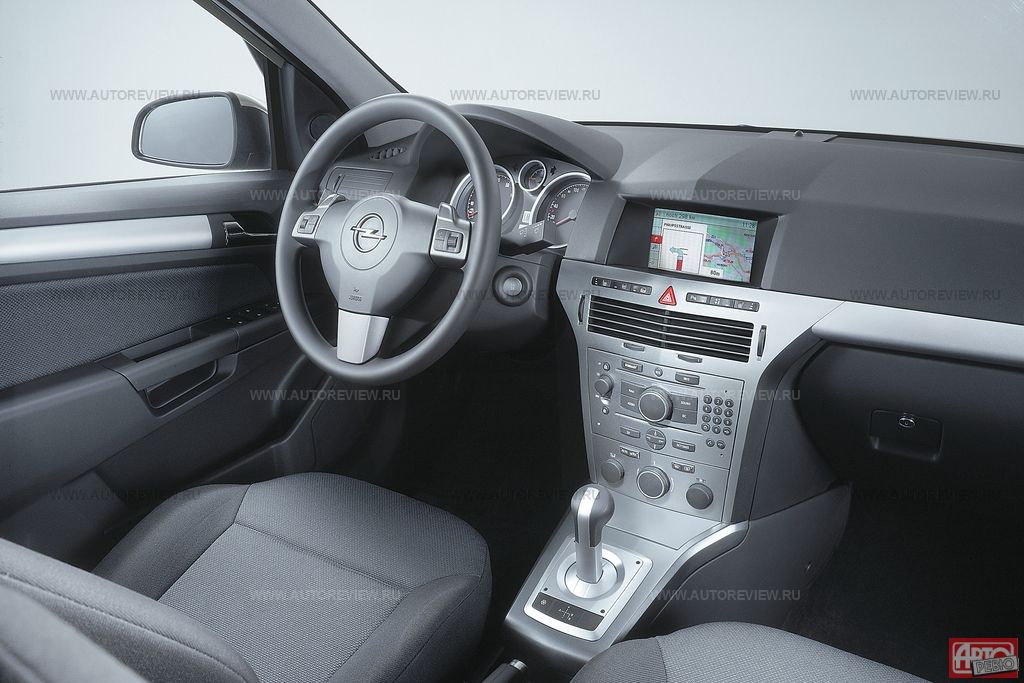 | 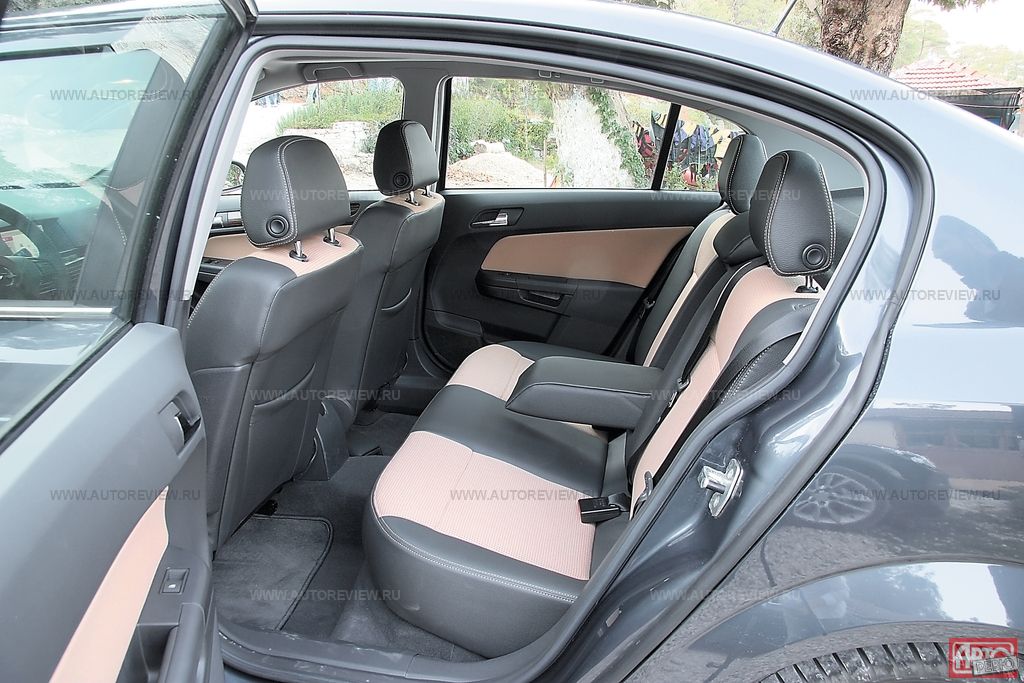 |
| The front panel is exactly the same as on hatchbacks: technocratic design and pleasant materials | A person 185 cm tall is comfortable in the back: the sofa is lower than in the hatchback and shifted back. Of the additional conveniences — only an armrest |
What attracts us to golf-class sedans?
The fact that we are not rich. And the fact that, buying the only car for the family, we want it to be spacious, roomy (the trunk of sedans is usually larger than that of hatchbacks), and also look solid.
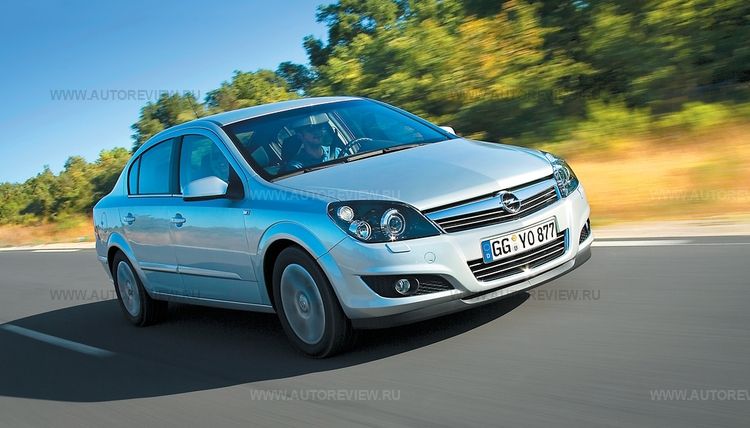
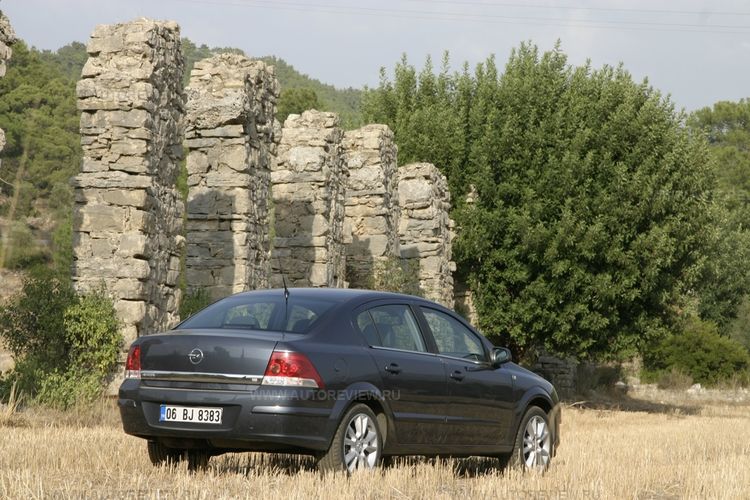
The new four-door Astra is just that. The descending roofline, protruding rear trunk, inexpressive taillights — there is no trace of the alluring sexuality of the three-door here. By the way, the chief designer of the sedan and the author of the appearance of the entire current Astra generation, Friedhel Engler, recently moved to Beijing, where he took the post of chief designer of the Asian division of General Motors and will now create the appearance of Chinese Buicks and Cadillacs. Interesting, is this a promotion or exile?
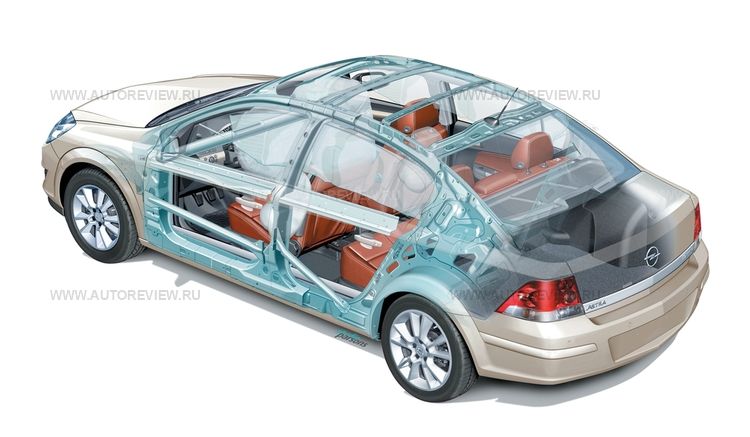
The four-door Opel Astra is built on the basis of the station wagon. The sedan is 288 mm longer and 116 kg heavier than the five-door hatchback. Torsional rigidity is 20000 Nm/deg versus 15000 Nm/deg for the five-door
A sedan based on a hatchback would look ridiculous, but the four-door Astra is made on the station wagon platform — with a wheelbase increased by 88 mm. The added centimeters were divided between passengers and cargo. The rear axle shifted back made it possible to move the sofa back by 15 mm and lower it by almost 10 mm. A trifle? I specifically switched from the hatch to the sedan and back several times — it was precisely these centimeters that were missing for a free seating.
All the rest of the base increase went to the trunk: its useful volume grew from 350 l to 490 l. By folding the back of the rear sofa, you can get up to 870 l of volume, but the "window" behind the back is very narrow. But thanks to the metal partition between the cabin and the trunk, the long body became a third stiffer.
At first I got the most powerful car — with a 140-horsepower 1.8 Ecotec engine and a five-speed manual. The "sixteen-valve" with variable phases is torquey, but managing acceleration is inconvenient — the driver is separated from the engine by an abyss of clutch pedal travel and the rubbery insensitivity of the accelerator. And after 4000 rpm, the engine begins to sing in a bad voice, which is increasingly accompanied by wind and tires as speed grows. The gearbox is also not without sin — with a clear but tight mechanism and a gap between second and third gears, which is felt during active driving.
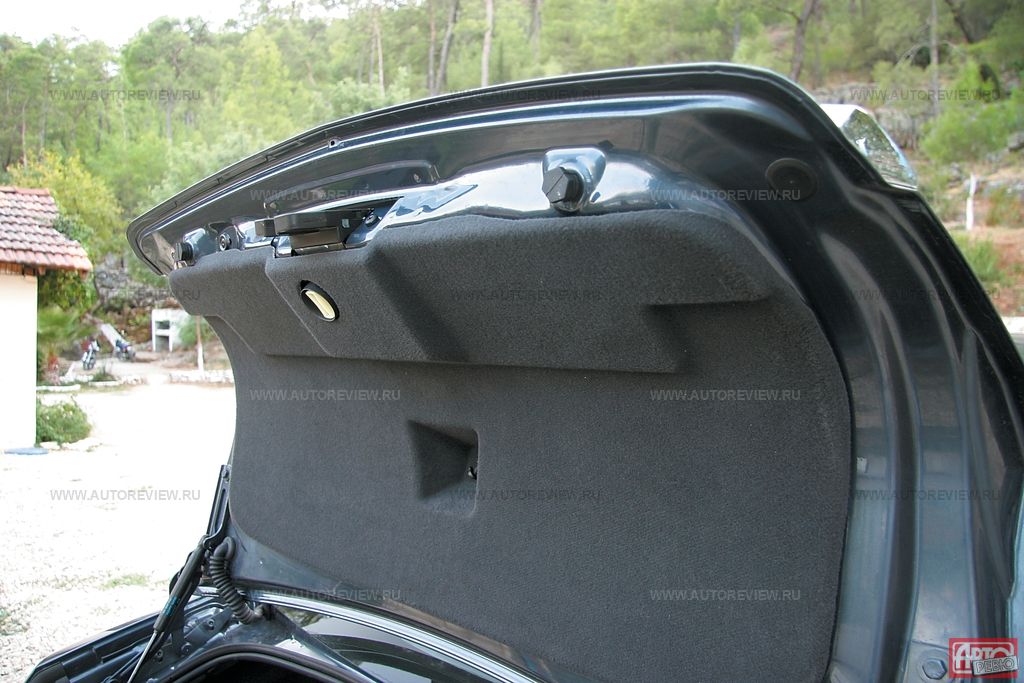 | |
| There is no inner or outer handle on the trunk lid... | ...and it can only be opened with the key or a button on the front panel. But "traffic light" thieves have zero chance |
The "automatic", forgive me, car gods, is much more interesting. In normal mode, nothing special: a "dull" gas pedal and a desire to quickly climb to the highest gear. But as soon as you press the Sport button on the front panel — and the "automatic" Astra transforms: the gearbox holds lower gears until the cutoff, and the accelerator turns into a bare nerve. True, in the city such driving — on second gear up to 110 km/h, under the constant scream of the engine and with consumption under 15 liters per hundred — turns into a real nightmare. But on a mountain road — it's a blast!
Especially since the chassis of the sedan is well tuned — with a quite "sharp" and informative steering. Moreover, despite the extended wheelbase, in corners the four-door Astra willingly goes into a skid on throttle lift — those who are afraid of this should order the non-switchable stability control system.
And what about ride smoothness?
— Be careful, — the organizers warned before the start, — there is gravel on the road.
If only! It turned out that in Turkey, "gravel" can be both pebbles the size of a coin and boulders a third of a wheel, and there are plenty of potholes. But it's not for nothing that the sedan was prepared for Brazil, Turkey, and Russia — newly tuned shock absorbers, other springs, and a front stabilizer allow passing potholes in silence and with minimal shaking. It seems that the four-door Astra is softer than the hatchbacks. True, the unpleasant pitching on the transverse waves of the high-speed highway was alarming.
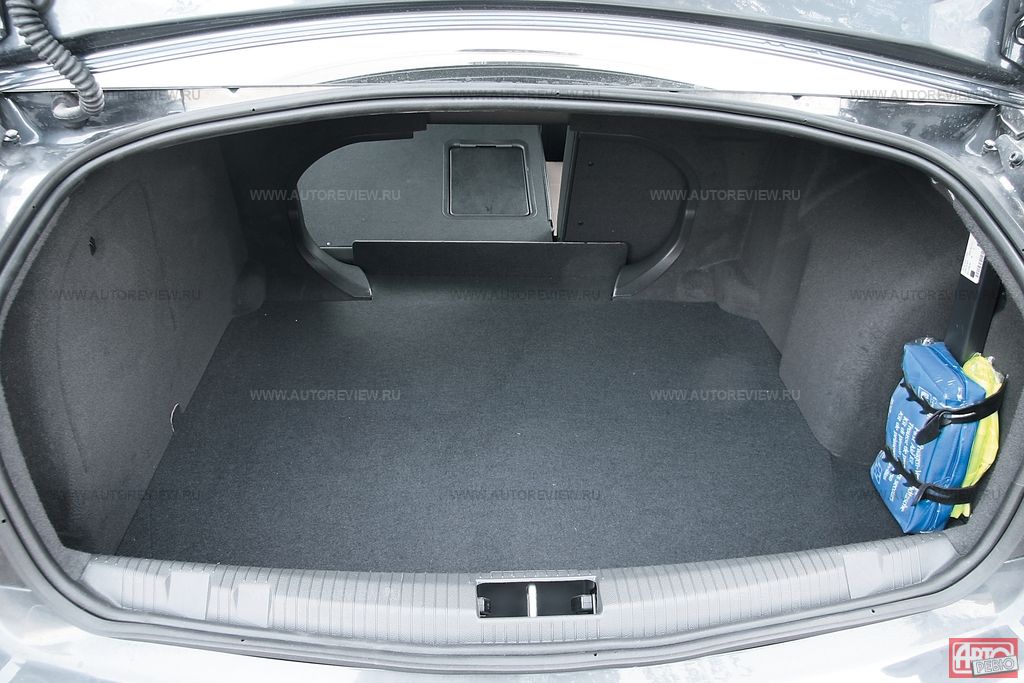 | 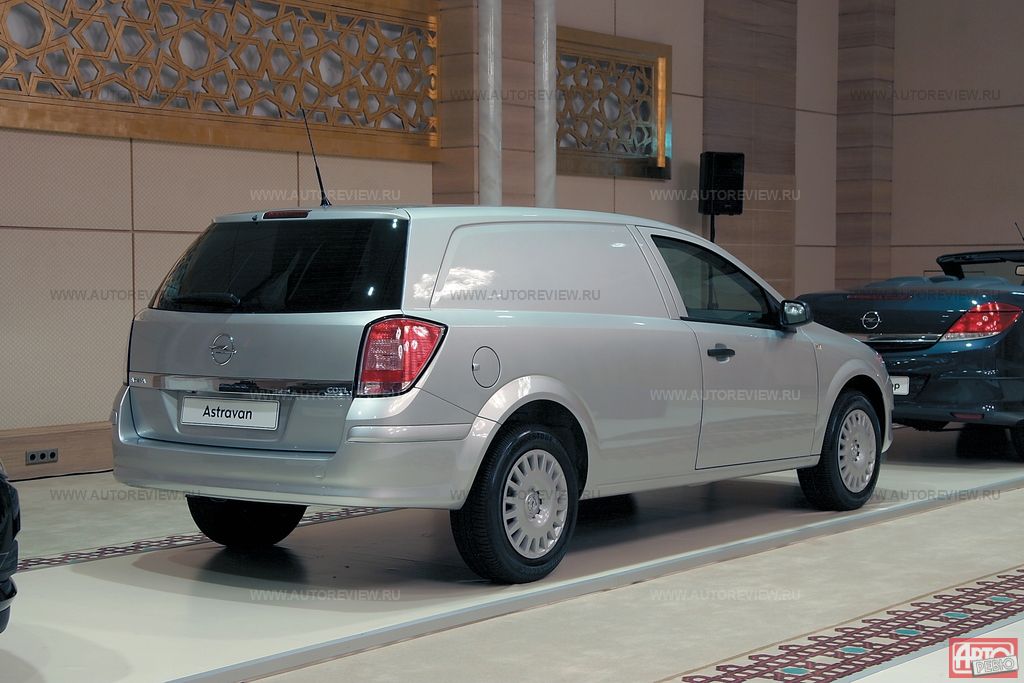 |
| The trunk is spacious, but not the most convenient: with a narrow opening, high threshold, small "window" and massive wheel arches. Under the floor — a full-size spare tire | In the UK and some other European countries, an unusual "commercial" Astra Van is sold — a van based on the station wagon |
In addition to the 1.8-liter engine, the sedan also has a 1.6 Ecotec engine (115 hp) — cars with such engines and manual or robotic gearboxes account for half of all sold Astras in our country. But I, alas, did not get such a car. But I did ride in a diesel Astra with a 90-horsepower German-Italian-Polish 1.3 CDTi engine — General Motors developed it jointly with Fiat, and the diesel is produced at a plant in the Polish city of Bielsko-Biala. A pleasant little engine — sluggish at the bottom, but after 2000 rpm there is plenty of torque: as much as 200 Nm versus 175 Nm for the 1.8-liter gasoline "four". And the gears of the six-speed manual are well chosen. Since November, such a diesel, like the 100-horsepower 1.7 CDTi engine, will appear in Russia on Astra hatchbacks. But whether to supply diesel sedans to us, Opel people are still thinking.
And what are the prospects for the Astra itself? After all, the sedan of the previous generation, which was predicted to be the laurels of a people's foreign car, failed in our country: who needed a Chevrolet Viva for $18,000?
The new Astra sedans will be even more expensive — prices are about $600 higher than for hatchbacks. This means that for the most modest sedan with a 1.6 engine, air conditioning, audio preparation and front electric windows, they will ask from $19,880 and up to $24,880 for the "top" Astra with an automatic in the Cosmo trim. You can't argue with the Vsevolozhsk Focus — in a comparable configuration it is $2,500 cheaper! But prices for Honda Civic, Mazda 3, Mitsubishi Lancer and Toyota Corolla sedans are approximately comparable. It remains to compare the cars with each other — and find out who is better...
| Specifications | ||
| Parameters | Vehicle | |
| Opel Astra | ||
| Modification | 1.6 Ecotec | 1.8 Ecotec |
| Body type | sedan | sedan |
| Number of seats | 5 | 5 |
| Length/width/height, mm | 4578/1753/1458 | 4578/1753/1458 |
| Wheelbase, mm | 2703 | 2703 |
| Trunk volume, l | 490/870* | 490/870* |
| Curb weight, kg | 1306 (1314)** | 1311 (1349) |
| Gross weight, kg | 1800 (1810) | 1805 (1845) |
| Engine | petrol, with distributed injection | |
| Location | front, transverse | front, transverse |
| Number and arrangement of cylinders | 4, in-line | 4, in-line |
| Displacement, cm³ | 1598 | 1796 |
| Cylinder bore/piston stroke, mm | 79.0/81.5 | 80.5/88.2 |
| Compression ratio | 10.5:1 | 10.5:1 |
| Number of valves | 16 | 16 |
| Max power, hp/kW/rpm | 115/85/6000 | 140/103/6300 |
| Max torque, Nm/rpm | 155/4000 | 175/3800 |
| Gearbox | manual, 5-speed (robotic, 5-speed) | manual, 5-speed (automatic, 4-speed) |
| Drive | front | front |
| Front suspension | independent, spring, McPherson | |
| Rear suspension | semi-independent, spring | |
| Front brakes | disc, ventilated | |
| Rear brakes | disc | disc |
| Tires | 195/65 R15 | 195/65 R15 |
| Maximum speed, km/h | 191 (192) | 207 (188) |
| Acceleration time 0–100 km/h, s | 11.7 (12.7) | 10.2 (11.4) |
| Fuel consumption, l/100 km | ||
| urban cycle | 8.9 (8.7) | 10.1 (10.6) |
| extra-urban cycle | 5.4 (5.2) | 6.0 (6.3) |
| combined cycle | 6.7 (6.5) | 7.5 (7.9) |
| Fuel tank capacity, l | 52 | 52 |
| Fuel | AI-95 | AI-95 |
| * With rear seat folded | ||
| ** Data in parentheses — for versions with robotic and automatic gearbox | ||