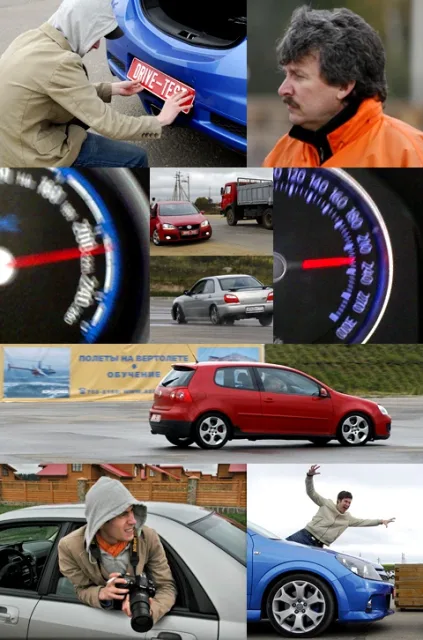
Having taken care of business, we immediately headed to the cars. We return to the editorial office almost at the same time. Colleagues eagerly share their impressions of the drives. "The Golf GTI is just a hurricane!" — one begins. "What hurricane — you just haven't driven the Astra OPC!" — the second retorts. And I chime in: "And the Škoda… its side mirrors are a bit small!"
Silence falls. "Well, how does it drive?" — the colleagues ask in surprise. "I have no idea," I honestly reply, "I got stuck in a massive traffic jam." But now I had the opportunity to go on and on about the quality of the plastic in the cabin, the convenience of the climate control, and other details they hadn't even noticed (and rightly so — I'd have done the same in their place). When I finished, my listeners started nodding off again — whether it was the early rise or my stories, I don't know. It's like judging the Mona Lisa with the phrase: "Look, what a beautiful frame!" But never mind, we still have time, because there are several days ahead with these cars.
We decided not to waste a minute. We slept, ate, and generally lived very little. But we drove, on the contrary, a lot. Moreover, we decided it would be best to do it in a place where we could push to the limit without fear of "flying off." That is, at a race track. So we called our old acquaintance Alexey Kolontay — a motorsport trainer, as well as the head and organizer of the "MasterClass" counter-emergency driving center. Alexey enthusiastically responded to our proposal to act as an expert, and we agreed to meet. Meanwhile, we had a little time left to drive the cars ourselves.
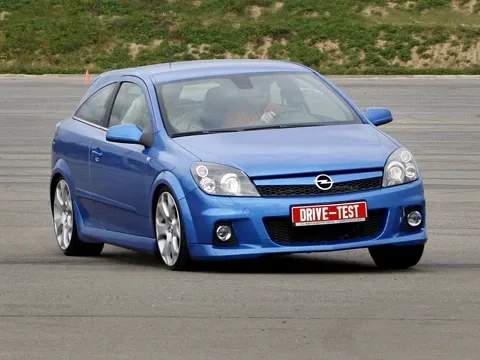
By the way, I've always been surprised that the Opel emblem features a lightning bolt. Lightning is something bright, powerful, and striking almost at the speed of light. It's unlikely that all these epithets can be applied to the products of a company that, for almost its entire history, made "just cars." No, it certainly had its moments of inspiration, but they were as rare as flashes of lightning in a cloudy evening sky. But now, it seems, a storm is brewing — in recent years, Opel has released a whole slew of "hot" cars. And the Astra OPC is just such a car, fully justifying the brand's logo.
In city traffic, the Astra really does resemble lightning. It's, of course, slower (about 10 million times), but its trajectory is the same: broken, with frequent and sharp changes of direction. It darts into one lane, then another — and so on the whole way. The thing is, you can't drive it any other way. If you try to go slowly, the car will start not just to annoy you — but to infuriate you! With its heavy steering and clutch, vibration, noise, and cramped cabin.
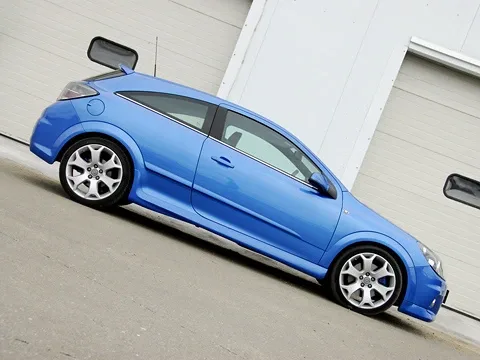
But if you press the gas… No, the noise and vibration won't disappear, they'll just be seasoned with such acceleration! Imagine you're a soccer ball, lying quietly and minding your own business. Now imagine a footballer kicking the ball (that is, you). Well, it's very similar! The acceleration is brutal; it seems limited only by the tires, which easily break into wheelspin even at speeds near 100 km/h. So the lightning on the Astra OPC's emblem is very fitting. But the name — not so much. An aster is, after all, a flower, cute and harmless. In my opinion, this car should have been named differently — for example, Sundew or Aldrovanda OPC. There are such flowers. Carnivorous ones.
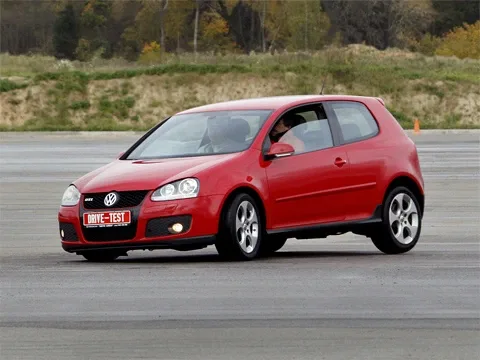
The "Golfers," which include the Golf GTI and the Octavia RS built on its basis, are not like that at all. Although together they surpass the Opel in power by almost double, individually they're still not as fast — they can be safely recommended for trips to the bakery. No, calm down, it's not that bad: in terms of dynamics, they may yield to the Astra, but only slightly. The thing is different: the cars don't impose a driving style of "I took lessons from Schumacher." You can both "cut loose" and drive calmly in them. Drive slowly — and passengers think they're sitting in a regular Volkswagen or Škoda. Quiet, relatively soft, and I'd even say comfortable. But just press the gas harder… The passengers' screams will be only a couple of decibels quieter than in the Opel, and the driver's smile won't be much smaller. That is, both the Golf GTI and the Škoda Octavia RS are almost as fast, but they are driver's cars, while the Opel is a driver's only car — it's better not to put passengers in it.
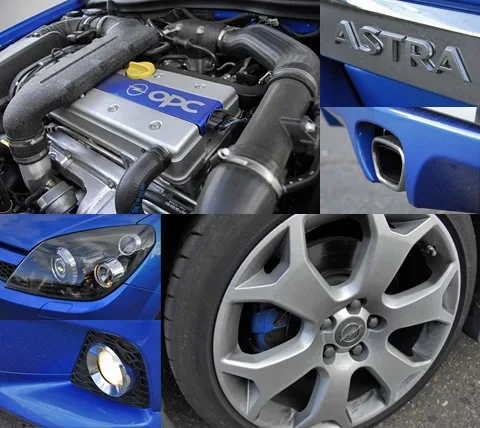
Under the hood of the Astra OPC is a 240-horsepower turbo engine that can accelerate it to 100 km/h in just 6.4 seconds. The car's top speed is 244 km/h.
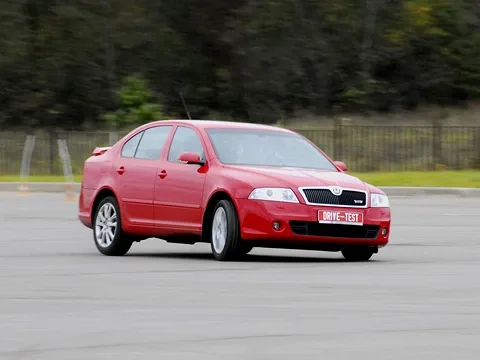
And the Octavia RS, after chip tuning by WKR, was supposed to develop 260 hp and thus become the most powerful car in the test. But, apparently, "chipped" horsepower differs from normal ones — the car turned out to be no faster than the Golf GTI. But getting into any of these cars after the Opel, you feel outright relief — because besides its frantic dynamics, the Astra OPC also has a hysterical character. Press the gas to the floor — the steering wheel immediately starts to tear away, like a violently insane person from the hands of orderlies. And if you hit bumps… You have to hold it very firmly! The Golf GTI and Octavia RS don't have that — they silently, without hysterics or arguments, carry out the driver's commands. As a result, driving them around the city is even more pleasant — you don't need to waste energy fighting the car, and you can focus entirely on driving.
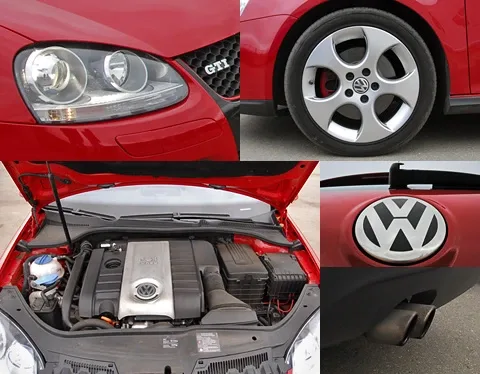
The Golf GTI is the "weakest" participant in the test: "only" 200 hp. But it has virtually no turbo lag, and in acceleration it doesn't lag far behind the Astra OPC.
We flew to the race track, located 50 kilometers from Moscow, in no time. All four cars (including our "photocar," which this time was a Subaru Impreza) deftly overtook summer residents who hadn't yet closed the season and heavy trucks. At the same time, we weren't rushing headlong (probably those who saw our convoy broke their necks — or rather, their necks) — we just didn't waste time, tailgating the next slowpoke and waiting for the moment to overtake. As soon as a "gap" appeared, it immediately became ours — the engines' power was enough for confident and quick overtaking.
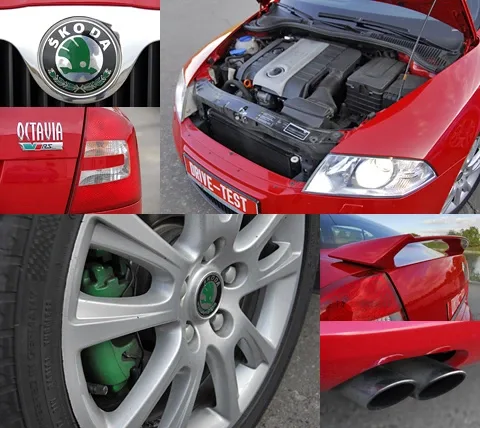
Formally, the Octavia RS became the most powerful car in the test — thanks to WKR chip tuning, its power was raised to 260 "horses." But it still couldn't outrun its rivals.
The Octavia RS was especially pleasing on the highway — you can safely hammer not only Moscow-region highways or the MKAD-burgring, but also German autobahns. But the Astra, on the contrary, is the most nervous. I'd even say nervously epileptic: it doesn't like ruts, it doesn't like potholes either, and on them it starts trying to show independence, "steering" to the sides. But you can get used to it, although it's better not to go on a "long-haul" in the Astra.
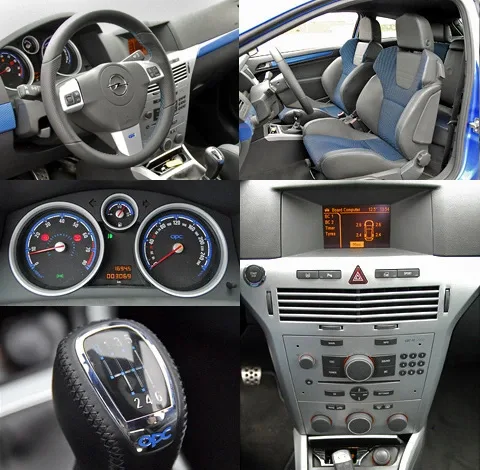
The Astra OPC has the "densest" Recaro seats and the most comfortable steering wheel. But the seating position is not great: tall people will hit their heads on the ceiling, and the adjustment ranges may not be enough.
We reached the needed turn so quickly and imperceptibly that we were greatly surprised to see the familiar sign. At first, we didn't even believe it and drove on. But after encountering several unfamiliar signs, we turned around.
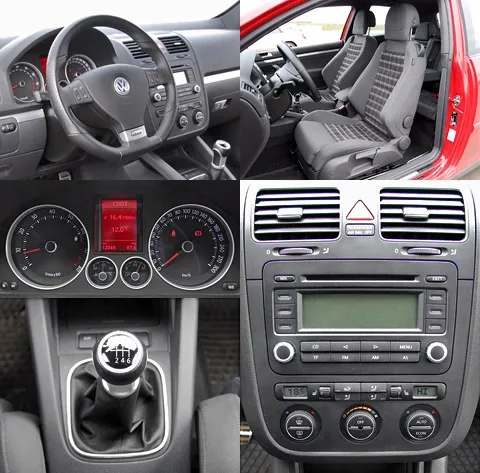
The Golf GTI's seats are not much inferior to the Opel's, but the seating position is frankly better. True, the "chopped-off" bottom of the steering wheel is rather inconvenient.
Early morning. It's quiet at the race track. Nothing but the roar of the tuned exhausts of three cars and the squeal of twelve tires disturbs the peace of nature. Even the birds have fallen silent. There are no restrictions here, so you can push to the limit — and even beyond. We hand the keys to Alexey with the words: "Please, the tires should last at least for the way back." And off we went! Three hours at the track flew by like one. Alexey did everything possible with the cars. And here's his verdict.
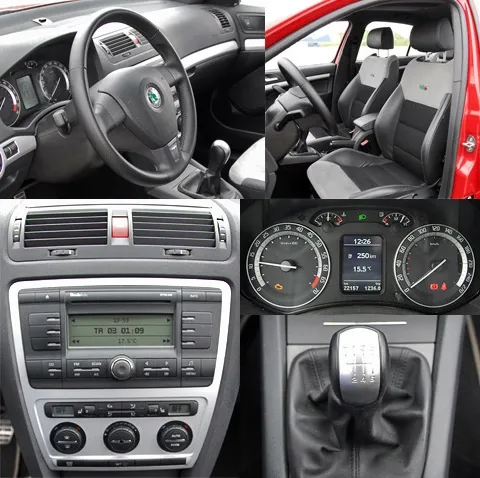
The seating position in the Octavia RS is roughly like in the Golf GTI, but here there are more "civilian" seats and a normal steering wheel.
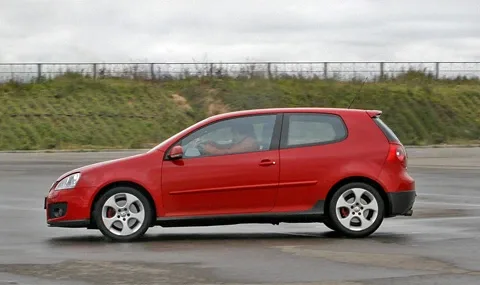
Volkswagen Golf GTI is essentially a regular "civilian" car, just with a powerful engine and sharpened handling. But for real racing, alas, it's not suitable. In a drift, it's easy to catch and straighten out, but in a corner at the limit, the GTI starts to suffer from understeer — the front end simply pushes wide. However, as a daily driver, it's very convenient. Electronic aids like ABS and ESP work flawlessly. Even when I deliberately provoked the car, sharply dumping the clutch and yanking the handbrake in a corner, the stability control instantly killed the slide and didn't let the car spin sideways across the road. It can't completely fool physics, of course, but the result is still impressive. The only thing that really annoyed me was the steering wheel with a flattened bottom. When you turn it with one hand, the sharp corners literally dig into your palm, making it impossible to get a proper grip on the wheel.
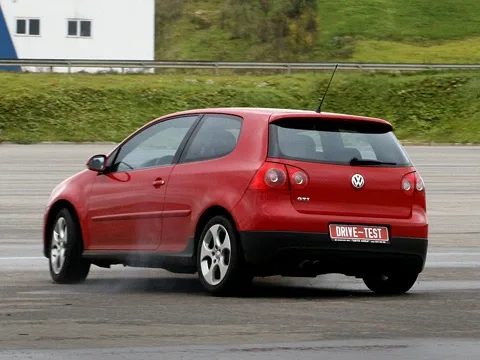
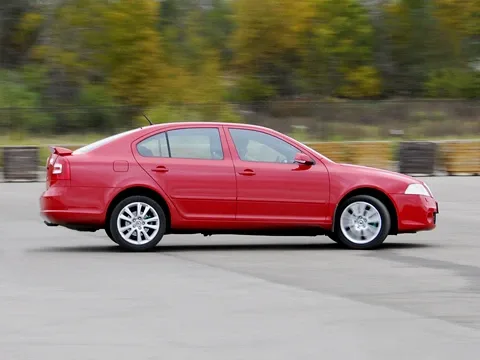
Skoda Octavia RS is technically the same Golf GTI, so it behaves very similarly, although the suspension feels a bit looser. But it's even more comfortable, and on a high-speed straight it holds its course just great — for long trips, this car suits best. The Golf GTI is slightly inferior in this regard, while the Astra OPC is not a car you'd want to take far at all. True, the Octavia RS lacks a bit of sharpness in steering response. Because of this, you want to make the suspension stiffer, but then comfort suffers. An eternal dilemma: either precise handling or softness. However, in the case of the Octavia RS, the engineers managed to find a very successful balance.
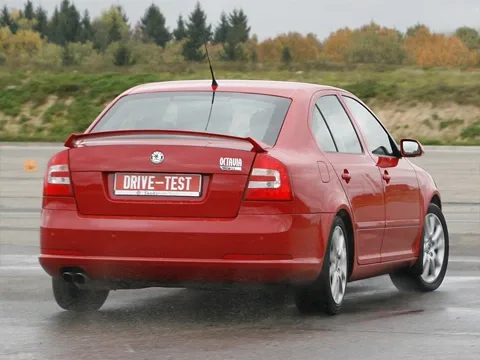
Skoda Octavia RS — the ideal compromise between the thirst for speed and care for loved ones. It's fast, spacious, and comfortable.
But I unconditionally give first place in our handling comparison to the Astra OPC, which has floored both the Golf GTI and the Octavia RS. Of the trio, this car is closest to real sport. And I don't mean city racing with "checkered flags," but the most genuine sport. The Astra OPC has the stiffest suspension, tenacious brakes, the best tires, a sharp steering wheel, and the most responsive throttle pedal. So from the very start, it delivered a powerful blow to its rivals: its cornering limits are noticeably higher, and body roll is significantly less. The second blow landed on the liver: in extreme modes, it handles better than all. The understeer that many front-wheel-drive cars suffer from is almost absent here: the car willingly screws into a corner even at the highest speed. Although, like its competitors, there's no front differential lock here — it's more about suspension tuning and the proprietary UCL (Understeer Control Logic) system that combats understeer. The brakes are also noticeably better. And finally, the last blow — to the groin: the Astra OPC is not only faster but also cheaper! The base version starts at $31,230, while the Octavia RS can't be found for less than $33,490, and for the Golf GTI you'll have to shell out at least $33,257.
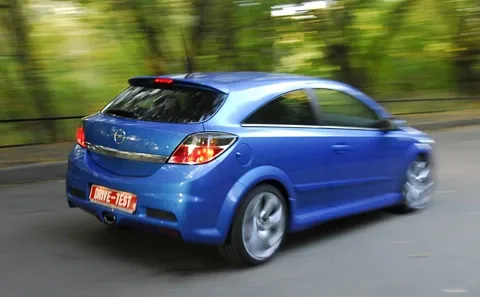
In the vocabulary of the creators of the Opel Astra OPC, the words "comfort," "quiet," and "calm" are clearly absent. But the word "speed" is clearly one of their favorites.
So, are the rivals already writhing in pain and begging for mercy? Not at all. For its audacity, Opel got its due. With all its wonderful qualities, this car is hardly suitable as the only car in a family. Want to drive it every day? Well, if you don't mind riding a jackhammer — then it's just the thing. That the Astra was not intended for "civilian" life is evident even in the cabin: there's nowhere to even put a phone. The control of the onboard computer and audio system seems to have been handled by sadists, with the sole purpose of ensuring that the driver, having once tried to figure out this puzzle, never goes back there. Visibility is terrible: not only to the rear, but also to the front — the mirror blocks half of the windshield. By the way, it's unclear why it's needed at all, because at the usual speed for the Astra OPC, you might not even need to look back — you can't drive this car slowly! That is, you can, of course, but it's pure sadomasochism. Masochism — because the driver suffers. And sadism — because he's tormenting the passengers at the same time.
In short, if I had a family and at least a drop of conscience, I'd choose not the Astra but the Octavia. Or the Golf. After all, in them you can sit in traffic, go grocery shopping, head to the dacha, and, of course, have a blast. The Golf and Octavia are softer, more spacious, and have a better-made, more thoughtful interior. But the main thing is that you can drive them fast or slow, on any road — and neither I nor my passengers will experience the slightest discomfort. That's how you can become a model family man: both the wife and kids are comfortable, and I'm satisfied.
Although choosing between these two cars is not an easy task. Overall, the Golf GTI looks more refined, but the Skoda Octavia RS drives no worse, especially on the highway. Plus, it has "extra" two doors and a cavernous trunk, and those could be the decisive argument at a family council.
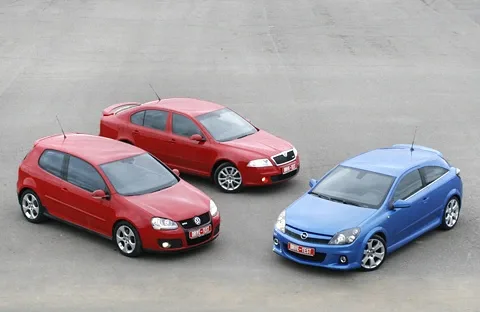
Astra OPC… This car is completely unsuitable as the only car. Going out for a spin in your free time — please. And there it will outrun both the Golf and the Octavia. But every day… absolutely not! Better to walk or take the metro. On the other hand, every day I see two yellow Mitsubishi Lancer Evolution VIIIs in the parking lot near the office. And in one of them, there's a child seat in the back… No, you get it? These guys on those crazy stools not only bring their butts to work every morning, they also carry their families in them!.. And I understand them. Because it's worth it! Not just the power and rocket-like acceleration, but also the suspension, the seats, that very "feel of the car," after all. And I want to have all that not just on weekends, but constantly. So I'll endure the shaking, the noise, and all other hardships. And no matter what anyone says, the Astra OPC, which is in no way suitable as a daily driver, will be bought precisely as a daily driver. And I can clearly picture its buyers. They are those who haven't yet saved up for a Lancer Evo or Impreza WRX STI.
Technical specifications
For the Skoda Octavia RS, the characteristics after chip tuning from WKR are shown in parentheses.
| Specifications | Opel Astra OPC | Volkswagen Golf GTI | Skoda Octavia RS |
|---|---|---|---|
| Body type | 3-door hatchback | 3-door hatchback | 5-door hatchback |
| Number of seats | 5 | 5 | 5 |
| Curb weight, kg | 1393 | 1335 | 1400 |
| Engine | petrol, with direct fuel injection and turbocharging | ||
| Location | front, transverse | ||
| Number and arrangement of cylinders | 4, in-line | ||
| Number of valves | 16 | ||
| Displacement, cm3 | 1998 | 1984 | 1984 |
| Max power, hp/rpm | 240/5600 | 200/5100 | 200/5100 (260/5300) |
| Max torque, Nm/rpm | 320/2400 | 280/1800 | 280/1800 (400/2000) |
| Drive | front-wheel drive | ||
| Transmission | 6-speed manual | ||
| Front suspension | independent, coil spring, McPherson, with stabilizer | ||
| Rear suspension | semi-independent coil spring | independent, coil spring, multi-link, with stabilizer | independent, coil spring, multi-link, with stabilizer |
| Front brakes | disc, ventilated | ||
| Rear brakes | disc | ||
| Tires | 225/40 R18 | 225/45 R17 | 225/45 R17 |
| Maximum speed, km/h | 244 | 235 | 240 (258) |
| Acceleration 0—100 km/h, s | 6.4 | 7.2 | 7.3 (6.0) |
| Fuel consumption, l/100 km | |||
| — urban cycle | 13 | 11 | 10.9 |
| — extra-urban cycle | 7 | 6.2 | 6 |
| — combined cycle | 9.2 | 8 | 7.8 (8.0) |
For the Skoda Octavia RS, the characteristics after chip tuning from WKR are shown in parentheses.
Trim levels of the tested cars
| Opel Astra OPC | Volkswagen Golf GTI | Skoda Octavia RS | |
|---|---|---|---|
| Cost of tested car | $35245 | $35529 | $34590 |
| ABS | + | + | + |
| ESP | + | + | + |
| Front airbags for driver and passenger | + | + | + |
| Side airbags | + | + | + |
| Inflatable safety curtains | o | + | + |
| Anti-theft system | o | o | o |
| Sport front seats | + | + | + |
| Multifunction steering wheel | + | + | - |
| Air conditioning | + | + | - |
| Climate control | o | - | - |
| Dual-zone climate control | - | o | + |
| Auto-dimming rearview mirror | + | + | + |
| Stereo with CD changer | o | o | - |
| Aluminum interior trim | - | + | - |
| Power-adjustable and heated mirrors | + | + | + |
| Fog lights | + | + | + |
| Xenon headlights | o | o | + |
| Adaptive bi-xenon headlights | o | o | - |
| Parking sensors | o | - | - |
| Tire pressure monitor | o | o | - |
| IDS+ shock absorbers | o | - | - |
| 17-inch alloy wheels | - | + | + |
| 18-inch alloy wheels | + | - | - |
| Cost of base trim | $31230 | $33490 | $33257 |
The Skoda Octavia RS had its engine control unit reprogrammed by WKR. Cost 1360 euros.
Legend: + included in base trim; - not available; o option installed on the tested car.
Cars for the test provided
by the official representative of Volkswagen Group Rus,
LLC "Volkswagen Group Rus" Skoda division,
LLC "General Motors".
The editors of DRIVE.RU thank the "MasterClass" counter-emergency driving training center for assistance in conducting the test.
Behind the scenes