
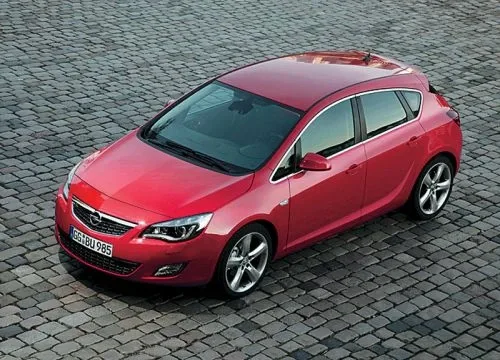
It seems that when creating the new Opel Astra, the main role was played not by engineers, but by marketers who carefully studied the demands of car enthusiasts. Moreover, it is evident that they tried not only to retain loyal fans of the brand, but also to attract a new audience.
The first acquaintance with the Astra took place at the Dudenhofen test site and its surroundings. But the most accurate first impression was formed even before the start of the drives — during a simple inspection of the car. What do we see? At first glance, features common with the older Opel models are noticeable. At the same time, the car clearly has its own character. Compared to the previous generation, the upper part of the radiator grille, which is now combined with the bumper, has become smaller. But the enlarged lower part has given the new "face" more sportiness and boldness. The design of the side body panels uses the "blade" motif familiar from the Insignia. True, in the Astra it is directed in the opposite direction, emphasizing the expressive rear section. The interweaving of body lines that smoothly transition into the rear window completes the image of a little athlete.
The new Astra has grown compared to its predecessor. Such a seemingly familiar event has already been dubbed by experts as the emergence of a new class — "compact plus". The point is that the new generation has become 17 cm longer. If compared with the main competitor — the Volkswagen Golf, the new model wins 22 cm against it. That's a lot. The widened track at the front and rear provided better stability and handling, which also positively affected the organization of interior space.
The "blade" theme has found its continuation in the interior as well. Door handles, the front panel with air vents — in short, everything that catches the eye speaks of the car's sporty character.
The front seats with pronounced lateral support are adjustable over a wide range. If you slide the driver's seat all the way back, even a basketball team's center could fit behind the wheel. True, sitting behind him would be comfortable only for a sheet of paper. The convenience of the driver's seat is a special pride of Opel's marketers. They assure that comfort is ensured for both men and women of any build. The space at the rear is organized so that a passenger above average height will not hit their head on the ceiling.
The engine range for the Opel Astra includes four petrol and four diesel units. True, the prospects for diesels in our market look rather uncertain. Diesel engines still remain a complex topic for many Western and Eastern manufacturers. The petrol engines are represented by two displacements — 1.4 and 1.6 liters. The difference is that two of them are naturally aspirated, and two are turbocharged. For testing, we chose the most powerful version. The claimed 180 hp at 5500 rpm and torque of 230 Nm did not make a special impression on the German autobahns. But the chassis tuning and steering pleased us. The front suspension of the Astra is from the Insignia. In addition to the usual McPherson, for the first time in the compact class, an adaptive damper control system FlexRide is offered as an option. It constantly monitors the operation of all four dampers and changes their settings in milliseconds depending on the road, driving mode, and driving style. To reduce noise and vibrations, the front lower arms and anti-roll bar are mounted on a subframe, which is attached to the body through four silent blocks.
The new is often the well-forgotten or rarely used old. In the tenth generation of the Astra, the rear torsion beam axle received a longitudinal "fold". The increased diameter and thickness increased torsional rigidity. Additionally, a system of levers was installed that counteracts lateral forces during cornering. Softer silent blocks significantly reduced unwanted noise and vibrations, which ultimately had a positive effect on comfort and handling.
Overall, the Astra remains a solid car in the "unisex" style, which will suit a wide variety of customer categories. Moreover, in the new generation, this versatility has manifested itself even more strongly. It remains only to wait for how the mass buyer, who votes with their ruble, so necessary in the crisis, will appreciate the marketing delights of the Germans.
A Turn of History
The first compact Opel appeared in 1936. It was the Kadett model with sedan-coupe and convertible bodies. Two years later, a four-door sedan version was released. In 1940, production of the C-class car at the Rüsselsheim plant was stopped. After the war, the equipment from the American occupation zone was dismantled and taken to the Soviet Union, where they began making "Moskvich" cars on it. Interestingly, the military governor of the zone, General Lucius Clay, did not take the money brought by the Soviet delegation and ordered that everything needed from the Opel plant be given to the Russians.
The revival happened in 1962, when production of the Opel Kadett A was launched at a new plant in Bochum. The first front-wheel-drive hatchback was released in 1979. The Kadett series ended with the E model in 1991, after which the compact class changed its name to Astra. Letter designations are still used today. For example, within the company, the new Astra is called nothing other than J. In the fall, the new model began to be assembled in England, and the current owner of Opel — the GM concern — will not give this plant to Russia even for big money — it will come in handy itself!
Love It or Leave It
To avoid missing in the dark, the GEAR SHIFT LEVER is illuminated in red. Fresh
THIS OPTION will help save fuel at the right moment by continuing the journey on a bicycle. Convenient
A STAND FOR SMALL ITEMS might come in handy when iron tens and fifty-kopeck coins appear. Thought out
Driving
Excellent: the adaptive electric power steering complements the good chassis settings.
Interior
In the stylish interior, everything is thought out to the smallest detail.
Comfort
The car is created not only for the driver; all passengers will be comfortable.
Safety
Passive and active safety in the basic configuration deserve compliments.
Price
The price, kept at the level of the previous model, is already a victory over competitors.
Advantages and Disadvantages
+ Good dynamic and acoustic characteristics, comfortable seats with a wide range of adjustments.
- Due to the low seating position, visibility problems are possible.
Specifications
- Make and model — Opel Astra 1.6 turbo
- Dimensions — 4419x1814x1510 mm
- Engine — petrol, 1598 cm3, 180 hp/5500 rpm
- Transmission — manual, 6-speed gearbox
- Dynamics — max 221 km/h; 8.5 s to 100 km/h
- Competitors — VW Golf, Ford Focus
Our Opinion
The new Astra is a confident step forward. The car has become bigger, more interesting, and more technologically advanced, but at the same time it has retained its versatility and practicality. The design, both exterior and interior, is now truly sporty. The adaptive FlexRide suspension is what the compact class was missing. The price at the level of its predecessor makes the new model a very attractive offer. The only question remains how the Russian market will behave, but that is already a test not for the car, but for marketers.
Opel claims that the price of the new Astra will not rise relative to its predecessor. If the company keeps its promise, the car has good prospects in the Russian market. However, to achieve success, the new model will have to enter into fierce competition with the Ford Focus and VW Golf. For an equal fight, the Astra has everything it needs, and the final winner will be determined only by the market.
© 5 Koleso