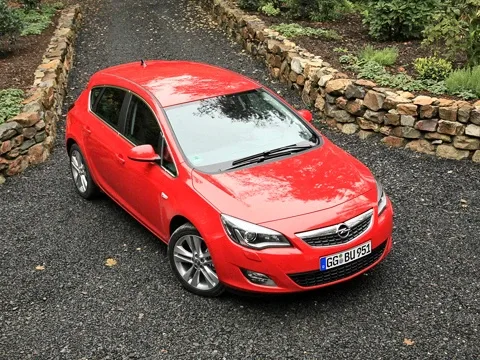
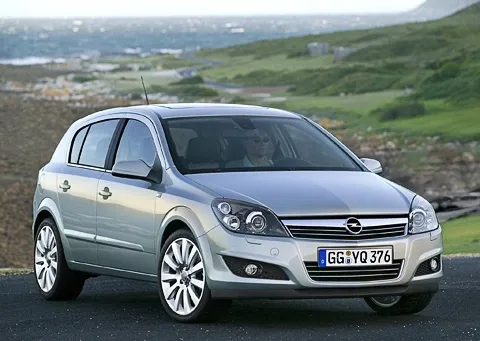
The exterior was the main trump card of the previous Astra. Its bright, unusual appearance made you forgive both the uncomfortable seating position and the intrusive understeer. I admit, I forgave my Astra everything solely for its expressive "eyes." And in the new generation, visual appeal is again at the core of the concept. Although at first glance, the new Astra (with index I) seems simpler than its predecessor — the lines are calmer, the angles are smoothed out. But this is a deceptive impression! It dissipates when you park the cars side by side. The newcomer easily outplays the five-door H-generation. And, in my opinion, it even looks more solid than the sixth Golf.
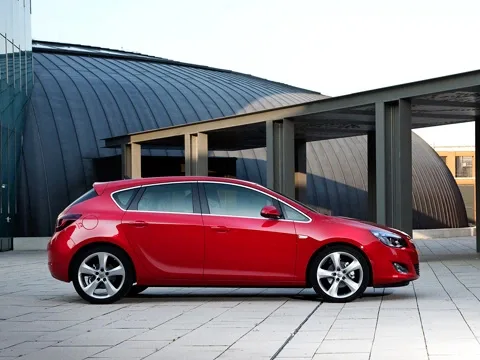
The wheelbase has grown by 71 mm (to 2685 mm), giving rear passengers noticeably more legroom. The old Astra was not a record holder in this parameter, the new one is significantly more spacious. The body has become 17 cm longer, six cm taller, and two cm wider. And the newcomer is also 21 mm longer than its main rival — the Volkswagen Golf hatchback.
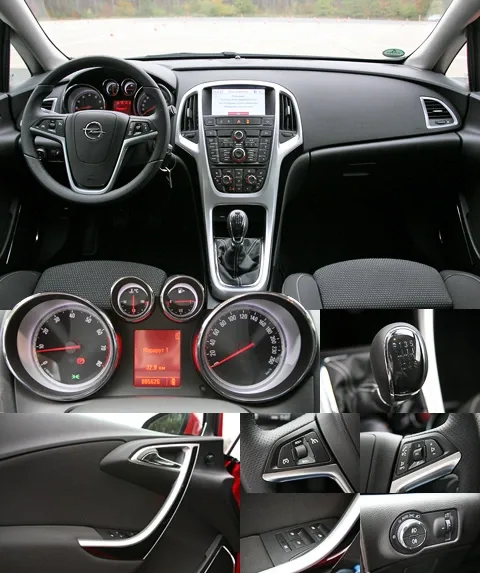
The massive center console, neat instrument lighting, quality trim materials, and soft red interior lighting make the new Astra a truly cozy car that you want to get into every day.
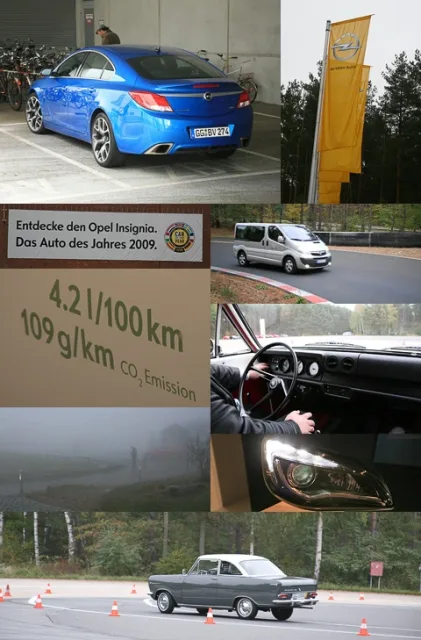
But what about the new chassis? Don't rush! The first minutes at the Opel test site in Dudenhofen were like a bad dream. I get behind the wheel, close the heavy door with a clang, buckle up with a seatbelt without pretensioners, engage first gear on the fifth try, and... immediately stall. Then again, and again — the same result! Yes, driving an Opel Kadett from 1962, even in perfect condition, is certainly interesting, but not at all easy. It felt like Opel had deliberately rolled out their retro vehicles so that the new Astra would shine even brighter against their background.
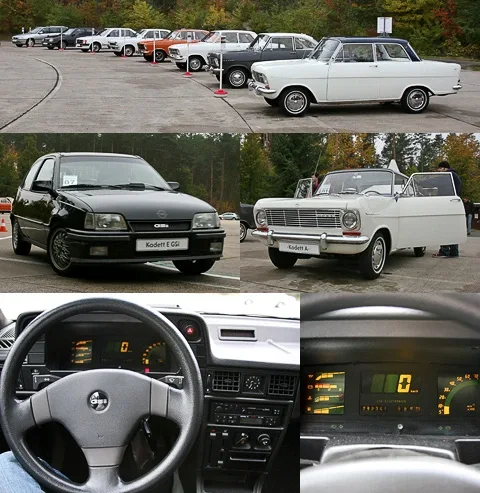
Opel engineers gave us a magnificent gift: they let us drive all the post-war Kadetts. The most vivid impressions were left by the capricious Kadett A, which kept trying to stall, and the "hot" 125-horsepower Kadett GSi hatchback with a futuristic electronic instrument panel created specifically for this version.
Half a century is a huge leap for progress! After interacting with the ancestor, the new five-door Astra seems like a spaceship that barely requires driver involvement. Take another look at the rear-wheel-drive rarities — does it matter that the Astra is built on the Delta II platform from General Motors, which is also used in the Chevrolet Cruze sedan? Oh, how Opel engineers dislike comparisons with the "Korean": "These are completely different cars, technologically our Astra is far ahead of the Cruze!"
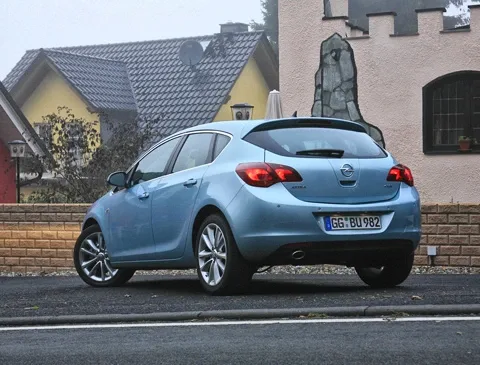
If the previous five-door was deliberately more restrained than the three-door, the new Astra even in the family body looks dynamic.
Instead of a hydraulic power steering, the Astra now has an electric power steering — to combine it into an electronically controlled system with adaptive dampers. The front McPherson struts received separated mounting of springs and dampers. A similar scheme, by the way, was even tested at AZLK: distributing loads across different supports improves ride smoothness. And the Watt's linkage, supplementing the rear torsion beam, is also for comfort. It takes on most of the lateral forces, allowing the silent blocks to be softer and reducing vibrations on the body. To reduce weight, the lower front suspension arms and steering knuckles are cast from aluminum, and the steel anti-roll bar is hollow. Still, the new Astra has gained 95 kg in weight — the curb weight is 1373 kg.
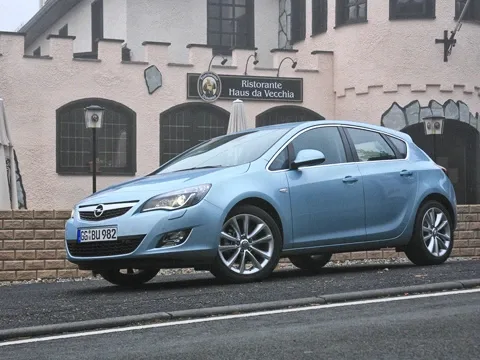
It would seem that the roof sloping down to the rear should press on the head of a tall passenger. Not at all. The headroom is more than sufficient.
But at the same time, it handles more clearly and confidently than the previous one. Undoubtedly, the optional three-mode adaptive FlexRide dampers play their role. With such a suspension, the Astra on both straight lines and in corners drives, at first glance, no worse than the new Golf with its multi-link. If you want comfort, choose the relaxed Tour mode, or you can press the Sport button, stiffen the dampers, and make the steering responses sharper. The response to the gas pedal also improves. Or you can touch nothing and trust the golden mean.
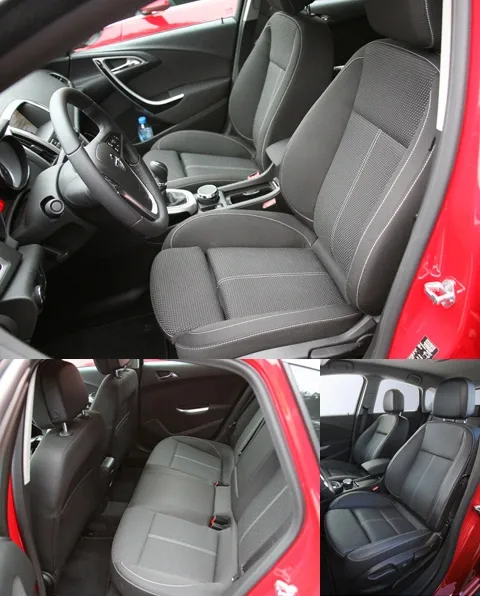
- The front seats are comfortable but a bit firm. However, after a long journey, the back does not get tired at all — it's not for nothing that the Germans received a certificate from domestic orthopedists. Only cars of a higher class can boast such "awards" so far. True, the super seat with an extendable cushion (bottom right) is only an option, and one of the most expensive.
- The standard seats are also not bad. But electric adjustment is provided only for the lumbar support. To not make the car more expensive.
To evaluate the handling in combat conditions, we were released onto a short track at the test site with many corners at different angles and elevation changes. The electronically controlled chassis — in Sport mode! The Astra holds the arc perfectly and only at high speed smoothly slides its nose outward of the corner. No jerks, jolts, or sharp movements of the rear. The rear suspension, thanks to the "love links," indeed copes better with lateral forces in corners, setting the correct trajectory.
And now a lap in Tour mode. No pleasure at all. The steering wheel is indecently light, the rolls are noticeably larger, in every corner the Astra tries to slip off the track, and during braking, unpleasant nose dives annoy. It's hard to believe this is the same car. But on the test strip with variable surface, the comfort mode is just what you need. The hatchback rides very smoothly, the new rear suspension diligently swallows both large and small bumps. Even in sport mode on low-profile tires, passengers do not experience much discomfort. Let's see, however, how the upcoming changes for Russia will affect the ride qualities: the ground clearance will be increased by 15–20 mm, the dampers will be changed, the ESP settings will become different...
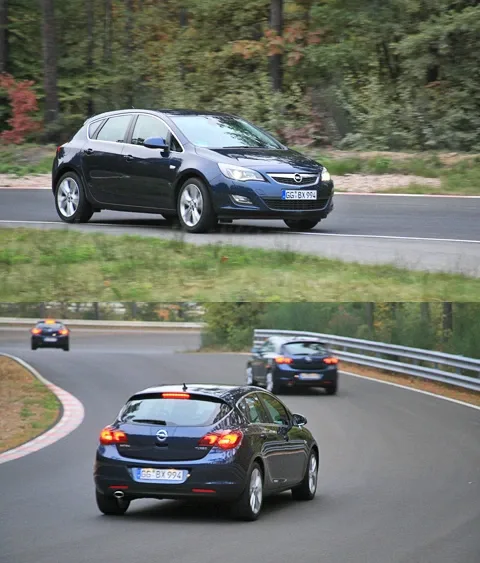
"The brother rattles, the rods wander here. Sometimes they wander, sometimes they stretch." On a smooth track, the rods of the Watt's linkage in the rear suspension minimize parasitic effects of lateral forces on the wheels.
The old Astra felt more loose and less capable, but more hooligan and sharper. The new one gives the impression of a car of a higher class, with a slight touch of stateliness and a more confident stride. But not everything is so smooth. The electric power steering sometimes does not keep up with the driver's actions: in very sharp corners, the feedback weakens, and when turning the wheel quickly, it bites a little. The Golf does not allow itself such behavior. Maybe the engineers should work on the power steering settings while there is still time before the model hits the market?
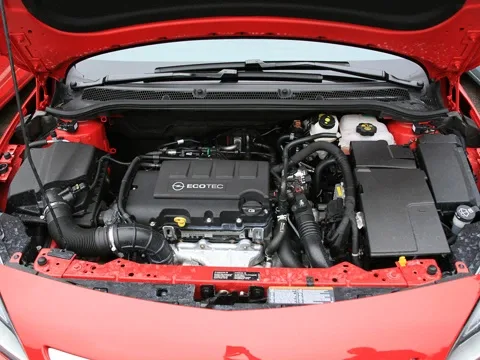
- The pneumatic hood struts, so loved by Astra owners, were abandoned. Now it is held by a regular prop — it is lighter.
- Another difference from the previous Astra is the wiper mechanism. Now they open in different directions, like on the Peugeot 307.
However, to go fast, you need to try. Unlike the Golf, which can deliver pleasure even with the naturally aspirated 1.6, the new Astra even with the 140-horsepower (200 N•m) 1.4 turbo petrol engine does not let you get excited. The engine pleased with its elasticity: it confidently pulls the hatchback already from 1800 rpm. But the Turbo badge should not mislead — here it means rather efficiency than explosive temperament. On overtakes, the thrust is barely enough. And the working range is a bit narrow: it is better to shift up before five thousand.
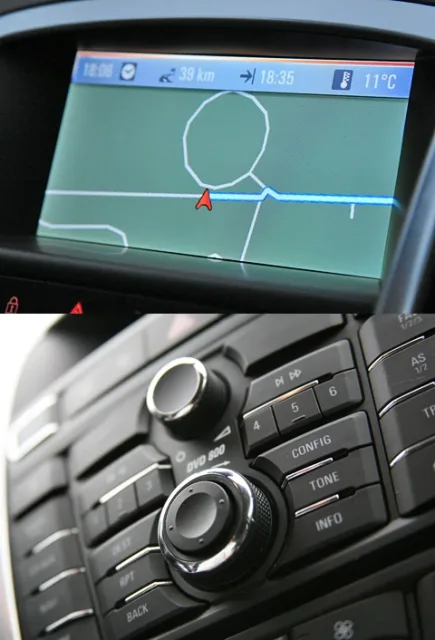
The navigation system is convenient, but the route confirmation button has to be searched for among the scattering of buttons on the front panel. You don't immediately guess that the chrome rim of the central dial is the button. Navigation on Astras will also appear in Russia.
The 180-horsepower (230 N•m) petrol version has a more flexible character. The 1.6 engine is familiar to us from the current Astra generation. You can rev it almost to five and a half thousand. But even such an Astra does not ignite. With the generation change, it did not gain agility either subjectively or on paper: from 0 to 100 km/h — in the same 8.5 seconds. As for the naturally aspirated modifications 1.4 (100 hp, 130 N•m) and 1.6 (115 hp, 155 N•m), there is nothing to say at all. The car just drives, no spark. For dynamic movement through the labyrinths of a metropolis, I would recommend the turbocharged engines. Even if they are not as nimble as you would like, they are economical.
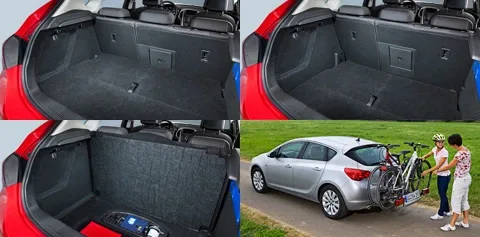
- The highlight in terms of transformation is the height-adjustable double floor in the trunk. The cargo compartment volume is from 370 liters. And by folding the rear seat back and the front passenger seat, you can get 1235 liters of useful volume.
The braking system did not impress me much. On the previous model, it was more comfortable to control deceleration. Now the pedal becomes a bit mushy at peak effort, which makes you involuntarily press it harder. But the braking intensity does not increase. Although this complaint is only relevant for extreme modes — in normal driving rhythm, the Astra's brakes are no different from its classmates. But on the highway and on winding roads near Frankfurt, I would like a more informative drive.
But the Astra's six-speed manual transmission left exceptionally pleasant emotions. The lever sits comfortably in the hand, the throws are short, it's hard to miss a gear, and the gear ratios are very well chosen. By the way, now as an alternative to the manual, only a six-speed automatic is offered. The era of the capricious EasyTronic robot has ended! It is possible that a completely new dual-clutch gearbox will appear later. The question is only when it will happen.
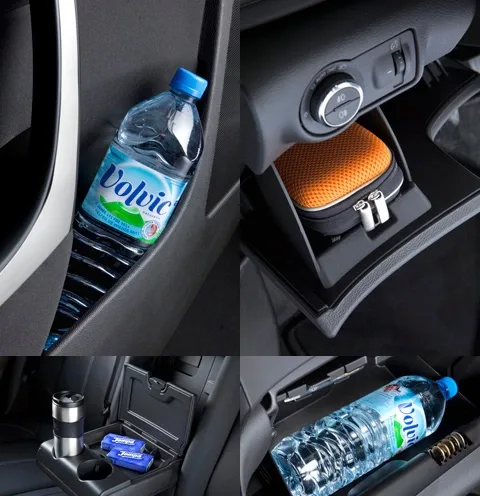
There are a huge number of niches, pockets, and compartments for small items in the car. One-and-a-half-liter bottles fit easily into the front doors, and under the front seat there is a pull-out drawer where you can put a laptop or women's high-heeled shoes. I don't seem to need it, but that's what 400 surveyed owners of current Astras wanted.
However, with the automatic, not everything is so smooth. Yes, its shifts are very soft, almost without jerks. But it decides to downshift too slowly. During overtaking, this starts to get on your nerves. Alas, at the presentation, only Astras with 160-horsepower 2.0 CDTi turbodiesels (350–380 N•m) were equipped with automatic transmissions, which have not yet been approved for Russia. The engine itself is pleasant and torquey. But our marketers are scared by the likely high price, weak demand, and the unsuccessful sales experience of diesel Astras of the previous generation. Let's hope that with gasoline engines, the automatic gearbox will get along better.
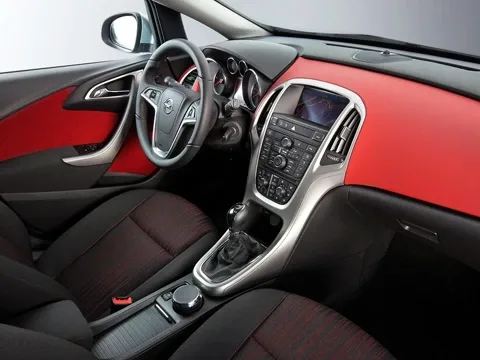
The front panel is available not only in black, but also in gray or red. This technique was already used on the younger model — the Corsa hatchback.
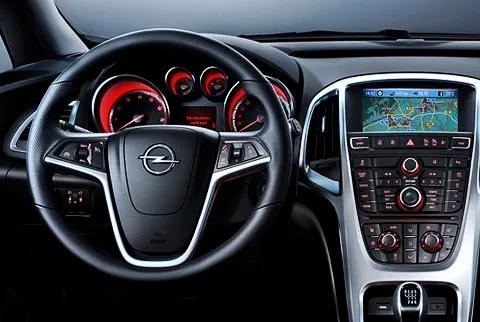
The instrument cluster can switch between two backlight modes: calm white and sporty red, as in the photo. For the first time in the golf class, a heated steering wheel can be ordered for the Astra.
The strongest side of the Astra is excellent sound insulation. On smooth German roads, the cabin is almost perfectly quiet. It's not for nothing that they tediously told us for an hour how the Germans fought against extra decibels. Compared to both the old generation and competitors, aerodynamic noises are minimized and only make themselves known above 150 km/h. Tires are almost inaudible, and the sound of the engine only starts to penetrate your ears when the window is lowered. Only light tapping of the wheels on rare bumps reminds you of movement. I can't say much about ride smoothness on ordinary roads — in Germany they are too good for testing the new suspension. Let's wait for Russian tests.
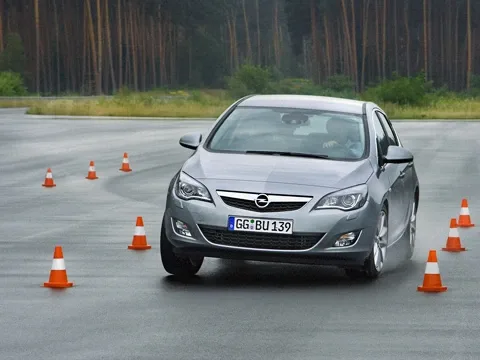
In Sport mode on the lane-change test, body rolls are minimal. The soft intervention of the stability control system is also pleasing, whose activation threshold in Sport is slightly pushed back.
Moreover, the wait won't be long: in February-March 2010, the first batch of new Astras will roll off the assembly line of GM's St. Petersburg plant in Shushary. Prices have not been announced yet, but representatives of Russian Opel say that the base configuration of the Astra will be richer and cheaper than the Kaluga Golf. So, we can count on a minimum price of about 600 thousand rubles. For now, the benchmark Volkswagen clearly loses to the Astra in one thing — in the feeling of coziness. The mathematically precise and cold interior of the Golf is far from the atmosphere of the Astra. Such an inviting cabin is hard to find, and not only in the golf class.
And yet, the impressions from the date on German soil remained mixed. The Astra is beautiful, elegant, and smart, but it doesn't touch the soul. This is not passion, but just sympathy. Yes, the Opel is comfortable and quiet to the point of deafness. But the "lever of love" is attached to a different part of the buyer audience than the one I belong to. And it's not that it's a family five-door — even in such a body, the previous Astra seemed aimed at a younger person. But this one has matured. The mischief has gone from Opel, for which I loved the previous generation. It's not even in the exterior. However, if I were choosing a golf-class car today, I would definitely take a closer look at the Astra. And I would even decide to buy it. But I'm afraid that on the way to the Opel dealer, I would definitely come across a Volkswagen showroom — with a new Golf shining in the window. Not as beautiful, but more dynamic, more characterful. With a real, not simulated, rear multi-link suspension.
Technical specifications
| Model | 1.4 | 1.6 | 1.4 Turbo | 1.6 Turbo | 2.0 CDTi |
|---|---|---|---|---|---|
| Body | |||||
| Body type | hatchback | hatchback | hatchback | hatchback | hatchback |
| Number of doors/seats | 5/5 | 5/5 | 5/5 | 5/5 | 5/5 |
| Length, mm | 4419 | 4419 | 4419 | 4419 | 4419 |
| Width, mm | 1814 | 1814 | 1814 | 1814 | 1814 |
| Height, mm | 1510 | 1510 | 1510 | 1510 | 1510 |
| Wheelbase, mm | 2685 | 2685 | 2685 | 2685 | 2685 |
| Front/rear track, mm | 1544/1558 | 1544/1558 | 1544/1558 | 1544/1558 | 1544/1558 |
| Curb weight, kg | 1373 | n/a | n/a | n/a | n/a |
| Gross weight, kg | 1870 | n/a | n/a | n/a | n/a |
| Trunk volume, l | 370–1235 | 370–1235 | 370–1235 | 370–1235 | 370–1235 |
| Engine | |||||
| Type | petrol | petrol | petrol, with direct fuel injection and turbocharging | petrol, with direct fuel injection and turbocharging | turbodiesel |
| Location | front, transverse | front, transverse | front, transverse | front, transverse | front, transverse |
| Number and arrangement of cylinders | 4, in-line | 4, in-line | 4, in-line | 4, in-line | 4, in-line |
| Number of valves | 16 | 16 | 16 | 16 | 16 |
| Displacement, cm3 | 1398 | 1598 | 1364 | 1598 | 1956 |
| Compression ratio | 10.5 : 1 | 10.8:1 | 9.5 : 1 | 8.8 : 1 | 16.5 : 1 |
| Max. power, hp/rpm | 100/6000 | 115/6000 | 140/4900 | 180/5500 | 160/4000 |
| Max. torque, N•m/rpm | 130/4000 | 155/4000 | 200/1850–4900 | 230/2200–5400 | 350 (380*)/1750 |
| Transmission | |||||
| Gearbox | M5** | M6 | M6 | M6 | M6/A6 |
| Drive | front | front | front | front | front |
| Chassis | |||||
| Front suspension | independent, spring, McPherson | independent, spring, McPherson | independent, spring, McPherson | independent, spring, McPherson | independent, spring, McPherson |
| Rear suspension | semi-independent, spring, with Watt's linkage | semi-independent, spring, with Watt's linkage | semi-independent, spring, with Watt's linkage | semi-independent, spring, with Watt's linkage | semi-independent, spring, with Watt's linkage |
| Front brakes | disc, ventilated | disc, ventilated | disc, ventilated | disc, ventilated | disc, ventilated |
| Rear brakes | disc | disc | disc | disc | disc |
| Ground clearance, mm | 130 | 130 | 130 | 130 | 130 |
| Performance characteristics | |||||
| Maximum speed, km/h | 178 | 188 | 205 | 221 | 215 |
| Acceleration time from 0 to 100 km/h, s | 14.2 | 11.7 | 9.7 | 8.5 | 9.0 |
| Fuel consumption, l/100 km | |||||
| — urban cycle | 7.2 | 8.3 | 7.8 | 8.8 | 6.4 |
| — extra-urban cycle | 4.5 | 5.1 | 4.8 | 5.6 | 4.1 |
| — combined cycle | 5.5 | 6.3 | 5.9 | 6.8 | 4.9 |
| Emission standard | Euro-5 | Euro-5 | Euro-5 | Euro-5 | Euro-5 |
| Fuel tank capacity, l | 56 | 56 | 56 | 56 | 56 |
| Fuel | AI-95 | AI-92–95 | AI-95 | AI-92–95 | diesel |
** Gearboxes: M5 — manual five-speed, M6 — manual six-speed, A6 — automatic six-speed
Technology
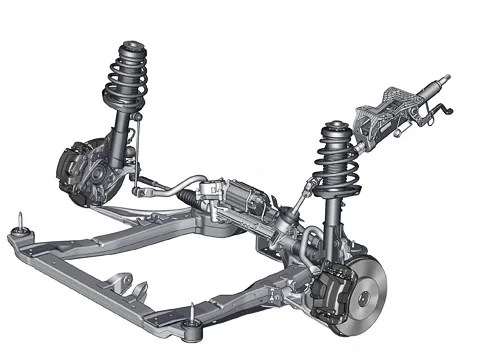
At the front, aluminum control arms are paired with McPherson struts, with springs and shock absorbers mounted separately. The front control arm bushings borrowed their design from the Insignia: they have become stiffer and have characteristics that change depending on load — all to improve handling. At the rear, hydraulic mounts are used instead, designed to dampen vibrations.
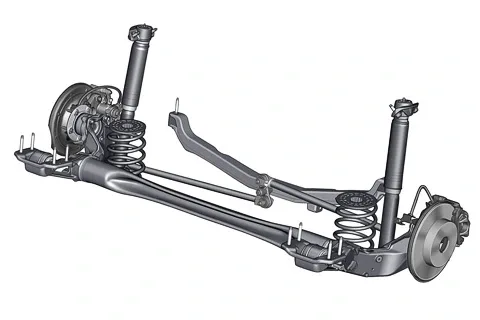
A key feature of the chassis is the Watt's linkage with a pair of trailing arms that extend from the longitudinal arms and connect via a bellcrank through a rigid central pivot. This design not only ensures stability in corners but also relieves the bushings from lateral loads. And since the loads are smaller, they can be made softer, which has a positive effect on vibration isolation.
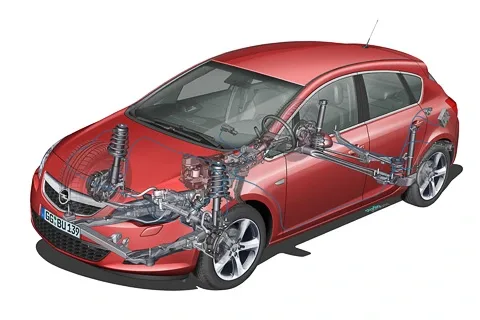
The body of the new Astra has become noticeably stronger than its predecessor: torsional rigidity increased by 43%, bending rigidity by 10%. The U-shaped torsion crossmember at the rear has a variable-thickness profile — this way engineers achieved optimal kinematics, and at the weld point with the longitudinal arms it takes on a cylindrical shape. The compliance of the crossmember can be changed by rotating it around the longitudinal axis. According to the developers, the combination of two diameters of the cylindrical part, three thickness options, and three installation angles gives a total of 18 possible rear suspension settings for different Astra modifications.
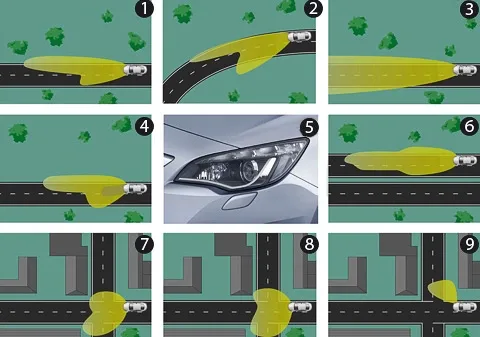
As on the Insignia, the Astra offers adaptive bi-xenon headlights AFL+ (Adaptive Front Light) with nine operating modes.
- Low beam for country roads — active at speeds from 50 to 100 km/h, provides a wider beam.
- Cornering light — activates above 40 km/h, headlights turn up to 15 degrees.
- Automatic high beam — switches to low beam if the camera detects oncoming or preceding vehicles, as well as on road crests.
- Low beam for bad weather — activated by the rain sensor, with the right headlight shining brighter and the left weaker to avoid dazzling oncoming drivers.
- “Daytime light” — LED “corners” in the headlights are bright enough to replace low beam, while being more durable and consuming less energy.
- Low beam for highway — activates above 100 km/h when there is no risk of dazzling oncoming traffic: headlight power increases, beam range reaches 140 meters.
- Low beam for city — at speeds below 50 km/h, the beam becomes wider but weaker.
- At speeds below 30 km/h, the headlights additionally turn 8 degrees toward the roadside.
- Cornering light for courtyards and parking lots — at speeds below 40 km/h with a strong steering turn, an additional side section lights up in the headlight.
Design
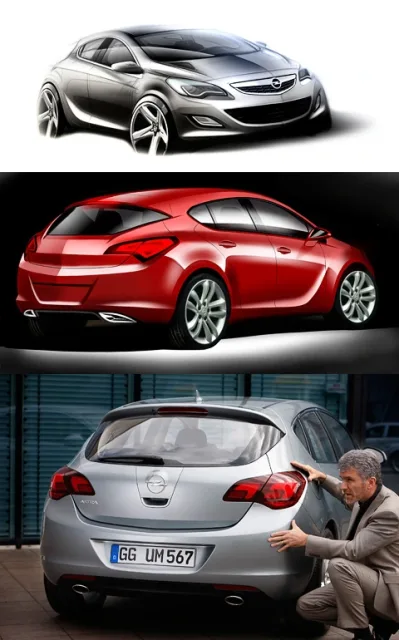
The exterior of the new Astra was worked on by Mark Adams, who has been with General Motors since 2002. The designer himself describes his creation as a combination of sculptural elegance and German perfectionism. Adams' team drew inspiration from old Kadetts and, of course, the spirit of the new Insignia. And, admittedly, the latter turned out more expressive.
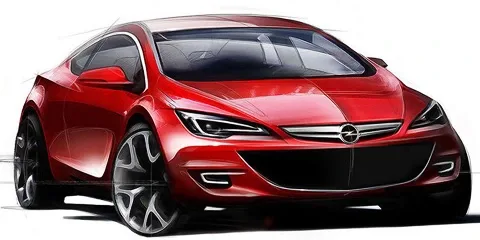
The creators are still keeping quiet about the three-door version of the Astra. Most likely, it will be shown in spring at the Geneva Motor Show. And we will see the “hot” modification Astra OPC no earlier than next year. At the same time, during a dinner conversation, Volker Strycek, head of the OPC division, noted that the top model will become more powerful than the current one, but fans will not see three hundred horsepower. Strycek considers such power excessive without all-wheel drive. A clever front suspension like those on the Focus RS and Megane RS — with separate steering knuckles — is designed to minimize torque steering on a powerful front-wheel-drive hatchback. A self-locking differential will also appear. In addition, Strycek promised that the Astra OPC will get a more comfortable steering wheel and gear lever. He also added that first we will see the return of the forgotten GSi version. It should also make a powerful impression.
Safety
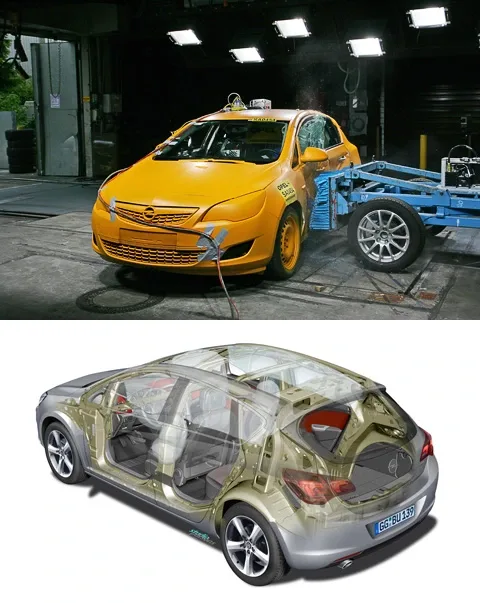
Crash tests according to the Euro NCAP methodology have not yet been conducted for the new model. For comparison: the previous generation Astra H under the old test system received the maximum five stars. However, engineers assure that the new model will be noticeably safer than its predecessor — and it's not just about a stronger body, but also about successful layout solutions that the fresh platform provides.
History
The debut of the first Opel Kadett took place in 1936. The car with a 1.3-liter engine producing 24 horsepower immediately became one of the most affordable on the market — the price was set at 2100 Reichsmarks. Moreover, the rear-wheel-drive car with a unibody body turned out to be very compact. Over four years, 107,608 pre-war Kadetts were produced at the plant in Rüsselsheim — they were made in three body types: two- and four-door versions, plus a convertible.
After the war, the equipment and tooling were taken to the Soviet Union — this is what made it possible to launch production of the famous Moskvich series 400/420. Until 1956, when production ceased, 247,439 such cars were assembled.
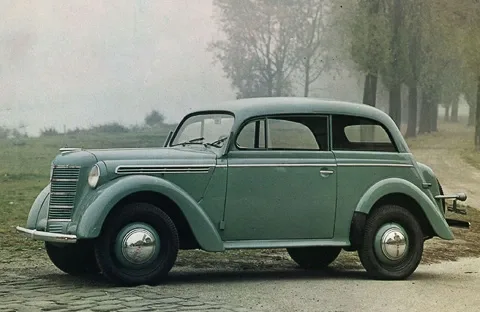
The first post-war Kadett with the index A appeared in 1962. Assembly was organized in Bochum, and the designers drew inspiration from Chevrolet models. The classic layout with a unibody body required only 12 body panels. The curb weight did not exceed 670 kg, so even the liter four-cylinder engine allowed this "fluff" to confidently pull away. The engine was offered in two versions — 40 or 48 hp. Over three years, 649,512 units were produced.
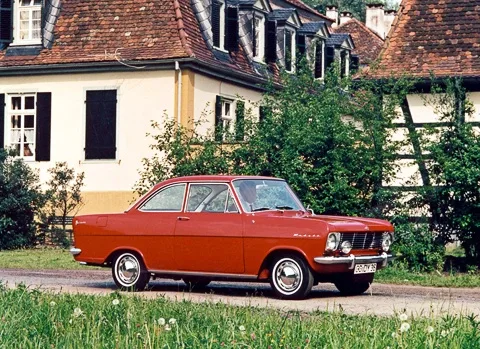
The Opel Kadett B, which appeared in 1965, was a deeply modernized version of its predecessor. The car grew in length and width, acquired an automatic transmission, and the liter engine gave way to units of 1.1 and 1.9 liters (45–106 hp). The lineup included five-seat sedan and station wagon, and there were 11 body variants in total! Production of the B generation continued until 1973; the car was even tried to be sold in the USA, but it seemed too simple to Americans, and sales were curtailed early. Total production — 2.6 million cars.
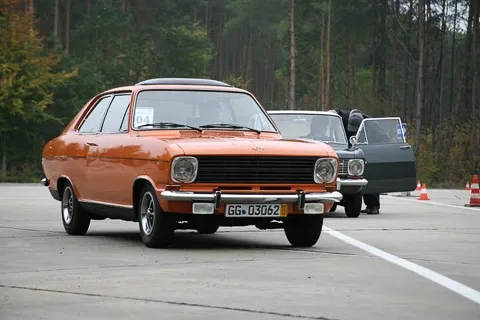
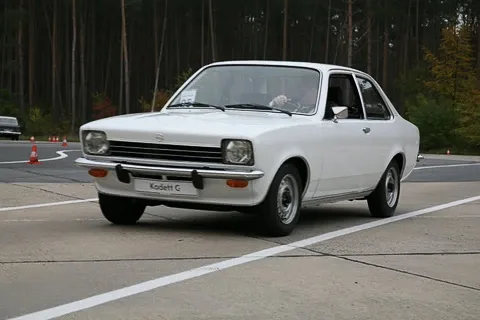
The C generation debuted in 1973. The layout remained rear-wheel drive, but for the first time there appeared a spring front suspension on transverse arms, a two-liter engine with injection, a five-speed manual, and three-point seat belts. The "C" was built on the global GM platform — T-Platform, so it had many official clones under the Chevrolet, Daewoo, and Isuzu brands. Production ended in 1979, having made 1.7 million cars.
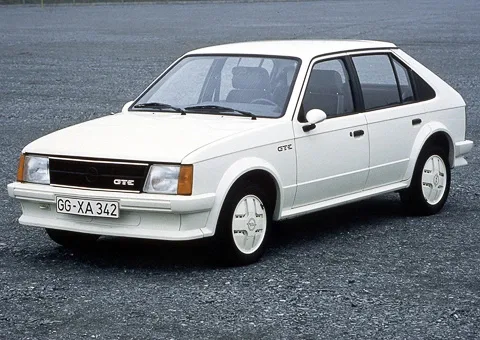
The Kadett D was a real revolution for Opel. The compact, which had always fought with Volkswagen models — from Beetles to Golfs — for the first time abandoned rear-wheel drive. The front-wheel-drive car became 12 cm shorter than its predecessor, but the new layout with a transverse engine and rear semi-independent suspension made the interior more spacious. The engine range — from a liter to two, power from 53 to 115 hp. A 1.6-liter diesel with 54 horsepower also appeared for the first time. The Germans received the new model with delight — at one time it even outsold the Volkswagen Golf. In total, 2.1 million Kadetts of the D generation were built.
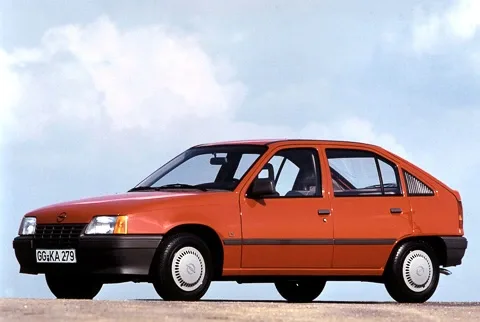
The last in the family was the Kadett E. In 1985, just a year after production started, it received the title "European Car of the Year". The aerodynamics of the "E" were phenomenal — Cx = 0.30, which allowed it to surpass the then fashionable Renault 25 and Lancia Thema. The result is logical: the last Kadett became the most mass-produced — by 1991, 3.8 million units were produced. Convertibles were made for a couple more years, but the main thing is different — the Kadett E is still alive today under the name Daewoo Nexia.
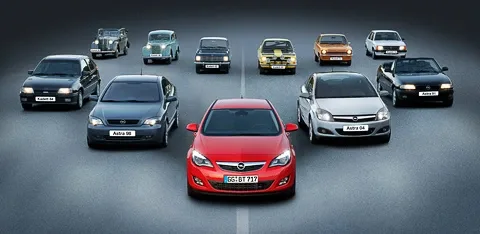
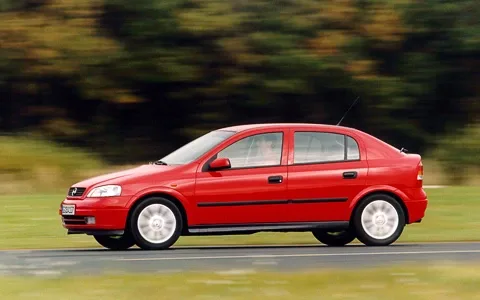
When it was time to change generations, General Motors decided to unify names for the two European twin brands — Opel and Vauxhall. The fact is that in Britain, the Kadett starting from the D generation was sold precisely as the Vauxhall Astra. So this name passed to Opel as well.
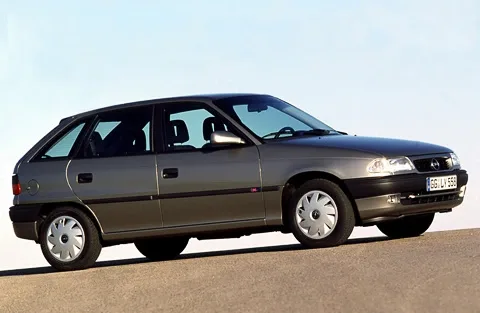
The premiere of the car with the new name took place in 1991 at the Frankfurt Motor Show. The Germans bet on safety — they mentioned computer simulation of body deformation and an abundance of active and passive protection systems. The Astra F lineup included six petrol and diesel engines with power from 60 to 150 hp. After the 1994 restyling, the car received a four-speed automatic from Japanese Aisin, gas-filled shock absorbers instead of oil ones, and improved anti-corrosion treatment.
The second generation Astra came out in 1998. It was then that the OPC version with a 200-horsepower turbo engine appeared, as well as elegant coupe and convertible created by the Italian studio Bertone. Suspension tuning was handled by Lotus specialists. The car, which also served as the base for the Zafira compact MPV, is still produced in some countries — for example, in Brazil. The sedan was also tried to be made in Russia under the name Viva, but the project did not take off.
On the third-generation Astra, which debuted in 2004, I personally racked up 35 thousand kilometers across the country. This generation is still in service — it is assembled in several countries, including Russia. The Delta platform is also known from other GM models: Opel Zafira, Chevrolet Cobalt, Chevrolet HHR. In 2007, the "third" Astra became the best-selling car in Europe, and a year later it tried its hand in the USA under the Saturn brand — but failed due to the high price.
Plant
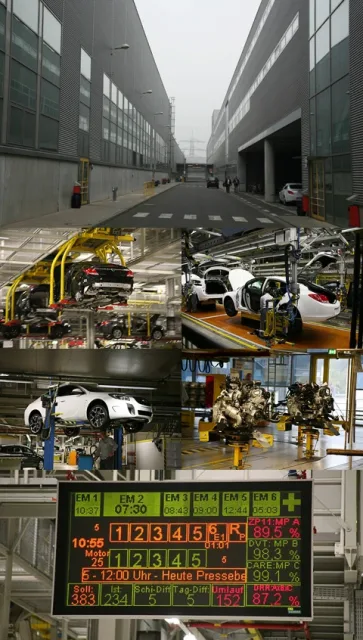
We also managed to look into the Opel plant in Rüsselsheim. Currently, they assemble sedans, hatchbacks, and station wagons of the Insignia, including the "charged" OPC versions. Next year, the "twin" Buick Regal for America will be added to them, and a year later — the Astra station wagon. Earlier, Vectras came off this assembly line, even earlier — Omega sedans and station wagons, and almost 75 years ago — the first Kadetts.
On the Insignia, we saw life ahead — in Russia, you can't find them even with a searchlight. In the first six months, fewer than 600 cars were sold. The main problem is the lack of automatic transmissions on versions with 1.6 and 1.8 engines. But during the plant tour, information was voiced that the launch of Insignia production in Russia is not ruled out — at a similarly equipped plant in Shushary. True, so far these are just talks.
Behind the scenes
The test of the new Astra took place in Frankfurt and its surroundings, as well as at the Opel test site in Dudenhofen. There we were strictly forbidden to shoot — around there were plenty of camouflaged cars of various brands. The weather also let us down: both days it drizzled, and the fog lay so low and was so thick that the car sometimes disappeared into the white veil already two meters from the lens.