
Opel has finally introduced its own SUV — the Antara model. Moreover, assembly of the car from Korean kits has already started in St. Petersburg, at the same facilities where its twin, the Chevrolet Captiva, is produced.
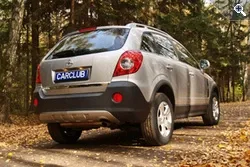 For a long time, Opel remained the only German manufacturer without all-wheel-drive models, but now this gap has been filled. Previously, the company only produced licensed copies of Isuzu SUVs — the Frontera and Monterey, but their production line stopped back in 2004. Since then, the market has changed, and even French brands, which previously shied away from AWD, are now mastering this segment.
The Antara was developed jointly with Korean partners, who half a year ago brought the related Chevrolet Captiva to the market. The Asian influence here is easy to trace.
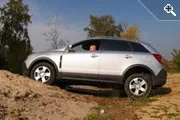
If you put both cars side by side, differences will be found only in the design of the front and rear — the overall silhouette is almost identical. The rear of the Opel is noticeably shorter, which makes the trunk smaller, and the third row of seats is not available at all, but the profile looks sportier. The sharp edges of the headlights add expressiveness, but at the same time deprive the car of individuality — you can recognize it as an Opel only by the badge.
The interior is much more original — here you can feel Opel's signature style, although it's hard to say which model it comes from. It's rather a collective image from various passenger cars of the brand: the same yellow display on the center console and three round deflectors. Gray climate control knobs and small radio buttons are scattered across the entire panel. Even those who have already dealt with the confusing interfaces of recent Opels will feel uncertain here. Others will not manage without instructions at all — even a simple radio station setup cannot be done blindly.
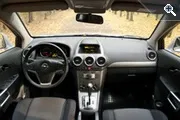
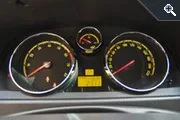
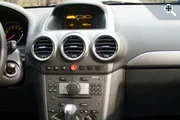
Under pressure from auto journalists, Opel finally abandoned the non-locking steering column switches in favor of conventional ones. They are indeed easier to use: you don't need to guess which algorithm the wipers are currently working on — everything is intuitive.
There are no open niches for small items in the cabin — there is simply nowhere to put a phone or a pack of cigarettes. Even stranger is that there is no ashtray on the center console. A "smoker's cup" can be installed in the door pocket, but it is located at the very feet, without lighting, and hitting it blindly is almost impossible. Moreover, even non-smokers often use the ashtray as a mini trash bin. The cigarette lighter is also poorly placed — between the seats, where you can't reach by touch. Given that it heats up red-hot, such experiments are unsafe. Although if you use it as a socket, the location next to the central box is quite logical.
Rear passengers live comfortably here — there is enough space in all directions, and the central tunnel is completely absent. The rear seat back is formally adjustable in angle, but the range is so small that there is almost no benefit from it. The shortened trunk in the five-seat version disappoints — only 370 liters.
On the move, the Antara behaves like a real SUV. The steering wheel lacks reactive force, the body noticeably rolls, and vibrations from unsprung masses are transmitted to the cabin — all this reminds of large jeeps. I even got out of the car to look under the floor and hood... And what? There is no frame, the suspension is independent, and the steering mechanism is a regular rack-and-pinion, like in passenger cars, not a "worm" like in real off-roaders. How GM managed to make such vague steering is a mystery. Perhaps it's a matter of the shock absorber settings from the Koreans?

As speed increases, the situation improves slightly: after 100 km/h the steering wheel fills with heaviness, and the tall and narrow tires make the car completely insensitive to ruts. Irregularities are swallowed by the powerful suspension. But there can be no talk of driving pleasure — you simply control some car N. You turn the wheel — the car goes, you make a mistake in a turn — the electronics will correct the trajectory and won't let you fly off. Safe, but boring!
However, acoustic comfort suffers on all fronts. The hum of tires, the howling of wind at speed, and to top it off — a modest engine that has to work at high revs. The engine is intrusively audible already at 3000 rpm, which in top gear corresponds to 100 km/h. Even in the city with calm driving, it's hard to keep the tachometer needle below this mark — acceleration turns out to be too drawn out. If you want to go faster, endure the engine's howl or turn up the music. The four-speed automatic tries to help, but the limited gear selection does not contribute to dynamics. And you shouldn't count on engine braking — even in manual mode, the "automatic" does not hold the set revs.
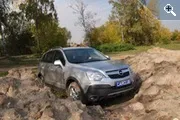
Off-road, the Antara is confident only as long as the wheels maintain grip on the ground. Driving along a dirt road at speed is quite possible — the energy intensity of the suspension is decent, and a city curb is stormed without problems thanks to the ground clearance. But serious obstacles are not for this crossover: the lack of locking differentials stops the car at the first hint of diagonal wheel hanging, and the traction control system works with delays and too roughly, with little benefit. Plus, the trim under the front bumper, which seemed aluminum, turned out to be flimsy plastic. In a word, the Antara's off-road capability is purely crossover — you can leave the asphalt, but it's not suitable for serious outings.
Conceptually, the idea of the Antara is not bad. It's a large and affordable SUV that could be an alternative to a pickup for those who don't need an open body but want a simple and spacious car for everyday use. However, the laws of the genre require a stricter approach. What is forgiven in a pickup starts to irritate in an SUV. It's especially disappointing for the ergonomic and sound insulation mistakes from Opel. When we tested the Chevrolet Captiva, the requirements were lower, but from a German car you expect something completely different. By releasing the Antara, Opel risks the reputation they have so diligently strengthened with their latest passenger models. Although the attitude towards this car will likely be formed not based on driving qualities, but depending on reliability. If the SUV serves faithfully, much can be forgiven.
Text: Leonid Pavlov