
Until recently, there were very few mid-size crossovers in Europe. But the situation is changing rapidly: the new Mitsubishi Outlander is hitting the market, along with the Peugeot 4007 and Citroen C-Crosser built on its platform, plus the seven-seat Chevrolet Captiva. And now the Captiva has a sibling — the fresh five-seat all-wheel-drive Opel Antara. Can this be called simple badge engineering? Both yes and no.
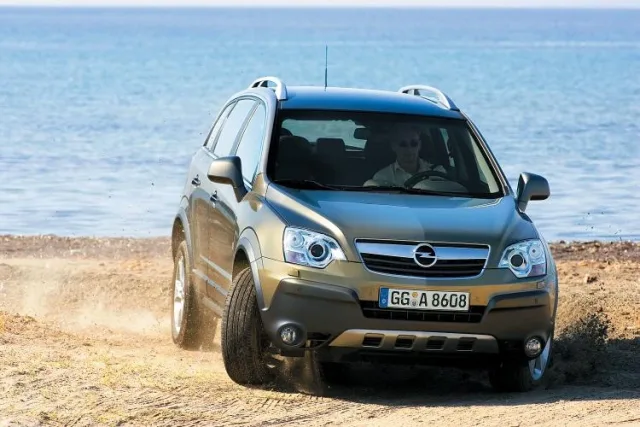
Even on a dirt road, the Antara behaves like a regular front-wheel-drive car — it's almost impossible to provoke a slide with a sharp press on the gas
In Opel's history, there was already a "European off-roader" — the Frontera model, which was a clone of the Japanese Isuzu Rodeo. Over the period from 1991 to 2004, that is, over 13 years, 285,000 people bought the Frontera. For the early nineties, the car was considered quite decent, but the body-on-frame design quickly became morally outdated.
After 2004, Opel's SUV slot remained empty for a full two years.
And now...
The Opel Antara and the slightly earlier Chevrolet Captiva are indeed twins, developed by the same team of engineers in parallel. But the differences are not limited to badges, body panels, and headlights. The key point: the Antara is 60 mm shorter than the Captiva, as the cars have different bodies. That's why the Chevrolet offers a third row of seats, while the Opel does not.
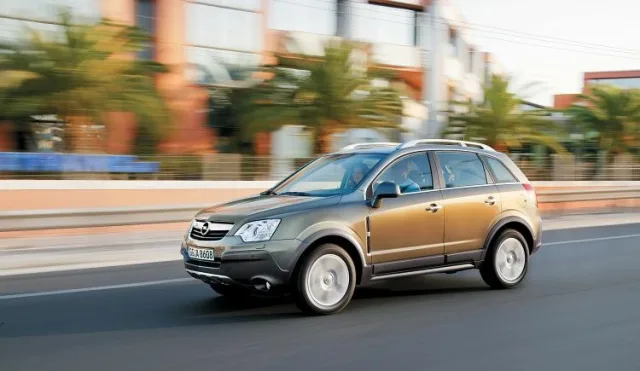
What other differences are there?
It's easier for me to answer this question than for many, since shortly before, I had already tested the Captiva (AR No. 15, 2006). So during the Antara presentation on Greek roads, I immediately understood the main thing: the Opel Antara is noticeably quieter!
The interior is also styled differently. The only thing the cars share is the inconvenient "handbrake," which constantly presses against the adjustable armrest, resembling an expander. If the Captiva internally resembles the Korean Chevrolet Aveo, the Antara is a real Opel! The instrument panel comes from the Corsa and Astra. The center console with silver trim, clear rectangular buttons, and convenient climate control knobs is topped with three "cannon" air vents and a navigation screen, which will only appear in Russia at the end of next year. The steering wheel feels pleasant to the touch but is slightly too large. The quality of materials is top-notch: soft leather or plastic resembling canvas everywhere.
 |  |
| The built-in Flex-Fix bike carrier hides in the rear bumper and extends the overhang by half a meter when pulled out. Load capacity: a pair of bicycles with a total weight of up to 40 kg | The carrier itself weighs only 23 kg and has its own lights, license plate mounting, and parking sensors |
The Antara's equipment is also richer. Opel's signature feature is the Flex-Fix pull-out bike carrier integrated into the rear bumper. By the way, unlike the Captiva, the Opel's "doughnut" spare wheel lies in the underfloor of the trunk, not suspended under the body. And although the powertrains are shared, the Antara sports its own exhaust mufflers — as required by the layout.
It is precisely because of the different exhaust system that the base 2.4-liter gasoline engine (made in Australia at the Holden plant) develops 4 hp more than the Captiva's. The design of this engine with a cast-iron block dates back to the late seventies — its ancestor appeared in 1980 under the hood of the Opel Ascona. Since then, the engine has been bored out to 2.4 liters, fitted with an aluminum 16-valve head and multi-point injection. But the thrust, alas, is not impressive: the 140-hp Antara 2.4 is just as leisurely as the Captiva with the same engine. The five-speed manual is no gift either: the lever is just as "cottony" and long-throw as its sibling's. The only consolation is Opel's promise to refine the gearbox and offer a six-speed manual.
 |  |
| The interior is stylish, ergonomic, and solid | The carbon-fiber cones in the manual's synchronizers work poorly — shifts lack precision |
 |  |
| Next to the inconvenient "handbrake" is a handle for the passenger. Just hope they don't mix them up... | The seats are excellent, holding you firmly in corners |
What about the 227-hp Antara V6 3.2 with an automatic? It is indeed quicker. But the automatic doesn't thrill either: it shifts lazily and "smeared." Manual mode only partially helps.
But I finally truly appreciated the diesel, developed jointly with VM Motori. A magnificent unit! True, at the very bottom there's a lack of torque, but there are no convulsions or jerks. And after 1500 rpm, a real waterfall of newton-meters pours onto the wheels, only drying up by 4000 rpm. Because of this, the diesel Antara subjectively accelerates no worse than the V6! In 2007, a less powerful diesel version (127 hp) is expected, which will be more tolerant of poor-quality fuel.
 |  |
| Variable-geometry turbo, injection pressure up to 1600 bar — an ultra-modern diesel producing 150 hp from just two liters of displacement | To get out of such a harmless pit, the Antara spins its front wheels for a long time |
The transmission with electronically engaged rear drive is exactly like the Captiva's. The settings haven't changed either: the electromagnetic clutch on the rear axle engages only after front-wheel slip, and even then with a two-second delay. So the Antara's off-road talents, alas, are modest — in those two seconds, the front wheels manage to dig into dirt, sand, or snow.
So what does the Opel do better than the Captiva, besides design and badges? The engines are the same, the transmissions are identical...
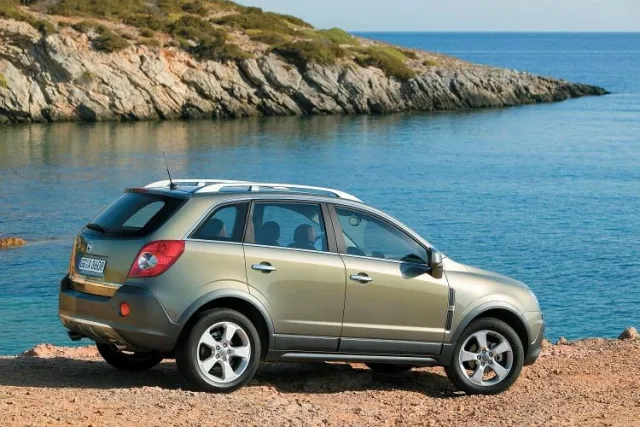
Sound insulation! That's the main difference. The Opel crossover is 75 kg heavier than the Captiva, and almost all of that "extra weight" is additional mats and mastic. The gasoline engines are practically inaudible on the move, and the diesel only reveals itself with a grumble at idle. True, the diesel's vibrations haven't gone away. But the rattling of pebbles on the underbody, tire hum, and suspension noise — all of that the Captiva owner hears constantly, while the Opel owner doesn't know these sounds at all! In the overall silence, only aerodynamics stand out: already at a hundred kilometers per hour, the massive mirrors start to "whistle."
 |
| There's enough room for both passengers and luggage |
But with ride smoothness, it's the opposite: the Antara feels stiffer than the Captiva. In pursuit of handling, Opel fitted more effective shock absorbers without touching the springs and stabilizers. The result is that the Antara meticulously follows the road profile and counts every small bump in detail. But on broken dirt roads, you can charge ahead very confidently: the suspension's energy capacity is excellent. Tested on a special stage of the Acropolis Rally!
 | |
| A shorter tail means a more dynamic silhouette: the Opel Antara (left) is shorter than the Captiva (right) by exactly 60 mm due to the rear overhang | |
And indeed, the Antara handles noticeably better than the Captiva. Body roll is reduced thanks to small "support" springs inside the shock absorbers. Steering responses are faster and more precise. The excellent "feel for the car" is also aided by a variable-assist power steering, which the Captiva lacks. On a high-speed straight, the steering wheel pleasantly fills with weight, while in sharp corners it doesn't require extra effort, maintaining "transparent" feedback. In this regard, the Opel Antara is very reminiscent of the Lexus RX 350.
 |
| Structurally, the Opel Antara and Chevrolet Captiva are as alike as two peas in a pod. The rear drive is engaged via a clutch in the rear differential housing: on electronic command, a built-in electromagnet compresses a pack of "wet" friction plates |
In short, the Opel Antara, especially in the diesel version with a manual gearbox, is already a full-fledged Sport Activity Vehicle, a car for trips to nature and outdoor activities. And the Captiva is a purely practical SUV, a car rather for utilitarian and sporting tasks. So the extra 2175 euros on the German market compared to the Captiva is a justified price for more aristocratic driving manners and impeccable finish quality.
 |  |  |
| The trunk is spacious, but there will be no third row of seats here | The "spare wheel" lies under a rigid cover, and on top is covered with a plastic tray with niches for small items | The guide "rail" for aluminum partitions and eyelets are the basis of the FlexOrganizer cargo securing system |
And how are things in Russia? Here the Opel Antara will go on sale only in February, and price lists have not yet been published. But it is already obvious that the Opel will be several thousand more expensive than the Chevrolet (which costs from $30,000 to $40,000) and will fall into an almost empty niche of mid-size crossovers with a claim to "moderate luxury." There are few competitors in this segment so far: the Toyota RAV4 and similar cars are smaller and cheaper, while the BMW X3, Nissan Murano, and serious SUVs like the VW Touareg are noticeably more expensive. So a nice, quiet, and obedient Antara, and even with a branded bike carrier... Why not?
| Specifications | |||
| Vehicle | Opel Antara | ||
| Modification | 2.4 | V6 3.2 | 2.0 D |
| Body type | 5-door wagon | 5-door wagon | 5-door wagon |
| Curb weight, kg | 1805 | 1865 | 1865 |
| Gross weight, kg | 2225 | 2505 | 2505 |
| Engine | petrol | petrol | turbodiesel |
| Location | front, transverse | front, transverse | front, transverse |
| Number and arrangement of cylinders | 4, in-line | 6, V-shaped | 4, in-line |
| Displacement, cm³ | 2405 | 3195 | 1991 |
| Number of valves | 16 | 24 | 16 |
| Cylinder bore/piston stroke, mm | 87.5/100.0 | 89.0/85.6 | 83.0/92.0 |
| Compression ratio | 9.6:1 | 10.3:1 | 17.5:1 |
| Maximum power, hp/kW/rpm | 140/103/5200 | 227/167/6600 | 150/110/4000 |
| Maximum torque, Nm/rpm | 220/2400 | 297/3200 | 320/2000 |
| Gearbox | manual, 5-speed | automatic, 5-speed | manual, 5-speed (automatic, 5-speed) |
| Drive | all-wheel drive, with pluggable electromagnetic clutch drive to the rear wheels | ||
| Front suspension | independent, coil spring, McPherson | ||
| Rear suspension | independent, coil spring, four-link | ||
| Front brakes/disc diameter, mm | disc, ventilated/296 | ||
| Rear brakes/disc diameter, mm | disc, ventilated/303 | ||
| Steering | rack and pinion, with power steering | ||
| Number of steering wheel turns from lock to lock | 3.2 | 3.2 | 3.2 |
| Fording depth, mm | 450 | 450 | 450 |
| Ground clearance, mm | 200 | 200 | 200 |
| Tires | 225/70 R16, 235/60 R17, 235/55 R18 | ||
| Maximum speed, km/h | 175 | 203 | 180 (178)* |
| Acceleration time 0-100 km/h, s | 11.9 | 8.8 | 10.3 (12.1) |
| Fuel consumption, l/100 km | |||
| urban cycle | 13.3 | 16.4 | 8.9 (11.5) |
| extra-urban cycle | 7.3 | 8.9 | 6.8 (6.8) |
| combined cycle | 9.6 | 11.6 | 7.5 (8.6) |
| Fuel tank capacity, l | 65 | 65 | 65 |
| Fuel | petrol AI-95 | petrol AI-95 | diesel Euro 4 |
| * Data in parentheses are for the version with automatic transmission | |||