
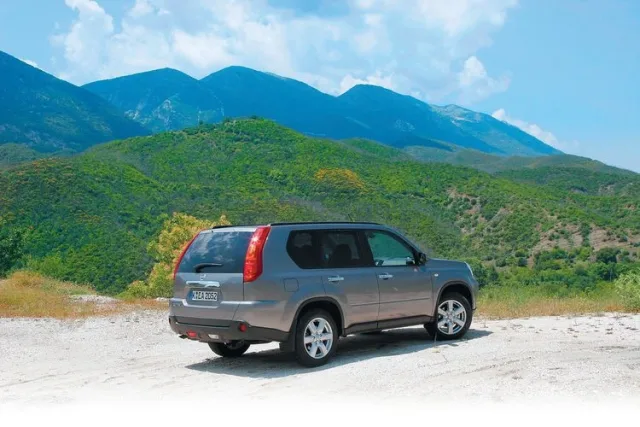
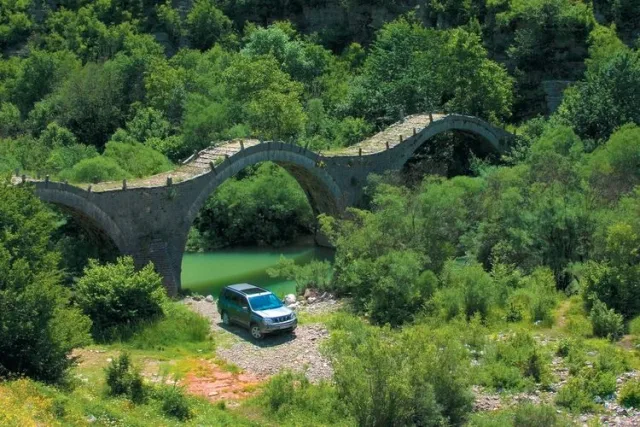
— Watch your step, a snake! — I push Maxim Kadakov aside. But he has already stepped on a gray "shoelace" writhing along the edge of the asphalt. Fortunately, the reptile was no less frightened than Max — and instantly disappeared into a roadside ditch. That's how our test of the new Nissan X-Trail crossover in the Greek province of Ioannina started. And later there were also turtles...
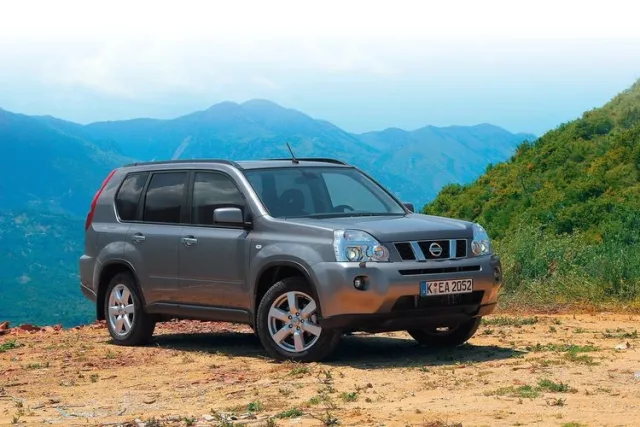
The route turned out to be not "pavement" at all: we crawled about 40 kilometers over rocky dirt roads, constantly fearing punctures in the 17-inch tires. In the forest thicket we took mud baths, then got caught in a "shower," fording a mountain stream. Good thing there were also mountain serpentines, where the Nissan X-Trail managed to surprise us... After all, it is based on the same platform as the Nissan Qashqai, which our experts have already driven and noted several shortcomings: "incorrect algorithm of the electric power steering," "suspension not adapted to Russian roads" (see AR No. 9, 2007). However, the point, of course, is not the platform, but the settings. And they must be different — if only because the Nissan
X-Trail is larger and heavier than the Qashqai. Plus, the image demands a lot: if the rounded Qashqai aims to be a ladies' favorite, then the angular X-Trail is a men's choice. And how many such compact crossovers are there? You can count them on your fingers — the Land Rover Freelander and, actually, the Nissan X-Trail.
True, at first a suspicion crept in that this X-Trail wasn't so new: at most, a facelift. The same "face," the same proportions... And you need to look closely to realize: all body panels and all "hardware" are truly new, starting with more convenient door handles and ending with the fifth door, which now lowers almost to the lower edge of the bumper, simplifying luggage loading. And the trunk itself has become more spacious: the car has lengthened by 12 cm, and almost all of this increase went to the cargo compartment.
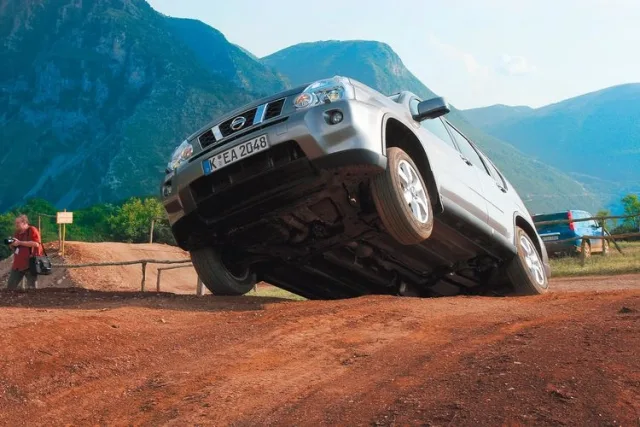
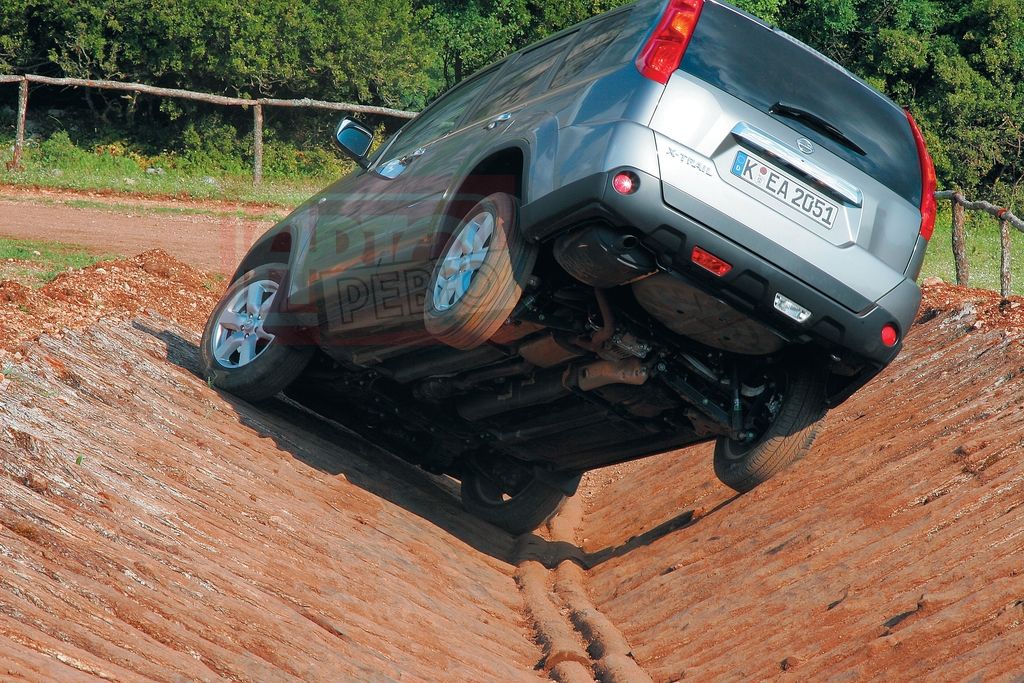
The electronic imitation of differential locks, although it does not make the X-Trail a full-fledged off-roader, helps in diagonal hanging
And the last doubts dissipate as soon as you look into the cabin. The instruments from the center of the front panel have moved to their rightful place — in front of the driver! The new car is definitely new.
— By moving the instruments, we freed up space for a spacious box above the center console, — explains Chris Lee, general manager of Nissan's all-wheel-drive vehicle development department.
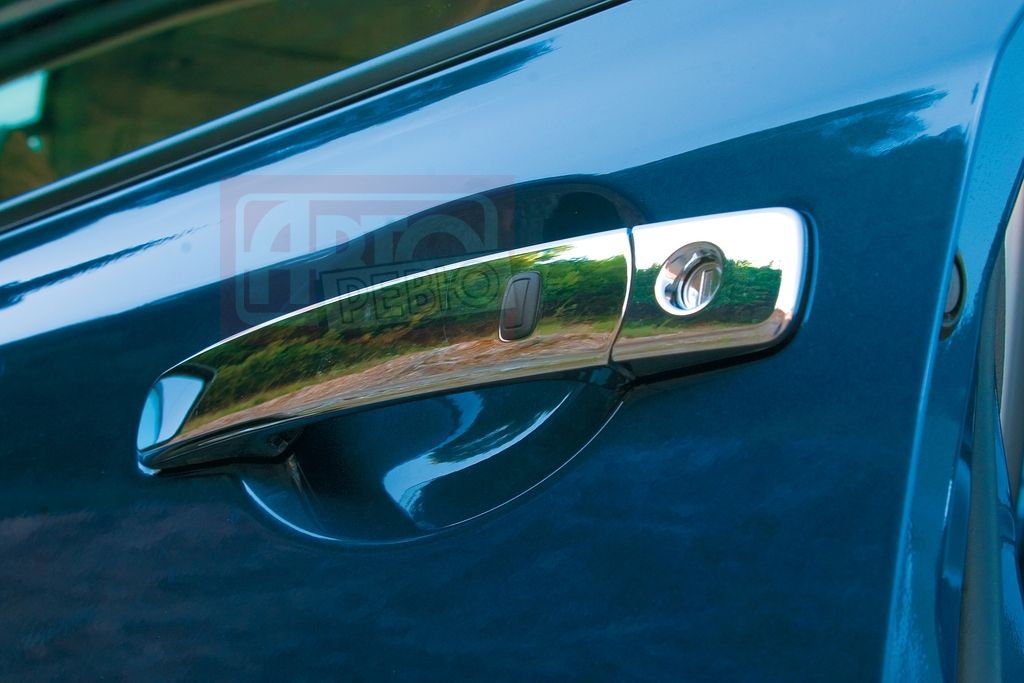 | 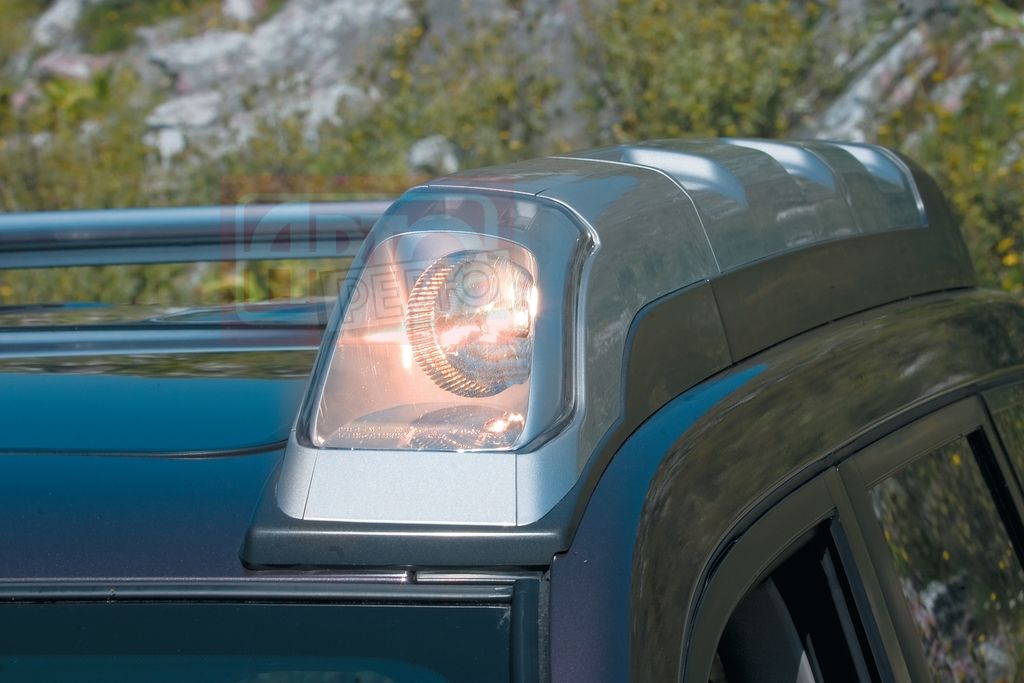 | 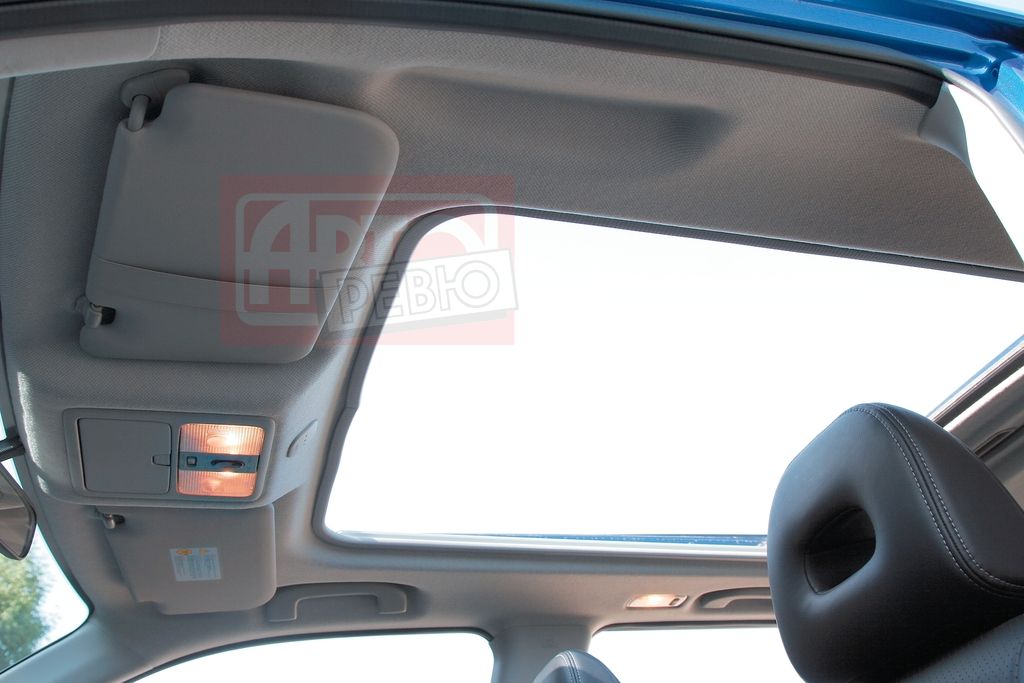 |
| Door handles have become larger and more convenient | Spotlights integrated into the roof rails turn on together with the high-beam headlights | The sunroof has increased in length by 8 cm — now its area is 0.6 m² |
Oh, Mr. Lee is being disingenuous. The box did appear, but the real reason for the "move" is different! Whatever the Nissan people say, justifying the placement of instruments in the center of the panel (like, when searching for the necessary information, the gaze "conveniently" moves horizontally rather than vertically, and that "central" instruments help not to lose sight of the road situation), the reason is clear: it was not only unusual but also inconvenient. We have repeatedly noted this in our tests.
But the high seating position remains the same. The driver sees the hood and perfectly feels the front dimensions, which on the new car are emphasized by small transparent "horns" on the headlights. Both the seat shape and adjustment ranges were to our liking: at a height of 190 cm — no crampedness, no offense. True, I set all adjustment ranges to the limit, including the steering wheel, which now moves in two directions. There are no complaints about the controls either.
But the center console is a bit plain. This does not apply to cars equipped with navigation with a large color screen. But Nissan X-Trail with navigation is not yet planned for Russia, which means there will be no rear-view camera in the options list either. A pity.
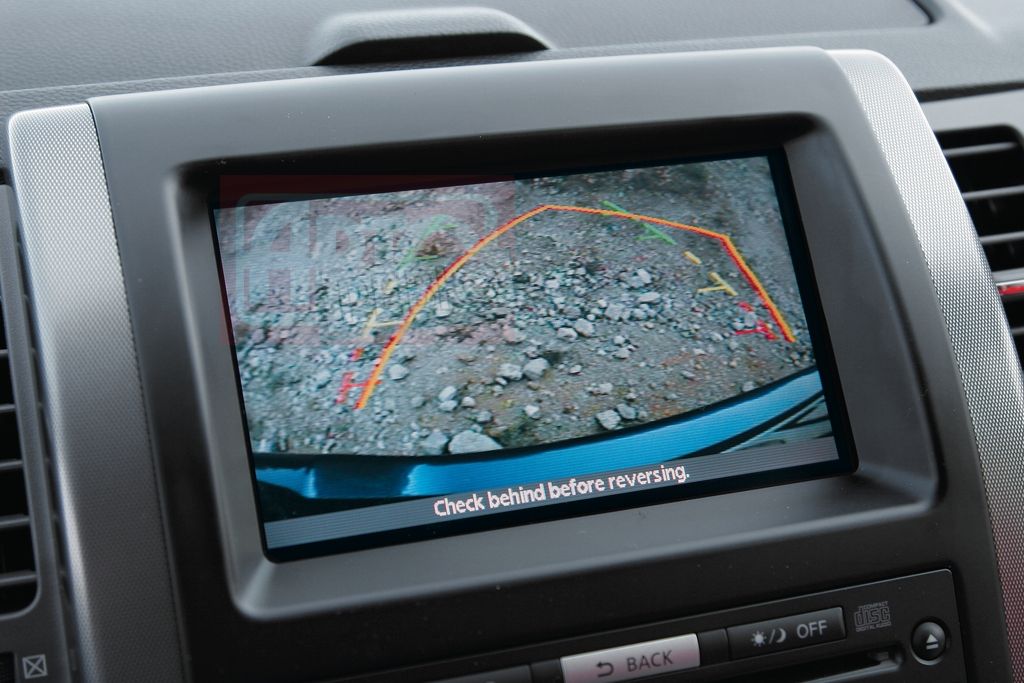 | 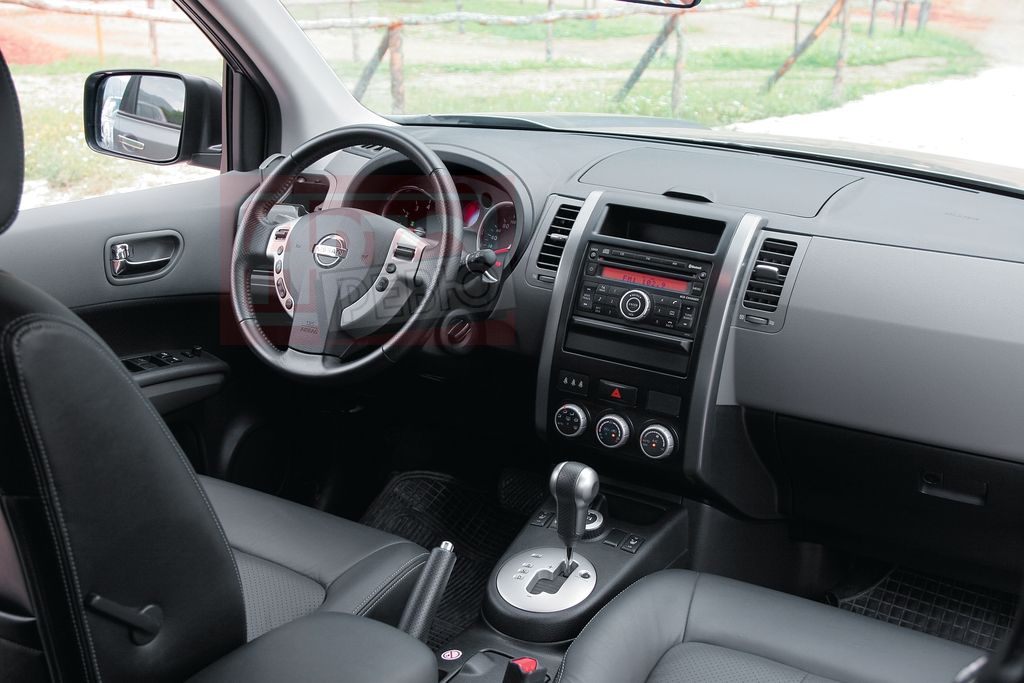 | 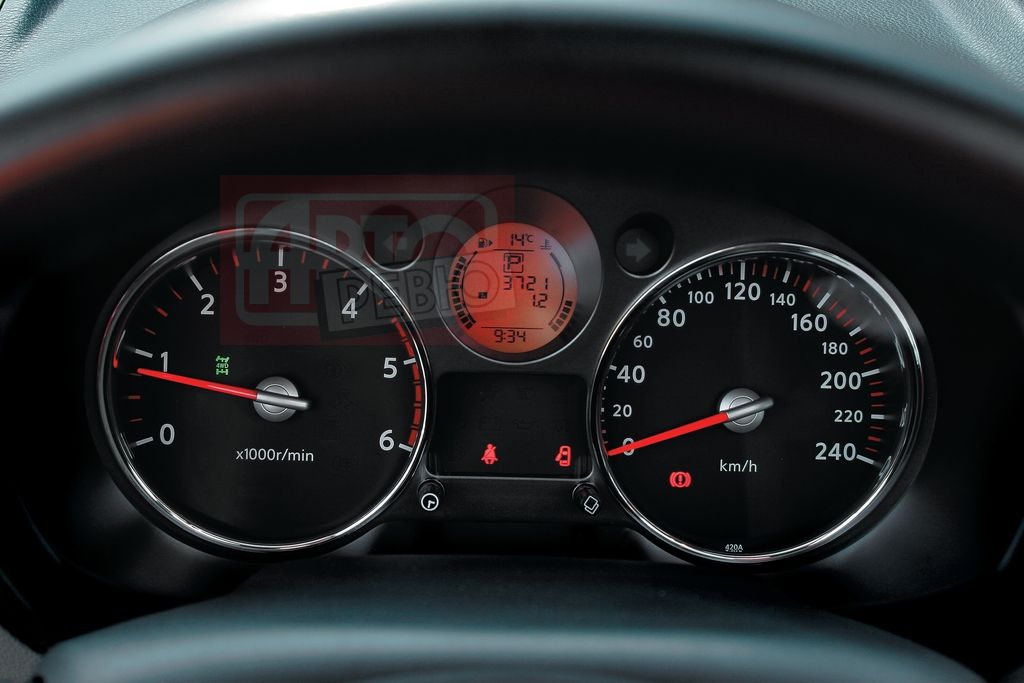 |
| The rear-view camera is offered paired with navigation. But in Russia neither will be available | The strict interior is trimmed with soft materials | The fuel level and engine temperature indicators are made "graphically" |
I move to the rear seat. There is enough legroom, but the roof "presses." This is due to the huge sliding sunroof with which the car was equipped — because of it, the headliner became lower by about five centimeters. But the "middle passengers" enjoy wonderful views through the 80 cm long roof window, and people of my height can recline the seatback — its angle changes by 12 degrees.
I get out and open the fifth door. How they praised this trunk at the press conference! And its volume is as much as 603 liters, and some unusual double floor with many compartments... Indeed, under the plastic flooring there are spacious trays, the configuration of which can be changed with easily removable partitions. It would seem great: here — a first aid kit, here — rags, here — gloves... And the plastic floor panels are easy to wash — you can safely throw dirty things on them. But, having put our bags in the trunk, we quickly regretted it. Things rolled around with a crash on the slippery floor, not only in corners, but also on straight sections — during acceleration and braking. The "plastic" trunk desperately lacks a net or other devices for securing cargo.
The new X-Trail has changed not only the platform, but also the range of engines. Of the previous generation engines, only the 2.5-liter gasoline engine remains, whose power increased from 165 to 169 hp during modernization. The other engines are new, and all are two-liter: a gasoline engine with 141 hp and two turbodiesels with 150 and 173 hp. The Nissan people are especially proud of the 150-horsepower 2.0 dCi diesel with a six-speed "automatic" — they say no Japanese competitor offers such a combination. We also rubbed our hands, but... What's the use? New diesel engines will not be supplied to Russia: they, they say, meet Euro 4 standards, but our fuel does not. But both gasoline engines can be ordered either with a six-speed manual gearbox or with a CVT, and cars with a 2.5-liter engine get a CVT with imitation of six gears that can be selected manually. Max and I saddled exactly such a Nissan X-Trail and, quickly mastering the "manual" shifting, recognized the CVT as quite combat-ready. Transitions from step to step are fast, you can actively brake with the engine, and most importantly — race along the serpentine as if it were not a heavy crossover, but a sports prototype with a sequential gearbox! And we raced. Then we thought that most potential buyers are still more interested in how the CVT works in automatic mode. Maybe, in response to full throttle, the engine will howl unpleasantly on one note? Nothing of the sort! The control system creates the illusion of driving a regular "automatic." You press the gas pedal, the engine immediately revs up to 4000 rpm, and then, as acceleration progresses, the revs continue to grow smoothly. There is no feeling of a slipping clutch at all! And there is only one complaint left for the CVT: sluggish reactions in "parking" situations when you jerk forward and backward. But we learned about this later, and for now — further into the mountains!
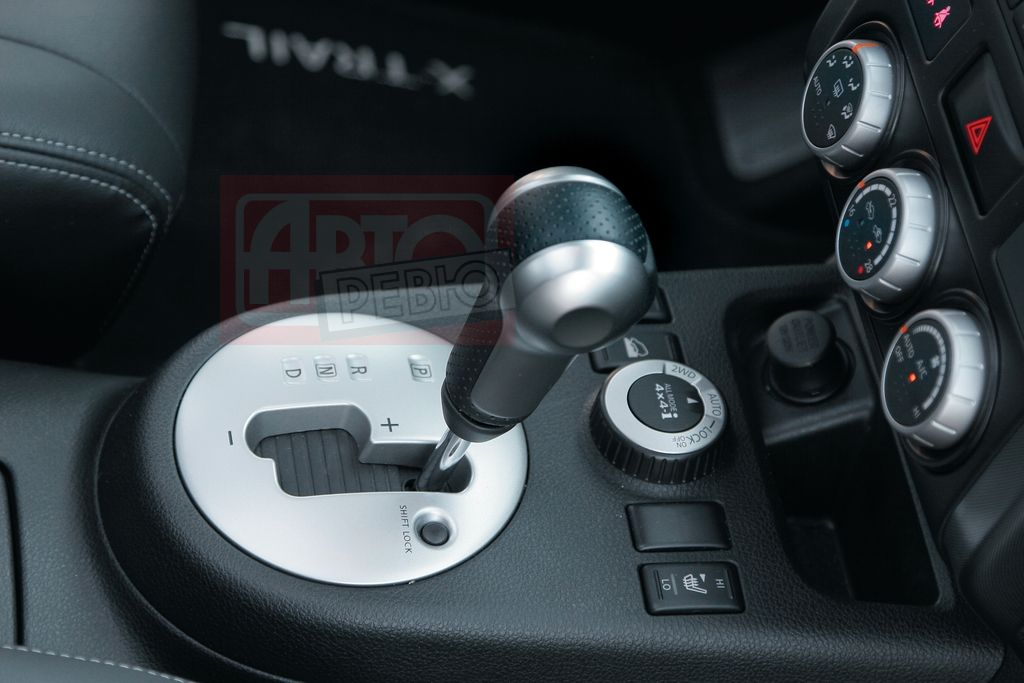 | |
| The CVT selector works according to the classic "automatic" scheme | "By default" the transmission operates in Auto mode: the electromagnetic clutch connects the drive to the rear wheels as needed |
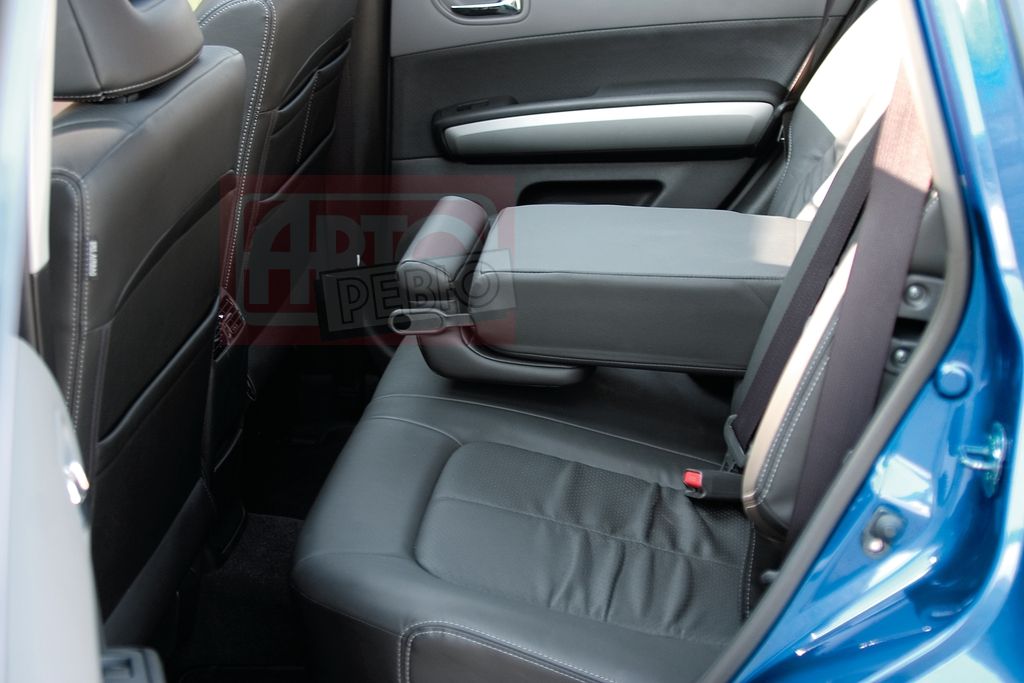 | 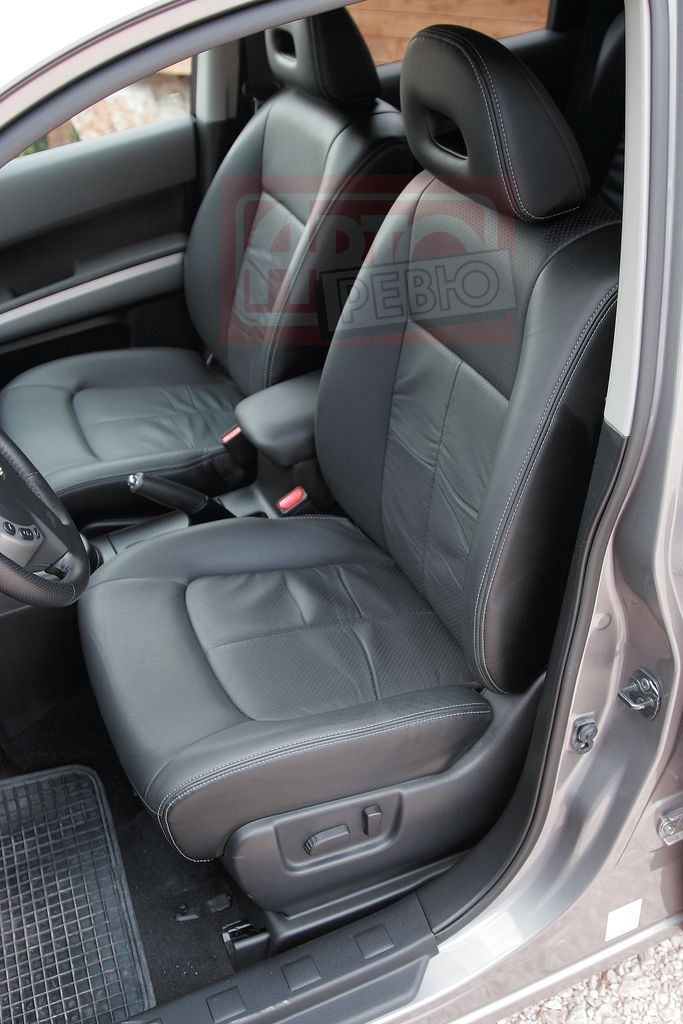 |
| The rear seatbacks change their angle within 12 degrees and fold in a 40:20:40 ratio | The seats are high, "commander-style"... |
The car holds its line perfectly, responds accurately to steering wheel turns. And the steering feel is excellent. And the electric power steering is like on the Qashqai...
The car's architecture remains the same, but the settings have clearly changed. The new All-Mode 4X4-i transmission also plays a significant role. The "i" stands for "intelligent": the multi-disc clutch responsible for connecting the rear axle works in conjunction with the stability control system. When the car approaches its limits, stability in corners is ensured not only by braking the necessary wheels but also by redistributing torque between the axles. Two years ago, a direct competitor, the Toyota RAV4, received a similar system, and after tests on slippery surfaces, we were absolutely delighted with it (see AR No. 7, 2006). It's still hard to say how the Nissan X-Trail will behave in such conditions, but on asphalt, the "smart" all-wheel drive works flawlessly. The body noticeably rolls, but the car easily enters corners, and at the limit, it smoothly understeers with all four wheels.
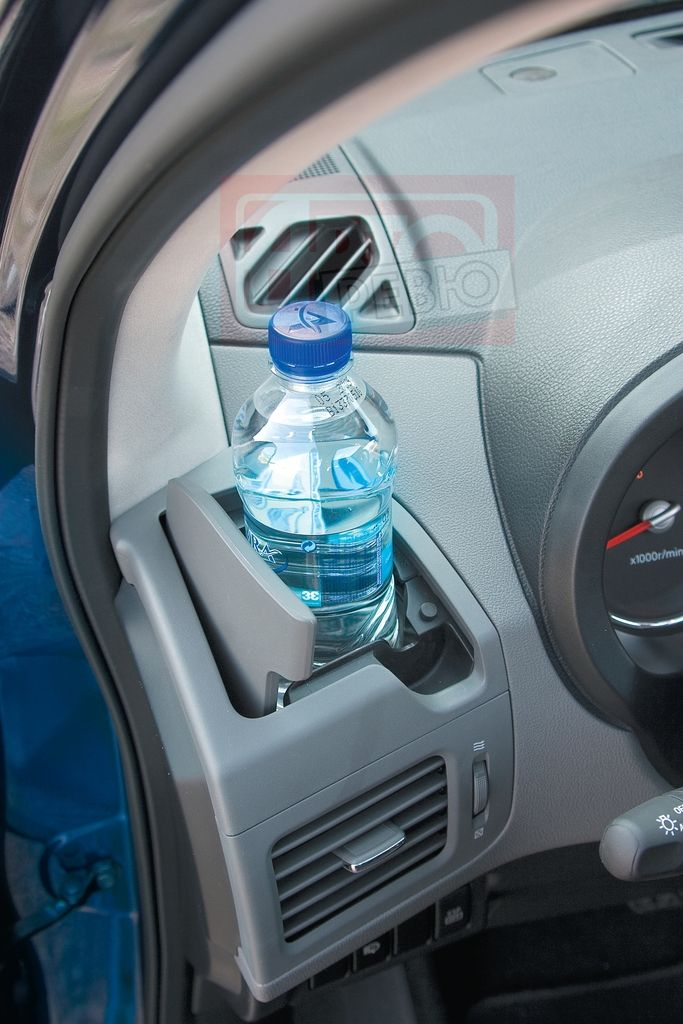 | 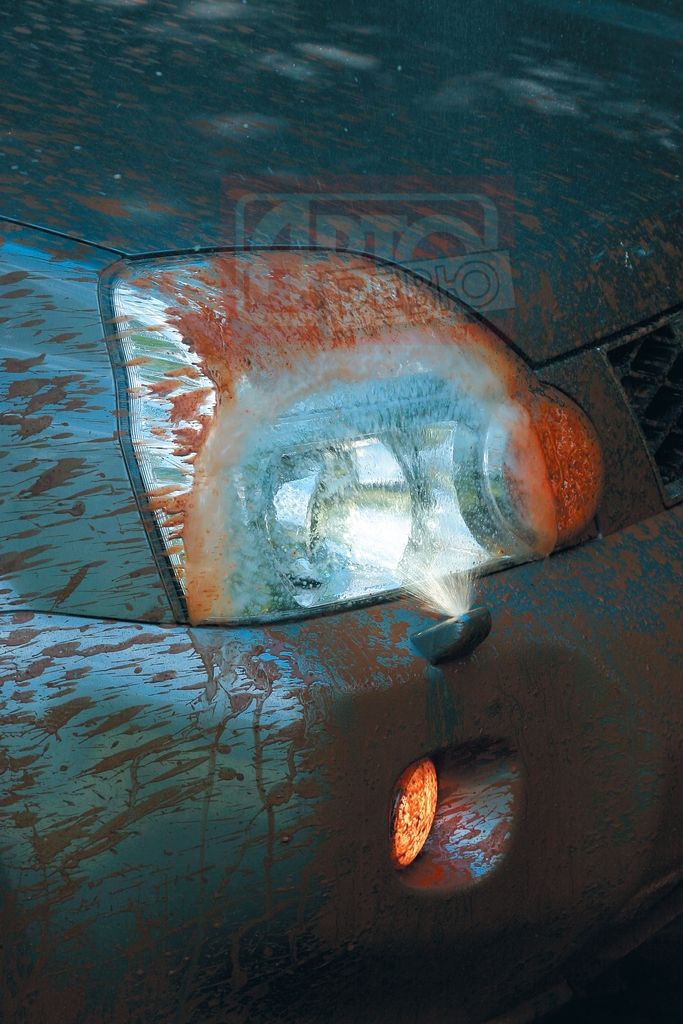 |  |
| Cup holders on the front panel — with heating or cooling (depending on the "climate" mode) | Such a washer will only clean the headlights of fresh dirt | Even now, you can easily open all doors, including the rear one — the torsional rigidity of the body has increased by a third |
However, even if you disable ESP and the drive to the rear axle (2WD mode), the car's behavior remains very confident. It was also pleasantly surprising that road irregularities do not knock the car off course. Local Greek roads are very similar to ours: either the asphalt has settled, or there are cracks. But even on 17-inch wheels, the Nissan softly absorbs road defects, and on the base 16-inch tires, it will probably be even more comfortable. Plus, there's good sound insulation. Perhaps, in terms of comfort, the new X-Trail will be among the leaders in its class.
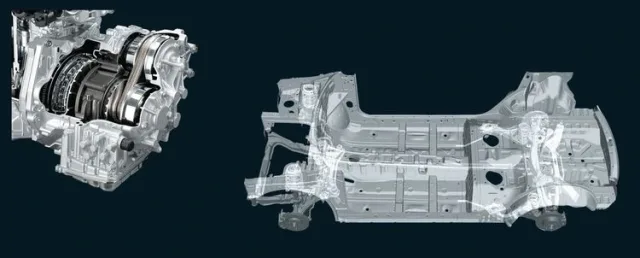 | |
| The V-belt variator is paired with petrol engines, and on the more powerful 2.5 version, six fixed "gears" are provided | The new X-Trail is built on the C platform, already familiar to us from the Nissan Qashqai |
What about off-road? The specially prepared route by the organizers is passed by the X-Trail with the variator with ease — but that's what it was prepared for. If you lock the clutch, the Nissan simply plows like a tank, sometimes lifting wheels a meter high. The 20-centimeter ground clearance and short overhangs provide excellent geometric off-road capability. On climbs, the USS (Uphill Start Support) system helps: it holds the car with the brakes for five seconds, during which the driver calmly moves their foot to the gas and starts smoothly. On descents, another system works — DDS (Downhill Drive Support), which prevents acceleration above 7 km/h.
But the fact that the X-Trail is still a "crossover" was, oddly enough, felt on the diesel version. Each of us stalled the engine about five times! Shame... But what to do? The diesel X-Trail simply doesn't go uphill! Below 2000 rpm, there's not enough torque, and if you keep the revs higher, the clutch burns. Most likely, the same problems off-road will be for drivers of petrol cars with a manual transmission: without a low-range gear, it's not driving but pure torment. The variator saves the day: with it, you can climb up even at a snail's pace.
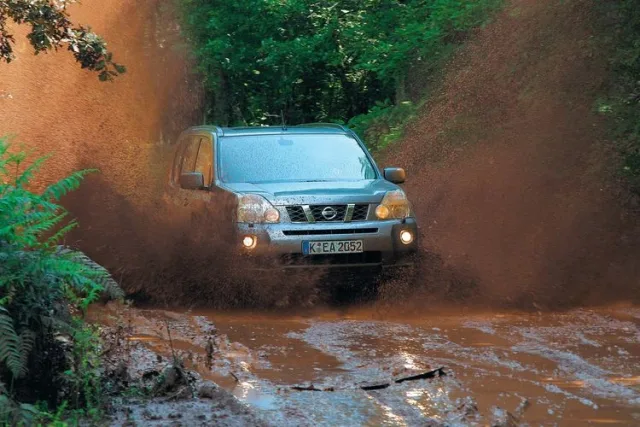
Overall, the Nissan X-Trail made a pleasant impression. At least, it fully matches its image and purpose and is ready for our roads without any modifications. However, the demand for such cars in our country is now such that it's time to initially design cars for Russia, and only then add a "package for good roads." Last year, 9,933 Nissan X-Trail crossovers were sold in our country — 400 more than in the UK, which ranks second in sales of this model. And the newcomer, apparently, will only increase the gap.
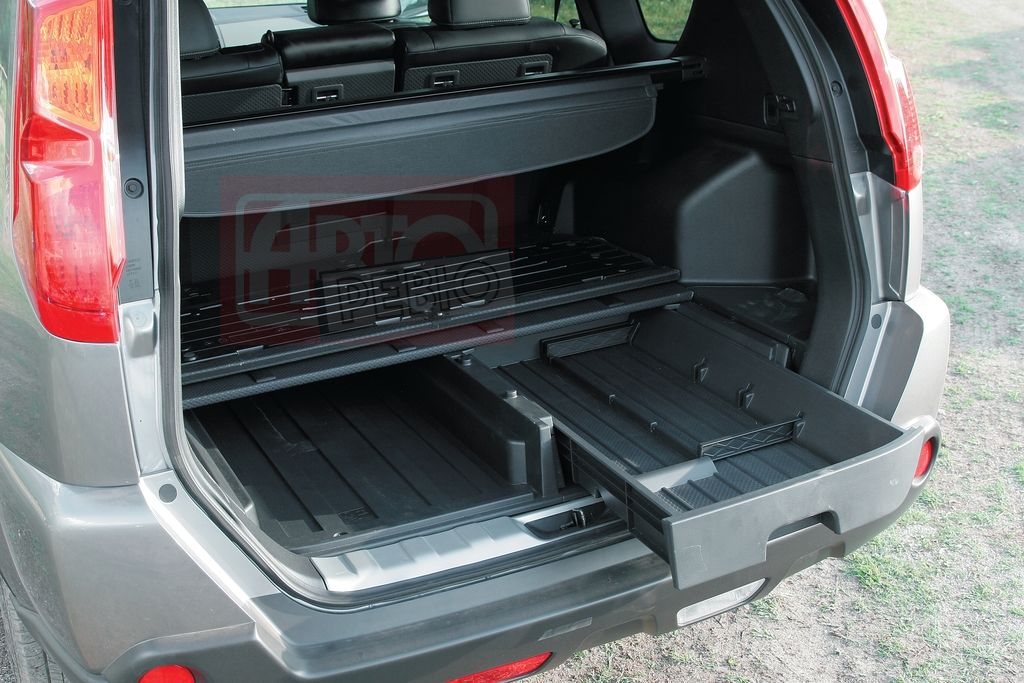 | 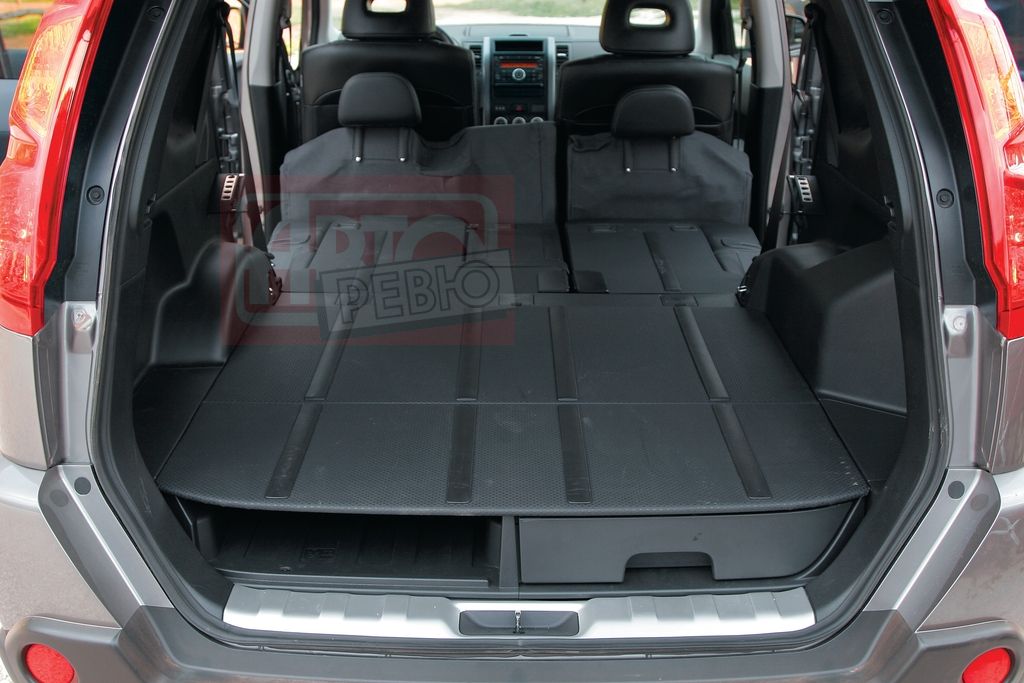 |
| In the underfloor — a sliding transformer tray | Folding the rear seats gives you a cargo area of 1,773 liters with a flat plastic floor |
Retail prices for the two-liter X-Trail start at $33,320. Already in the base — six airbags, ESP, rain and light sensors, CD-changer. For the variator, you'll have to pay an extra $1,600. And the most expensive Nissan X-Trail 2.5 with a variator, xenon headlights, and leather interior will cost $40,820.
| Specifications | ||
| Parameters | Vehicle | |
| Nissan X-Trail | ||
| Modification | 2.0 | 2.5 |
| Body type | 5-door wagon | 5-door wagon |
| Number of seats | 5 | 5 |
| Dimensions, mm | ||
| length | 4630 | 4630 |
| width | 1785 | 1785 |
| height | 1685 | 1685 |
| wheelbase | 2630 | 2630 |
| track front/rear | 1530/1535 | 1530/1535 |
| ground clearance | 200 | 200 |
| Departure/approach angle, deg. | 29/23 | 29/23 |
| Trunk volume, l | 603/479*/1773** | 603/479*/1773** |
| Curb weight, kg | 1482—1563 (1514—1592)*** | 1544—1599 (1565—1623) |
| Gross weight, kg | 2050 | 2050 |
| Engine | petrol, with distributed fuel injection | petrol, with distributed fuel injection |
| Location | front, transverse | front, transverse |
| Number and arrangement of cylinders | 4, in-line | 4, in-line |
| Displacement, cm³ | 1997 | 2488 |
| Cylinder bore/piston stroke, mm | 84.0/90.1 | 89.0/100.0 |
| Compression ratio | 10.2:1 | 9.6:1 |
| Number of valves | 16 | 16 |
| Max. power, hp/kW/rpm | 141/104/6000 | 169/124/6000 |
| Max. torque, Nm/rpm | 196/4800 | 233/4400 |
| Gearbox | manual, 6-speed (CVT) | manual, 6-speed (CVT with simulation of six fixed steps) |
| Drive | all-wheel, with electromagnetic clutch in rear wheel drive | all-wheel, with electromagnetic clutch in rear wheel drive |
| Front suspension | independent, spring, McPherson | independent, spring, McPherson |
| Rear suspension | independent, spring, multi-link | independent, spring, multi-link |
| Front brakes | disc, ventilated | disc, ventilated |
| Rear brakes | disc, ventilated | disc, ventilated |
| Tires | 215/60 R17 | 215/60 R17 |
| Maximum speed, km/h | 184 (172) | 194 (185) |
| Acceleration time 0—100 km/h, s | 11.1 (11.9) | 9.8 (10.3) |
| Fuel consumption, l/100 km | ||
| urban cycle | 11.1 (10.8) | 13.0 (12.0) |
| extra-urban cycle | 7.3 (7.2) | 7.7 (7.7) |
| combined cycle | 8.7 (8.5) | 9.6 (9.3) |
| Fuel tank capacity, l | 65 | 65 |
| Fuel | AI-95 | AI-95 |
| * With installed false floor | ||
| ** With folded rear seat backs | ||
| *** Data in parentheses — for versions with CVT | ||