
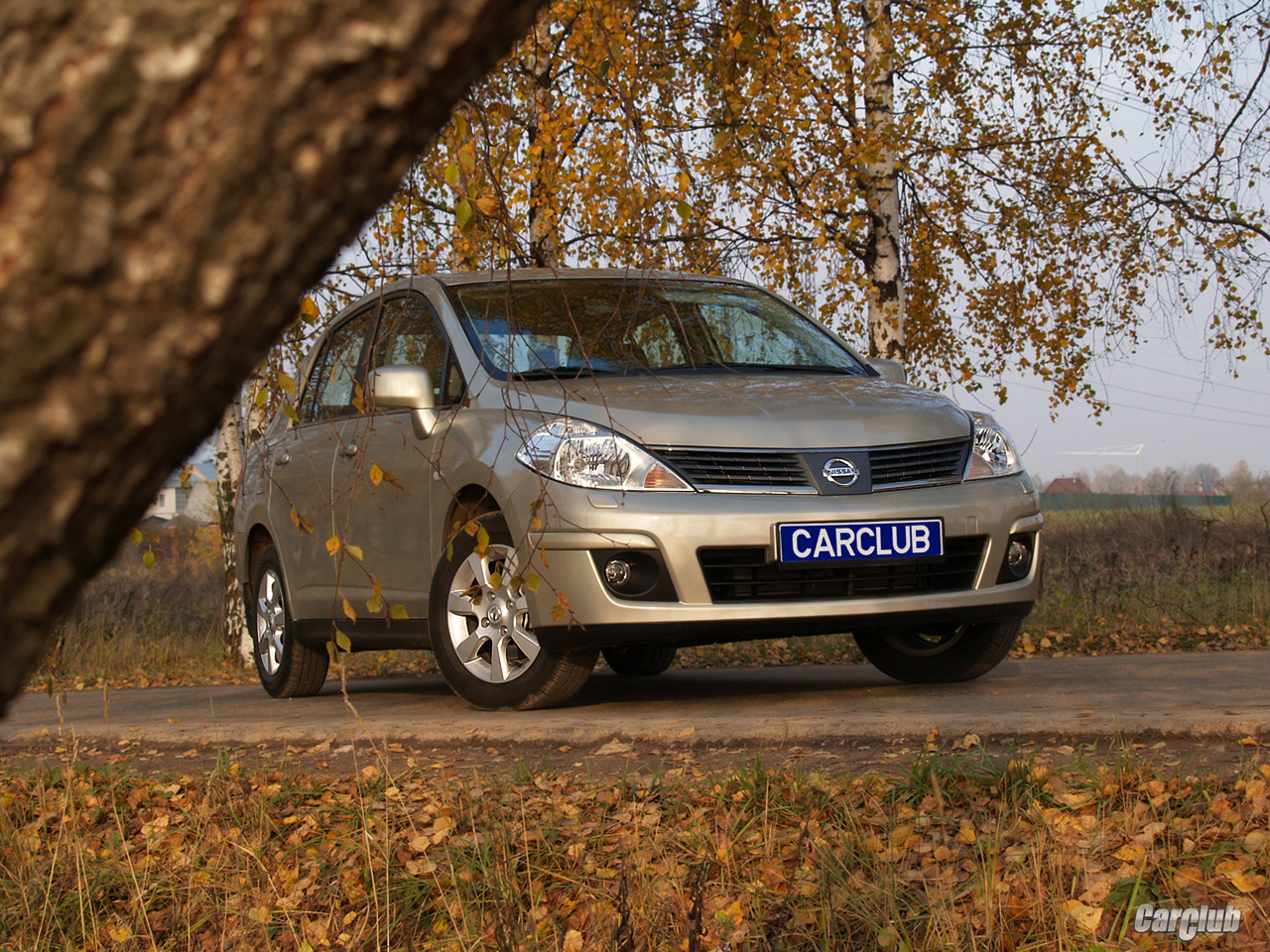
 Of course, tastes differ, but it's unlikely there is a person who would call the Tiida's appearance even pleasant, let alone beautiful.Comments (3)
The Tiida sits one step higher in the price hierarchy than the Almera Classic sedan, although in dimensions they are almost twins. Is there any point in paying more?
 Carlos Ghosn, who heads the Renault-Nissan alliance, is undoubtedly an outstanding figure. In 1999, he took under his wing Nissan, which was teetering on the brink of bankruptcy, and a few years later the company became one of the most profitable in the industry. All efforts were thrown into cutting costs, while image and sports projects that did not bring due profit were sent to the dustbin of history: no racing series or factory teams — only high-margin models. The very ones for which the buyer is willing to pay more than they are really worth. SUVs of all kinds — from crossovers to pickups — are at the forefront here, but passenger cars are not forgotten either.
How is this effect achieved? The question is not simple, but let's figure it out using Nissan itself as an example. Our hero — the Tiida sedan — is a true masterpiece of economic thought. The golf class today is an arena of fierce competition, and squeezing out decent profit here is almost unrealistic. Prices are comparable for everyone, and buyers with calculators in hand calculate where for every ruble or dollar they will get more "horses," airbags, and electronics. Many brands participate in this game more for prestige and the title of "class bestseller," and as a result barely break even — losses in this segment are common.
Realizing this, Nissan marketers slightly elevated the model above the golf class (note the body height), and also selected decent equipment. Already in the base Comfort version — central locking with remote, four airbags, air conditioning, heated front seats, power windows, and an audio system with steering wheel controls and built-in Bluetooth headset. And in our test sedan in the Elegance trim, there were options completely unseen for competitors: a chip key with keyless access and engine start, rain and light sensors, as well as power-folding mirrors. There is also a top Tekna version with leather interior and cruise control. From a technical point of view, nothing sensational — a 1.6-liter engine and a 4-speed automatic. At the same time, the price of such a fully equipped car is quite average — 570,900 rubles. So what's the catch, where is the promised savings? Let's try to find it.
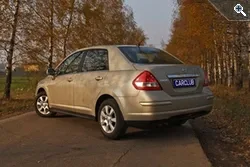
It seems that cost-cutting in the Tiida began at the design stage, and the first to go under the knife was the designer. As if some C-student hastily glued the nose of a Nissan Murano to a massive American-style bumper, and drew the trunk lid along a ruler at the back. However, tastes differ, but I sincerely want to see the person who would find the Tiida even slightly attractive, let alone beautiful.
Individual details may seem elegant, but overall the car looks extremely dubious, especially the sedan. Upon closer inspection, the Tiida reveals features of the Renault Logan — also, by the way, a brainchild of Carlos Ghosn, so the stylistic kinship is hardly accidental. Only the price of the Tiida is twice as high, than that of the Logan.
The interior no longer causes such violent rejection — it is simply boring. Medium-quality plastic, a steering wheel without leather trim (don't take this as nitpicking, but in such a rich trim and for such money, this is a minus), three round instruments on the panel with the signature orange-yellow backlight. However, as in many other Nissans, the thoughtful interior design down to the smallest details wins you over. For example, a closing niche on the center console — it's convenient to hide your phone there, especially since you don't need to take it out when a call comes in: the Bluetooth headset is already built into the stereo. The engine starts by turning the knob on the steering column that imitates a key, while the chip key itself rests calmly in your pocket. For front passengers — four cup holders, two more for rear passengers. As in the Renault Logan, the Tiida has an incredibly spacious rear seat: vertical body pillars and an almost flat floor allow three people to sit comfortably. An ideal taxi…
But the comfort of the driver's seat seems to have been saved on considerably. The steering wheel adjusts only for height and is positioned so that you have to reach for it in a natural seating position. Perhaps someone is used to holding the wheel with outstretched arms, but you get tired quickly, and control over the car is no longer the same. Even more surprising is the plastic: it is soft only where you can reach without lifting off the seat back. The other panels look the same but feel hard to the touch.
The trunk pleased with unexpected capacity — a low floor, under which a full-size spare wheel is hidden, gave an impressive 467 liters. If only the opening were larger, but for that you'd have to go to the hatchback — loading bulky items into the sedan is not very convenient. Unlike the Logan, the rear seat backrest folds in parts, though a noticeable step forms on the floor.
After such a controversial exterior, a logical question arises: didn't the engineers save on driving qualities? Key to start. The 1.6-liter engine produces 110 hp and, paired with a 4-speed automatic, gives the Tiida surprisingly brisk dynamics. You don't expect such agility from such a simple unit. The automatic shifts smoothly and promptly — both up and down. And you don't regret the lack of a manual mode at all. For overtaking or more responsiveness, you can turn off overdrive with a button on the selector — on the remaining three gears, the Tiida won't let itself or the driver down. Only outside the city does the lack of power make itself felt: after 120 km/h, the sedan accelerates without enthusiasm, which is quite expected for an engine of this size. However, with patience, the speedometer needle can be brought to almost 200 km/h, although the claimed maximum is 170 km/h. Either the wind was favorable, or the speedometer is slightly lying.
The power steering works in unison with the engine — precisely and with a slight sporty touch. There is always a clear reactive force on the wheel. Even in parking, when the steering is as light as possible, there is no feeling that the wheels are dangling in the air. It's also pleasant that the steering wheel willingly returns to the center position. The suspension is tuned more for comfort than sport — in corners, the tall body noticeably rolls, but the force on the steering wheel helps the driver and instills confidence that the car is under control. And confidence is important also because the Tiida has neither traction control nor stability control — you have to rely only on yourself, and in a truly critical situation, on ABS and six airbags. But that's force majeure: it's very difficult to upset the Tiida's balance.
Honestly, when I picked up the car for the test, I was extremely skeptical. Twenty-three thousand dollars for, let's say, not the most attractive golf-class model with rather mediocre technical indicators — that seemed like overkill. However, after spending time behind the wheel, my opinion of the Tiida's behavior noticeably changed for the better: this sedan drives and obeys the steering wheel almost as confidently as its "younger brother" — the Nissan Note, which a year ago I almost bought for myself. And even now, if any of my friends ask my advice about an inexpensive family car, I will boldly recommend they look at the Note or Ford C-MAX. As for the Tiida itself… well, as they say, it's a matter of taste — personally, I still don't like it. But those who have taken a liking to this little sedan can quite confidently buy it without unnecessary doubts — the car is definitely worth its money, just as Carlos Ghosn claimed!
Test: Leonid Pavlov