

Nissan Tiida. Price: 499,900 RUB. On sale: since late 2007.
Nissan decided to bring a new car to the market, named Tiida. The newcomer aims to fight for customers in the densely populated C segment. What can this debutant offer against competitors? We study the model's strengths and weaknesses at the Dmitrovsky test track.
2007 Nissan Tiida
© Photo: Sergey Krestov, 5 Koleso
2007 Nissan Tiida
© Photo: Sergey Krestov, 5 Koleso
Nissan reasoned that it was not worth bringing too expensive modifications of Note and Almera Classic to the market. Each of these cars has already found its buyer who considers their price-quality ratio ideal. A price increase could scare off customers. That is why they decided to create a new car that, even in the base trim, would have more generous equipment and could compete with Toyota Corolla, Honda Civic, and Renault Megane.
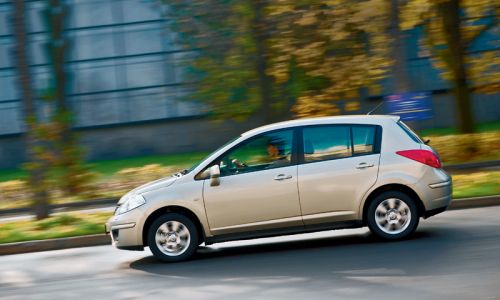
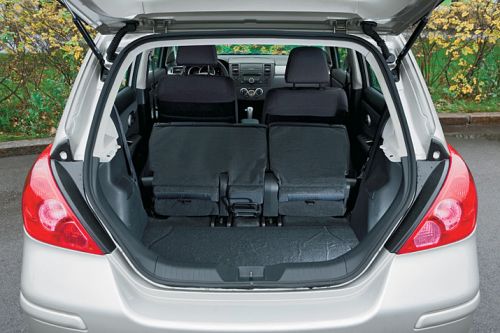
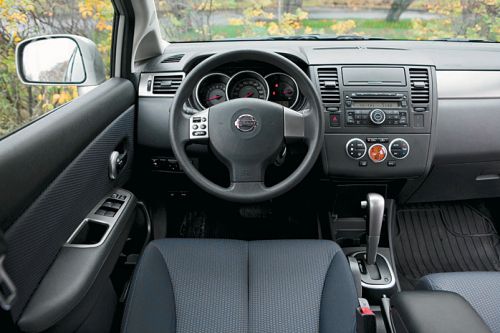
Tiida's design can hardly be called a model of beauty. It combines the brand's current stylistic techniques. At the front, the car vaguely resembles Teana, but the rear raises questions: the triangular shape of the hatchback's rear door seems an unfortunate solution. Because of it, access to the trunk has suffered. In the interior, it is easy to recognize elements from Note and Micra. Overall, the design looks cohesive and neat. The plastic is quite solid, and fabric inserts on the doors add a homely coziness to the cabin.
2007 Nissan Tiida
© Photo: Sergey Krestov, 5 Koleso
2007 Nissan Tiida
© Photo: Sergey Krestov, 5 Koleso
How does Tiida behave on the road? For tests, we took the most popular version — with a 1.6-liter engine (110 hp) and an automatic transmission.
Mediocre acceleration dynamics immediately catch the eye. However, this is expected: rarely does anyone manage to get excellent dynamics by combining a low-power engine with an "automatic." The car accelerates to 100 km/h in 12.2 seconds. Further acceleration is also not easy — due to long gears, the engine takes a long time to rev up. The maximum speed recorded by instruments is 170 km/h, which is quite decent. We are talking about real figures obtained with measuring equipment, because the analog speedometer often overstates readings.
2007 Nissan Tiida
© Photo: Sergey Krestov, 5 Koleso
2007 Nissan Tiida
© Photo: Sergey Krestov, 5 Koleso
In lane-change tests, Tiida holds at the level of competitors. It was pleasantly surprising that the results of the exercise in loaded and empty states almost do not differ. On the VDA lane change, the entry speed in both cases was 68 km/h, and the exit speed was 53 km/h without load and 51 km/h with load. On the long lane change, the speed reached 123.4 km/h and 122.6 km/h, respectively. On the 18-meter slalom, the difference was minimal — 0.4 km/h (62.5 vs. 62.1 km/h). Amazing stability! The price for this was a tendency to rapidly developing oversteer during emergency maneuvering — intervention must be early and precise. This behavior is explained by the same soft suspension, which allows rolls and unloading of the wheels.
The brakes deserve special praise. In many cars with an "automatic," they quickly overheat. Tiida behaves much more decently: after reaching operating temperature, the brakes consistently maintain a high level of efficiency.
Nissan Tiida is not like typical products of the modern automotive industry. From a technical point of view, there are almost no complaints about the debutant. An honest car for its money.
Business-class space
2007 Nissan Tiida
© Photo: Sergey Krestov, 5 Koleso
Our assessment
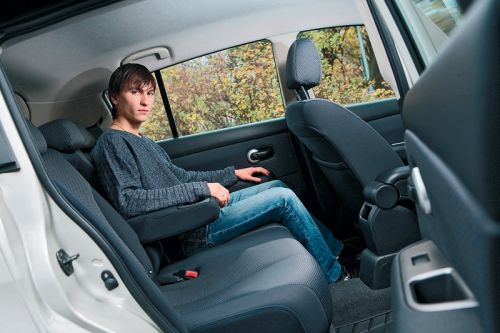
Nissan Tiida pleases with a balanced suspension and a spacious cabin. The car has absorbed all the best from its closest relatives in the model range. At the same time, the price fully corresponds to what the car offers.
Body
2007 Nissan Tiida
© Photo: Sergey Krestov, 5 Koleso
+ convenient transformation
+ good sound insulation
- inconvenient shape of the trunk door
Ride comfort
+ spacious cabin
+ comfortable rear seats
- large speedometer errors
Powertrain
+ economical engine
+ low noise level
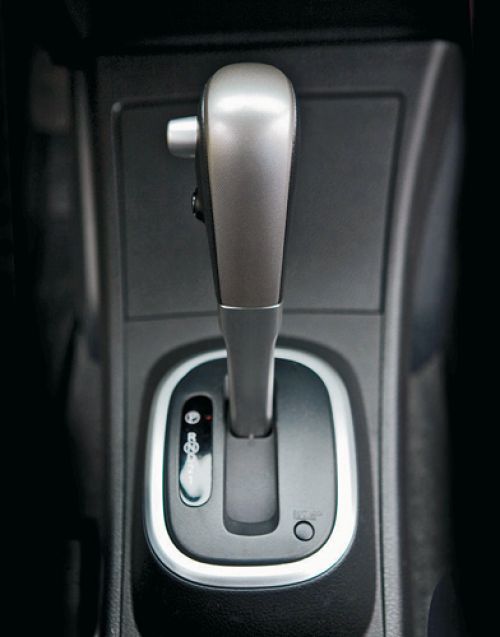
- sluggish automatic
Handling
+ large ground clearance
+ energy-intensive suspension
- body rolls during sharp maneuvering
Safety
+ airbags provided for each passenger
Ecology
+ fuel consumption at an acceptable level
+ compliance with toxicity standards
© 5 Koleso