
My acquaintance with the Nissan Teana in St. Petersburg began while the city on the Neva was suffering from unusual heat, and the roads offered a full range of sensations—from battered regional routes to a decent highway towards Finland. There was also an opportunity to drive around the city itself, assessing the car in heavy traffic. Such a busy program was just right: the Teana, which replaced the Maxima on the assembly line, is designed as a universal business-class sedan. According to its creators, it should be equally suitable for daily commutes to work (with or without a chauffeur) and for family trips to the sea.
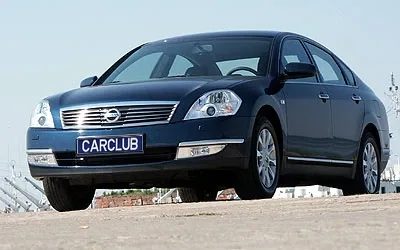
The design of the Nissan Teana can hardly be called fresh,
The Japanese took a long time to decide on replacing the aging Maxima for the Russian market. In the US, the new Maxima with a 3.5-liter engine and full options was already selling well, but it wasn't suitable for us—the price of such a car would exceed $50,000. Among Nissan customers, there are many who want a large car that is relatively inexpensive, even at the expense of power and excessive options. Europe, on the other hand, hardly needs such cars: there, people choose either a modest Primera or immediately a Mercedes E-Class.
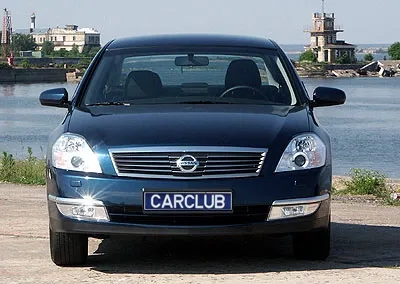
but the signature headlights make the sedan easily recognizable
Therefore, the Russian branch of the brand paid attention to the Teana, which is assembled in Japan and exported to Thailand and Korea—where a left-hand drive version exists. The current generation of the model has been produced since 2000, but recently underwent a facelift that affected both the exterior and the technical part.
Despite the modernization, the Teana's exterior didn't personally impress me. The front might still be appealing, but the rear looks frankly old-fashioned. In profile, the sedan can easily be mistaken for the previous-generation Volkswagen Passat. But it all depends on priorities. Most Teana buyers are conservative people who don't need design frills or attention on the road, but rather comfort.
The interior is quality in a Japanese way, but also with a touch of old-fashionedness. What catches the eye are the optitronic instrument cluster and the color display in the center of the dashboard, which is only available in expensive versions. It shows the image from the rear-view camera, which is very helpful when parking. The camera is even more practical than a regular parking sensor: you can see the road surface behind the car.
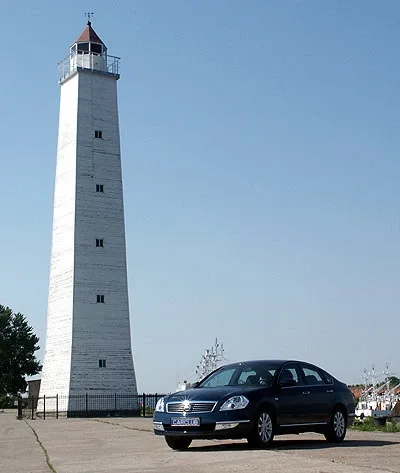
Conceptually, the Teana repeats the previous Maxima: the same front-wheel drive and spacious interior. The engine lineup includes four-cylinder units of 2 liters (136 hp) and 2.3 liters (170 hp), as well as a 3.5 V6 producing 245 hp. All versions come only with automatic transmissions, and the V6 works with a CVT. By the way, the same powertrain is installed on the Nissan Murano crossover. Of course, especially with the powerful engine, you'd want all-wheel drive, but it's only available in Japan and only with right-hand drive.
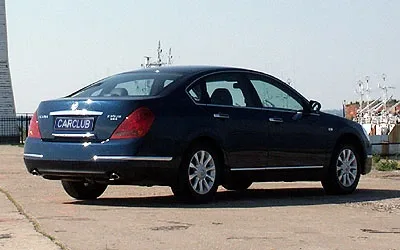
The rear is styled in the spirit of the latest Nissan models
For the test, I got cars with 2.3 and 3.5-liter engines, both in the top Premium trim. I first got behind the wheel of the more modest version, but didn't get upset: in the city, you rarely get to realize the full potential, and on the highway, most drivers don't chase records.
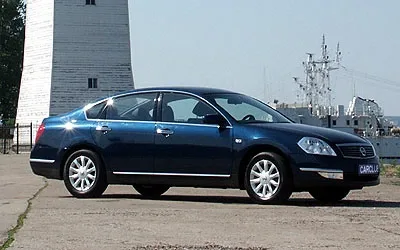
The side silhouette resembles an enlarged VW Passat
On the move, the Teana turned out to be unusually friendly to both the driver and passengers. The old four-speed automatic unhurriedly shifts gears, of which there are few, and doesn't rush to accelerate the heavy sedan. Even when pressing the pedal to the floor, nothing exciting happens: the engine's tone in the cabin changes only slightly, and the Nissan smoothly picks up speed. You can switch to manual mode, but four gears don't give much freedom of maneuver. On a flat straight, I accelerated to 170 km/h, but there was no desire to go faster—it's too cozy in the cabin. The Teana seems to float over bumps: even tram tracks remain somewhere deep in the suspension, reaching you only as dull thuds from the tires. High-profile tires 205/65 R16 play a significant role in this, completely absorbing road imperfections.
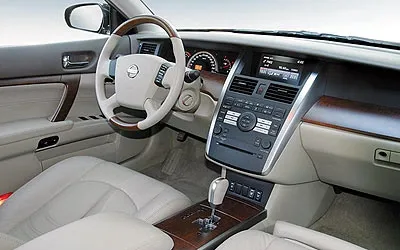
The interior is solidly finished and well-equipped
The flip side of comfort is traditional handling. Soft suspensions allow the car to lean noticeably, and on a high-speed curve, the driver loses control: the steering wheel barely fills with effort, so you have to ease off the gas before turns. Only the ESP stability control system, available in the Premium trim, saves the day. Without it, driving such a large sedan on the edge of sliding would be uncomfortable, and you wouldn't want to: the car is clearly designed for calm driving. On a straight, it still allows you to maintain a high pace, ignoring the road surface quality, but it's not suitable for attacking corners.
After a short pause, I'm handed the keys to the Teana with the 3.5-liter engine. The engineers claim the suspension hasn't been touched, and for the top version, only 17-inch wheels 215/55 R17 are provided, but the car's behavior changes for the better. The modern V6 paired with the CVT gives the sedan excellent dynamics. A sharp press on the gas even on dry asphalt causes the front wheels to spin, and on a straight, the speedometer needle easily reaches the electronic limiter at 210 km/h. Noise insulation remains at the same very high level—you can talk in the cabin without raising your voice even when the engine is revved to the limit. At first, this CVT feature is distracting: the hum at constant revs creates the feeling that the car isn't moving, but a glance at the speedometer quickly convinces you otherwise. Acceleration to 100 km/h for the Teana with the 3.5-liter engine takes 7.9 seconds, and then the car accelerates very confidently, with the pace only dropping slightly after 180 km/h.
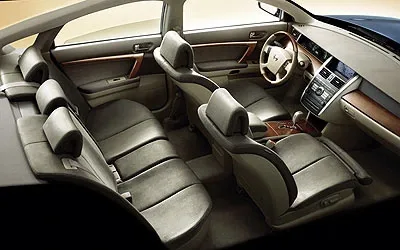
The front passenger seat is equipped with a fold-out footrest
As a passenger, I appreciated the Ottoman function—a fold-out footrest that allows you to recline almost half-lying, and combined with massage, it's very relaxing. This option is only available in the top trim and could be a serious trump card: none of the competitors in the price range up to $50,000 offer anything like it. Additionally, the Teana can boast an electrically heated rear seat, which is also rare for the business class.
Based on the test results, another advantage of the CVT emerged—low fuel consumption. Despite the fact that the 3.5 V6 is one and a half times more powerful than the 2.3-liter engine, their appetite is roughly the same, while the difference in dynamics is enormous. Of course, with Russian fuel prices, the share of fuel in the maintenance costs of a car over $30,000 is minimal, but the fact that the more powerful Teana turns out to be more economical during calm driving cannot but please.
The sedan's market prospects can be divided in two. Versions with 2 and 2.3-liter engines priced from $30,000 will compete with the Koreans—Hyundai Sonata and Chevrolet Evanda, while the top 3.5 V6 for $45,000 will enter the fight with the business-class leader Toyota Camry. With the former, everything is clear: Japanese assembly, rich base equipment, and the brand's reputation will ensure good sales. But whether Nissan can compete with the new Camry—our upcoming test of the Toyota sedan will show.
Leonid Pavlov