
Nissan Note. The pinnacle of the model range
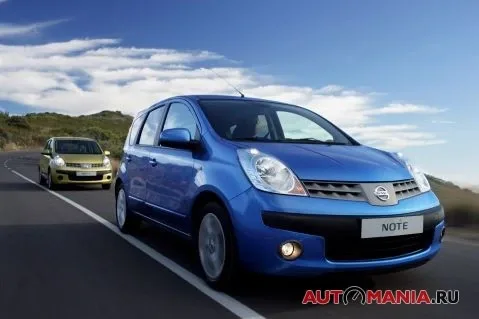
'The arrival of a child makes you settle down. It's believed that it's time to part with a sports coupe and look toward a more practical family car. For avid drivers, such a prospect might seem dull. The Nissan Note opens fresh horizons for owners: it's a spacious car ready for daily family chores, yet with excellent dynamics'—this is how the Japanese see their creation, and our compatriots who have already bought it generally agree.
The Note's main trump card, which apparently became the sales locomotive, is its design. The Japanese reasoned sensibly: a project for young, energetic, but already family-burdened drivers should be entrusted to an equally young, energetic, and family-oriented designer. And they didn't miss the mark. The bet was so successful that a gentleman with the surname Toyoda (whose sketches formed the basis of the Tone concept) could easily have a monument erected. He managed to organically combine seemingly incompatible traits of the 'toy-like' Micra and the solid 'American' Murano. From the former, the Note inherited a humped hood with huge headlights resembling Pokemon eyes; from the latter, the characteristic arched metal-look trim on the faux radiator grille. Despite such blatant borrowing, the car turned out distinctive and essentially became a benchmark of Nissan's modern 'multifunctional' style.
Every centimeter of the newcomer seems saturated with speed and drive. Just look at the swift, slightly curved roofline or the rear light clusters that flow over it. At the same time, the car isn't devoid of solidity: you wouldn't drive it to a casino, of course, but it wouldn't look out of place at a nightclub. The Murano theme is clearly evident inside as well: the upper part of the front panel and the instrument cluster have familiar contours. The plastic with a coarse texture adds to the solidity. Stylish and substantial—that's how one could describe the Note's interior. Though it's easy to notice that functionality outweighs emotion. That's logical, since the creators' motto for compacts—'smaller outside, bigger inside'—strictly prioritizes practicality.
Since we're talking about practicality, it's worth noting: the Note's wheelbase is even longer than the Almera's, but the body dimensions keep it firmly within the compact class. Capacity here is achieved through more rational use of space. A high roof, upright seating... As a result, there's ample headroom and legroom—two or three can fit on the rear sofa. The only drawback is tight shoulder room, so it's better to leave a winter jacket in the trunk.
Speaking of the trunk. Its nominal volume is just under 300 liters. With the Flexi-Board system, the compartment divides into two parts, giving you 280 liters of free space plus an additional isolated section. Overall, for such a car, the capacity is quite respectable. Additionally, the driver can slide parts of the rear sofa forward or fold them, increasing the useful volume from 437 to 1332 liters.
As befits a true family car, the Note's cabin is full of various compartments for the little things that accompany us on daily trips. A nine-liter glovebox that easily holds a couple of 1.5-liter water bottles, personal cup holders, and pockets in the front doors. Rear passengers 'have to make do' with a pair of fold-down tables, soft pockets for press, and the upper part of the trunk.
True, such cargo capacity partly affected ergonomics—at least concerning the front passenger seat, under which is hidden a traditional for Japanese compacts hidden but quite roomy box. Because of it, the seat lost vertical adjustment. Otherwise, the Note has fewer such problems than any classmate: everyone can sit with acceptable comfort—the adjustment ranges of the seats and steering column make it easy.
When developing the Note, the Japanese, of course, didn't forget about the driving ambitions of future owners. Two engines are offered: 1.4 and 1.6 liters, with the latter—a 16-valve motor producing 110 horsepower—being a completely new development. In the first case, the unit is paired only with a 5-speed manual; in the second, with a manual or a 4-speed automatic.
The main, but not the only, advantage of the 1.4-liter engine, which delivers 88 hp, is fuel efficiency. Consuming just over 6 liters of fuel on average, it can accelerate to 165 km/h, providing quite decent dynamics for such a car. If you don't plan frequent long highway trips, this option will be the most attractive and, importantly, less costly. The minimum price for such a Note in Comfort trim is $15,490. Already in the base: front airbags, ABS with electronic brake-force distribution and brake assist, front power windows, power mirrors, headlight washers, and a fully transformable rear sofa. For an additional package of $1,100, you get air conditioning and a cooled glovebox, so even the base version owner won't feel deprived with a small extra payment.
In the next trim, Luxury (from $17,730), all these 'delights' are already included 'by default'. Plus: a pair of side airbags, heated seats, rain sensor, rear power windows, onboard computer, that same box under the front passenger seat, a CD-player stereo, multifunction steering wheel, and the already described Flexi-Board system that divides the trunk into two independent zones.
The top trim Tekna is available only with the 1.6-liter engine. In addition to Luxury, it adds climate control, fog lights, folding mirrors, and a stability control system (but only for manual transmission cars). The cost of such a car is at least $20,290, and for the 'automatic' they'll ask almost $21,000.
Let's step away from the numbers and turn to the dynamics of the top version of the compact van, especially since the author of these lines had the chance to drive it extensively. The Note's transmission is straightforward and structurally outdated. But here it's worth remembering: don't fix what isn't broken... That's exactly the case with the new Nissan. Allowing quite noticeable jerks during shifts, the automatic does everything remarkably correctly and timely, providing the car with very decent dynamics. Paired with the 4-speed 'automatic', the Note hits 100 km/h in just over 10 seconds. The responsive steering and moderately stiff suspension easily compensate for the high center of gravity (which still makes itself known in corners)—the Nissan goes down the road like on rails. But that's in the city. On the highway, behavior is different and requires caution. The relatively long wheelbase allows the Note to remain indifferent to wavy surfaces even at decent speeds; the car continues to please with directional stability. However, the body becomes very sensitive to strong gusts of wind, and the suspension at speeds above 120 km/h fully exhausts its stiffness reserve and begins to allow noticeable body rolls in corners. The driver should take this into account when navigating bends and open sections—which, by the way, is quite easy.
Technical specifications:
Nissan Note
Dimensions:
Length (mm) 4083
Width (mm) 1695
Height (mm) 1690
Wheelbase (mm) 2600
Weight (kg) 1090
Trunk volume (l) 280/437/1332
Engine displacement (cm3) 1598
Max. power (hp) 110
Max. torque (Nm) 153
Max. speed (km/h) 183
Acceleration 0-100 km/h (s) 10.1
Avg. fuel consumption (l/100 km) 7.3
Price ($) 15,490 - 20,990 Please provide the text of the test drive that needs to be rewritten. I am ready to complete the task according to all your requirements: rephrase each sentence, preserve facts and figures, keep the first-person narrative, not add new data, and not change the author's assessments."}