
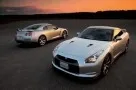
A race track, helmeted pilots, serious machines — this is where the Nissan GT-R feels right at home. Imagine: this car's top speed exceeds three hundred kilometers per hour. And soon this supercar will appear in our showrooms.
The Japanese at Nissan are currently actively thinking about starting official GT-R deliveries to Russia. Someone might say: "Big deal, just another car." But no — we've hardly seen any of these here. In fact, the only real competitor for the Japanese car in our market is Porsche.
The GT-R is that dream car that makes tough men's pulses quicken and their eyes light up. And no wonder: a machine capable of accelerating faster than 300 km/h. The average person, of course, will twirl a finger at their temple — who, they say, needs such a rocket. But trust me, there are plenty of enthusiasts. In Europe, they understood this even before the first cars reached dealers. In just a month, Europeans snapped up the annual quota — fifteen hundred units. The British grabbed the most — 950 orders. True, the first owners will get their cars only by next spring, but that doesn't scare off those interested at all.
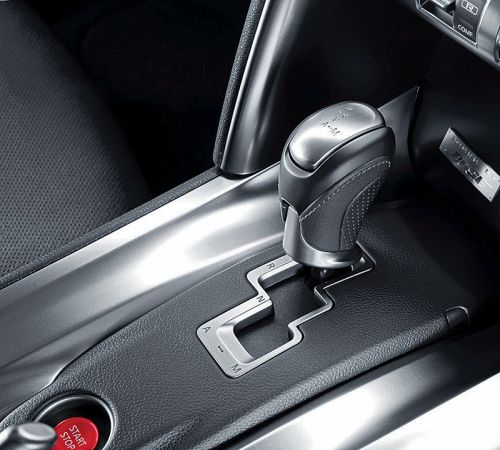
They say that when the GT-R was shown in Tokyo in 2007, life at neighboring stands simply froze. What was it about this Nissan that captivated visitors so much? First and foremost — its wild technical characteristics, made possible by an innovative engine. Under the hood is a VR38 unit with a 3.8-liter displacement, producing, attention, 473 horsepower at 6400 rpm. It's a V-shaped "six" with twin turbos. To use the power as efficiently as possible, the car is equipped with ATTESA all-wheel drive and a 6-speed Borg Warner gearbox with dual clutch — without it, perfect acceleration would be impossible.
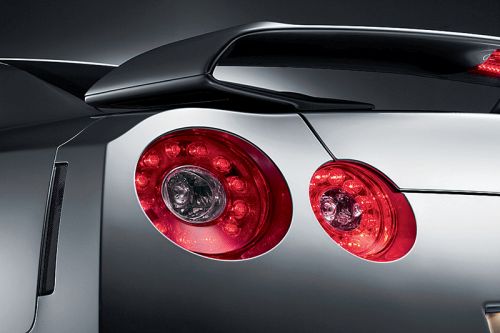
2008 Nissan GT-R
© Photo: Nissan
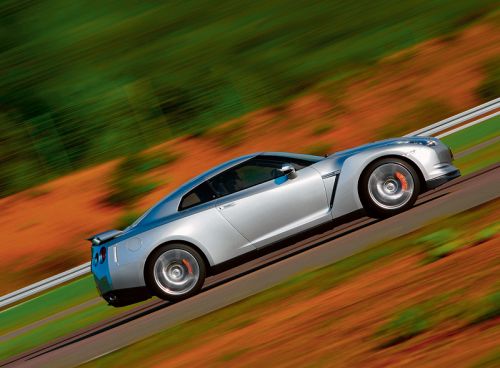
2008 Nissan GT-R
© Photo: Nissan
The unusual layout with separated engine and transmission plus all-wheel drive gave rise to an interesting engineering solution. The GT-R has as many as two driveshafts. The first, carbon fiber, transmits torque from the engine to the gearbox. From there, traction goes through one of the wet clutch packs and the preselective gearbox to the rear wheels via a self-locking differential. Inside the gearbox, there's also a power take-off with a multi-disc electromagnetic clutch. In normal driving, the clutch is open — and the GT-R drives like a rear-wheel-drive car. But as soon as the rear wheels start to slip, on a corner or during acceleration, the electronics partially or fully engage the clutch, and part of the torque goes forward through a steel driveshaft (the front differential is free, without locking). The time and degree of engagement are determined by electronics: they monitor longitudinal and lateral accelerations, steering angle, and wheel slip. The main feature is a new yaw sensor that sees the difference between how the car actually turns around its axis and how the driver wants to turn it with the steering wheel.
But enough theory. Driving the GT-R around the city or on regular roads at speeds up to 120 km/h is simply pointless. That's why the Japanese rented the famous Portuguese "Estoril" with its rich racing history.
2008 Nissan GT-R
© Photo: Nissan
2008 Nissan GT-R
© Photo: Nissan
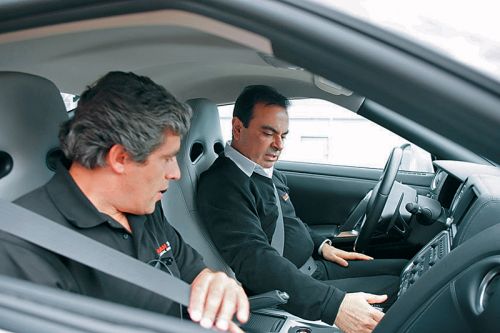
The interior immediately reminds you of a fighter jet cockpit: a bunch of gauges, dials, and switches. To figure everything out, you need at least an hour. On the screen, you can display a host of driving parameters — from wheel angle to G-forces. Three levers on the center console control the transmission, shock absorbers, and stability system. But there was no time to enjoy the information abundance: as soon as the checkered flag was waved, my gaze was already frantically searching for the next turn, the approach speed of which could simply scare an unprepared person.
The higher the speed, the more the Nissan seems to stick to the asphalt. Thanks go to aerodynamics for that. The Japanese assure that downforce is sufficient in all conditions. And the low drag coefficient of 0.27 helps with both top speed and fuel consumption.
By the way, in the official documents handed out at the test, there was no data on acceleration dynamics for some reason. They say the GT-R hits 100 km/h in 3.5 seconds. Or maybe even faster? It's also hard to find fault with the handling — after all, it's a supercar.
A famous car on a famous racetrack
"Estoril" is famous because from 1984 to 1996, the Portuguese Formula-1 Grand Prix was held here. The Autódromo Fernanda Pires da Silva track was built in 1972 on a mountain plateau near Estoril, a suburb of Lisbon. The configuration — a long straight and two complexes of corners with variable geometry — resembles Barcelona's "Catalunya." At first, clubs and "Formula-2" raced here, and in 1984, after a 25-year break, Formula-1 returned to Portugal — and precisely to "Estoril." In that debut round, which closed the world championship, the fate of the title was decided: Alain Prost won the race, but in the final standings he lost by half a point to Niki Lauda. In 1996, the last Portuguese F-1 race took place here. In 1995–1996, the track hosted the ITC away rounds, and after reconstruction in 2004, a DTM round. Now there are plenty of junior formula races and MotoGP here.
Driving
The car literally bites into the asphalt. Perfect handling, super-reliable brakes, and excellent aerodynamics.
Interior
The abundance of instruments, buttons, and switches immediately makes it clear: no joking around.
Comfort
For a sports car, comfort isn't the main thing. But even in this regard, the GT-R deserves a five, with the caveat that it's a racing machine.
Safety
The GT-R is very well protected. But if the speedometer shows 300…
Price
For such a car, money is no object.
2008 Nissan GT-R
© Photo: Nissan
Pros and cons
- + Excellent handling, superb dynamics.
- — Inability to assess the car's potential in ordinary road conditions.
Technical specifications
- Make and model — Nissan GT-R
- Dimensions — 4655x1895x1370 mm
- Engine — petrol, 3799 cm³, 480 hp
- Transmission — manual, 6-speed
- Dynamics — max over 300 km/h; 3.5 s to 100 km/h
- Competitors — Porsche 911
Our opinion
The Nissan GT-R can give the driver truly powerful emotions. One piece of advice: if you decide to buy, take a couple of lessons from professional racers. 480 "horses" under the hood is no joke. Nevertheless, we are all for this famous car appearing in Russia as soon as possible.
July 25, 2008
Author: Stanislav Pavlov
© 5 Koleso