
Hondas have always stood apart from other Japanese brands. Multi-link suspensions even on inexpensive hatchbacks, engines with output almost like racing cars — on ordinary "civilian" models...
However, the previous Civic significantly tarnished this reputation. The car turned out spacious and attractive, but without that very "zest." Now, the eighth-generation Civic takes the stage — a sedan with a 140-horsepower 1.8-liter engine and automatic transmission. As its rivals, we took the Nissan Almera 1.8 sedan and the "almost sedan" Skoda Octavia 2.0 FSI — also with automatic gearboxes.
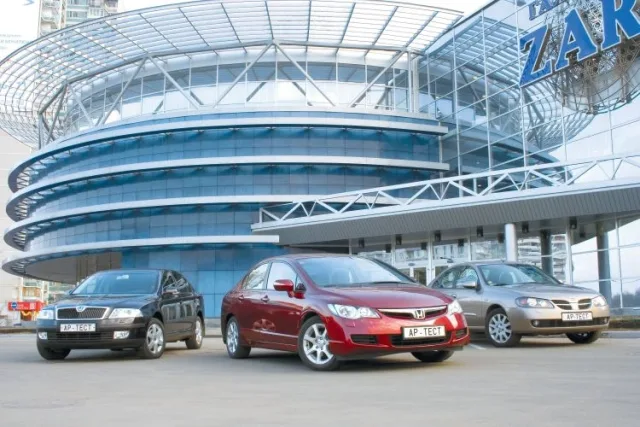
The previous Civic was a true "overachiever" — one of the longest-wheelbase and most spacious cars in the golf class. The new sedan continues this tradition. Inside — incredible freedom: plenty of air in both the first and second rows. And the exterior... Pure obsession!
Wedge-shaped profile with heavily raked windows, expressive stamping along the lower body edge, turn signal repeaters on the mirrors. The interior seems from a sci-fi movie. The three-spoke steering wheel of small diameter with pleasant non-slip plastic adjusts in two planes. "Cosmic" instruments are split into two tiers. In the usual place — a large tachometer with indicator lights and gear mode display. Above the steering wheel, on the second level — digital speedometer and fuel and temperature gauges. Everything reads well, but on bright sunny days the displays could use extra contrast.
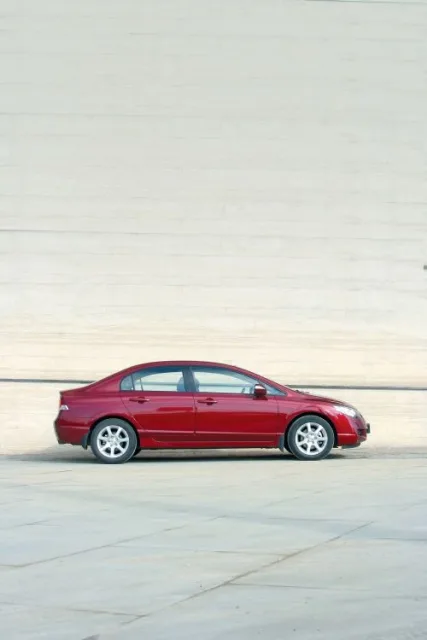
Long wheelbase — the secret to interior spaciousness
Fabric seats please with proper firmness and anatomical profile. Adjustments — a huge range both in length and height. Pedals with floor-mounted "gas" are very comfortable. The automatic selector moves in a straight slot, but positions are clearly fixed, and modes are visible on the panel — impossible to make a mistake. Nearby — an ergonomic Z-shaped "handbrake," a model to follow. Climate control is simple to operate: a couple of rotary knobs and buttons around a not-so-bright display.
 |  |  |
| New Civic — futuristic style plus practicality | Glove box is small | Trunk is small, and the opening is narrow |
But style spoiled visibility: massive front pillars with triangular windows can hide an entire car. Rear visibility is average: good side mirrors, but the rear window has a high lower edge, above which three headrests protrude.
 |  |  |
| The most spacious second row — in the Honda | Seats are good both in shape and fabric grip | Control of "music" and climate is convenient. Except for the "dim" lower display |
Nissan against the Honda is a "soldier of the invisible front." The Almera is like a chameleon: evokes no emotions, instantly drowns in traffic. Inside — everything is familiar and mundane. Dreary plastic of not the best quality brings melancholy. The large slippery steering wheel adjusts only for height. The shapeless seat suits only large-built people — almost no lateral support. Tall drivers may lack longitudinal adjustment, but you can change the cushion angle — front and rear parts of the seat adjust separately. Pedals are not ideal either: the left footrest is recessed deeper than the gas pedal. And the simple automatic selector moves in a straight slot with almost no detents, with no mode indicator on the panel at all. However, climate and audio modes are displayed on a huge "TV," though controlled by the same buttons. Confusing!
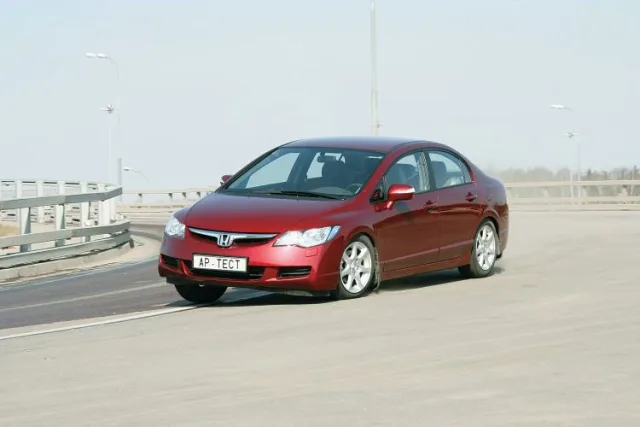
The new Civic is impeccable in corners: easily dives into turns with no hint of understeer
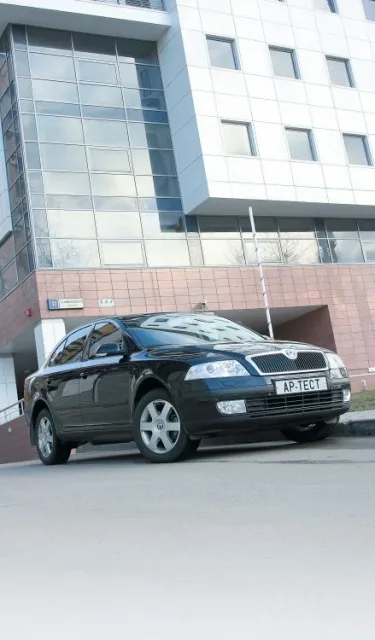
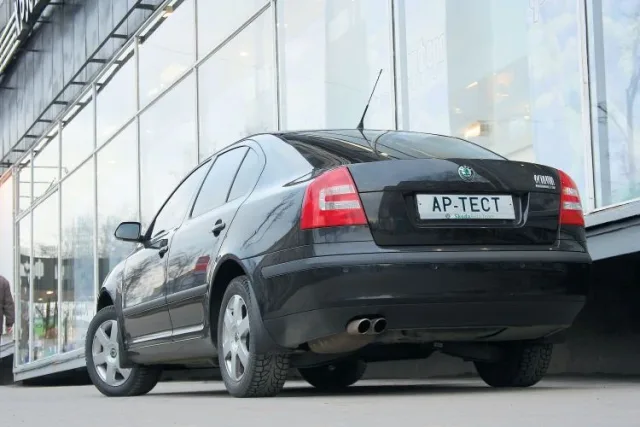
Against the "Japanese," the Skoda looks monumental and solid. Especially in black, with tinted windows and alloy wheels. The interior is gloomy and strict, like a medieval castle. Hard leather seats reinforce the feeling of "German order." The leather steering wheel fits perfectly in hands, adjustment ranges for wheel and seat are huge. But there are flaws. The pedal assembly is not ideal: you can hit the brake when moving your foot from the gas. The massive automatic selector knob with a large release button requires getting used to. Instruments are boring, scales are small. Visibility is spoiled by the small rear window opening with a high lower edge. Good that side mirrors compensate.
And where is more space in the back? Here the new Civic is again the leader. No central tunnel, knees don't touch the front seatbacks... And the shape of the Honda's rear bench is the best. The only drawback — when riding three abreast, outer passengers will hit their heads on the heavily raked pillars.
 |  |  |
| Z-shaped "handbrake" — a very convenient solution | VSA stability system can be switched off | Split instruments read perfectly |
The Skoda is worse: bulky tunnel, passengers' knees almost touch the front seats, legs are cramped. But the Nissan is the tightest. If the Almera lost to classmates seven years ago, what to say about comparison with the newest "overachievers" of the golf class... However, the Nissan's trunk is spacious, the lid has upholstery and a convenient handle. Only the powerful body reinforcement limiting transformation disappoints — the opening is narrow. Under the floor — a "doughnut" spare and tools.
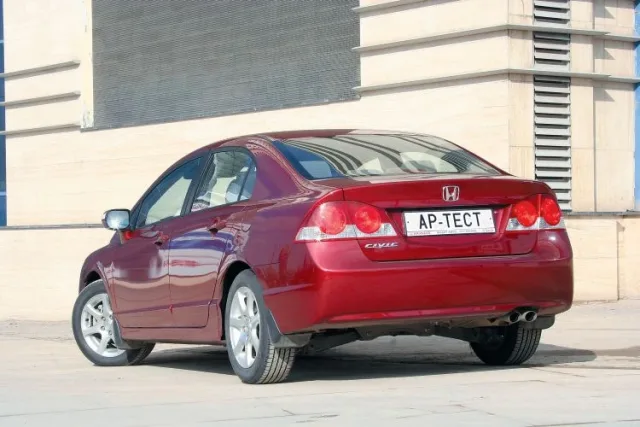
And the Honda's trunk is smaller! The opening is also small. Only the remote seatback release handles and full-size spare please. But why is there no upholstery on the inside of the trunk lid? What inappropriate economy on a car priced over $20,000?
In the end, the largest and most convenient cargo area is in the Skoda (also with a full-size spare). The only drawback — protruding bumper hindering loading.
The Honda engine is the most powerful: 140 hp from 1800 cc. At idle, the engine noticeably vibrates, responds instantly to throttle, and acceleration is magnificent — the Civic gains speed powerfully and confidently, with peak activity in the 4500—6000 rpm range. But why is there a piercing squeal from under the hood?
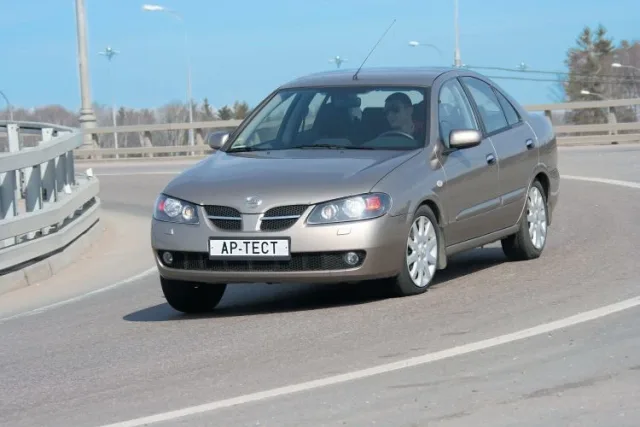
The Almera doesn't shine with lively steering response, but in sharp corners it behaves very reliably — slight stable understeer
And the four-speed automatic, alas, is not tuned in the best way. Delays in downshifts, too hasty upshifts — all this hinders active driving. And the engine begs for action! It's a pity.
 |  |
| Instruments are simple and concise | Inside the Nissan is boring — even the huge glaring display doesn't liven up the interior |
 |  |
| Seats are wide and amorphous | Rear seats are the tightest |
The Almera, with the same engine displacement, noticeably loses — only 116 horsepower extracted from 1.8 liters. When accelerating, the engine screams even more piercingly than the Honda's. The simple automatic responds to commands with noticeable delay... You can drive, but there's almost no pleasure in the process.
 |  |
| The Almera's trunk is modest, but easy to handle | The Nissan's automatic is morally outdated |
Skoda with its high-tech two-liter direct-injection engine is noticeably more powerful — 150 hp. Whether it outpaces the Honda in dynamics is hard to say without instruments. Its character is completely different. The briskness seems to dissolve in smoothed throttle responses and the soft operation of the modern six-speed automatic. You press the pedal — the gearbox smoothly, almost like a CVT, selects the right gear, and the Octavia, under the low, velvety voice of the Volkswagen engine, swiftly carries its passengers away. Additionally, there are manual and sport modes. With such an engine and gearbox, you can confidently attempt even the riskiest overtakes!
But, honestly, you don't feel like doing that — the Skoda itself sets you up for unhurried, solid driving, matching its strict appearance. Sometimes this deliberately calm response to steering inputs even annoys. Although in sharp corners, the Octavia handles confidently, without understeer, and when you lift off the throttle, it neatly transitions from slight understeer to smooth oversteer. At high speeds, the car holds its line steadily even on rutted highways. The steering wheel is firm, but it lacks feedback. And there are questions about the brake pedal: it travels too deep.
However, the ABS on the Skoda operates very delicately, and during hard braking on uneven surfaces, the Octavia stops perfectly straight. Ride comfort is excellent: the suspension absorbs bumps quietly and effectively. The only "but" — medium-sized potholes transmit somewhat harshly to the seats.
Maybe it's the tires? After all, the Octavia was shod with winter studded tires, and we were driving on asphalt…
The Honda, in turn, was on summer tires. And, unlike the boring seventh-generation Civic, it left truly vivid impressions.
 |  |
| The strict profile of the Skoda's leather seats won't appeal to everyone | The glovebox here is purely symbolic |
The chassis is tuned sportily! The new Civic responds instantly to the steering, doesn't understeer in sharp corners, holds the road confidently in fast bends, and boasts excellent directional stability. In the lane-change test, no excessive oscillations! Even on ruts worn by trucks, the Civic barely pays attention.
But ride comfort has suffered: the stiff suspension meticulously transmits every detail of the road surface. The constant vibration from small irregularities is also tiring. However, the energy capacity is such that you could go rallying right now — impacts from large potholes are absorbed excellently.
The brakes are also up to par — deceleration is easy to modulate, and the limits are impressive. Though, the pedal could be firmer, and the ABS isn't perfect: during full braking on mixed surfaces, the car starts to pull to one side.
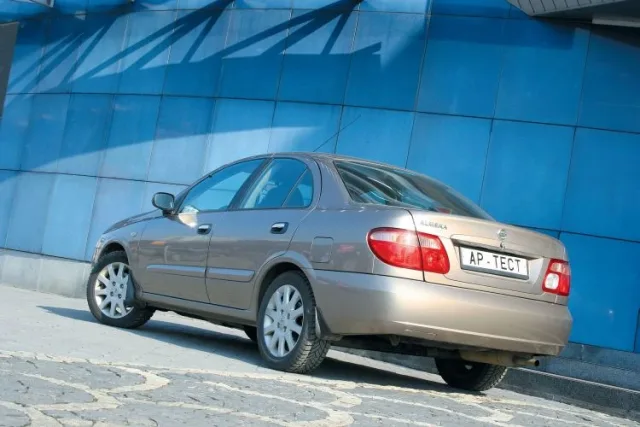
The Nissan Almera loses to both rivals in handling and ride comfort (it was also on winter friction tires). The loose suspension prevents the car from precisely following the intended path. On the highway, ruts cause noticeable deviations from the course, and large, harsh bumps simply push the Nissan sideways — especially unpleasant in corners. Add to that a steering wheel that lacks feedback around the center... However, in sharp corners, the Almera behaves predictably: moderate understeer, a good stability reserve, and adequate steering effort. In short, the handling is normal. It's just characterless — as if no one specifically tuned it. Neither the Skoda's restraint nor the Honda's zest.
And ride comfort disappoints. While smoothing out asphalt waves decently, the Nissan's suspension gives up on harsh bumps — powerful, ringing impacts reach the cabin. On the other hand, small seams and micro-irregularities don't bother passengers.
 |  |  |
| The Volkswagen automatic works flawlessly | The rear seat of the Skoda is tighter than in the Civic | But the trunk is simply huge! |
However, the Almera's brakes pleased — here is the most understandable pedal and the most convenient deceleration algorithm. The ABS works correctly, allowing the wheels to lock slightly. But on uneven surfaces, the car noticeably pulls toward the more grippy surface.
What about acoustic comfort? The Skoda leads again. Its engine is quieter than the Nissan's and only slightly louder than the Honda's, but it sounds pleasant and refined, unlike both. Tire noise (even studded) is minimal, and the suspension also keeps quiet…
The Civic's main problem is poor sound insulation. You hear every small crack, and sand and splashes ring loudly in the wheel arches. Aerodynamic noise appears quite early, though even at 150 km/h it doesn't become excessive. In the Almera, acoustic comfort is spoiled primarily by the noisy engine: its strained cries during downshifts and howls at high revs are irritating. Aerodynamics make themselves known before 100 km/h, and the picture is completed by the ringing of sand in the arches and suspension knocks on bumps.
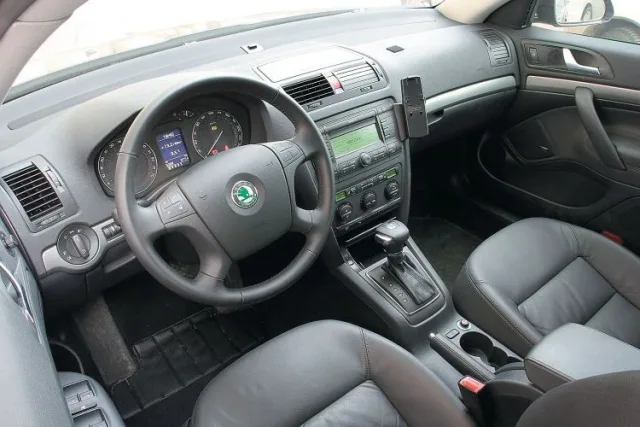
Inside, the Octavia is as strict and gloomy as it is outside
So what's the bottom line? The Skoda Octavia wins — solid and "thoroughbred." Not only in points but also in price, and by a large margin: a new Octavia 2.0 FSI with an automatic costs $33,931, which is more than $10,000 dearer than the Civic or Almera!
The Nissan Almera offers a democratic price ($21,080) and quite decent consumer qualities. It may look like a harmony of imperfection, but statistics are relentless: last year, three times as many Almeras were sold as Octavias. So the Almera will continue to be sold in Russia as long as there's demand. Especially since the updated Almera Classic — essentially a reskinned Samsung SM3 — has already arrived to help.
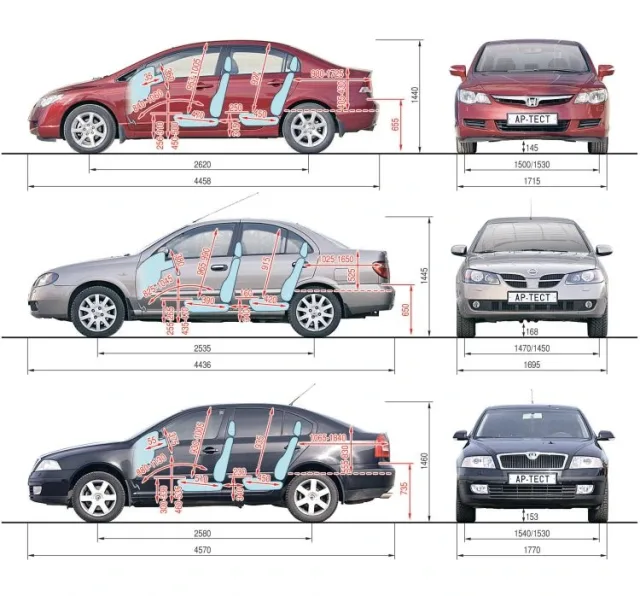
Meanwhile, the new Civic lost to the expensive Skoda by only a little. And for its spirited handling and fighting engine, combined with the "cosmic" interior and excellent ergonomics, we would forgive this car its poor visibility, bumpy ride, and cabin noise. Though, we'd prefer the Civic not with an automatic for $23,900, but with a manual for $19,900.
Later, the sedan will be joined by the hatchback — with an even more extravagant appearance. They say that despite the simplified rear suspension, it should be even more "driver-oriented." We'll check soon!
What costs how much?
Nissan Almera — the oldest, but the most affordable participant in the test: the base sedan (or hatchback) Almera 1.5 Comfort (98 hp) could be had for $14,850. But very soon, these cars will be replaced by the Almera Classic (Samsung SM3) with a 1.6-liter engine (107 hp), with prices starting from $13,490.
And the "regular" Almera with a 1.8-liter engine (116 hp) will cost at least $17,010. For $18,860, they offer the Almera 1.8 with an automatic and ABS, while the top version 1.8 Luxury costs from $19,980 (manual) to $21,080 (our test car with an automatic).
Warranty — 3 years or 100,000 kilometers.
The eighth-generation Honda Civic sedans have become cheaper compared to the seventh-generation cars. The base Civic 1.8 Comfort (140 hp) with a six-speed manual gearbox and rich standard equipment (ABS, 4 airbags, electric power steering, air conditioning, CD stereo) costs $19,900. The same car can be ordered with an automatic for $20,900. And the top version Civic 1.8 Executive (6 airbags, VSA dynamic stability system, alloy wheels, cruise control, climate control, audio system with 6-disc changer) — already for $23,900. Later, other modifications will appear at dealers.
Warranty — 3 years or 100,000 kilometers.
The second-generation Skoda Octavia is the largest and most expensive participant in the test. For a hatchback with a 1.4-liter engine producing 75 hp, four airbags, and air conditioning, you'll have to pay $19,760. For extra money, almost everything is available: turbodiesels, all-wheel drive, a wagon, and the DSG robotic gearbox. However, the cost of well-equipped cars is noticeably higher than competitors: for example, the Octavia 2.0 FSI Ambiente (150 hp) with an automatic is priced at $30,900, with only fog lights and a CD stereo as equipment. Our version, the Octavia 2.0 FSI AT Elegance, stuffed with leather interior, xenon, and other options, already costs $33,931. All-wheel-drive modifications are offered exclusively as wagons: the petrol Octavia 2.0 FSI 4x4 costs $32,020, and the diesel Octavia 1.9 TDI (105 hp) — $31,640.
The car comes with a three-year warranty with no mileage limit.
Reader's forecast
Before the tests began, we asked visitors of www.autoreview.ru to choose a favorite among the test participants. The votes were distributed as follows:
Honda Civic 69.2%
Nissan Almera 5.5%
Skoda Octavia 25.3%
A total of 7308 people took part in the voting.
| Honda Civic 1.8, Nissan Almera 1.8, Skoda Octavia 2.0 FSI (manufacturer data) | |||
| Honda Civic | Nissan Almera | Skoda Octavia | |
| Body type | 4-door sedan | 4-door sedan | 5-door hatchback |
| Number of seats | 5 | 5 | 5 |
| Trunk volume, l | 389/n.a.* | 460/n.a.* | 560/1350** |
| Curb weight, kg | 1221 | 1180 | 1310 |
| Gross weight, kg | 1700 | 1735 | 1915 |
| Engine | petrol, with distributed injection | petrol, with distributed injection | petrol, with direct injection |
| Location | front, transverse | front, transverse | front, transverse |
| Number and arrangement of cylinders | 4, in-line | 4, in-line | 4, in-line |
| Displacement, cm³ | 1799 | 1769 | 1984 |
| Cylinder bore/piston stroke, mm | 81.0/87.3 | 80.0/88.0 | 82.5/92.8 |
| Compression ratio | 10.5:1 | 9.5:1 | 11.5:1 |
| Number of valves | 16 | 16 | 16 |
| Max. power, hp/kW/rpm | 140/103/6300 | 116/85/5600 | 150/110/6000 |
| Max. torque, Nm/rpm | 174/4300 | 163/4000 | 200/3500 |
| Gearbox*** | A5 | A4 | A6 |
| Gear ratios | |||
| I | 2.67 | 2.86 | 4.15 |
| II | 1.53 | 1.56 | 2.37 |
| III | 1.02 | 1.00 | 1.56 |
| IV | 0.72 | 0.70 | 1.16 |
| V | 0.52 | — | 0.86 |
| VI | — | — | 0.69 |
| reverse | 1.96 | 2.31 | 3.39 |
| final drive | 4.44 | 4.07 | 4.10 |
| Drive | front | front | front |
| Front suspension | independent, coil spring, McPherson | independent, coil spring, McPherson | independent, coil spring, McPherson |
| Rear suspension | independent, coil spring, multi-link | dependent, coil spring, with Scott-Russell mechanism | independent, coil spring, multi-link |
| Front brakes | disc, ventilated | disc, ventilated | disc, ventilated |
| Rear brakes | disc | disc | disc |
| Tires | 205/55 R16 | 195/55 R16 | 195/65 R15 |
| Maximum speed, km/h | 200 | 173 | 210 |
| Acceleration time 0-100 km/h, s | 10.6 | 12.8 | 11.8 |
| Fuel consumption, l/100 km | |||
| urban cycle | 9.5 | 10.6 | 11.8 |
| extra-urban cycle | 5.1 | 6.2 | 6.3 |
| combined cycle | 6.6 | 7.8 | 8.3 |
| Fuel tank capacity, l | 50 | 60 | 55 |
| Fuel | AI-95 | AI-95 | AI-98 |
| * n.a. — not available for the Russian version | |||
| ** With rear seats folded | |||
| *** A4 — automatic four-speed gearbox, A5 — automatic five-speed gearbox, A6 — automatic six-speed gearbox | |||
| Expert assessments of Autoreview | ||||
| Parameter | Max. score | Honda | Nissan | Skoda |
| Design | 160 | 145 | 120 | 130 |
| Exterior | 80 | 70 | 60 | 65 |
| Interior | 80 | 75 | 60 | 65 |
| Ergonomics | 160 | 130 | 135 | 135 |
| Driver's seat | 80 | 75 | 65 | 70 |
| Visibility | 80 | 60 | 70 | 65 |
| Dynamics | 290 | 230 | 215 | 240 |
| Acceleration dynamics | 90 | 70 | 60 | 75 |
| Braking dynamics | 100 | 80 | 80 | 85 |
| Handling | 100 | 80 | 75 | 80 |
| Ride comfort | 210 | 150 | 140 | 160 |
| Ride smoothness, vibration protection | 80 | 60 | 55 | 65 |
| Acoustic comfort | 70 | 40 | 40 | 50 |
| Climate control | 60 | 45 | 40 | 50 |
| Interior comfort | 180 | 120 | 110 | 145 |
| Rear seats | 70 | 55 | 45 | 50 |
| Trunk | 60 | 35 | 40 | 55 |
| Interior transformation | 50 | 30 | 25 | 40 |
| Total score | 1000 | 790 | 725 | 800 |
| Equipment of test participants | |||
| Model | Honda Civic | Nissan Almera | Skoda Octavia |
| Front airbags | + | + | + |
| Side airbags for front passengers | + | + | + |
| Curtain airbags | + | – | + |
| ABS | + | + | + |
| Stability control | + | – | + |
| Automatic transmission | + | + | +* |
| Power steering | + | + | + |
| Steering column with height adjustment | + | + | + |
| Steering column with reach adjustment | + | – | + |
| Steering wheel controls | – | + | + |
| Leather-wrapped steering wheel | – | – | + |
| Central locking with remote control | + | + | + |
| Immobilizer and alarm | + | + | + |
| Heated front seats | + | + | + |
| Power-adjustable and heated mirrors | + | + | + |
| Power windows | + | + | + |
| Active head restraints | – | + | – |
| Driver's seat height adjustment | + | +** | + |
| Climate control | + | + | +*** |
| Rear seat split-folding | + | + | + |
| Rear armrest | + | + | + |
| Pass-through for long items | – | – | + |
| Audio system with CD | +**** | + | + |
| CD changer | – | – | + |
| Fog lights | – | + | + |
| Full-size spare wheel | + | – | + |
| Engine protection | – | – | – |
| Alloy wheels | + | + | + |
| Metallic paint | + | + | + |
| Xenon low beam | – | – | + |
| Leather interior | – | – | + |
| Test car price, $ | 23900 | 21080 | 33931 |
| * With manual mode; ** Height and tilt adjustment; *** Dual-zone; **** With changer | |||