
On the northernmost Japanese island of Hokkaido, the climate is noticeably cooler than in stuffy Tokyo. Bears and macaques live in the forests here, and volcanoes and hot springs (onsen) are found in the mountains. In the southern foothills of the island lies the asphalt oval of the Tokachi proving ground, owned by Mitsubishi Motors. It was there that we first got to see the new-generation Pajero.
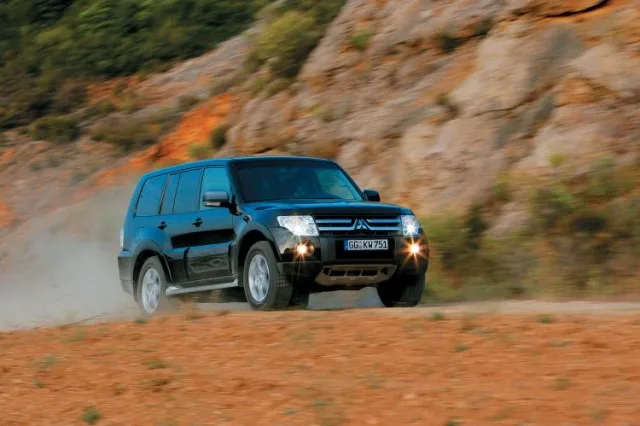
 The question of what the new Pajero would be like had been troubling us for a long time. We even asked it directly to Mitsubishi's chief designer, Akinori Nakanishi, when we visited the technical center in Okazaki (see AR No. 16, 2005). The answer boiled down to the Pajero remaining true to itself: spacious, utilitarian, and off-road capable.
Now I'm examining the familiar contours in a new guise. But how familiar they are to me!
Is this really the new Pajero?
It has become noticeably sleeker — the protruding "cheekbones" of the front wheel arches have disappeared. The front end now references the discontinued compact Pajero Pinin more than the "adult" model. However, the other family traits are in place: the signature step on the lower edge of the headlights (as on the very first Pajero), almost vertical roof pillars, the rising window line toward the rear, familiar door openings, and the rear door that opens to the right…
 |
| The interior hasn't changed its layout. All "Russian" Pajeros will get a third-row seat that folds into the floor, and leather seats — for the Instyle and Ultimate versions |
Why does the fourth-generation Pajero look so much like its predecessor? Because the body has essentially remained the same.
The dimensions have changed slightly — only due to new exterior panels. The wheelbase is untouched. And the list of changes in the body structure can be counted on one hand: they added a transverse structural element under the rear seat, bent the reinforcement under the front panel differently, increased the number of weld points at the junction of the bulkhead with the side members, and mounted the spare wheel lower and closer to the center. Plus an aluminum hood — to save weight.
What does the updated body give — surely increased torsional rigidity? Engineers honestly admit they didn't take measurements but relied on a computer model that promises an increase of... only 1%.
And safety? The third-generation Pajero from 1999 didn't undergo EuroNCAP crash tests, but the Japanese themselves admit it would likely have scored no more than three stars out of five. The new Pajero claims four: in addition to the reinforced body, it has inflatable "curtains" for the head. The base equipment now includes six airbags, and the front ones are dual-stage.
The interior has been updated to match the exterior: it has become more modern and fashionable, although the "sporty" instruments in two plastic cowls look frivolous for a true off-roader. In the center of the new console is a large color display. The top Russian version, Ultimate, comes with a Rockford Fosgate audio system and a rear-view camera; later, navigation with Russian language will be added. There will also be a more modest Intense trim — with a velour interior and a simple CD receiver instead of a DVD player.
Maybe the changes affected engines, transmissions, or suspensions?
But here too, everything was limited to a light modernization.
 |  |  |
| The five-speed adaptive "automatic" retained its gear ratios, but the shift algorithm was tweaked. The manual gearbox only gets a new lever | Versions with the 7-inch multimedia screen are equipped with a rear-view camera and navigation with a 30-gigabyte hard drive | The color display under the cowl of the central console shows readings from the trip computer and electronic "off-road" instrumentation — compass, altimeter, and barometer. In front — its own climate control; for rear passengers — a separate air conditioner |
The previous Pajero had a gasoline V6 3.5 GDI with direct injection. When development of the new model began, former patrons from DaimlerChrysler advised putting one of their archaic V8s for the American market on the SUV. But after the "divorce," the Japanese settled on their own 3.8-liter V6, with which the Pajero was already sold in Japan and the UAE. This is the familiar "six" 6G75, which has powered the American Galant since 2004 and the Eclipse coupe since last year. True, if earlier it produced 218 hp on the SUV, now it has received cylinder heads like the American versions — with the MIVEC system (variable valve timing and lift). Now the gasoline Pajero develops 250 hp. Interestingly, neither the Galant V6 3.8 nor the Eclipse are supplied to us: the Pajero will be the only Russian Mitsubishi with this engine.
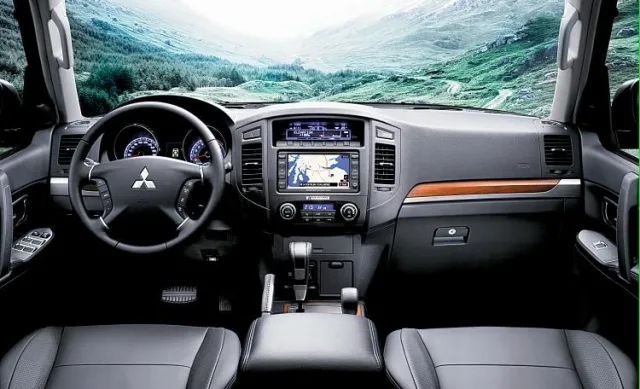
The dashboard and steering wheel are completely new, although the mutual arrangement of controls hasn't changed. The steering wheel is multifunctional, and the trim materials have become better quality
The 3.2 DI-DC diesel is a venerable "four" with a displacement of 3.2 liters, which received a new-generation Common Rail injection system and now develops 165 hp. For Russia, which Mitsubishi has designated as a separate market, turbo-diesels will come in a specially adapted version — for cold climates and with exhaust meeting Euro 3 standards (for Europe and other countries — Euro 4).
The adaptive INVECS-II "automatics" are the same. Moreover, the gasoline engine is paired only with a four-speed automatic transmission, while the turbo-diesel is available with both a manual and a five-speed "automatic."
Maybe something changed in the all-wheel-drive transmission?
No, "don't look a gift horse in the mouth": the legendary Super Select system of the second generation is so good that there's no point in changing it yet. On the Pajero, it allows almost everything! First, in 2H mode, the car is purely rear-wheel drive. You move the lever to 4H — and the front axle engages. Moreover, not rigidly, as in many SUVs (for example, the Nissan Patrol), but through a center differential: in this mode, you can drive on asphalt calmly. You can and should, since a viscous coupling is built into the "center," acting as a self-locking mechanism to improve handling on slippery surfaces.
For off-road, there are 4HLc modes (all-wheel drive with a locked "center") and 4LLc (the same plus low range). In addition, a button on the panel can lock the rear differential.
A dream for an off-road enthusiast!
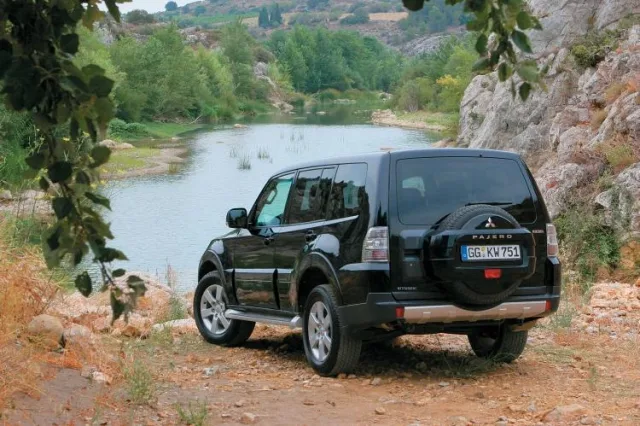
The rear end especially reveals the facelifted essence of the new Pajero — the lighting, fenders, spare wheel mount, and the glass of the fifth door have changed
To create the appearance of progress, the Japanese present the new Pajero's transmission as Super Select 4WD III. The "third generation" is a pure marketing trick. After all, neither the engageable front axle, nor the "transfer case" with a silent plate chain and low range, nor the asymmetric (33:67 in favor of the rear wheels) center differential with a viscous coupling and the possibility of forced locking have changed. The lever with which the driver selects one of four modes also remains.
| The suspension design is the same — double wishbones at the front (the lower ones are now aluminum), a "multi-link" at the rear. But the springs, shock absorbers, and stabilizers have become stiffer, and the track is 10 mm wider. The power steering has also been recalibrated |
The only innovation: previously, the rear differential lock with pneumatic drive was installed only on Pajeros without a stability control system; now it equips all vehicles. On the third-generation Pajero for Russia with gasoline engines, the role of the lock was played by the electronic traction control system MATC (Mitsubishi Active Traction Control), and now the Japanese have "married" it with the rear differential lock. Compatibility is achieved simply: if the rear axle is locked, the traction control electronics are disabled. As soon as the speed exceeds 12 km/h, the pneumatic drive automatically "releases" the rear differential, and MATC comes into play again.
An interesting detail: on the European market, the Mitsubishi Pajero is in the vast majority of cases bought not for conquering off-road terrain, but as a tractor for towing trailers. Therefore, there the forced rear differential lock is offered for an additional fee. Here, in Russia, the Pajero is perceived primarily as a true off-road vehicle, and therefore the lock will be included in the base configuration. In addition — all the necessary "driver" electronics. On the new Pajero, as before, they are combined into the M-ASTC complex (the letter "M" here stands for Mitsubishi). This includes the stability control system MASC (Mitsubishi Active Stability Control), the traction control system MATC, as well as the engine brake assist control on descents MEBAC (Mitsubishi Engine Brake Assistant Control)…
In essence, there is nothing radically new here. As engineer Kaoru Sawase, who created the Super Select transmission and the unique all-wheel drive system for the Lancer Evolution sedan, explained, in the future the Pajero will still get advanced electronic features similar to those used on Land Rover vehicles. But we Russians are unlikely to like such a development. We understand perfectly well: in our conditions — in mud and snow — nothing more reliable than mechanical differential locks, which the driver engages manually, has been invented yet. The less electronic interference, the calmer we feel!
So Mitsubishi's current conservative approach is exactly what Russia needs. True, it cannot be said that the company chose it voluntarily. Rather, it was forced.
How much did it cost Mitsubishi to create this "not-new new" Pajero? Gowi Yesugi, director of the SUV division, draws the number "35000000000" on an office whiteboard with a marker. That's in Japanese yen. Converted to dollars, the sum is much more modest — 300 million. Moreover, half of these funds went to modernize production lines at the plant in Gifu Prefecture, where the Pajero has been assembled from the very beginning. In total, the Japanese were left with only 150 million dollars for the development of the car itself!
By modern standards, this is almost a laughable figure: to create a truly new model "from scratch," you need at least a billion. But where can a company balancing on the brink of financial collapse find such money?
When three and a half years ago Mitsubishi was just starting to think about the new Pajero, partners from DaimlerChrysler envisioned it quite differently — larger, less suited for off-road, in the American spirit. However, after the loud breakup in 2004, Mitsubishi was left alone with its problems.
Thus, the "anti-crisis" fourth-generation Pajero was born — a product of severe cost-cutting. A telling fact: the team of Kaoru Sawase, which worked on the transmission, had only 7 people until last spring. Can you do anything fundamentally new with such resources and such a budget?
But, as they say, every cloud has a silver lining.
The new Pajero could well have turned into a typical "American." Or become overly "electronic."
But it didn't turn into one and didn't become one — it remained the very Pajero for which it is loved here. In the USA, such a car is no longer in demand, so overseas they don't plan to sell the "new" Pajero. And which of the remaining 170 markets is considered the main one for the model? That's right, Russia!
While in Europe Pajero sales fell by 14.5% over six months, in Russia even the old SUV at the end of its career continues to grow: over seven months, the increase was 37% compared to last year. Therefore, at Mitsubishi headquarters they openly admit: Russia is one of the main engines of the company's recovery.
True, the question remains: will the "newness" of the Pajero, which is actually just a deeply modernized previous model, attract buyers? Will those who expected a completely new car but got a facelift turn away from Mitsubishi?
Time will tell. The "new old" Pajero with petrol engines will appear at Russian dealers as early as December. Diesel versions will arrive later — no earlier than spring. Prices promise to be very attractive...
However, Russia is not the only market the company is counting on. Sales in the Japanese and American markets also grew, albeit by modest 3% and 8% respectively. The financial situation is gradually stabilizing: the "recovery plan" is being implemented even ahead of schedule, and this year the company expects to become profitable. Kaoru Sawase's team now has not 7 but 15 people — work is in full swing. What are Mitsubishi engineers currently working on? At the Tokachi proving ground, they showed us something. But more on that later.
| External speed characteristics of Mitsubishi Pajero engines | |
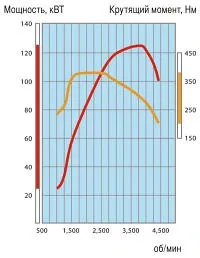 | 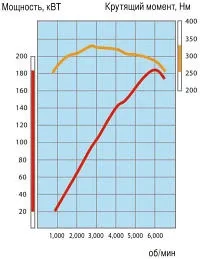 |
| Turbo diesel 3.2 Di-DC (Euro 4) | Petrol engine V6 3.8 MIVEC |
| Specifications | ||
| Vehicle | Mitsubishi Pajero | |
| Modification | 3,8L MIVEC | 3,2L Di-DC |
| Body type | 5-door wagon | 5-door wagon |
| Number of seats | 7 | 7 |
| Trunk volume, l | 215—1790 | 215—1790 |
| Curb weight, kg | 2215 | 2310 (2300)* |
| Gross weight, kg | 2910 | 3030 |
| Engine | petrol, with distributed injection | diesel, turbocharged |
| Location | front, longitudinal | front, longitudinal |
| Number and arrangement of cylinders | 6, V-shaped | 4, in-line |
| Displacement, cm³ | 3828 | 3200 |
| Cylinder bore/piston stroke, mm | 95,0/90,0 | 98,5/105,0 |
| Compression ratio | 9,8:1 | 17,0:1 |
| Number of valves | 24 | 16 |
| Max. power, hp/kW/rpm | 250/184/6000 | 165/121/3500 |
| Max. torque, Nm/rpm | 329/2750 | 381/2000 |
| Gearbox | A5** | M5***/A5 |
| Drive | part-time, all-wheel drive | part-time, all-wheel drive |
| Front suspension | independent, coil spring, double wishbone, with stabilizer | independent, coil spring, double wishbone, with stabilizer |
| Rear suspension | multi-link, coil spring, with stabilizer | multi-link, coil spring, with stabilizer |
| Front brakes | disc, ventilated | disc, ventilated |
| Rear brakes | disc, ventilated | disc, ventilated |
| Tires | 265/60 R18 | 265/60 R18 |
| Maximum speed, km/h | 200 | 177**** |
| Acceleration time 0—100 km/h, s | 10,8 | 14,0**** |
| Fuel consumption, l/100 km | ||
| urban cycle | 17,7 | 13,1**** |
| extra-urban cycle | 11,2 | 9,1**** |
| combined cycle | 13,5 | 10,6**** |
| Fuel tank capacity, l | 90 | 90 |
| Fuel | AI-95 | diesel |
| * Data in parentheses — for diesel version with automatic transmission | ||
| ** A5 — automatic 5-speed transmission | ||
| *** M5 — manual 5-speed transmission | ||
| **** For Euro 4 version with automatic transmission | ||
Quarter century of Pajero
 |
| Traditional headlights with a characteristic step were nicknamed "Pajero eyes" — they were absent only on third-generation cars. On the fourth, the "eyes" reappeared |
This year, the Pajero celebrates its quarter century — the first car of this family was produced in 1981. But the history of all-wheel drive vehicles with three diamonds on the hood already spans 70 years.
Formally, the first all-wheel drive passenger car from Japan is considered to be the experimental Mitsubishi PX33, built in 1936, before the war. Mass-produced all-wheel drive vehicles at Mitsubishi began after the war: in 1953, the company bought a license to produce the famous Willys. This veteran was assembled in Japan until the 90s! But already in the 60s, Mitsubishi started thinking about its own SUV. Therefore, starting from 1969, concepts based on the Willys appeared one after another — Jeep Minica, Pajero I Concept (1973), Jeep Concept (1977). In 1979, the original Pajero II Concept was presented. And the production three-door Pajero went on the assembly line in 1981.
The first-generation Pajero was remembered for its simplicity and reliability: ladder frame, torsion bar front and leaf spring rear suspension, rigidly engaged front axle without a differential, low-range gear. Various locking mechanisms were used in the rear axle. But it was the front independent suspension that made the character of this SUV closer to passenger cars. In 1984, a long-wheelbase five-door Pajero appeared. The second generation, which saw the light in 1991, became a deep modernization of the first. The frame and torsion bars in the front suspension remained, but springs appeared at the rear, a third row of seats in the cabin, and in the transmission — the revolutionary Super Select 4WD transfer case with four drive modes, low-range gear, and lockable rear and symmetrical center differentials.
The third generation Pajero, which debuted in 1999, made a real revolution for the model. Instead of a frame — a unibody, instead of dependent axles — independent coil spring suspensions all around, the engine received direct injection, and the driveshaft became carbon fiber. The Super Select 4WD II transmission also seriously updated: the center differential was made asymmetrical with a torque split of 33:67, and control of all modes was transferred to servos.
An interesting detail: the first Pajero did not fade into oblivion after being taken off the assembly line — it was produced under other brands, for example, as the Hyundai Galloper or Chrysler/Dodge Rider. And since 2002, Mitsubishi itself brought the second generation back to life, launching it under the name Pajero Classic.
Over a quarter of a century, more than 2.5 million units of the Mitsubishi Pajero have been sold worldwide.
 |  |  |
| The all-wheel-drive staff car PX33 from 1936 did not go into production — at that time Mitsubishi was making trucks | Pajero I Concept (1973) was built on the basis of a licensed Willis | Pajero II Concept (1979) — already an in-house development |
 |  |  |
| The first-generation Mitsubishi Pajero stayed on the assembly line for 10 years, from 1982 to 1991 | The second Pajero (1991—1999) was one of the few SUVs of that time with a self-locking center differential | Mitsubishi Pajero III (1999—2006) — "puffy" design and improved Super Select II transmission |