
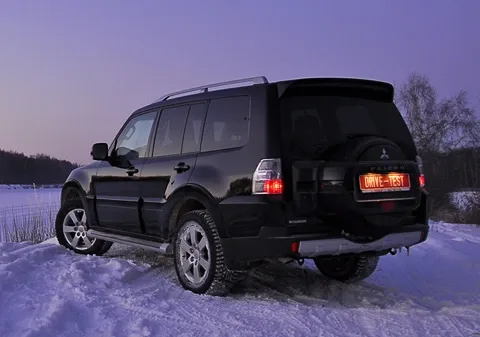
The new Mitsubishi Pajero IV won me over almost from the first minute of our acquaintance. Although, to be honest, calling it the fourth generation is only possible with a big caveat. Yes, there's a fresh look, a different engine, a reworked suspension, and much more. But in essence, we have a very serious modernization, not a fundamentally new car. And even the updated front end won't fool me — the body-on-frame construction has actually carried over from the third Pajero. Though the face now looks noticeably more brutal: the former "puffiness" above the wheel arches is gone, and the silhouette has become more composed and masculine. Maybe it would have been more logical to call this creation Pajero 3.5? No, I'm not talking about the engine displacement.
However, as soon as I found myself in the cabin, all my previous thoughts evaporated on their own. If, of course, you take a magnifying glass and meticulously compare the interior details of the old and new models, you can find many identical elements, but overall the difference is colossal. A completely different level! And it's precisely a qualitative level — moving from the fourth Pajero back to the third, you feel almost like you're behind the wheel of a combine harvester, not a respectable SUV. The new one has a stylish design, pleasant-to-touch soft plastic, harmonious "aluminum" and "wood" inserts, bluish instrument lighting in deep wells, and excellent Rockford Fosgate acoustics.
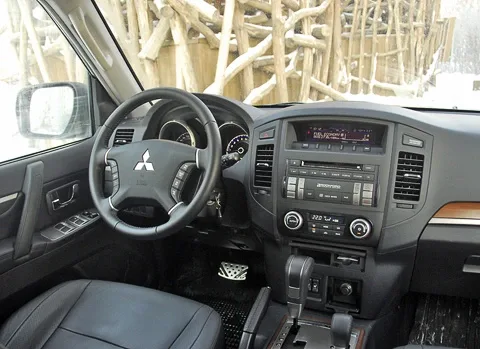
The interior pleases the eye and is pleasant to the touch. Compared to the "three," the Pajero has become not only more comfortable but also noticeably quieter.
The test car came to me in the richest trim: leather seats with electric adjustments, that very audio system, a DVD player with a screen for rear passengers, and dual-zone climate control. True, the climate zones are divided not left and right, as usual, but between the front and rear rows. Although, perhaps, this solution is even more convenient.
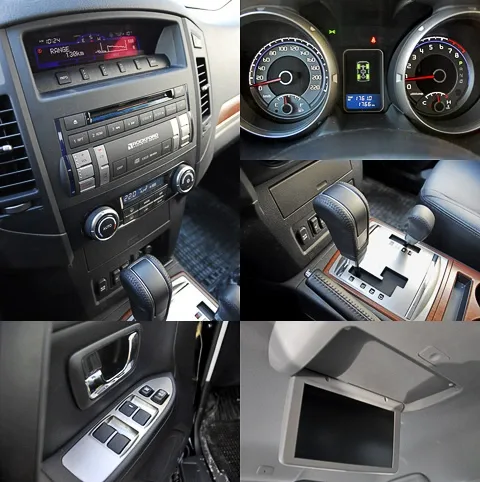
The information display on the center console is partially obscured by the upper visor — a tall driver can't see part of the data. The all-wheel drive mode is shown on the instrument panel.
All this is wonderful. But off-road, you know, absolutely doesn't care how attractive your "cruiser" is, what plastic is in the cabin, or how the music sounds. And you're unlikely to be comforted by the thought of how picturesque a mud-splattered car looks in the middle of a field — a tractor won't appear by itself; you'll have to walk for it. Therefore, I was much more interested in the Pajero's off-road capabilities. Let's check what it's really capable of.
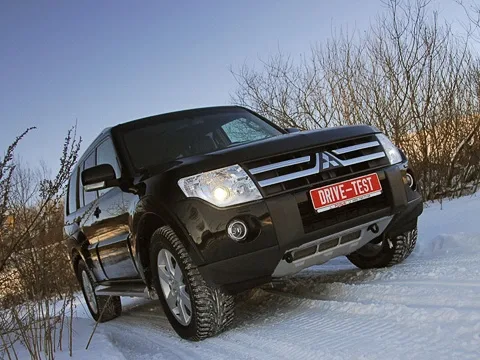
Like its predecessor, the new Pajero has the same modest overhangs, large ground clearance, and decent approach and departure angles. Of course — the body, as I already noted, is the same. That is, everything is serious, as before. This also applies to the transmission: the refined Advanced Super Select 4WD is an extremely honest system. I have four modes available, selected by a separate lever — 2H, 4H, 4HLc, and 4LLc. The first is pure rear-wheel drive. The second is permanent all-wheel drive with torque distribution in a 33:67 ratio favoring the rear axle. Moreover, unlike many cars with a similar scheme, the Pajero can be driven calmly on asphalt with permanent all-wheel drive — the transmission won't suffer from this.
The last two modes are permanent all-wheel drive with a locked center differential and, accordingly, with an additionally engaged low range. In 4LLc mode, all stability systems, ABS, and other electronic assistants are automatically disabled — you're left one-on-one with the car. Also, a separate button can lock the rear differential. The front axle can also be locked, but only by electronic imitation, which is quite reasonable — a full self-locking differential would make the car's behavior too specific, and there would be little benefit from it.
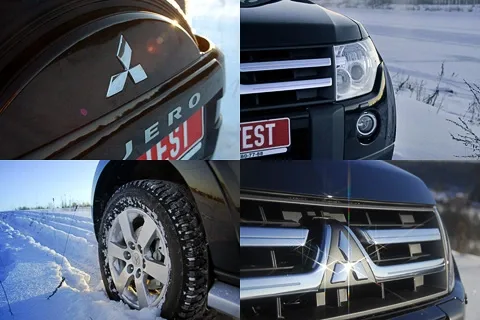
All these abstruse terms boil down to one thing — the Pajero IV is very seriously prepared for off-road, even despite independent suspension on all wheels (by the way, many of its elements are now aluminum) and a mass of over two tons. But let's not get ahead of ourselves — to test all this in practice, you first need to get out of Moscow. And that, I'll tell you, has recently been no easy task. Well, let's try.
I get on the highway — and immediately hit a dense traffic jam caused by a decent snowfall and the subsequent professional holiday of "tinsmiths." "No, I won't go here," I decided. Better to turn off and head wherever my eyes lead. There's no rush anyway, so at least I'll take a drive.
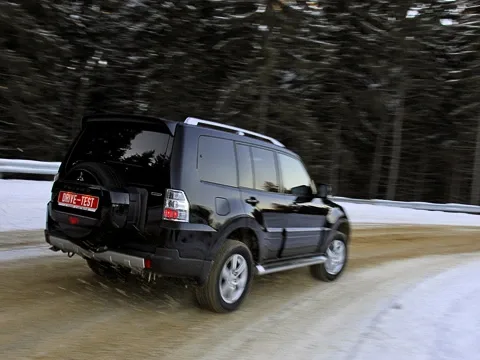
And here I am somewhere in a field. Did you say something about off-road? Here it is. But I won't immediately dive into the deepest snowdrift — the reserve of "coolness" of any SUV and its capabilities during thoughtless driving melt away very quickly. Especially since the Pajero, although an SUV, is by no means an all-terrain vehicle. No, I'll start more carefully.
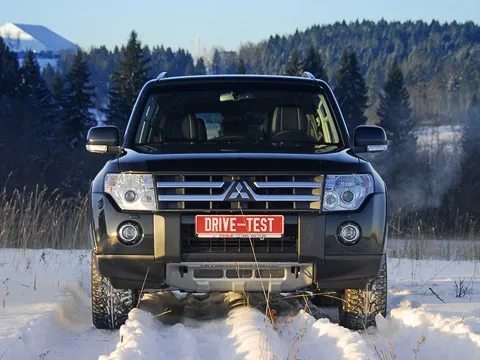
Climb to the very top of the hill? Easy!
And the snow was falling like from a bucket. The tracks I left in the field were barely visible after ten minutes. The main thing is that the amount of precipitation in millimeters should be less than the Pajero's ground clearance. Otherwise, you won't be playing hero for long. But fortunately, it worked out — the car never sat on its belly, and it crawled with simply amazing confidence. If you lock the center differential and engage low range, it seems the car will cling to anything and go even upside down. However, after half an hour of storming berms and "breaking virgin soil," it became frankly boring — nothing interesting will happen here. Unless you hit some piece of iron hidden under the snow and puncture something. For some reason, I didn't want that. Better I go somewhere in the Moscow region — to storm hills and slopes.
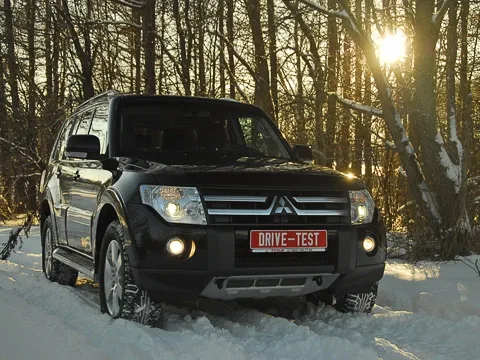
What can really stop you from storming rough terrain is not the car's cross-country ability, but its black shiny sides — it's a pity to scratch them.
And I went. True, not immediately, but the next day. First, I had to endure traffic jams — you can't escape them even in an SUV. While standing, I realized that the car's age can't be hidden from engineers. The interior is, of course, not bad, but the ergonomics... My left knee presses against the front panel, precisely where the "fog light" and mirror control buttons are. And it would be fine if I just occasionally touched this block with my foot. Once, when I was about to change lanes, I glanced at the right mirror — and it was looking somewhere wrong. While driving, I "adjusted" it, you see. In the end, I found a compromise by moving a bit further from the steering wheel and not trying to rest my foot on the footrest. But then I want to move the steering wheel closer — and it, as luck would have it, only adjusts for height. However, all this is relevant only for people of my height — 190 cm. Those who are shorter and with shorter legs didn't experience discomfort. And I eventually adapted somehow.
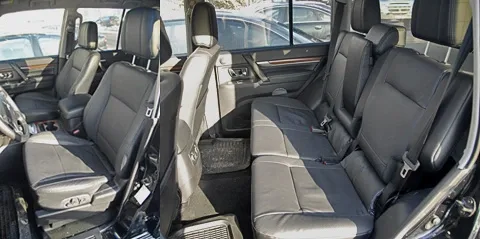
Both front and rear seats are very comfortable. And there's plenty of space.
The 3.8-liter V6 engine, borrowed from American Mitsubishi Galant and Eclipse, has an excellent appetite — fuel consumption in traffic jams turned out to be not the most modest. But, as it turned out immediately, as soon as I broke free, it also pulls excellently. It briskly accelerates the car even with a full load, and the five-speed "automatic" INVECS-II selects gears timely and smoothly. On slippery surfaces, you can use the manual mode — by the way, absolutely honest.
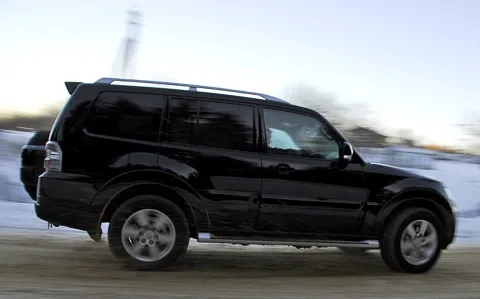
And here I am out of town. On a high-speed straight, the car holds remarkably well, and the high seating position adds comfort on a long journey — you can see far ahead. But the speed is felt even too well — you seem to be driving not very fast, but passengers already call you a psycho and a racer. What I do like is the fairly moderate body sway and small rolls. They exist, of course, which is normal for an SUV, but they don't annoy at all. And the car handles well. When I turned off the four-lane highway onto a narrow road winding between hills, the Pajero drove along it quite confidently. Lag and laziness in steering are certainly present, but, again, not too much. And if you overdo the speed in a corner, the car will start to leave the trajectory very smoothly and predictably. Although, when a two-ton mass under you suddenly starts going the wrong way, it becomes very scary.
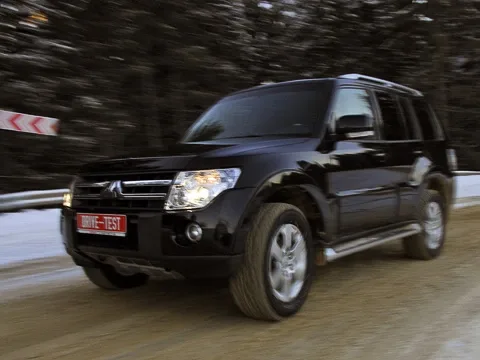
Meanwhile, we've already reached our destination. The beauty is indescribable! The scenery is a feast for the eyes. If there's any place to get stuck, it's here! And it doesn't matter that the nearest tractor is about ten kilometers away and most likely out of diesel. Though, let's hope that this time the beauty won't demand sacrifices.
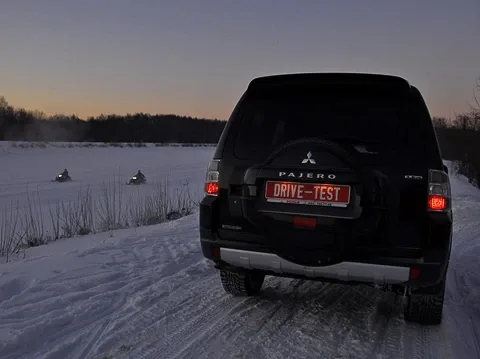
I leave the asphalt. At first, the road was just a dirt track, but with every meter it became deeper and worse. At the hill, it suddenly tilted to the right — I even feared we'd roll over, but it turned out fine. Mitsubishi claims that the Pajero can drive with a lateral tilt of up to 45%. However, the car constantly slid downward, and with locked differentials, when it turns very reluctantly, getting it back on track was not easy. A couple of times on the hills, there were trenches that appeared out of nowhere, but the Pajero overcame them too. And in situations where there was no chance at all, my inner voice told me: "No, we won't go further." I didn't want to get stuck.
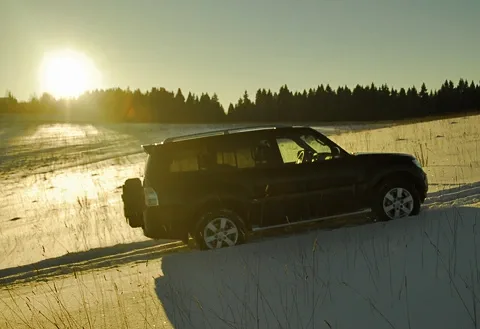
And in general, good geometric off-road capability and an easy-to-manage all-wheel-drive transmission allow anyone to feel like a seasoned "jeeper." Super Select can do almost everything. A deep ditch ahead? The Pajero will conquer it. Diagonal wheel hanging? We lock the differentials and confidently crawl on. A steep slippery descent? The EBAC engine braking system will come to the rescue. Stuck on the belly? We take out the shovel and, with cheerful curses, start digging out. Fortunately, I didn't have to do that then — my trip to the Moscow region also went without "losses."
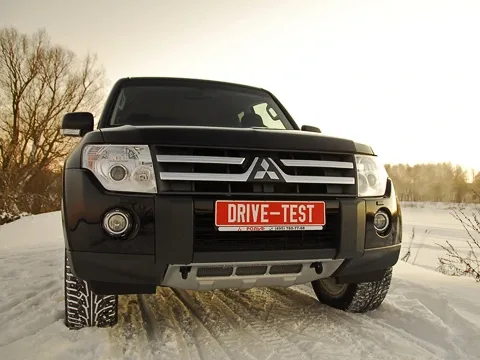
And finally, all these tricks can be done with a large company — after all, the car has seven seats. Passengers in the third row will, of course, grumble and complain about the cramped space, but let them better say "thank you" that there's a place for them at all. But the second row is spacious — plus, there's an armrest, its own climate control, a TV with DVD, and the seat backs recline.
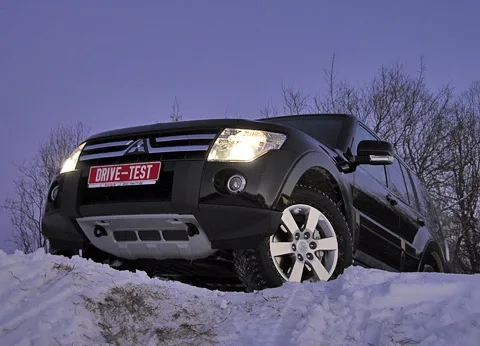
But here I am, stuck (see the first paragraph). I engage first forward, then reverse, trying to rock the car out. Low range, lockers — all in vain. I'm stuck. And why did I have to go there! I felt like taking a night drive. And go wherever my eyes led me — I looked and went. At first, everything was fine. But this trouble happened on the way back.
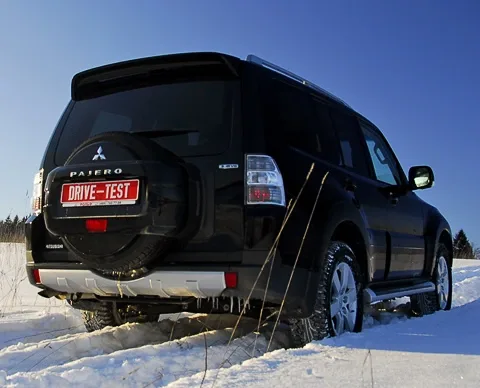
Here's what happened. When I was approaching the parking lot near my house at night, the guard at the entrance greeted me with the phrase: "Listen, there are no spots left. Snow piled up, snowdrifts everywhere." And I had to start showing off — saying, I'm in a Pajero and I've been through worse, what's your little snowdrift in the parking lot to me. But the snowdrift turned out to be big and dense — so I got stuck like a fool. In the parking lot near my house! Isn't that annoying? I'd rather have gotten stuck there, in the middle of a field fifty kilometers from Moscow. Though no, not better. There I'd have to walk a long way for help, but here, in five minutes, a few guys pushed the car out (thanks, guys).
Okay, I'll head home quickly, because tomorrow I have a ton of things to do: I need to return the car, go to the presentation, write this text, finally. Did I like the new Pajero? Definitely. It's not a "crossover" that gives up at the slightest serious off-road, nor an archaic mud-slinger completely devoid of comfort and handling. This car is a fighter: it suits the mud and it drives decently on roads. It's well-equipped and very utilitarian. And the fact that it looks like the old Pajero... After all, do you need a generation or to drive?
Technical specifications
| Specifications | $60990 |
|---|---|
| Dimensions and weight | |
| Overall length, mm | 4900 |
| Overall width, mm | 1875 |
| Overall height, mm | 1870 |
| Wheelbase, mm | 2780 |
| Ground clearance, mm | 220 |
| Curb weight, kg | 2110 |
| Maximum gross weight, kg | 2910 |
| Number of seats | 7 |
| Dynamic characteristics | |
| Fuel consumption* (EEC), l/100 km urban/highway/combined cycles | 17.7/11.2/13.5 |
| Acceleration** (0—100 km/h), s | 10.8 |
| Maximum speed**, km/h | 200 |
| Engine | |
| Type | Petrol, V-shaped, 6-cylinder, with two overhead camshafts, 24-valve |
| Displacement, cc | 3828 |
| Maximum power (EEC), kW (hp) / rpm | 184 (250)/6000 |
| Maximum torque (EEC), N?m / rpm | 329/2750 |
| Fuel system | |
| Fuel equipment | ECI-MULTI electronically controlled multipoint fuel injection |
| Fuel type | Unleaded petrol AI-95 |
| Fuel tank capacity, l | 88 |
| Suspension | |
| front | Double wishbone, coil spring, with anti-roll bar |
| rear | Multi-link coil spring, with anti-roll bar |
| Brakes | |
| front | 17-inch ventilated brake discs, 4-piston calipers (disc diameter 332 mm) |
| rear | 17-inch brake discs with integrated drum parking brake mechanisms (disc diameter 332 mm) |
| Multi-mode ABS with electronic brake force distribution (EBD) and brake booster | |
| Transmission | |
| 5-speed adaptive automatic INVECS-II Sports Mode (with manual mode) | |
| Drivetrain | |
| Multi-mode Advanced Super Select 4WD (SS4-II) transmission with on-the-fly switching up to 100 km/h between modes 2H (rear-wheel drive), 4H (all-wheel drive, direct gear), 4 HLc (all-wheel drive, locked center differential, direct gear). Low range engages after stopping. Forced mechanical locking of the rear differential. In total, Pajero IV is equipped with 5 types of locks: — automatic electronic locking of front wheels, automatic and forced locking of the center differential, automatic electronic and forced mechanical locking of the rear differential, which provides excellent off-road capability and active safety on all types of roads. | |
| M-ASTC active safety and off-road enhancement system suite: | |
| ASC — dynamic stability control system | |
| TCL — traction control system | |
| MEBAC — engine braking assist system for descents in difficult conditions | |
| Steering | |
| Rack and pinion with power steering | |
| Tires and wheels | |
| tires (front, rear) | 265/60 R18 |
| wheels (front and rear) | alloy 18×7.5JJ |
| spare wheel | 265/60 R18 |
Equipment of the tested vehicle
The car for the test drive was provided by Rolf Holding, the official distributor of Mitsubishi Motors in the Russian market.
Off-camera - 18-inch alloy wheels;
- Front climate control (fully automatic air conditioner). Rear air conditioner;
- Heated front seats;
- Third-row seat, stowable into the floor recess in the luggage compartment;
- Rockford Acoustic "Premium" audio system with 12 speakers, 860W amplifier and 6-disc CD changer;
- Rear passenger entertainment system with DVD player and 9-inch ceiling-mounted screen;
- Leather-wrapped steering wheel with audio and cruise control buttons;
- Leather-wrapped gear shift lever;
- Central multi-function display (outside temperature, audio info, odometer, clock, compass);
- Aluminum pedal covers;
- Leather seats, driver's with electric adjustments in 5 directions, front passenger's — in 4 directions;
- Center panel trim "wood" and "aluminum";
- Silver roof rails;
- Silver front bumper protective trim;
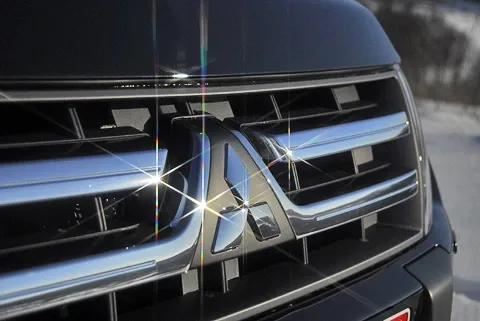
- Chrome decorative radiator grille;
- Front fog lights;
- Xenon headlights;
- Rear spoiler;
- Side steps;
- Front and rear mud flaps;
- Windshield washers and wipers with variable interval;
- Dual-stage front airbags for driver and front passenger;
- Side airbags and curtain airbags on door windows.