
Mitsubishi Outlander. "Miracle from Japan"
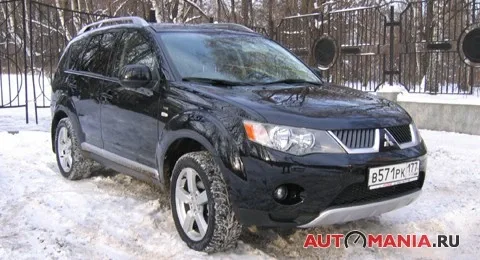
The frost is mentioned here for a reason. The heater in the Outlander with climate control (even if single-zone) works as if the car was prepared for the Far North. In the morning, when the thermometer showed -27, the cabin warmed up in a matter of minutes, and after a couple of kilometers, you could take off your jacket and stay in a shirt. I have not seen anything like this even in the recently tested Audi A8. The air flows are distributed so competently that you do not feel a draft, which means that a cold from the air conditioner in summer or the heater in winter is definitely not a threat.
The second generation of the Outlander differs from the first in about the same way as the ninth Galant, which entered our market almost simultaneously, differs from the eighth. Both models are extremely ambiguous and combine advantages with disadvantages. The reason is that the Galant is a purebred American, while the new Outlander is an internationalist. It was built on the universal Project Global platform, which allows the car to be adapted to different markets - Japanese, American, Russian, Asian, and European - without large costs.
Take the interior - we had the top version for $44,990 in the test. The leather of quite good quality contrasts sharply with the plastic of the doors and the front panel - hard, not too pleasant to the touch, and vaguely reminiscent of "Zhiguli" plastic. The press release says that it is special and even absorbs cigarette smoke. Let's take it at face value. The desire to save money is also visible in the fact that only the driver's seat is equipped with electric adjustment - the passenger will have to turn the knobs manually. The center console is somewhat similar to Toyota's, the speedometer and tachometer with the onboard computer display look stylish, but similar ones can be seen in the Audi Allroad, A8, and Q7. The three round ventilation and climate controls seem to have moved from the small Colt. But the button for controlling the onboard computer, unlike in the mentioned Audis, is not placed in the best way: it is not on the steering column stalk, but on the panel to the left of the steering wheel. Reaching for it is inconvenient, and the switching process distracts from the road.
On the outside, the new Outlander is no less contradictory. The headlights resemble Toyota's from the Camry with protruding turn signals. At the rear, everything seems original, but if you look closely, the rear vaguely resembles the Lexus RX 300. The side view is something between the Hyundai Santa Fe and the Suzuki Grand Vitara.
Perhaps I am too picky, because the Outlander, despite the abundance of foreign cars on our roads, does not go unnoticed and attracts glances. Over three days, many people approached me: a Galant owner at a gas station, a neighbor in the building, a Pajero owner picking a car for his wife, three guys from a cafe near which I parked. Questions were even asked from passing cars. Almost everyone had already read about the new model, but saw it live for the first time. The conclusion is simple: within a year, the second Outlander may well become a bestseller among crossovers in Russia. After all, in addition to the mentioned competitors, it will fight with the Toyota RAV4, the new Honda CR-V, the Chevrolet Captiva, and the Opel Antara. The Mitsubishi Outlander XL - "an American in European skin" - is a clear contender for victory in this "championship."
By the way, many of my interlocutors were confused by the low-profile tires on 18-inch wheels. I had to explain that this is not a mandatory option - if desired, you can choose thicker tires.
The advantages include the aluminum roof, which allowed lowering the center of gravity. The front and rear bumpers consist of separate parts, which significantly reduces repair costs. Unlike the first version, there is now a mode selector for the all-wheel drive system - from 2WD through 4WD to the "Lock" mode with the ability to rigidly lock the clutch. Previously, the Outlander had only permanent all-wheel drive, and the innovation was again introduced to please the Americans.
The car drives excellently - smooth acceleration without jerks is provided not only by the 3.0-liter 220-horsepower engine (by the way, created specifically for America, where powerful engines are valued) but also by the 6-speed automatic transmission - in this configuration, the XL will be supplied to Russia for now. The tachometer almost always stays at 2-2.5 thousand rpm, which helps save fuel. According to the passport, 15.3 liters per hundred are required in the city, but without constantly pressing the pedal to the floor, I managed to fit into 13.9. A rare case when the real consumption turned out to be lower than stated. But the promised 9.7 seconds to a hundred raise doubts. I did not time it, but it is hard to believe these figures. At intersections, I did not start first (we do not count Zhigulis).
Before the test, I read reviews from colleagues who tested the Outlander in Japan. I agree with some things, not with others. Like them, I noticed that the car is quite noisy (it is not about studded tires) and stiff. Although for an SUV of such dimensions, this is natural. But I disagree about lateral rolls - it is the stiffness that minimizes them. The SUV does not tire at all - neither on the highway nor in traffic jams.
Compared to the first generation, the SUV has become longer by 95 mm, wider by 50 mm, and higher by 10 mm, and the ground clearance has increased to 215 mm. True, this is unlikely to affect off-road capability, because even with the clutch lock, you need to be careful with off-road. And it is better to move only forward. The reason is the full-size spare tire, which, like many overseas SUVs, lies not under the trunk floor (as in the first Outlander) but below under the bottom. It is partially covered by a thin plastic tray, but about 5 cm of the wheel remains unprotected. The spare tire hangs quite low, and when moving backward, the tray can be easily damaged even by a small obstacle. And if you try hard, you can also knock off or puncture the wheel. Although this is nothing compared to the Nissan X-Trail - there, if you remember, the problem is in the low-hanging muffler, which is also easy to tear off in reverse, and the repair will cost a pretty penny.
However, you also need to get used to moving forward. No matter how I adjusted the seat at a height of 178 cm, the blind zone in front of the right front fender remained. Something similar is felt behind the wheel of a Hummer H2. The dimensions on the right are not felt. But this is a matter of time and habit.
Now about the advantages. The main one is the trunk with a volume of 1619 liters with a split rear door, which simplifies loading and unloading. The algorithm for folding the rear seats was very pleasing - you can increase the volume by pressing one button.
The most pleasant surprise for lovers of good sound - in the top version (Inspire trim), a Rockford Fosgate Acoustic audio system is installed with a 650-watt amplifier, nine speakers, and a 12-inch subwoofer in the trunk. The test car was exactly like that, and believe me - the sound is impressive.
Finally, a few words about the model's history and its prospects in Russia. The Outlander XL was created back in the days of the Mitsubishi alliance with DaimlerChrysler. In the USA, the Jeep Compass and Dodge Caliber crossovers were built on the GS platform (both have been sold here for a year). But the alliance broke up, and now only the new Lancer and Evolution X will appear on this platform. As for Europe, two French crossovers will soon be released based on the Outlander XL - the Citroen C-Crosser and the Peugeot 4007. In essence, it will be the same car assembled in Japan with French badges, but with 2-liter diesels. Diesels will not be brought to Russia. But a more affordable version with a 2.4-liter gasoline engine (from the Galant) with a 6-range CVT or 5-speed manual will appear. It seems that it is then that the Outlander XL will be able to confidently enter the leaders among all crossovers in our market.
Technical characteristics:
| Dimensions (mm) | 4640 x 1800 x 1680 |
| Maximum power (hp) The SUV I took for the test is a real American. It is big, heavy, and incredibly self-confident. It is immediately clear that its element is not city bustle, but open spaces, where you can leisurely roll along a straight line, feeling like the captain of a huge ship. Under the hood of this monster is a gasoline V6 with a volume of 3 liters. It produces 220 horsepower and 276 Nm of torque, available at four thousand rpm. Honestly, for a car weighing 1650 kilograms, this is not so much. Acceleration to a hundred takes 9.7 seconds, and the maximum speed is limited to 200 kilometers per hour. On the highway, this is felt: overtaking is difficult, you have to calculate the maneuver in advance and press the pedal to the floor to get at least some dynamics. But the fuel consumption here is without compromise. In the combined cycle, the appetite is 15.3 liters per hundred, and this is with a tank of only 60 liters. With such an appetite, it is better to go on long distances with a full tank and estimate where the next gas station will be. Fuel is only A-95, so you will not be able to save on the quality of gasoline. The price of the tested version is $44,990. But how good this car is off-road! Here it feels like a fish in water. The suspension swallows all the potholes and bumps, and the steering wheel is light and informative, despite the size. In the city, on the contrary, the car seems a bit clumsy and heavy, but this is the price for its off-road talents. In the end, we have a bright representative of its kind. It doesn't try to be a universal vehicle or disguise itself as a city crossover. This is a true workhorse for those who need not just to drive, but to drive where other cars simply cannot go. If your life is constant trips into nature, not parking lots at shopping malls, then this car is your choice. |