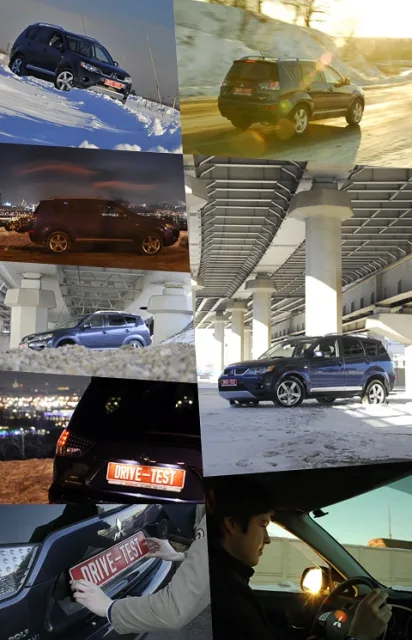
To be honest, if I had met a Mitsubishi engineer right after reading the official press release about the new model, the conversation would have been tough. At first, the Outlander, which had acquired the XL suffix, appealed to me — stylish looks, a pleasant interior, a torquey engine, and a six-speed automatic… Beautiful! That was exactly what the previous Outlander lacked. However, then, like a bolt from the blue, I came across a phrase that first puzzled me and then downright angered me.
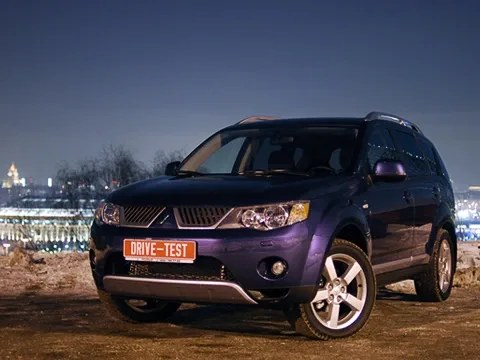
The first Mitsubishi Outlander was a proper and honest car. Even though its exterior and interior were not to everyone's taste, it could boast a truly honest all-wheel drive, an energy-intensive suspension, and excellent handling. Few competitors among crossovers could boast that — they usually distracted buyers from the primitive on-demand all-wheel drive with a brutal appearance or generous equipment. And this, by the way, bore fruit.
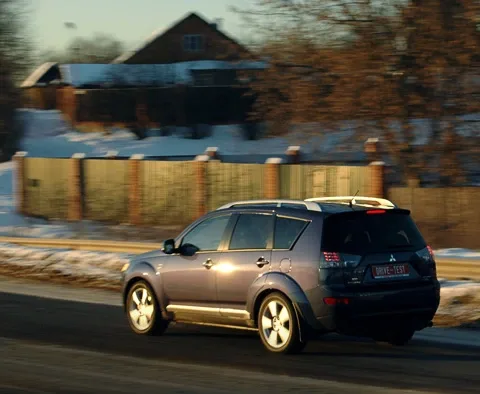
Now, the Outlander XL has everything like everyone else. Attractive design, a three-liter engine, a modern interior, a stability control system, and… on-demand all-wheel drive. Like everyone else. For some, this is progress, but for me, it's a step back. Isn't that right, comrade engineer? Why are you hiding your eyes?
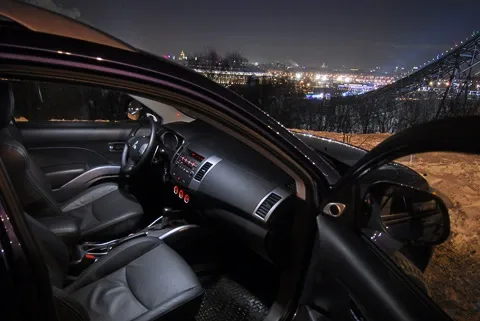
The interior retained many design solutions from the previous model, like the "double" instrument hood, but became much better in quality. True, the steering wheel is still only adjustable for height, and the seat heating buttons are located who knows where.
However, had I given the engineers a real interrogation, within half an hour I would have extracted quite a few curious details from them. And, perhaps, I would have softened. In reality, everything is not as simple as it seems at first glance. The all-wheel drive of the Outlander XL would be more correctly called not on-demand, but disconnectable. Yes, on the nice round washer on the center tunnel, there is a 2WD mode that engages only the front axle. But it will be useful only for the highway and for fuel economy. And even then, as it turns out, with a sharp press on the gas in 2WD mode, part of the torque still goes to the rear. But the 4WD and Lock modes are truly honest. The electromagnetic clutch, controlled by electronics, constantly "juggles" the torque, sending up to half of the traction to the rear axle. So theoretically, the Outlander XL should drive well. Let's check it with all due rigor.
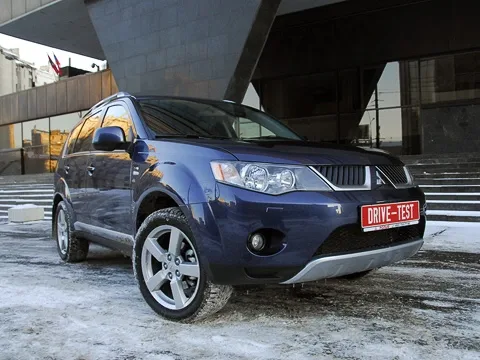
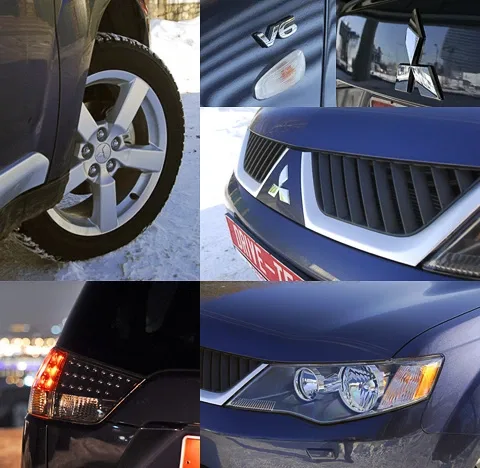
I pick up the car. Oh, what a beauty! But I shouldn't let my vigilance be lulled. Trying with all my might not to stare at the wheel arches, as if drawn with a huge compass, the modern LED taillights, and the predatory face, I dive into the interior. Inside, the picture is no less rosy — nice design, hard but quality-looking and feeling plastic. An excellent Rockford Fosgate audio system with nine speakers and a subwoofer, a rear row that can be moved forward and backward and the backrest angle adjusted. And you can fold the backrests with just one button from the trunk. Pleasant. The numerous compartments for small items also pleased me, two glove boxes, one of which is cooled… Okay, enough distractions, time to hit the road!
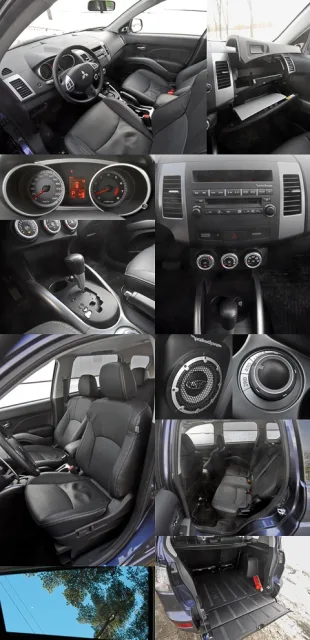
The display on the center panel, which shows such interesting information as the time or the number of the track being played, "goes blind" when the headlights are turned on. And in sunny weather, almost nothing is visible on it. But the trunk is very convenient — besides being spacious, the loading height is also very low.
Immediately in motion, the unexpectedly light steering wheel and pedals catch the eye. Moreover, this inconvenience is not serious enough to swear or find fault. The effort on the steering wheel is quite adequate, and you get used to the pedals in a couple of minutes. Nitpicking? Perhaps. Especially since in city traffic it's even more convenient. But still, I'd like them to be a bit tighter. Otherwise, you press the gas unusually, and…
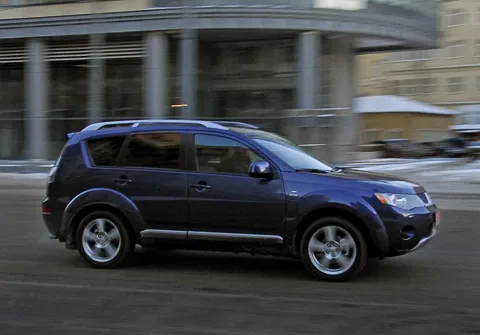
The jerk will be "not childish." After all, along with the more "adult" appearance, the Outlander also received "adult" filling. The three-liter 220-horsepower unit and the six-speed gearbox are good on their own, and together they are simply excellently matched. Of course, acceleration to 100 km/h in 9.7 seconds is not the most impressive indicator, but there is enough traction always and everywhere, and most importantly, the transmission selects the right gear out of six very timely and imperceptibly. And the absence of a sport mode is not perceived as a drawback: in the normal mode, there is both smoothness for calm driving and responsiveness for "igniting." Which, by the way, both the engine and the fairly sensitive chassis encourage. And for slippery roads, there is a manual mode. You can turn it on in two ways — move the automatic transmission selector to the left or use the paddle shifters. We will definitely get to the slippery winding roads, but for now — the highway leading to them.
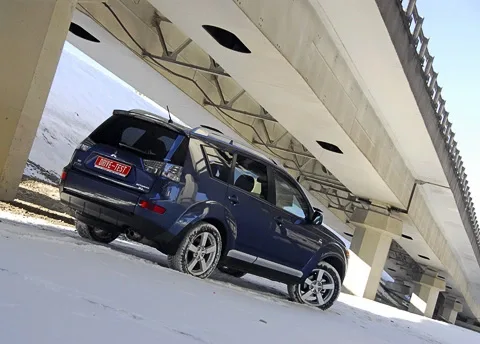
The Outlander XL passes high-speed tests with flying colors. The engine is enough both for confident overtaking on the highway and for frankly hooligan speeds, the car holds the straight line stably, ignoring ruts, potholes, and other irregularities. In the spacious seats, you can lounge and drive with one hand on the wheel. Listen to music, chat on the phone. By the way, the Outlander XL has the ability to connect a phone via Bluetooth. The suspension passes small joints and cracks somewhat stiffly, but it's hardly worth complaining about. Unless you're one of those who likes the car to rock, but in my opinion, better let it shake. Penalty points can be awarded only for somewhat weak sound insulation. And the engine is not particularly quiet — during every acceleration, it starts to "talk" quite noticeably with its decent but somewhat loud six-cylinder voice.
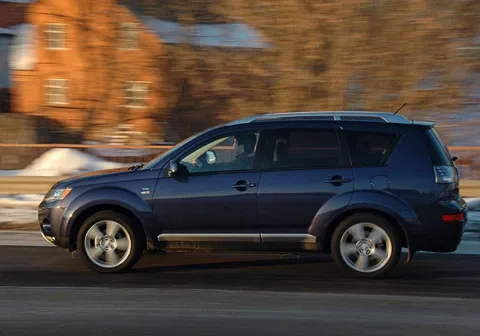
And here I am already far from civilization. Around are fields, forests, snowy roads. An excellent obstacle course. And maybe I was wrong to badmouth the Mitsubishi engineers? If an ordinary normal driver gets behind the wheel of this Outlander, then definitely in vain. After all, the old model had no stability control system at all, but here it is. He, however, didn't really need it if you know how to handle it. But for most drivers, whether the all-wheel drive is "honest" or "dishonest," it's still scary without a stability control system. And that's right — let it be.
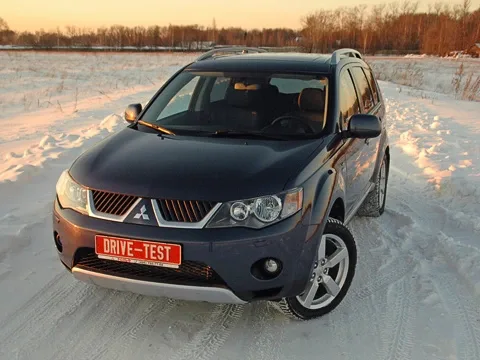
But we don't look for easy ways, so with the first steep snowy turn, I press the M-ASTC off button and find myself one-on-one with the car. What clutch did you say is here?
And it turned out to be quite good. In 4WD mode, the car behaves predictably. Press the gas harder — and the Outlander XL wags its tail like a rear-wheel-drive. But the fact that the rear axle sometimes lacks torque is still felt — sometimes you want to turn the car into a corner with the gas, but it, on the contrary, straightens the trajectory. Eh, what prevented you from sending more traction to the rear wheels, comrade engineer?
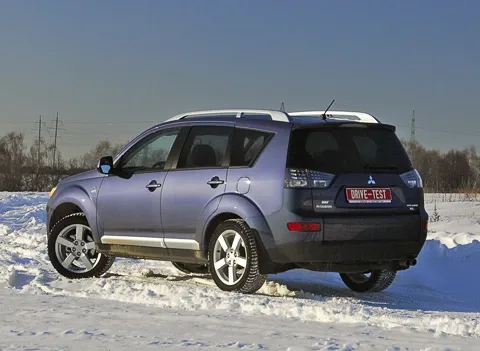
But, having once flown out of a turn into a snowdrift, I was able to get out of it without any problems. Then I did it again, and then just went for a drive on the virgin snow. And it turned out that as a "scout" and "trespasser," the Outlander XL is quite good — by crossover standards, of course. It's not for nothing that it has such a cunning squint of the headlights. Although the low-hanging spare tire is not good.
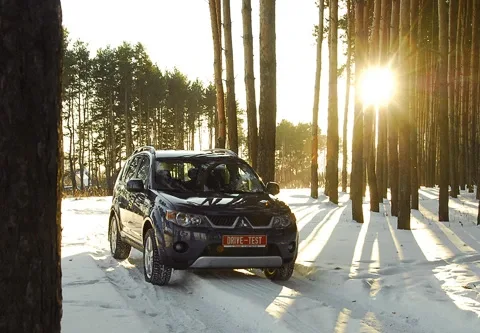
During the test, I was constantly asked about the car by neighbors in traffic jams, at gas stations, and parking lots. They asked what kind of car it was, how much it cost, and what it had. I tell them.
It's not cheap, to be precise, from 39,490 dollars for the base trim. Which, however, already includes the three-liter engine, the automatic, and a lot of other "tasty" things. And in the maximum trim — with leather interior, sunroof, xenon headlights, Rockford Fosgate audio system, and electric adjustments for the driver's seat — it will cost 44,990 dollars. That is, much more expensive than the less powerful Toyota RAV4 and Nissan X-Trail, but significantly cheaper than the larger Nissan Murano and Subaru B9 Tribeca. Exactly in the middle, in general. The golden mean.
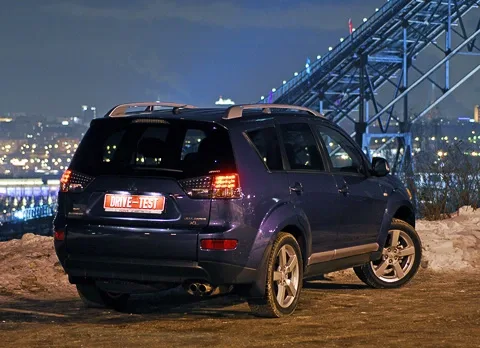
And yet, the Outlander XL can drive, and it does so quite decently. Yes, it is noticeably calmer and more comfortable than the previous Outlander, but that is precisely its strength: it has become much more cozy and convenient for everyday life. The power reserve and handling characteristics allow you to feel confident in a fairly dynamic urban rhythm, and the geometry and transmission make it possible to easily venture onto light off-road. The only thing that might bother it is truly large-scale shopping: the trunk, alas, is not rubber. In addition, it is worth noting that the car looks modern and stylish, and its interior is not embarrassing to carry anyone — whether a business partner or relatives. Okay, I take back my words: I was overly strict. Charges dropped, case closed.
Specifications
| Characteristics | Mitsubishi Outlander XL |
|---|---|
| Dimensions and weight | |
| Overall length, mm | 4640 |
| Overall width, mm | 1800 |
| Overall height, mm | 1720 |
| Wheelbase, mm | 2670 |
| Ground clearance, mm | 215 |
| Curb weight, kg | 1650 |
| Maximum gross weight, kg | 2175 |
| Number of seats | 5 |
| Dynamic characteristics | |
| Acceleration (0-100 km/h), s | 9.7 |
| Maximum speed, km/h | 200 |
| Engine | |
| Type | petrol, 3-liter, V6, 24-valve, SOHC, MIVEC (proprietary electronic control system for valve timing and lift), Euro-3 |
| Displacement, cc | 2998 |
| Maximum power (EEC), kW (hp) / rpm | 162 (220) / 6250 |
| Maximum torque (EEC), N-m (kgf-m)/ rpm | 276 (28.2) / 4000 |
| Fuel system | |
| Fuel tank capacity, l | 60 |
| Suspension | |
| front | MacPherson struts with anti-roll bar |
| rear | multi-link with trailing arm and anti-roll bar |
| Brakes | |
| front | 16-inch ventilated disc (2-piston calipers) |
| rear | 16-inch disc with integrated drum parking brakes |
| ABS with integrated electronic brake-force distribution system EBD | |
| Gearbox | 6-speed adaptive automatic transmission |
| Transmission | Multi-select 4WD (multi-mode all-wheel drive transmission "On demand 4WD" (all-wheel drive on demand) with electronic control and automatic engagement of rear drive when front wheels slip |
| Steering | rack and pinion with power assist |
| Tires and wheels | |
| tires (front, rear) | 225/55 R18 |
| wheels (front and rear) | 18-inch alloy |
| spare wheel | full-size spare wheel, alloy 18-inch |
Equipment of the tested car
- Standard equipment
- M-ASTC
- 18-inch alloy wheels and tires 225/55R18
- Full-size spare wheel, alloy 18-inch
- Headlight washers
- Silver side moldings
- Silver roof rails
- Rear mud flaps
- Heated windshield wiper zone
- Power-adjustable, heated, and folding side mirrors
- Automatic headlights (light sensor)
- Rear fog light
- Multi-function display (in instrument cluster)
- Power steering
- Tilt-adjustable steering column
- Leather-wrapped steering wheel
- Hands-free system for mobile phone (Bluetooth connection)
- Audio and Hands Free controls on steering wheel
- Leather-wrapped automatic transmission selector lever
- Leather seats (driver's with power adjustment, front seats with heating)
- 3 12V power outlets: in cargo area, center console, and floor console
- Cabin dust filter
- Climate control
- Air duct for supplying warm air to rear passengers' feet
- Front dual-stage airbags of the latest generation for driver and front passenger
- Side airbags for driver and front passenger and curtain airbags
- Front passenger airbag switch
- Child safety locks on rear doors
- Immobilizer
- ABS with integrated electronic brake-force distribution system EBD
- Brake Assist system
- ISO-FIX child seat anchors
- Additional equipment
- Cruise control
- Xenon headlights with "black chrome" trim
- Automatic headlight leveling
- Tinted windows (except windshield and front door windows)
- Sunroof
- Premium audio system Rockford Fosgate Acoustic, with 650W electronic amplifier and 9 speakers
Price of test car $44990
Test car provided by
"Rolf Holding", distributor of Mitsubishi Motors in Russia.
Behind the scenes