
Mitsubishi Lancer. Old Warhorse
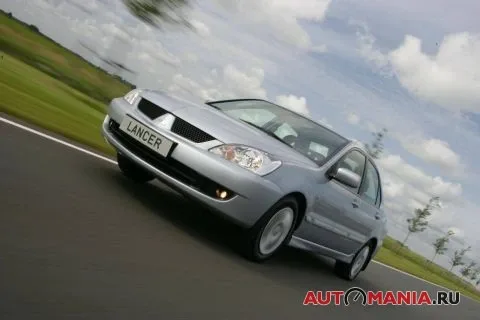
Classic silhouette, expressive lines… The appearance is modest, slightly old-fashioned, but still quite relevant. A year and a half or two ago, the Japanese decided to boost buyer interest with a facelift done in the spirit of modern automotive design. The main principle of the update is minimalism, if not to say severe cost-cutting. Perhaps there were other reasons, but otherwise the point of such "cosmetic procedures" is lost.
In short, the designers did not radically change the Lancer's appearance. Their work came down to a couple of new touches in the front of the body — nothing more. The main changes are a slightly enlarged radiator grille and a slightly more massive front bumper. New hubcaps and alloy wheels are not seriously considered innovations. The interior was also refreshed: instead of black lacquered wood on the dashboard, doors, and gearshift lever, titanium trim appeared, the seat upholstery became more pleasant to the touch, and a decorative insert was added to the trunk lid. But the base remained the same. And honestly, there was nothing much to change there: the universal classic style of the interior already combined perfectly with the exterior and looked modern. So why all this? — To stimulate demand. Russia is a strategically important market for Mitsubishi: unlike the rest of Europe, the Lancer sells excellently here. In conditions of fierce competition, every detail matters, and perhaps it was this facelift that allowed the model not only to survive to this day but also to maintain its leadership. So it is hardly worth reproaching the Japanese for such a marketing move. Firstly, if it isn't broken, don't fix it, and reworking a popular model without good reason is foolish. And secondly, Mitsubishi simply could not have handled large-scale changes right now.
But the main thing in the Lancer is not style, but convenience: all controls are in their places, all the little things are at hand. Four people can easily fit in the cabin. Behind the wheel, of course, there is more space, but rear passengers will not complain either. The trunk easily holds "430 liters of luggage," and the rear seatback folded in a 2:1 ratio will allow you to take a couple of friends with full gear on a ski trip. True, there is also a remark: the shape of the central headrest in the second row should be reconsidered by the Japanese — it completely blocks the driver's view.
The Lancer gives the buyer the opportunity to choose options to their taste. The basic range currently includes three trims. The most affordable Lancer Invite for $14,690 is a 1.3-liter 82-horsepower engine with a 5-speed manual, ABS, four airbags, air conditioning, power steering, immobilizer, central locking, and power windows and mirrors. The same Invite, but with a more powerful 1.6-liter engine, will cost $15,790. And the top version Intense for $20,550 is already a 2-liter 135-horsepower unit, climate control, fog lights, 16-inch wheels, sports suspension, and a styling package.
It is clear that the "golden mean" is in greatest demand — the 1.6-liter engine with a manual transmission. By the way, such versions were previously sold with an "automatic" as well, but now this transmission has disappeared from the price lists. However, with the "stick," the engine will not disappoint. Of course, 98 "horses" for the golf class is a modest indicator, but the peak torque is reached already at 4000 rpm. Plus optimally selected gear ratios of the gearbox — the car does not grab stars from the sky, but it drives at the level of most competitors. Shifts are light and precise, lever travel is minimal. Brakes are beyond all praise. But the chassis settings will not be a surprise even for a beginner. The Lancer handles well: it confidently holds a straight line, reacts adequately in corners. But the ride smoothness let it down. On good asphalt, the car rides calmly, densely, but without harshly working through bumps. But on a gravel road, the suspension "tuned" for our roads is uncompromising — it shakes noticeably. Similar sensations are on bridge joints. Rigid seats, which hold well in corners, only aggravate the situation. However, the manufacturer usually has a small choice: either acceptable durability or passenger comfort. You should not harbor illusions about the possibility of combining these two options.
That, perhaps, is all. It would seem foolish to discuss the model's prospects when there is a living successor, but not in this case. As already mentioned, the Japanese plan to sell both versions in parallel, and this is understandable. The tenth generation was initially made for Europe and was supposed to revive the faded glory of the brand. Accordingly, its price is unlikely to seem as attractive to our compatriots. In Europe, the main selection criterion remains the "safety-quality-price" ratio — in that order. The Russian market, due to its specifics, transforms this formula into "price-size," and the first part most often turns out to be decisive. The ninth Lancer took off here precisely because of this: a sufficient set of basic options, an excellent balance of driving characteristics, and a decent "pedigree" at a price lower than many competitors — that is what allowed it to become the most popular imported car in the golf class. The tenth Lancer will naturally be more expensive, but the main competitors have also managed to update and rise in price over the past year and a half, so, as they say, time will tell.
Technical specifications:
Mitsubishi Lancer
Dimensions:
Length (mm) 4480
Width (mm) 1695
Height (mm) 1445
Wheelbase (mm) 2600
Weight (kg) 1185
Trunk volume (l) 430
Engine displacement (cm3) 1584
Max. power (hp) 98 at 5000 rpm
Max. torque (Nm) 150 at 4000 rpm
Max. speed (km/h) 183
Acceleration 0-100 (s) 11.8
Average fuel consumption (l) 7.2
Price ($) 14,690-20,550
Source – www.automania.ru