
Mitsubishi Lancer. The Heir Apparent
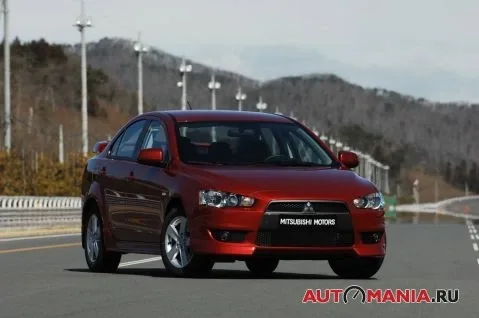
How does the tenth generation Lancer differ from its predecessor? First of all, in design. The new Lancer has become deliberately sporty, as if reminding of its famous rally past. Hence the massive "predatory" grille, which with its honeycomb pattern captures both the hood and the bumper down to the lower edge; embossed side ribs, wide wheel arches, and, of course, the rear spoiler. True, it was previously installed on versions with a two-liter engine, and for the new model this rule has not changed. Only the wing itself has become noticeably more expressive: lower, wider, and with a pronounced aerodynamic profile. In general, the muscular and well-built body leaves no doubt — we have a sports sedan. In addition, the manufacturer claims that body rigidity has increased by 56% in torsion and 50% in bending. It is clear that this directly affects the stability and behavior of the car in corners.
Anyone who looks at the photos of the new Lancer will note its successful design and catch its dynamic character. But the interior, unlike real "racing" cars, is not Spartan at all. All details look quite expensive, are well thought out and neatly fitted to each other, but their shape immediately makes it clear — you are sitting in a car with a legendary rally pedigree. It is enough to look at the bucket-shaped front seats, instruments recessed into deep wells, a thick three-spoke steering wheel, as well as "carbon-look" inserts on the front panel and "metal-look" ones on the center console.
However, with all its image refinements, the new Lancer has not lost the practicality inherent in mid-size sedans, but has even increased it. The car has grown noticeably: by 35 mm in length, 60 mm in height, and 65 mm in width compared to its predecessor, which has made the cabin noticeably more spacious. There is 25 mm more space between the front seats, and the shoulder width has increased by as much as 51 mm. Now it will be more comfortable not only for the driver and front passenger, but also for three occupants on the rear sofa — after all, the car, although with a sporty bias, is positioned as a full-fledged five-seat four-door sedan. True, in terms of overall cabin length, the total legroom on both rows remains the same as in the current Lancer, which already leads the class in this indicator. Despite the increased body, it was possible to maintain a small turning radius — only 5 meters, which is still the best in its class. This, of course, facilitates maneuvering and parking in a cramped city. Plus, the car has a spacious trunk, and the rear sofa folds in a 2:1 ratio, allowing, together with the luggage compartment, to get additional space for transporting long or oversized items. However, for the Lancer owner, all these conveniences are not the main thing. No, they are not superfluous at all, but the main thing in the car is its legendary name.
The sporty character of the new Lancer is emphasized not only by the exterior and interior, but also by some technical solutions. Thus, two-liter versions with 150 horsepower (they will be the first to go on sale in June this year) can be equipped with a CVT Sport Mode variator with paddle shifters — like in Formula-1 cars. To switch to manual mode, just slightly pull the "paddle" towards you — and the car will shift to a lower or higher gear, and to return to automatic, you need to hold the "plus" lever for a second. This is very convenient, not to mention that such a transmission literally provokes aggressive driving. For those who do not race for a quarter mile, a 4-speed adaptive "automatic" INVECS-II Sport and a regular 5-speed "manual" are provided. Although the power of the two-liter engine, equipped with an innovative electronic valve timing control system, is quite enough for confident acceleration with any of these gearboxes. It is just that with the "automatic", acceleration will be smoother, and fuel consumption more moderate, while with the variator or manual transmission, the car will be more agile when starting from a traffic light and during sharp lane changes in traffic.
The suspension of the previous Lancer was a compromise — something between comfortable and stiff. When developing the new model, Mitsubishi engineers bet on European, stiffer settings. The tenth Lancer received a completely new chassis design: MacPherson struts in front and a multi-link scheme in the rear. The wheelbase increased by 60 mm, which added stability in corners. The suspension travel increased by 10 mm, which improved handling. The front suspension uses a flat cross member, and the rear — a multi-level one, which increased the lateral rigidity of the mounts. As a result, the new suspension improved handling and made the ride more comfortable: no rolls in turns, excellent directional stability, and other habits of a real sports car. Even the engine hum is not a miscalculation of sound insulation, but an element of heritage laid down by the manufacturer.
Closer to the end of summer, versions with a 1.5-liter engine producing 107 hp, paired with a 5-speed "manual", will appear in Russia. They will become the "base" ones. The owner of such a car will not be left without the necessary set of passive safety features (airbags and so on) — the car fully complies with five stars according to the EuroNCAP classification. In addition, it will get power windows, air conditioning or climate control, and many other benefits of automotive civilization. This version will be noticeably cheaper than the "fancy" two-liter one — from $17,990 versus $24,300. In parallel with it, the previous model will be sold for some time, which, as is known, is even more affordable. But by the end of 2007, the new Lancer will completely displace it from the market.
Technical specifications:
Mitsubish Lancer New
Dimensions:
Length (mm) 4570
Width (mm) 1760
Height (mm) 1490
Wheelbase (mm) 2635
Weight (kg) 1325
Trunk volume (l) 315
Engine displacement (cm3) 1998
Max. power (hp) 150
Max. torque (Nm) 198
Max. speed (km/h) 200
Avg. fuel consumption (l/100 km) 11.2
Price ($) 17,990-24,300
Source – www.automania.ru