
On the roads of Russia there are plenty of cars that try to appear sporty: spoilers, massive body kits, loud exhausts, and other external tricks. Many manufacturers also offer models with "charged" modes for gearboxes and suspensions, adding attributes to emphasize their difference from regular versions.
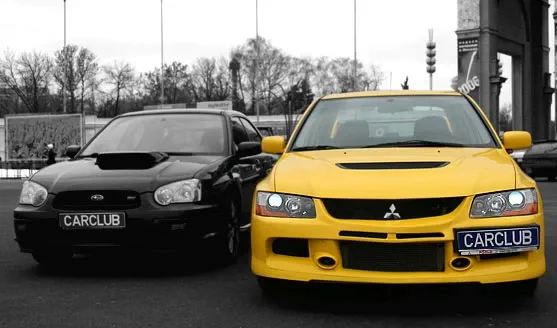
However, there are not many true "charged" fighters where the spirit of freedom and drive is felt in every detail. Among them are Subaru Impreza WRX STi, Mazda 6 MPS, and, of course, Mitsubishi Lancer Evolution. It is the latter in the "Ultimate" trim with gas Bilstein shock absorbers and BBS wheels that we got for the test. In this form it costs $51,090, and if you choose the version with Enkei wheels and Kayaba struts, the price drops to $46,750.
What happens if you take a regular Mitsubishi Lancer, add a turbo, stiff suspension, aggressive body kit, and put "bucket" seats in the cabin instead of standard ones? The answer is obvious — the civilian sedan turns into a real "firecracker"! That is exactly the word that came to mind for everyone who saw the Lancer Evolution IX. And for good reason: every element of the EVO hints at the potential hidden under the hood, capable of igniting everything around.

Find 9 EVO differences
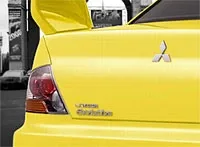
From the front, the car at first glance looks almost the same as the EVO VIII, but on closer inspection, the front bumper is completely new. It has lost all unnecessary openings, and instead a huge air intake has appeared for better engine cooling. The carbon spoiler on the trunk lid solves the downforce problem at the rear. The weight is distributed in a 60/40 ratio to the front and rear axles, so without this striking element, the rear wheels would lose traction. Under the rear bumper there is also a large diffuser, which together with the wing creates negative lift on the rear axle. The roof, hood, and protective bars in the doors are now aluminum — this allowed shedding 60 kg and bringing the curb weight down to 1300 kg.
All this, together with the new rich yellow color, gives the Lancer Evolution IX a unique look that is impossible to miss. So much so that it sometimes became awkward from the intense stares of drivers in neighboring cars — as if they had seen an alien on the road. Some may not like the toy-like appearance, but when you get inside, you forget about it and completely surrender to the sea of dynamics and the magic of the whistling turbo.
Inside the ninth EVO, things are not as impressive as outside, but that is not needed — this is not a Mercedes AMG or BMW M-series. In such cars, the main thing is sporty asceticism. By and large, it does not matter whether the seats are upholstered in fabric or leather, but the Recaro "bucket" seats with a combination of leather and Alcantara appealed to me. The seat is comfortable and cozy, the only thing that irritated me was the backrest adjustment using a tight and awkwardly placed "knob," like in old cars. The rest of the interior details look much more modest: the kinship with a $15,000 sedan, from which the plastic and other mid-quality elements were inherited, shows.
To remind you that you are in a sports car, not a civilian one, there are the small three-spoke Momo steering wheel, carbon inserts on the dashboard, and a carbon fiber strip with the inscription "Evolution" behind the gear lever. The instrument panel pleases with red backlighting, a speedometer up to 270 km/h, and a tachometer up to 9,000 rpm. Aluminum pedal covers are another generic feature of the "charged" Lancer. And the only revolution in the Lancer evolution was the appearance of climate control, which is controlled by three small knobs on the center console.
EVOlution on the road
 After turning the ignition key, the cabin fills with a steady low rumble from the exhaust system and a barely noticeable vibration from the engine. I press the clutch, engage first gear, and here a dissonance arises: the lever travel turned out to be long, like in civilian cars. It turned out that the ninth Lancer Evolution is equipped with a new 6-speed gearbox from… Nissan. Gears now shift easier, acceleration has become smoother, and fuel economy has improved, but in return the car has lost some of its character. Rally cars and some Japanese versions still have the good old 5-speed manual gearboxes, which are much better suited for active driving. However, what can I say: in the Land of the Rising Sun, there is an Evolution wagon, and even with an automatic…
In addition to the new transmission, the EVO IX also received an updated all-wheel drive system, including an active center differential and a rear differential with the Super Active Yaw Control system, which redistributes torque between the rear wheels. In a regular car, you have to brake before a corner, but the EVO, on the contrary, seems to provoke you to press the gas. Entering a corner, it forgives many mistakes, transferring energy to the right wheels.
In a calm city rhythm, the car drives and consumes fuel like a regular Lancer with a two-liter engine. But as soon as you rev the 2.0-liter turbo engine past 3,000 rpm and floor the gas pedal, the consumption immediately jumps to 30 liters per hundred. When the turbo kicks in, you feel all 280 hp and 355 newton-meters transmitted to all four BBS wheels with your whole body. A stunning surge — and the force of inertia literally presses you into the seat. This continues up to 7,500 rpm, then you shift up. Second, third — and now the first 100 km/h, and only 5.7 seconds have passed… Speed grows rapidly, and only in sixth gear does the "evolution" dynamics begin to fade, and the speedometer needle crawls slowly and reluctantly to the top speed of 250 km/h.
 The conclusion is simple: this car is made for suburban highways, free roads, and race tracks. But in Russian realities, long trips in the Evolution are almost impossible due to one well-known problem — 98-octane gasoline, which goes into the tank of the Japanese "firecracker" in decaliters. There is a risk of being left with an empty tank without reaching a gas station with "super" fuel. Mitsubishi Lancer EVO is ideal for show-offs who want to "show off" in front of friends, or for true fans of the model — those who cannot imagine life without adrenaline, racing, and night drag racing. Such a car should clearly be the second or even third in the owner's garage, but not the first.
EVOlution with a continuation
Every year, the Japanese manufacturer increasingly strives to make the Lancer Evolution accessible to the masses: the controls become simpler and more understandable, and the interior more comfortable. The next, tenth generation of the legendary rally car, which will be released in 2007 based on a completely new Lancer, will receive a number of innovations. It is said that the use of an automatic transmission, as on the Mitsubishi Concept X concept, is planned, as well as the appearance of a switchable stability control system. In addition, at the Mitsubishi Motors engineering center in Okazaki, work is underway on "lightened" versions of the future EVO X: with a naturally aspirated engine and plug-in all-wheel drive, as well as with a medium-turbocharged engine, which will be opposed to the Impreza WRX from the eternal rival — Subaru.
Daniil Sonin