
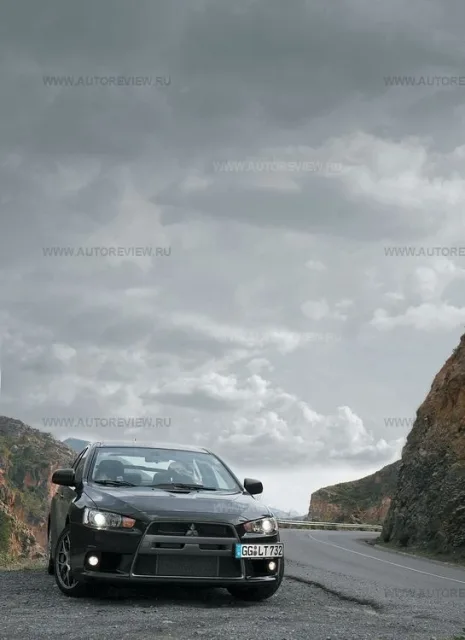
Before heading out in the latest Mitsubishi Lancer Evolution X, I was sternly warned: "Don't even think about racing — local police are ruthless. Exceed the limit a bit, and you'll get a fine and lose your license!" And I had neither extra cash nor a spare license with me. So here I am, crawling along a Spanish highway at the permitted 120 km/h, mentally begging: "Someone, pinch me hard!"
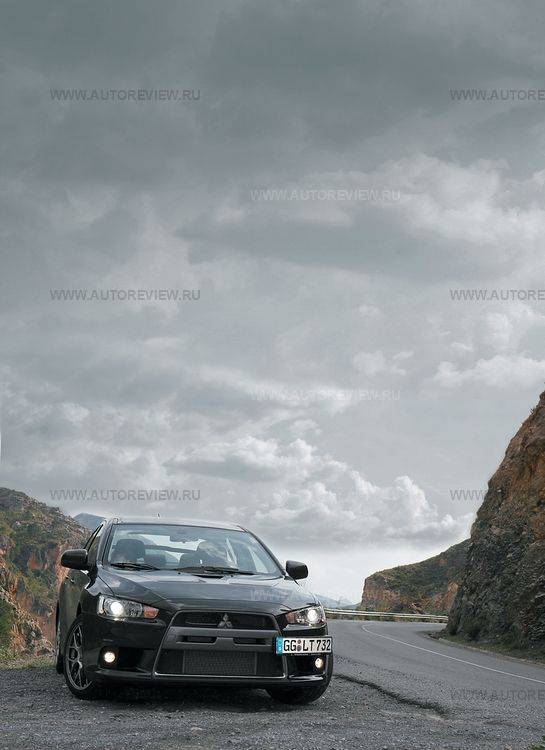
Any moment now I'll wake up, and all this will turn out to be a dream. And the car under me won't be an Evo X at all. Because the real Evolution is a Spartan. A samurai blade — light, sharp, piercing any armor. In the hands of a master, it becomes an extension of his gaze and thought…
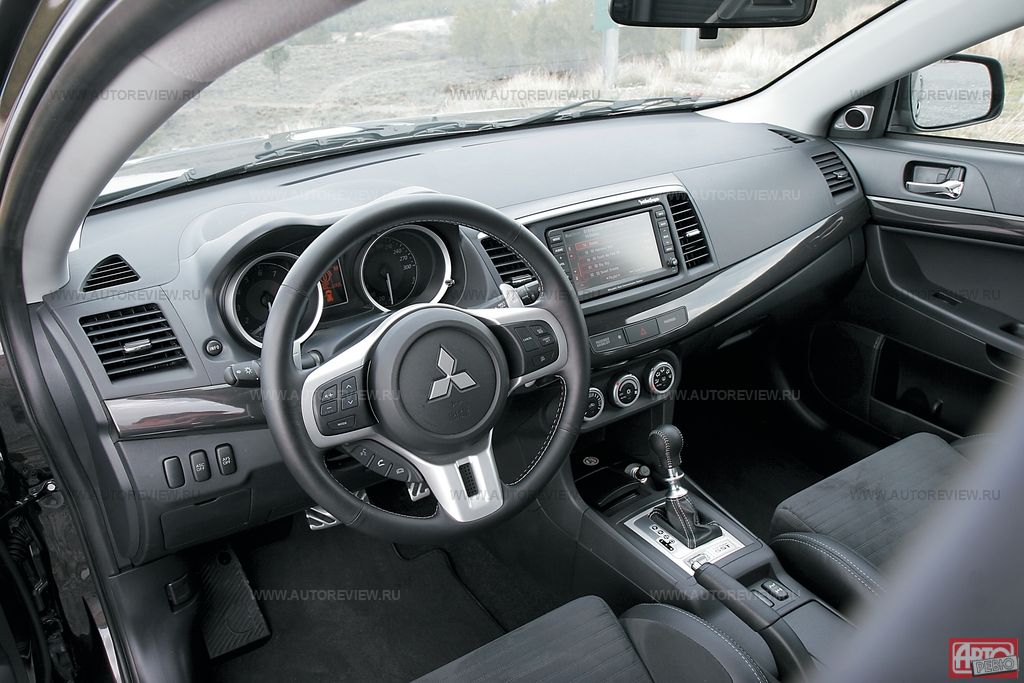
But I'm sitting in a seat that seems spacious even for my size 50 frame. In the middle of the dashboard — a huge multimedia and navigation screen, on the steering wheel — cruise control buttons. Below — only two pedals. Yes, exactly two! And when half an hour ago I opened the trunk to toss in my jacket, my eyes landed on a subwoofer. Come on, wake me up quickly!
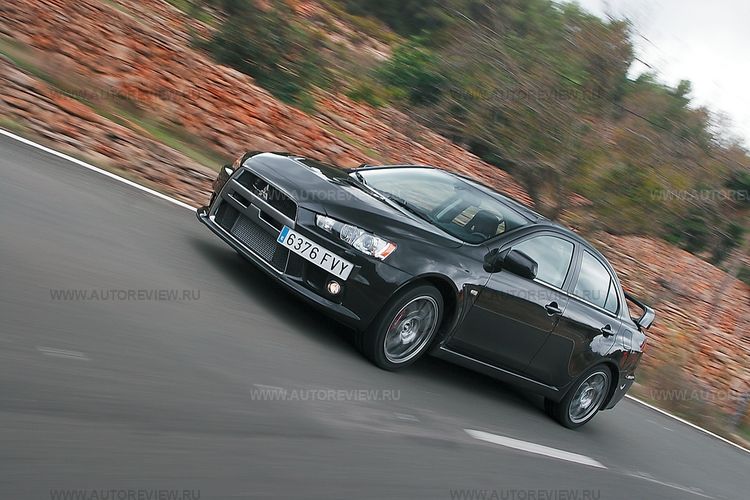
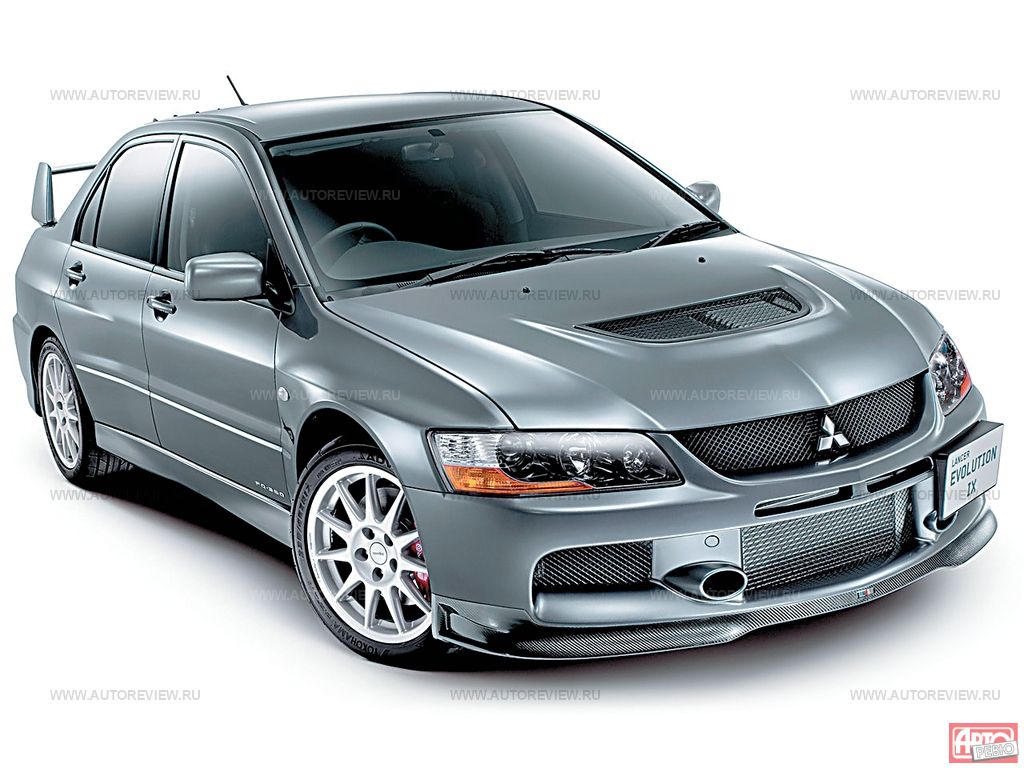
If previously the Evolution was unmistakable, now there could be problems with that. There are minimal exterior differences from the standard Lancer — a slightly larger rear wing, slits in the front fenders, and a modest air intake on the hood
But no, I'm not asleep. This is indeed the tenth-generation Evolution. It has grown, gained about a hundred kilograms due to all these "joys of life," and received a chrome trim on the radiator grille...
Moreover, the Evo X could have weighed even more if not for the completely new engine. The legendary 4G63 "four" with a cast-iron block has been replaced by a unit with the index 4B11 — from the family of "global engines" created by Mitsubishi together with Chrysler and Hyundai. With the same two-liter displacement, it is 12 kg lighter than its predecessor — primarily due to the aluminum cylinder block. Power has grown from 280 to 295 hp, and torque — from 355 to 366 Nm. Interestingly, the same figures are produced by the "charged" Dodge Caliber SRT4 (see AR No. 8, 2008) — it has a turbo engine from the same family, but with a 2.4-liter displacement.
 |
|
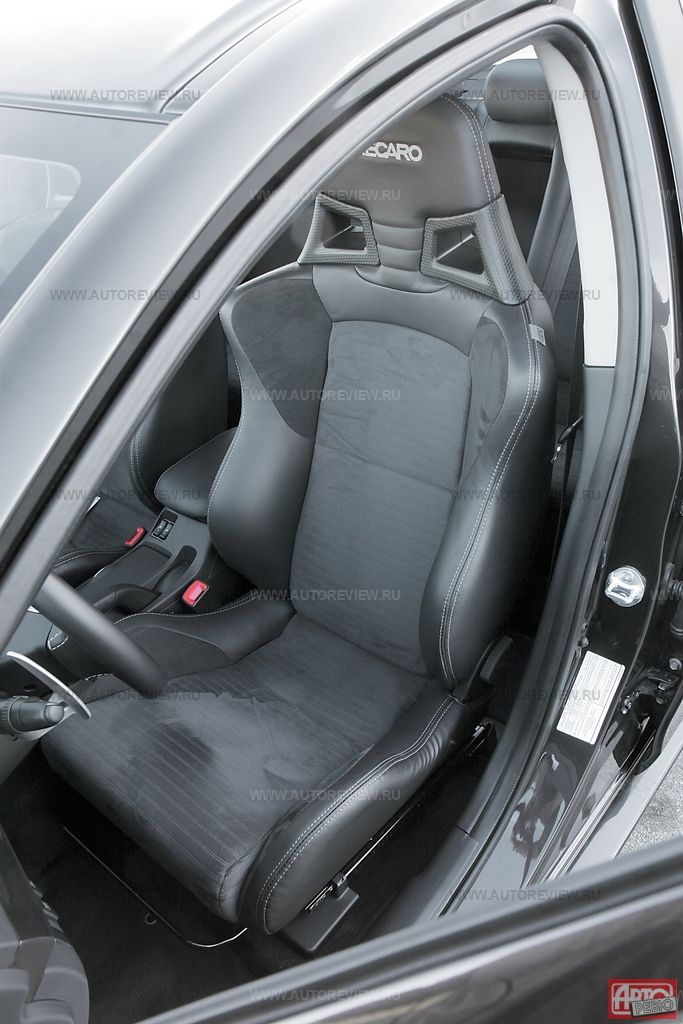
| Recaro seats are comfortable despite the sparse set of adjustments. But the slots for four-point belts are more like props: they are made of some kind of "carbon" imitation and also wobble | |
 |
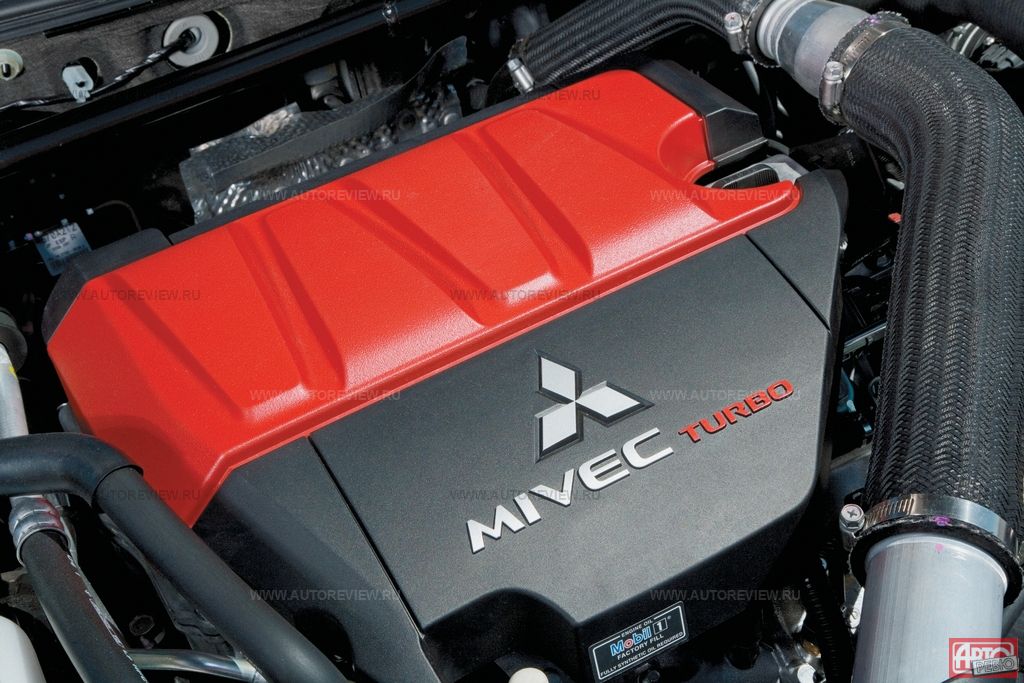 |
| The interior of the tenth Evolution is a realm of plastic. Matte, glossy, "aluminum-look"… But equally hard. However, the European version of the Evo X has nine airbags, including a "knee" one. The steering column, like in the regular Lancer, adjusts only by tilt angle | The "global engine" 4B11 with an aluminum block lost its balance shafts and got the MIVEC variable valve timing system on intake and exhaust. Mahle pistons — with "floating" pins to reduce friction. The turbo is now located behind the engine, which allowed the engine to be lowered by 10 mm |
But why didn't the Japanese follow in Subaru's footsteps — not put a larger engine in the Lancer and not get an honest three hundred horsepower from it?
"Without the two-liter engine," they explain at Mitsubishi, "we can't do anything; we need it for the domestic market and for rally homologation. And making two different engines is too troublesome. Moreover, the unit produces 295 hp on regular 'average' gasoline. If you fill it with better fuel, the power will even exceed three hundred! And the new two-liter also pulls better at low and medium revs."
Improved low-end torque is provided by the new turbo and the MIVEC system, which now also controls valve timing on the exhaust valves. And as a "free bonus" — an electronic throttle pedal instead of a cable drive. Ecology, nothing to be done...
 |
 |
|
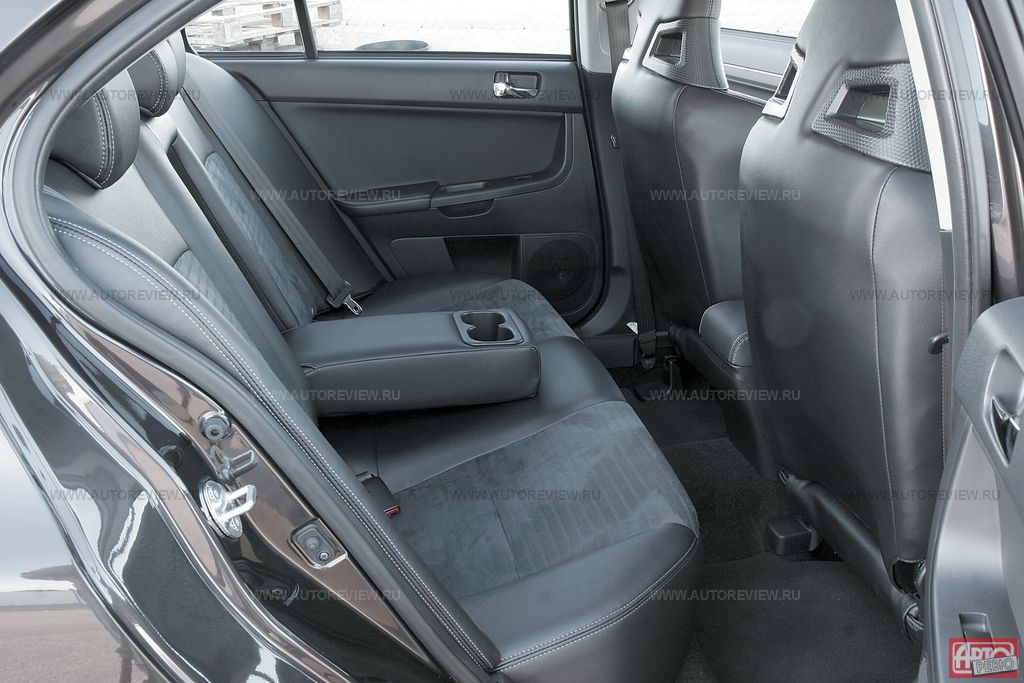
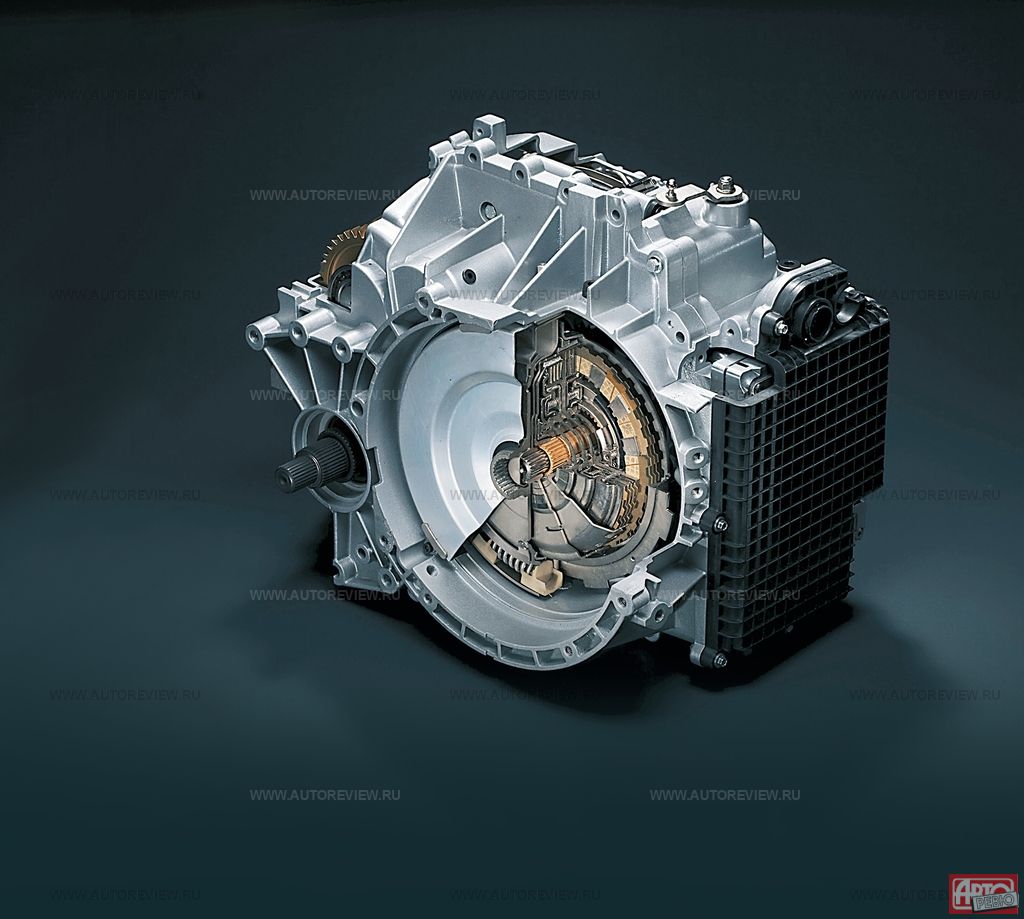
| It's more spacious in the back, but from amenities — still only cup holders | The turbochargers of European Evo Xs have turbine wheels made of nickel alloy Inconel. On engines for Japan — a lighter titanium rotor, which raised torque to 422 Nm versus the "European" 366 Nm. But titanium is afraid of overheating and is not suitable for Europe with its long autobahn hauls | The six-speed Twin Clutch SST transmission is designed and produced by Getrag. The unit, together with hydraulics and control unit, is 30 kg heavier than a regular five-speed manual. Shift speed is not record-breaking — about 0.2 seconds in the fastest mode. Acceleration to 100 km/h for the "automatic" Evo takes 6.3 seconds — almost a second longer than with a regular gearbox |
Unsurprisingly, the character of the "newcomer" is no longer the same as that of the cult 4G63. That one, when boost kicked in, unleashed a whole avalanche of torque on the driver. But the current one really pulls well from the very "bottom," wakes up at 2500 rpm, smoothly reaches peak acceleration by four thousand — and after a couple of seconds sends the needle to 7500. But it does this somehow mundanely, with a monotonous howl instead of the former triumphant roar — and with a hard hit against the rev limiter.
Another new feature of the Evo X is the Twin Clutch SST (Sport Shift Transmission) gearbox. Following Volkswagen, Ford, and BMW, Mitsubishi is also introducing a robotic "manual" with two clutches. This six-speed transmission will go "to the masses" later, but for now, they plan to install it on 85% of Evo X sedans sold in Europe. For the remaining fifteen percent and the homologation RS version — a classic "manual," which Mitsubishi engineers designed "from scratch." They prioritized low weight, compactness, and the ability to handle high torque. To this end, they enlarged the gears, abandoned the sixth gear (in sport, there's little use for it anyway), and also the drive and driven reverse gears. Their role is played by the first and third gear gears — until now, this was only found on racing cars. It's a pity that getting acquainted with the "manual" Evo is postponed until summer — at the Spanish presentation, there were only cars with "robots."
 |
 |
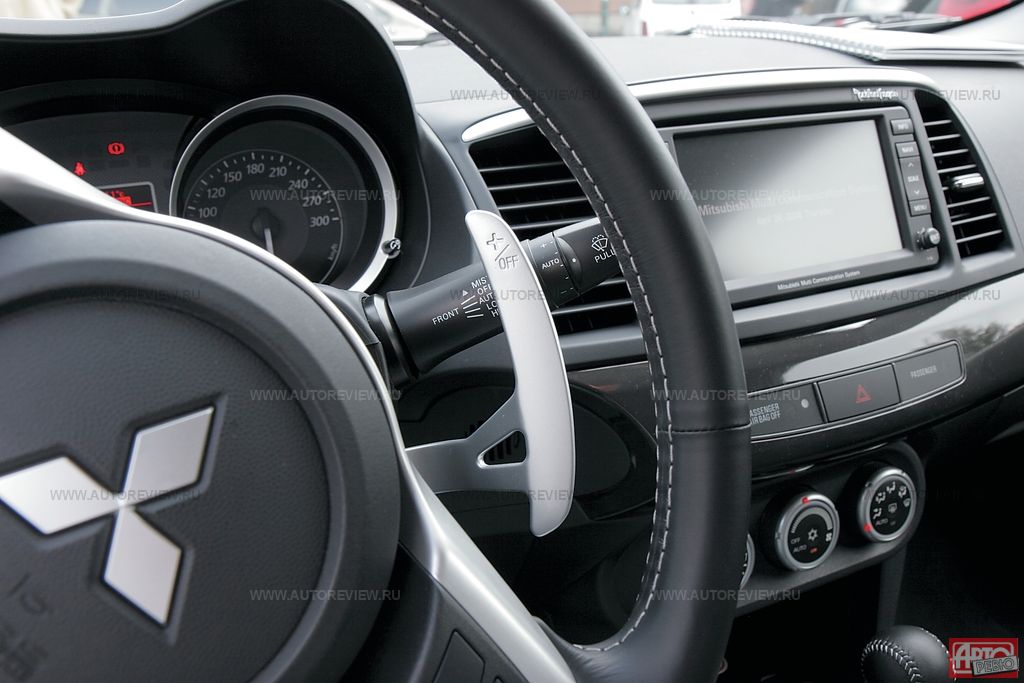 |
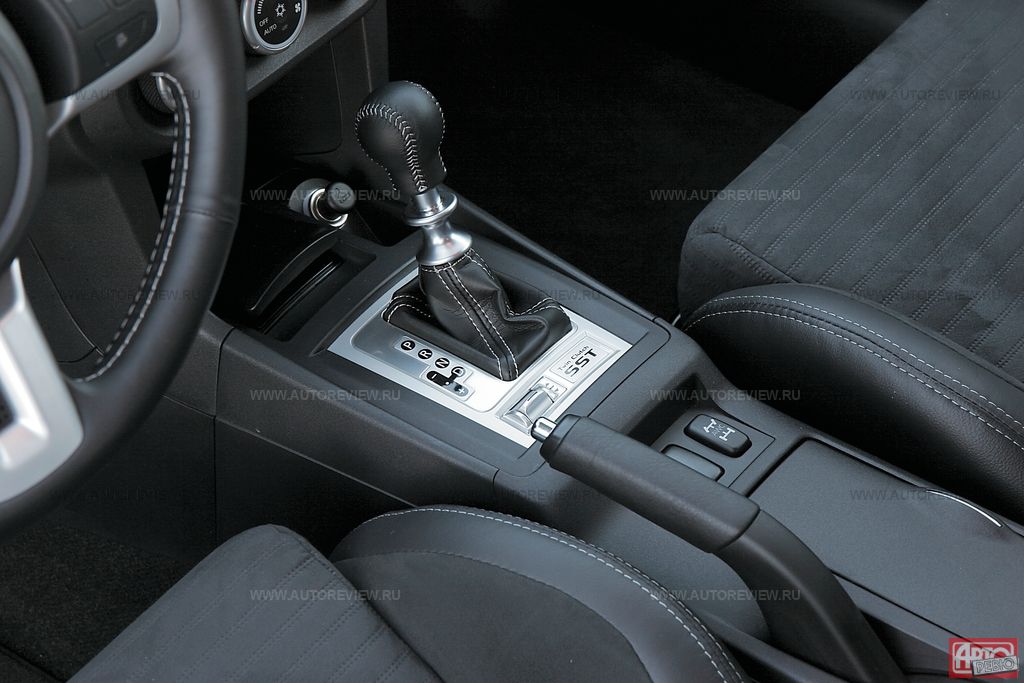
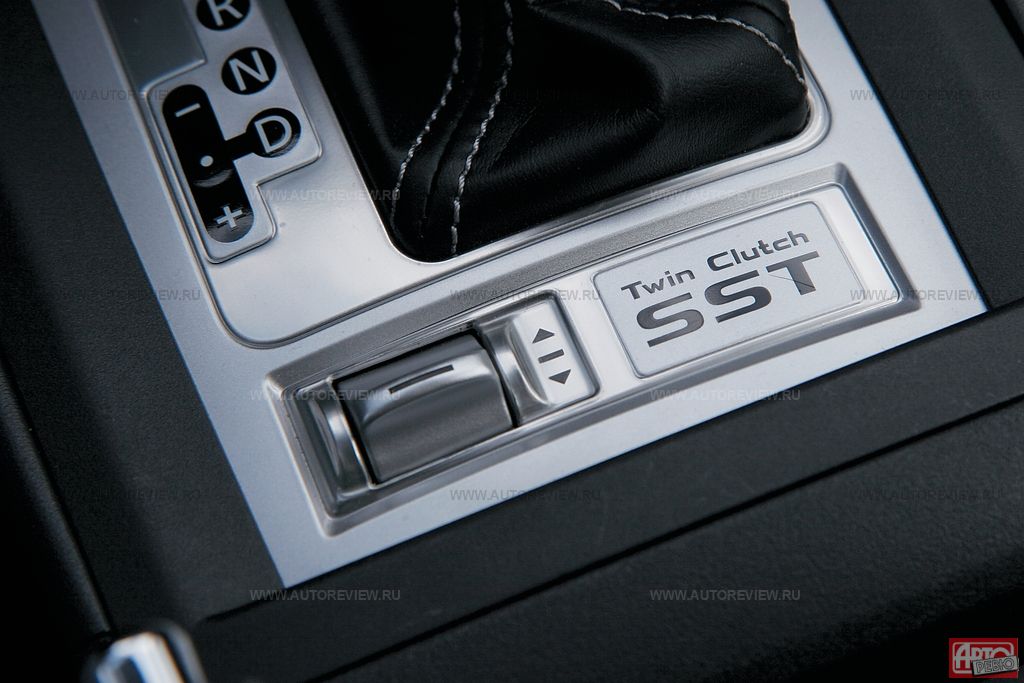
| To move the SST gearbox selector into Drive or back, you need to pull the safety ring. In manual mode, gears are changed via paddle shifters. A key on the tunnel switches between Normal and Sport modes, and to engage Super Sport, you need to stop and hold it for a few seconds | ||
In design, the Twin Clutch SST and DSG are very similar. A pair of clutches operating in an oil bath, a three-shaft gearbox with separation into even and odd rows, shift hydraulics, and an electronic "brain" with "preselective" gear selection programs. Under the driver's right hand — a classic "automatic" selector with Drive and Manual modes, and next to it — a key to select one of the gearbox operating algorithms (and also the electronic throttle pedal) — Normal, Sport, and Super Sport.
 |
|
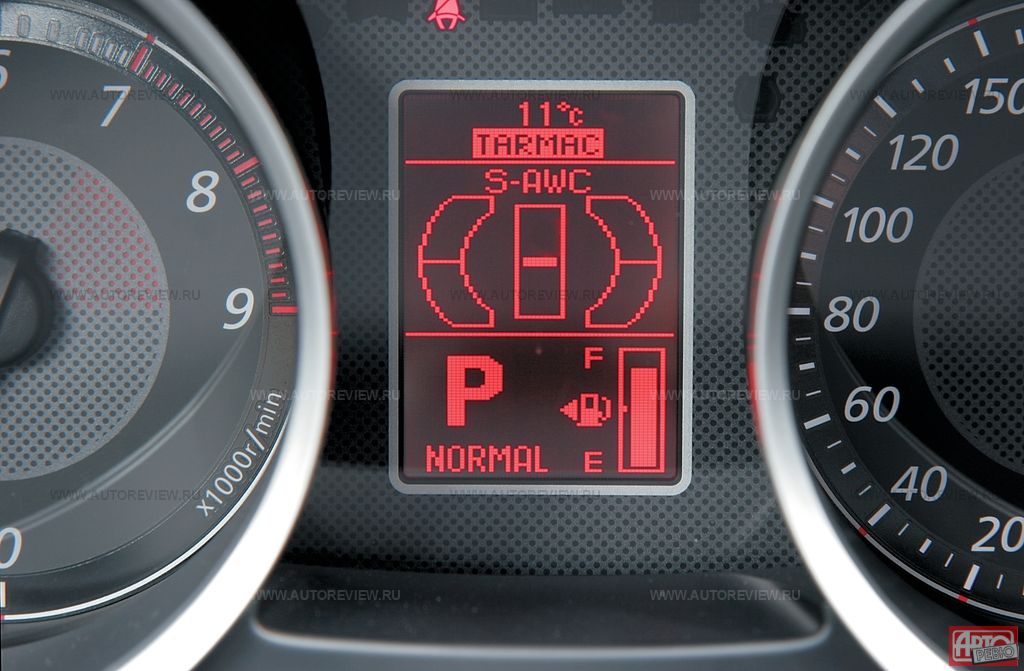
| The instrument panel is laconic: speedometer, tachometer, and a small electronic fuel gauge in the corner of the display. But a full-fledged trip computer has been added, showing average and current fuel consumption. True, the uneven speedometer scale is sometimes confusing | The instrument cluster screen also displays the AWD and AYC system operation diagram. The downside — the odometer readings disappear at the same time |
 |
|
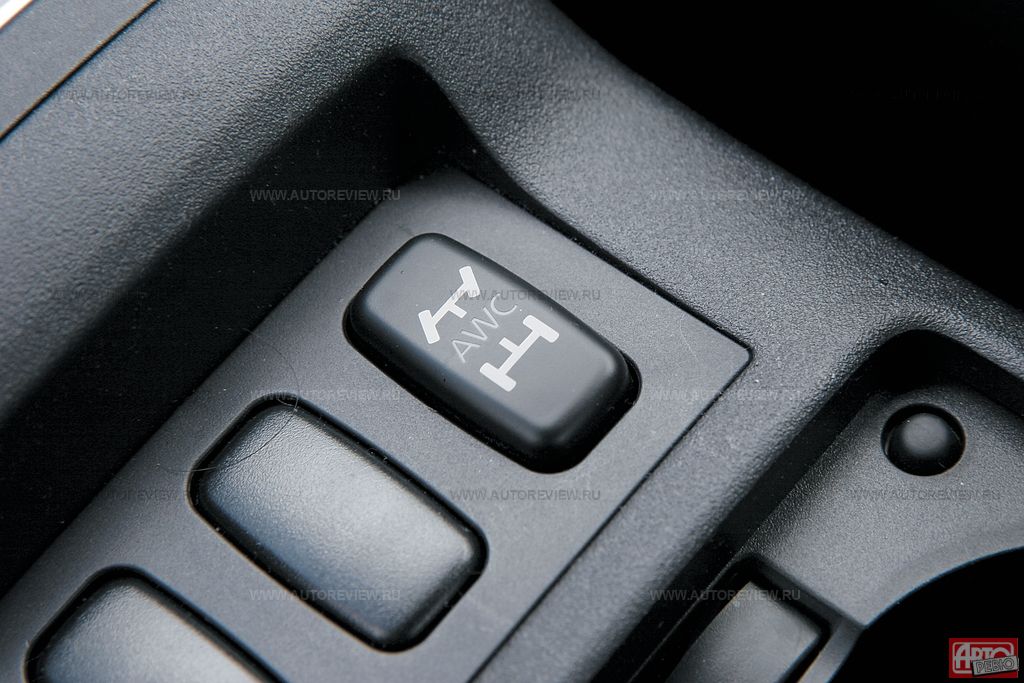
| The S-AWC mode selection key is now located on the central tunnel... |
...and on the base GSR trim it was duplicated on the left steering wheel spoke |
And yet I couldn't find the ideal mode for myself. Normal turns the gearbox into a regular "automatic," with a clear tendency toward higher gears, noticeable pauses during downshifts, and a muted accelerator pedal. Maybe for some that's "normal," but not for an Evo. In Sport mode, the car transforms: the engine responds more eagerly, and the tachometer needle barely leaves the boost zone — the SST holds the gear even when you fully lift off the throttle and willingly downshifts. But driving at a constant speed while listening to the engine howl on one note is hardly a pleasure. Of course, you could switch to manual mode. But then why pay extra for this miracle gearbox and lug around an extra 30 kilograms of its weight? Just to click the paddle shifters without a clutch?
 |
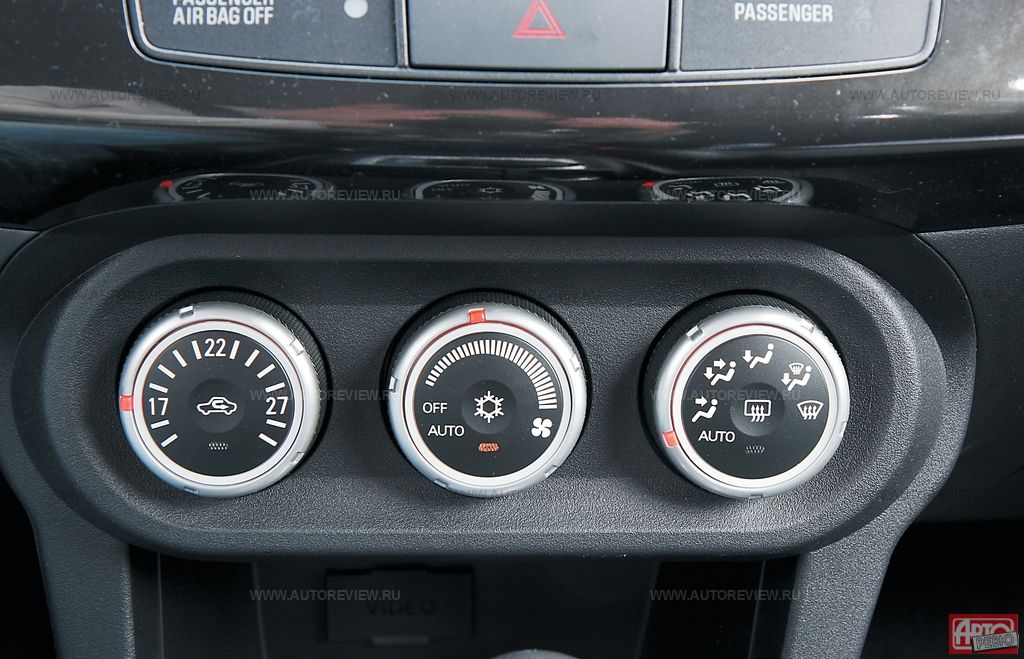 |
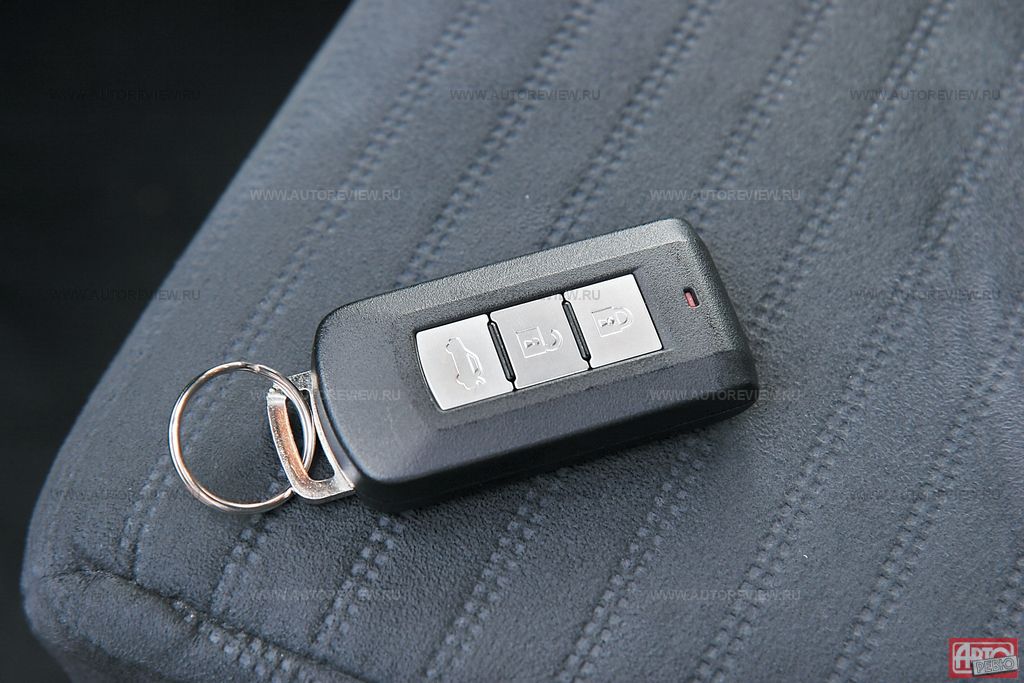
| Keyless access system — only on the top MR version. There's no engine start button — the ignition switch has a rotary plug | Climate control was already on the Evo IX, but now its knobs have become more ergonomic |
 |
|
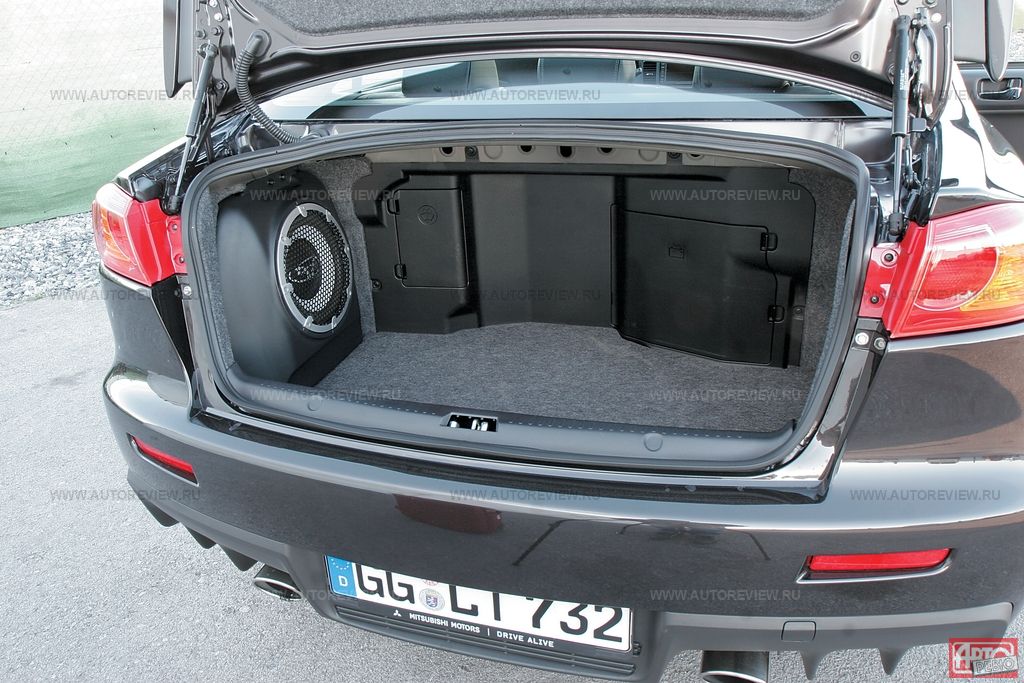
| The left button disables stability control, the right one — the adaptive headlight system AFS | In the trunk of the MR version — a Rockford Fosgate subwoofer. The rear seat back is solid, and behind the plastic trim are hidden the battery and washer fluid reservoir |
Super Sport mode is even noisier. Here, even during calm acceleration, the electronics rev the engine to the red zone and won't let the revs drop below four and a half thousand. So "Super Sport" is only for those times when you really intend to "go all out." And with my finances right now, to put it mildly, things are tight...
But can I at least sharply change lanes into the adjacent one?
No, that's still a dream for me. When changing lanes, the Evolution noticeably rolls from side to side! And of the former "transparency" of the steering, when it seemed the front wheels were an extension of your hands, there's no trace left.
If you believe the press release, the Evo X chassis has become better. The torsional rigidity of the new body has increased by 39 percent, and bending rigidity by 64. The wheelbase and track have become longer and wider, the center of gravity has dropped lower. Moving the battery and washer fluid reservoir to the trunk allowed improving the axle weight distribution by a couple of percent. The mounting points of the arms and struts have been reinforced, stiffer bushings have been installed, and the caster has been increased. And finally, the S-AWD all-wheel drive has become even more advanced. Could all this be just to install softer springs and shock absorbers — and make the Evo more comfortable?
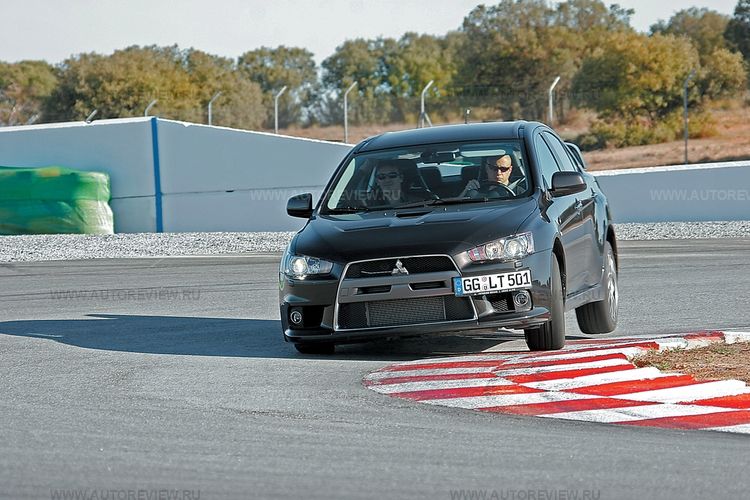
On the race track, the S-AWC transmission works wonders, successfully combating understeer and allowing you to attack the apex of a corner unusually early
| Brembo brakes with composite front discs are powerful and not prone to overheating on the race track, the pedal is excellently informative |
Although at high speed the Lancer is still commendably stable, and on a mountain road it wins you over with the precision of its reactions and the highest ultimate capabilities, allowing you to storm the Sierra Nevada switchbacks without fear or reproach. Only the steering angles seem a bit large. And when exiting a particularly tight corner, the excess traction first "pushes" the car's nose half a meter off the trajectory and only then turns into a slide, which is tamed by the ASC stability control system — another new feature for the Evo. And what if you turn it off? I'd better postpone that experiment until the race track...
"Try driving the first laps in Sport mode with the stability control on. And only then turn it off and switch to Super Sport," recommends a smiling Japanese engineer from the testing department. "And stay in 'automatic,' then the SST will shift faster." I try.
Powerful braking before a corner, a smooth transition from braking to turning — and now you can, unusually early, contrary to all racing canons, get back on the throttle without fearing either understeer or oversteer. The super-transmission S-AWD merely rotates the car, transferring torque to the rear outer wheel, and if necessary, slightly holding back the inner front wheel with the brakes. The stability control can be safely turned off — with excess traction, the Lancer begins to smoothly slide outward with all four wheels. And thanks to the sport ABS, braking can be finished already on the arc — in another car, such a maneuver could only be executed by an experienced driver.
It seems that on the race track, the new Evolution is at least not slower than the old one. It doesn't lack speed, but it lacks character. And pleasure. If we continue to compare the Evo IX and its predecessors to Japanese battle swords, then the newcomer is like a modern replica, a souvenir copy. Beautiful, shiny, with a richly finished handle. Perhaps, if careless, you could even cut yourself with it...
Why did Mitsubishi abandon the cult of pure speed and sport, nurtured over years of engineering work, testing, and racing? Why did they do this to us, the Evo adherents?
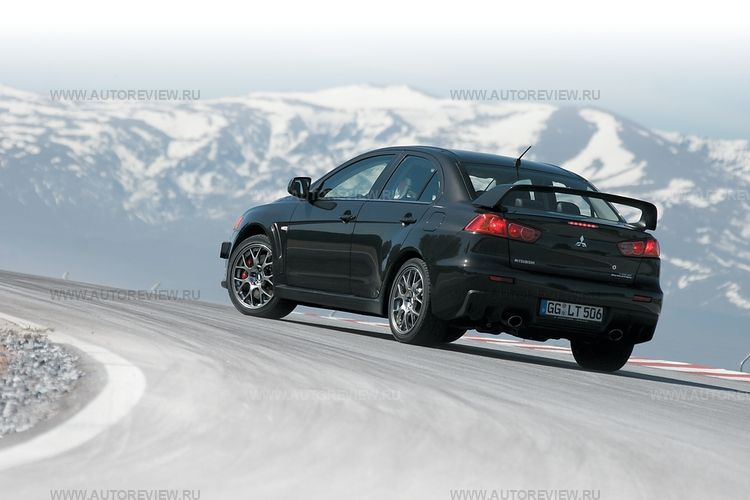
The more expensive MR version can be distinguished from the base GSR by its forged BBS wheels, each almost a kilogram lighter than the cast Enkei, and composite front brake discs, saving another 2.6 kilograms. The MR also gets Eibach springs and Bilstein monotube shock absorbers
"The rivalry with Subaru cannot last forever. With the new Evo X, we are moving away from the image of a powerful but cheap car for youngsters, fans of street racing and the movie 'The Fast and the Furious.' And we are taking a step toward cars like the BMW M3 and Audi S4," explains Daniel Nakass, PR director of the European division, outlining Mitsubishi's new marketing plan. Therefore, in most markets (but not in Russia!), the car will be called simply Lancer Evolution, without another numeric index. The car now has a new life...
| The Evo body differs from the regular Lancer with aluminum roof, hood, front fenders, and bumper crossmembers. For greater rigidity, a V-shaped reinforcement is welded behind the rear seat, a strut tower brace is installed under the hood, and the suspension mounting points, floor and roof crossmembers are reinforced. The body sides are additionally welded |
The Japanese can be understood. Over the past decade, the market for sports cars with engines over 200 hp has grown 16-fold. But — primarily due to premium segment cars. And European Evo sales, although higher than planned, only fell from 2004 to 2006 — from 3,188 to 2,535 cars. The current sales plan is more optimistic — about 3,000 Evos per year. Furthermore, the "ninth" Evolution did little to help the Japanese sell the regular Lancer in Europe, since the cars were related only by the emblem on the grille. And now even some of my colleagues mistook a regular Sport Sedan for an Evo.
The plan is good, but...
To gain a place in the "premium" segment, a long list of equipment is no longer enough. Today, no one is surprised by navigation, rain sensors, or adaptive "xenon"... And in the Evolution, all this is combined with the "plastic" interior of a regular Lancer. In many much cheaper European cars, the interior is richer and more interesting. "For the Japanese, quality is above all reliability," they respond at Mitsubishi. "And besides, we don't put the Evolution on the same level as BMW and Audi. It occupies its own, special niche."
The claim about a special place in the sports car ranking is debatable. After all, the new Impreza WRX STI is now also fully equipped and still doesn't yield to Mitsubishi in power. So there's no escaping competition with Subaru.
And so we come to the last, and perhaps the most significant "but." Not long ago, another sedan could be placed alongside the new Mitsubishi — the Mazda 6 MPS. Also powerful, also all-wheel drive, but much more subdued and, importantly, cheaper. Yes, in Russia, people queued up for the "six." But I wonder, was there at least one person in that queue willing to switch from an Evo to an MPS for comfort? And if you look at global sales, the Mazda 6 MPS didn't gain much popularity at all. Therefore, among the new generation "sixes," there is no such modification yet, and whether they will appear is a big question. Isn't Mitsubishi, albeit from a different direction, stepping on the same rake, trying to combine the incompatible? Won't the "ten" become a disappointment not only for Evo fans like us, but also for Mitsubishi Motors itself?
Well, time will tell. For now, I want to believe that this whole situation is just a bad dream.
Someone, please pinch me!
| Passport data | ||
| Parameters | Vehicle | |
| Mitsubishi Lancer Evolution X | ||
| Modification | GSR | MR |
| Body type | 4-door sedan | 4-door sedan |
| Number of seats | 5 | 5 |
| Dimensions, mm | ||
| length | 4505 | 4505 |
| width | 1810 | 1810 |
| height | 1480 | 1480 |
| wheelbase | 2650 | 2650 |
| track front/rear | 1545/1545 | 1545/1545 |
| Curb weight, kg | 1560 (1590) | 1600 |
| Gross weight, kg | 2040 (2040) | 2040 |
| Engine | petrol, with distributed injection and turbocharging | petrol, with distributed injection and turbocharging |
| Location | front, transverse | front, transverse |
| Number and arrangement of cylinders | 4, in-line | 4, in-line |
| Displacement, cc | 1998 | 1998 |
| Cylinder bore/piston stroke, mm | 86.0/86.0 | 86.0/86.0 |
| Number of valves | 16 | 16 |
| Max power, hp/kW/rpm | 295/217/6500 | 295/217/6500 |
| Max torque, Nm/rpm | 366/3500 | 366/3500 |
| Gearbox | manual, 5-speed (robotic, 6-speed)* | robotic, 6-speed |
| Gear ratios | ||
| I | 2.86 (3.66) | 3.66 |
| II | 1.95 (2.37) | 2.37 |
| III | 1.44 (1.75) | 1.75 |
| IV | 1.10 (1.32) | 1.32 |
| V | 0.76 (1.01) | 1.01 |
| VI | – (0.78) | 0.78 |
| reverse | 2.89 (4.01) | 4.01 |
| final drive | 4.69 (4.06) | 4.06 |
| Drive | all-wheel, with active center and rear differentials | all-wheel, with active center and rear differentials |
| Front suspension | independent, spring, McPherson | independent, spring, McPherson |
| Rear suspension | independent, spring, multi-link | independent, spring, multi-link |
| Front brakes/disc diameter, mm | disc, ventilated/350 | disc, composite, ventilated/350 |
| Rear brakes/disc diameter, mm | disc, ventilated/330 | disc, ventilated/330 |
| Tires | 245/40 R18 | 245/40 R18 |
| Maximum speed, km/h | 243 (250)* | 250 |
| Acceleration time | ||
| 0–100 km/h, s | 5.4 (6.3) | 6.3 |
| 60–100 km/h, s | 5.1 (3.4) | 3.4 |
| Fuel consumption, l/100 km | ||
| urban cycle | 13.6 (13.9) | 13.9 |
| extra-urban cycle | 8.3 (8.5) | 8.5 |
| combined cycle | 10.2 (10.5) | 10.5 |
| CO₂ emissions, g/km | 243 (250) | 250 |
| Fuel tank capacity, l | 55 | 55 |
| Fuel | petrol AI-98 | petrol AI-98 |
| * In parentheses — data for the version with robotic gearbox | ||
Full electric package
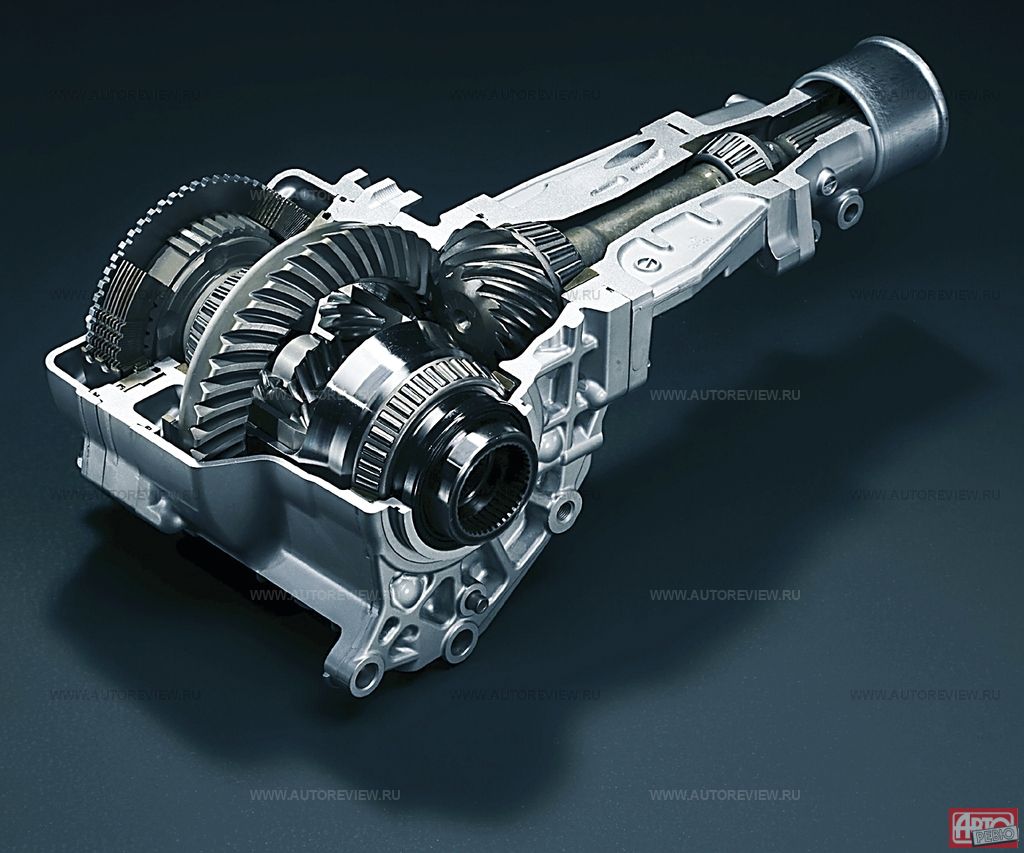
The scheme of the “intelligent” all-wheel drive transmission S-AWC remained the same. The center differential ACD (Active Centre Differential) is still locked by a multi-disc clutch controlled by electronics. The front inter-wheel differential has a mechanical lock. And the rear unit Super AYC (Active Yaw Control) thanks to built-in planetary gearboxes can forcibly accelerate the rotation of one of the wheels, redistributing traction and helping the Evo X “turn” in corners.
| ACD | Super AYC |
 |
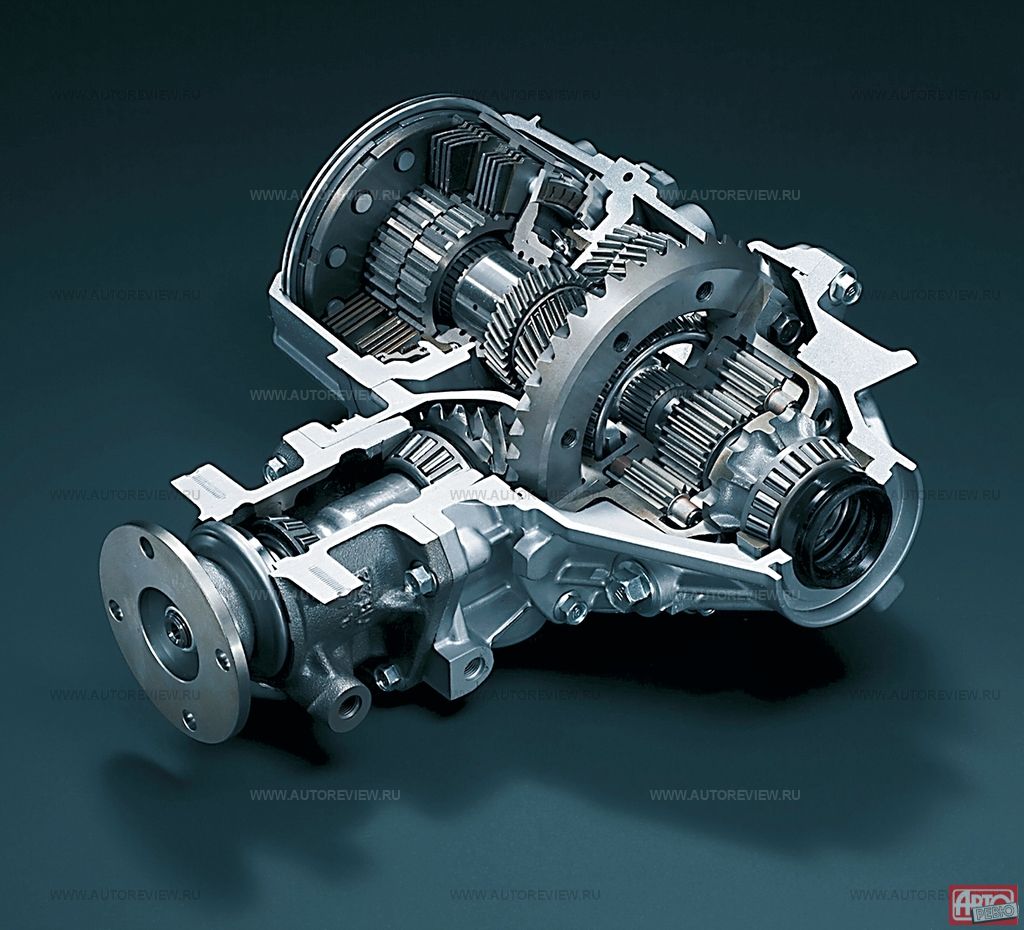 |
| The “mechanics” of the all-wheel drive transmission has not fundamentally changed. The modernization affected only the control electronics | |
This time, the updates affected only the electronic “brain” of the system. As before, the S-AWC transmission has three modes: Tarmac, Gravel, and Snow. However, now the system, in addition to longitudinal and lateral acceleration sensors, has a so-called yaw-sensor — a yaw moment sensor. Thanks to it, the Super AYC control received feedback, which allows faster and more accurate torque distribution between the wheels.
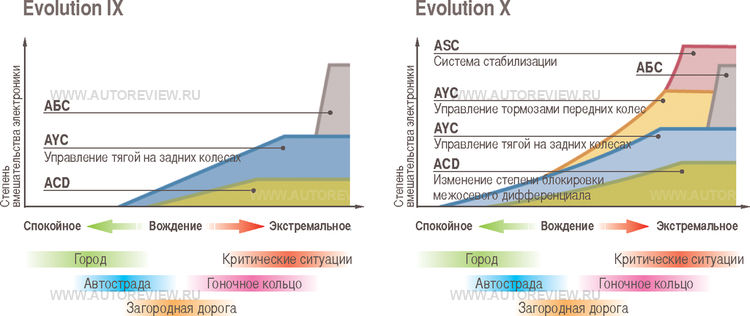
On the Evo X, electronics interfere more in driving than on the “nine”. However, all the additional “superstructure” can be turned off with the ASC off button
In the Evo X, the engine, gearbox, ABS, ASC stabilization and S-AWD control units are combined by a high-speed digital CAN bus and work in close conjunction. For example, the yaw-sensor and steering angle sensor are used not only in the all-wheel drive operation, but also in the “sport” ABS, which provides stable braking in corners. And the brakes, in turn, help the all-wheel drive! Now the yaw moment that “pushes” the car into the turn is created not only by “transferring” traction to the rear outer wheel — simultaneously, the electronics gently brakes the front inner one. If such driver assistance is not needed, it can be turned off: for this, you need not just press, but hold the ACS off button for three seconds.
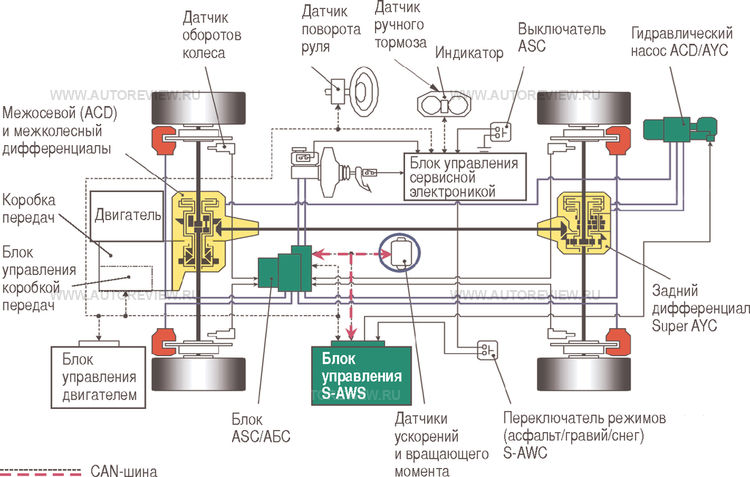
The main electronic components of the Evo X chassis closely interact with each other via a high-speed digital CAN bus
What will be the future of Japanese technologies? For example, will Mitsubishi engineers follow BMW's example and replace hydraulics with electrics in controlling the Super AYC differential clutches? The company answers evasively: “We'll see. We have vast experience and a solid production base of hydraulic units. We ourselves have not yet decided what the eleventh Evolution will be like.”
Turns of evolution
Igor VLADIMIRSKYThe current Evolution bears the index X, that is, the tenth in a row. However, if you look closely, in essence it is only the fourth generation of the “Evo”!
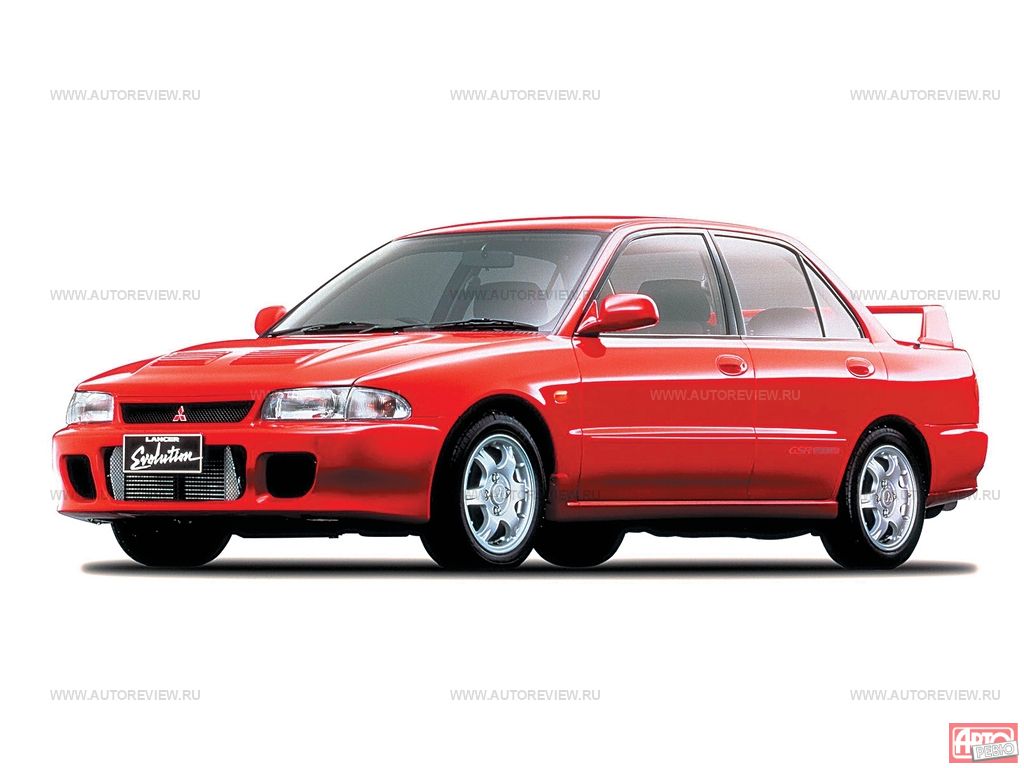
In the late eighties of the last century, the Mitsubishi Galant VR4 sedan defended the honor of Mitsubishi on rally tracks, but soon the team management came to the obvious conclusion: for tight and winding special stages, a more compact car is better suited. So in 1992, the Mitsubishi Lancer Evolution appeared — in essence, a reworked body of the seventh-generation Lancer, into which the units from the rally “Galant” moved. Under the hood settled the legendary turbo engine 4G63, which debuted back in 1987. The two-liter engine produced 250 hp and 309 Nm of torque. From the combat sibling, without serious modifications, the transmission was also inherited: five-speed manual, permanent all-wheel drive and a symmetrical center differential with a built-in viscous coupling. For homologation in group A, the Japanese planned to assemble 2500 units, but the popularity of the model among local street racers was so high that the print run had to be doubled.
 |
 |
 |
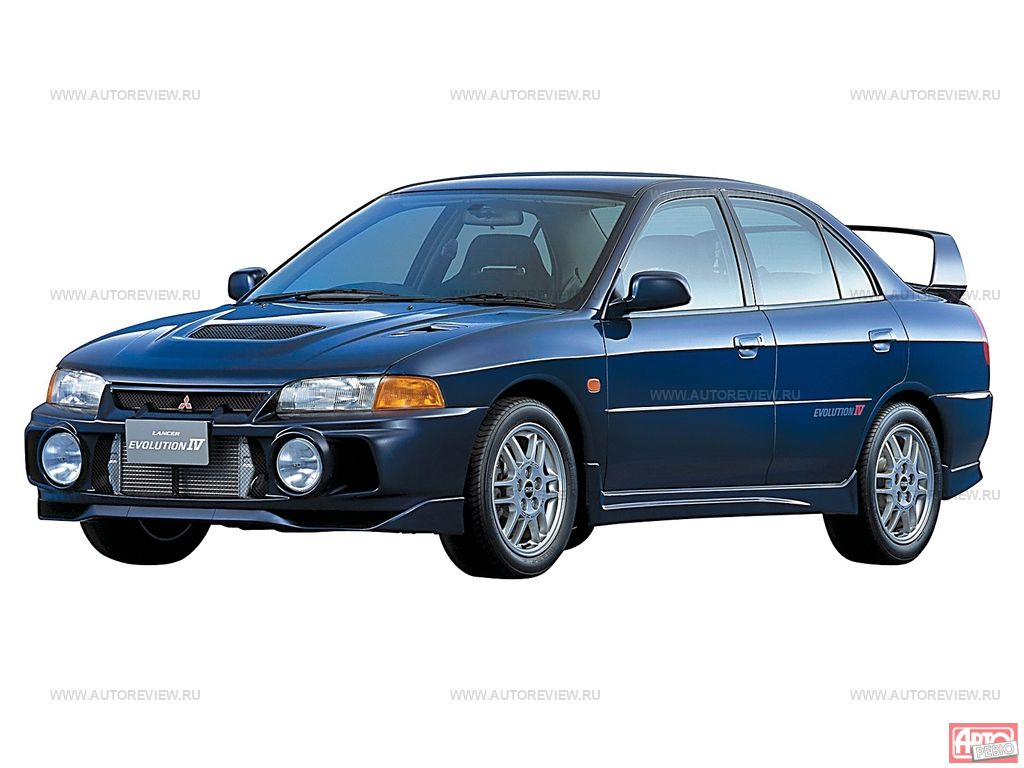
| The first Mitsubishi Lancer Evolution (1992-1993) was divided into two versions: the regular GSR had ABS, power windows and a rear wiper. The semi-racing RS, lighter by 70 kg, was deprived of all this. This division has survived to this day | Mitsubishi Lancer Evolution IV (1996-1998) acquired the AYC system with a pair of onboard friction clutches and step-up gears in the rear differential. It is capable of smoothly redistributing torque between the rear wheels, creating a rear steering effect | The farewell series of two hundred Mitsubishi Lancer Evolution IX MR FQ-360 sedans, released in February 2007, was distributed among English collectors. These cars had engines boosted to 366 hp, a lowered suspension by 10 mm and an additional spoiler at the front |
The Mitsubishi Lancer Evolution II sedans (1994) and Evolution III (1995) were close to the firstborn: engine output grew (for the "third" - up to 270 hp), the chassis was recalibrated, the body became stiffer, and aerodynamics were improved.
In 1995, the eighth-generation Mitsubishi Lancer debuted, and already in August 1996, the Lancer Evolution IV sedan was based on it. The car gained weight, power increased to 280 hp, and torque to 352 Nm. However, the main feature was the AYC (Active Yaw Control) system, which was offered as an option on the "civilian" Evolution IV GSR.
The Evolution V, which appeared at the end of 1997, for the first time received a rear wing with an adjustable angle of attack. Torque jumped to 373 Nm, but power remained the same - Japanese legislation did not allow more. The engine of the "sixth" Evolution in 1999 received a new turbocharger with a lightweight rotor and improved cooling. Special attention deserves the Evolution VI Tommy Makinen Edition version with a body kit from the combat Lancer WRC and a lowered "asphalt" suspension.
The seventh generation of Evolution, which debuted in 2001, was based on the new Mitsubishi Lancer Cedia sedan (ninth generation). The car became noticeably larger and heavier. But in the transmission appeared another electronic assistant - the ACD (Active Center Differential) system with a friction clutch for locking the center differential. And for Japan, a GT-A modification with a five-speed "automatic" was offered.
In 2003, the Mitsubishi Lancer Evolution VIII received a Super AYC rear differential with cylindrical gears instead of bevel gears, as well as an optional six-speed manual from Nissan - it was available only in Japan. In addition, the "charged" MR series boasted a lightweight aluminum roof. Starting from the eighth generation, the Evolution began to be officially sold in Europe and the USA.
And finally, the Lancer Evolution IX sedan of 2005 differed from its predecessor only by a modernized engine with the MIVEC variable valve timing system (thanks to this, torque increased to 400 Nm) and a "standard" aluminum roof. The European version received a Nissan six-speed gearbox. Production of the ninth-generation cars ended in February 2007, and with them the legendary 4G63 engine went into history.