
“Now I consider myself a city dweller…” At Mitsubishi, the new L200 pickup is no longer positioned as a “workhorse.” Now it’s a “budget SUV”—more prestigious, stylish, and expensive, aimed more at affluent owners of country houses than at farmers.
But has the new Mitsubishi really become “urban”? To get acquainted with the car, I had to go to Hokkaido, where Mitsubishi operates the Tokachi test track.
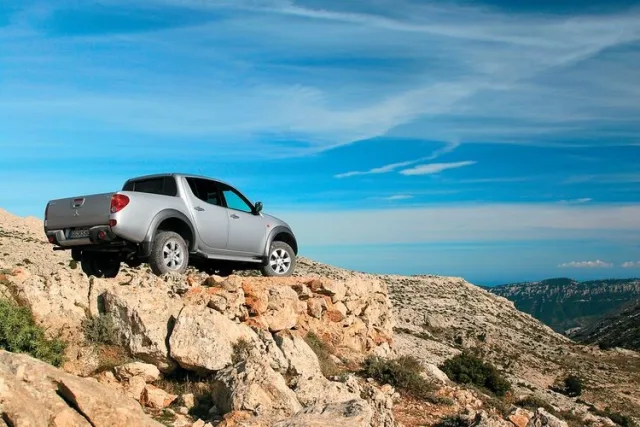
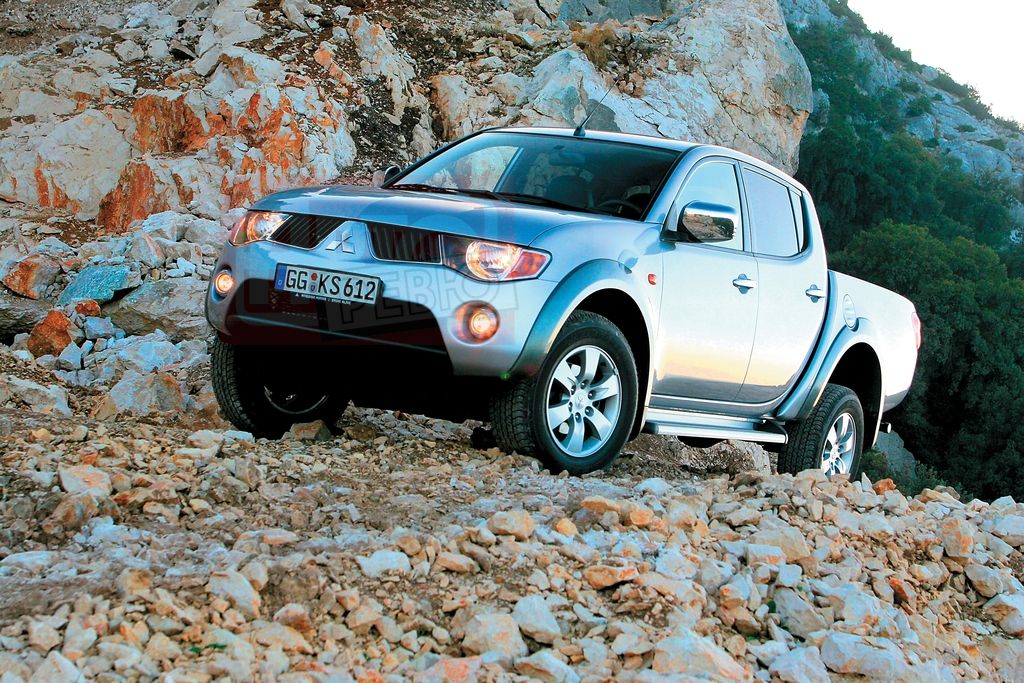 The lineage of the L200 pickups at Mitsubishi traces back to the three-wheeled Mizushima motorized rickshaw, produced in 1946. A half-motorcycle with a body under a canvas awning—simpler is impossible! The first two generations of the L200 were also known for their unpretentiousness and purely utilitarian character. And the previous pickup, which had already moved up the price ladder, we valued primarily for its simplicity and practicality: a ladder frame, manually engaged four-wheel drive, a five-seat cab, and the ability to carry three-quarters of a ton in the bed.
And no one was bothered that the L200 didn’t chase fashion. It remained true to itself. Yes, the cab shape hadn’t changed for almost two decades. But can you say that the Mitsubishi pickup with its simple, masculine, and expressive appearance is ugly?
And the Pajero Sport SUV, built on the same platform as the L200, is still in demand…
But the new Mitsubishi L200 has become different.
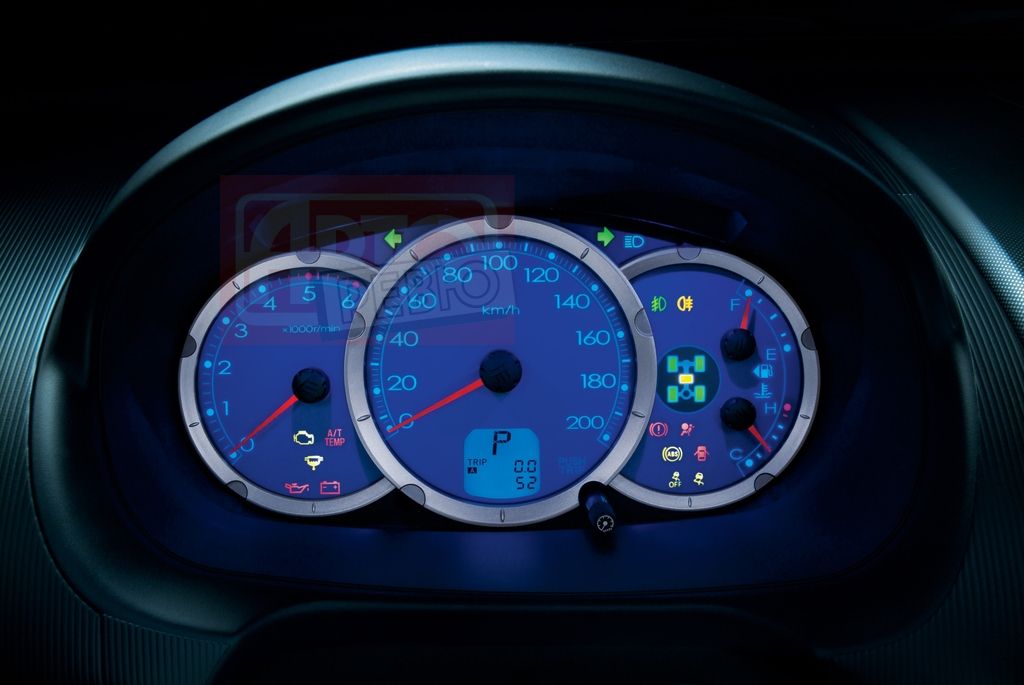 | Scales with a blue “backing” are a privilege of expensive trims. In the center of the right dial is the transmission indicator |
The single cab, of course, still looks trivial. But in Russia, there will be no “single cabs” or one-and-a-half “booths”—we’ve decided to sell only four-door Double Cab versions with a cargo platform for nine hundred kilograms: according to statistics, this combination is chosen by 80% of all L200 buyers. In appearance, such a pickup is a real fashionista. Just look at the “wheel-shaped” back! The picture is complemented by a new “face” with headlights in the style of the Outlander crossover and somewhat garish taillights. You can immediately feel the hand of former Mitsubishi chief designer Olivier Boulay, who, at the behest of DaimlerChrysler management, ruled over the Japanese from 2001 to 2005.
But despite the external “metrosexuality,” the new L200 is still a true workhorse pickup. A ladder frame, a solid rear axle on leaf springs, short overhangs. Moreover, the new frame resists torsion one and a half times better, and an energy-absorbing section has appeared in its front part—combined with other passive safety measures, this should bring the new pickup four stars on the five-star EuroNCAP safety rating scale. The torsion bars in the front suspension have given way to ordinary springs—with them, suspension travel increased, and the mass of the unit decreased by 12 kg.
The approach and departure angles have hardly changed, and the wheelbase has been extended by 40 mm. At the same time, the “double” L200, which was five meters from nose to tail, remains so. But the ground clearance has noticeably decreased—from 240 mm to 200 mm. For an “urban” pickup, that’s fine, but for a “rural” one…
By the way, the “streamlined” cab is a tribute not only to aesthetics but also to aerodynamics. After all, the aerodynamics of a pickup is an eternal headache for designers. The vertical rear wall, the “trough” of the body… Try to organize air flows here. But the roof was made curved, and the sides of the cargo platform were made as “streamlined” as possible. As a result, the drag coefficient dropped from 0.58 to 0.46. Of course, by passenger car standards, these are “achievements” from forty years ago, but for a pickup, it’s very good.
And reducing Cx also means reduced fuel consumption and low noise levels…
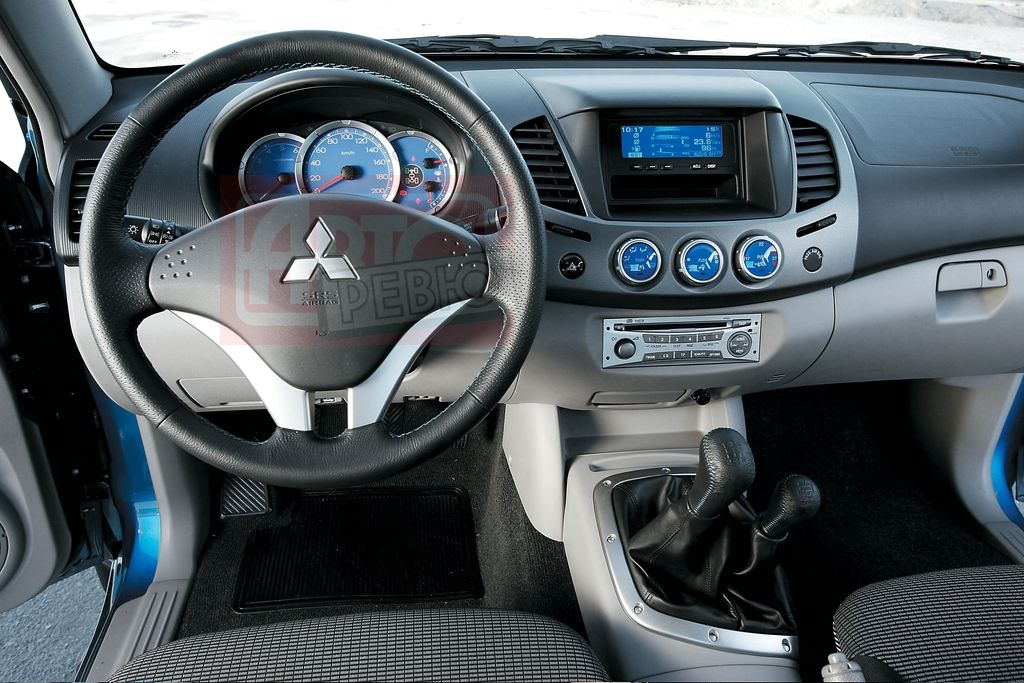 | 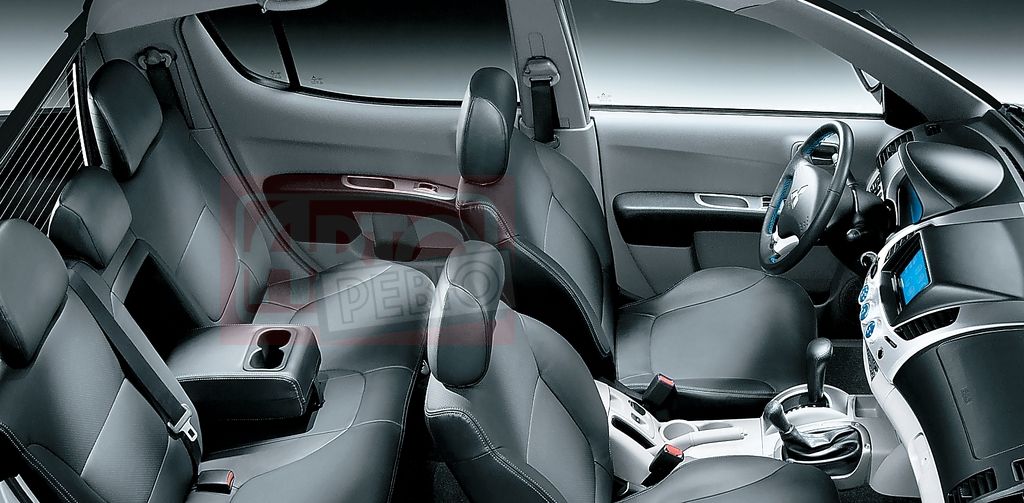 |
| The interior design is qualitatively different. Three round knobs for climate control and the absence of a central console have become family traits of Mitsubishi interiors | The cabin has become more spacious in all dimensions. The distance between the backs of the front and rear seats is 810 mm—even some D-class sedans would envy this |
With the new double cab, the interior has become even cozier. Nice instruments, a solid front panel, a beautiful steering wheel. The materials, of course, are inexpensive. But now you can order climate control on the L200. True, a large multifunctional touchscreen display is not provided for Russian cars—only a regular “information window” of the onboard computer. However, it’s also quite large and with pleasant graphics.
Due to the frame construction, the floor in the cabin is high, and the seating has become even more “passenger-car-like”—the seats of the new pickup are installed almost three centimeters lower to ease entry and exit. The front seats are good; in the back, it’s no longer just a bench with a stool-vertical backrest, but a normal seat. The backrest has a “human” 25-degree incline, and there’s a folding armrest with two cup holders. And of the 15 centimeters by which the cabin of the new “double” cab has become longer, 6 cm went to increase knee room for rear passengers.
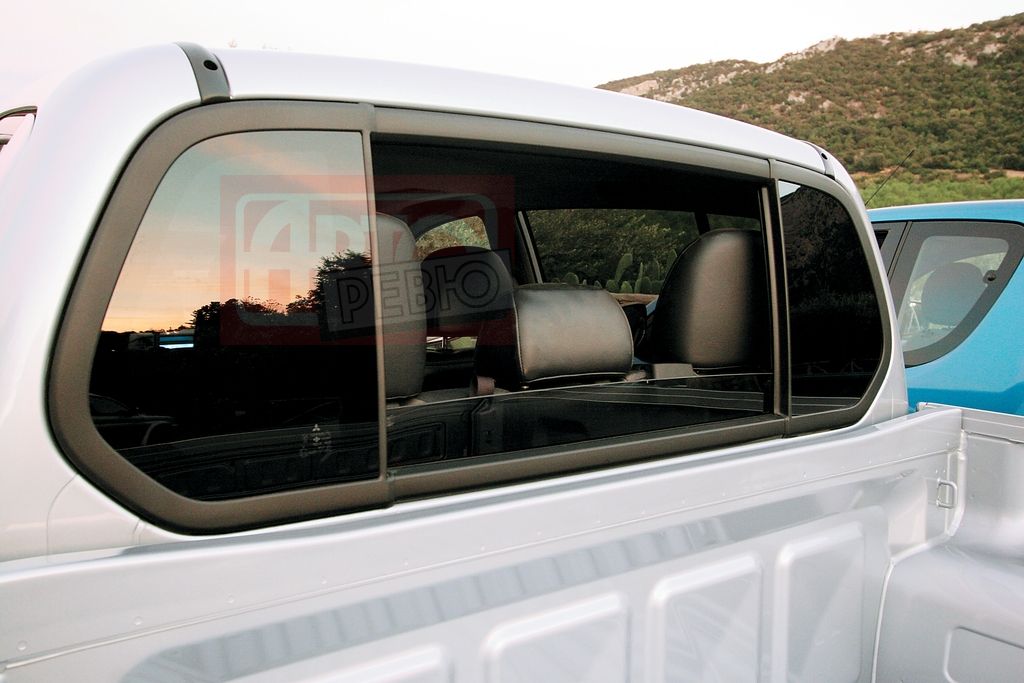 |
| Expensive versions have a rear electric window lifter |
The engine for the new L200 is still only one—a 136-horsepower turbodiesel with a displacement of 2.5 liters. The inline “four” with the designation 4D56 appeared on the L200 back in the eighties and has been constantly modernized. And the current engine is essentially a new unit: with a sixteen-valve cylinder head, a modern accumulator injection system, and a Euro 4 toxicity certificate. True, the exhaust of Russian pickups will only meet Euro 3 standards—the quality of our diesel fuel doesn’t allow more. Because of this, by the way, the L200 with the 115-horsepower engine, which appeared in 2002, was not supplied to us. But the old 100-horsepower diesel was also good. And the new one is both more powerful and more tractable—already at 2000 rpm, there are all 314 Nm “under the pedal,” a third more than before. But the turbodiesel still doesn’t like high revs, forcing early gear changes.
The behavior of the new pickup on asphalt seems to have become more “passenger-car-like.” After all, the track has noticeably increased, and most importantly, instead of the archaic “screw-ball nut” steering gearbox, a modern rack-and-pinion steering has finally appeared. Even the steering angles of the front wheels have changed: for a U-turn, the pickup now needs a patch a meter smaller in diameter! For the city, that’s crucial.
And if the previous Mitsubishi L200 was only equipped with a manual five-speed gearbox and a simple Easy Select transfer case with rigidly engaged front drive, now there are more options: you can order both an “automatic” and a more complex Super Select transmission!
For a short familiarization trip at the Tokachi test track, I got exactly such an L200—with “Super Select” and an automatic gearbox. This is a non-adaptive four-speed “automatic” INVECS of the first generation—like on the current Pajero Sport SUV. The Super Select transfer case is also not the most modern—first generation, with a symmetrical differential that splits traction between the axles in half, and manual switching using a regular lever that sticks out to the right of the manual gearbox lever or the “automatic” selector.
But still, for a pickup, this is a very progressive transmission. After all, Super Select I allows you to drive both with rear-wheel drive (2H mode) and with permanent all-wheel drive (4H)—including on asphalt, since there is a center differential here. And not a simple one, but with a built-in viscous coupling—for self-locking on slippery surfaces, which improves handling. On a winter road, that’s just what you need!
| The front suspension remains double-wishbone, but instead of torsion bars—springs, and the steering is rack-and-pinion. The leaf springs are now attached to the rear axle from above—this improved geometric off-road capability. But the shock absorber mounts still remain under the beam | The new frame is made by hydroforming. Its torsional rigidity increased by 50%, and bending rigidity by 70%. The yellow highlights sections with programmed deformation in a frontal impact |
Four-wheel drive can be engaged at any time—at speeds up to 100 km/h. And off-road, you can use more serious transmission capabilities. For example, bypassing the 4HLc position with a locked “center,” you can immediately “engage” the toughest option—4LLc, with a low range in the transfer case. And in addition, you can also engage the rear differential lock.
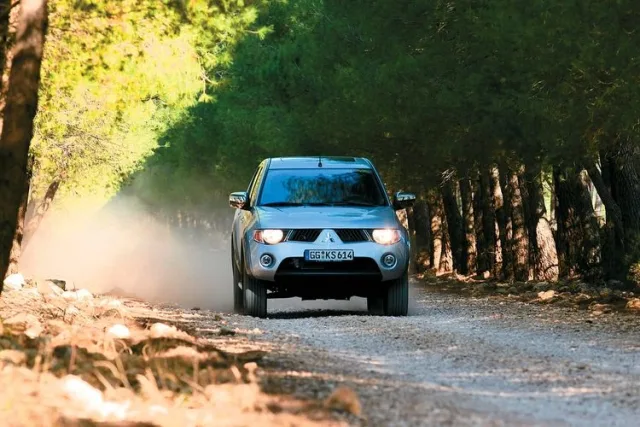
Now the test track’s climbs, slopes, and bumps are not scary for the pickup—it just crawls forward, purring with a leisurely diesel. Well, where’s the half-meter-deep ford that the L200 can cross, according to the specifications?
For those who don't need the fancy Super Select system and are ready to drive on asphalt exclusively with rear-wheel drive, simpler pickups with a hard-connected front axle Easy Select will do. The price for such L200 starts at a quite acceptable $24,990 — this is the most basic version with two airbags, fabric interior, polyurethane steering wheel, and black bumpers. Manual transmission is the only gearbox option. Paying an extra $2,000 gets you air conditioning, tinted windows, and side steps. However, ABS and stability control cannot be ordered for such budget vehicles. This is a purely "rural" option. For those accustomed to the city, more expensive and better-equipped modifications are available — from $29,990 for a pickup with Super Select transmission, climate control, audio system, and ABS.
The top version of the Mitsubishi L200 costs $33,490 and offers an automatic transmission, leather power-adjustable seats, chrome exterior details, 17-inch wheels, and the M-ASTC system that combines stability control and traction control. It's worth noting that the presence of M-ASTC electronics makes it impossible to install a manual rear differential lock.
Unsurprisingly, the new L200 has become on average $2,000 more expensive compared to its predecessor. However, against the backdrop of competitors, this Mitsubishi passenger-cargo vehicle still looks attractive — the new Mazda BT-50 costs about the same, the Ford Ranger is awaiting an update and price increase, and for the Nissan Navara you'll have to shell out at least $37,000.
Which one is better? We'll find out soon…
| Specifications | |
| Parameters | Vehicle |
| Mitsubishi L200 Double Cab | |
| Body type | passenger-cargo pickup |
| Number of doors/seats | 4/5 |
| Turning diameter, m | 11.8 |
| Fuel tank capacity, l | 75 |
| Curb weight, kg | 1760—1890 |
| Payload capacity, kg | 865—1080 |
| Engine | diesel, turbocharged |
| Location | front, longitudinal |
| Number and arrangement of cylinders | 4, in-line |
| Displacement, cm³ | 2477 |
| Cylinder bore/piston stroke, mm | 91.1/95.0 |
| Compression ratio | 17.5:1 |
| Number of valves | 16 |
| Max power, hp/kW/rpm | 136/100/4000 |
| Max torque, Nm/rpm | 314/2000 |
| Transmission | manual, 5-speed (automatic, 4-speed) |
| Drive | part-time, four-wheel drive |
| Front suspension | independent, coil spring, double wishbone, with stabilizer |
| Rear suspension | dependent, leaf spring |
| Front brakes | disc, ventilated |
| Rear brakes | drum |
| Maximum speed, km/h | 167 (165)* |
| Acceleration 0—100 km/h, s | 14.6 (17.8) |
| Fuel consumption, l/100 km | |
| urban cycle | 10.7 (11.9) |
| combined cycle | 8.7 (9.6) |
| Off-road performance | |
| max approach angle, deg. | 32.7—33.4 |
| max departure angle, deg. | 23.8—27.2 |
| max ramp angle, deg. | 24.7—26.3 |
| Ground clearance, mm | 200—205 |
| * Data in parentheses — for version with automatic transmission | |
L200: Four Generations
The L200 index has been in the Mitsubishi lineup relatively recently — since 1978. But in fact, the lineage of Mitsubishi pickups can be traced back to 1947, when at the Mizushima Motor Vehicle Works — one of the fragments into which the allies divided the Mitsubishi Heavy Industries empire after the victory over Japan — they began producing motorized tricycles. The primitive hybrid of a half-truck and half-motorcycle Mizushima seemed like a mockery of Mitsubishi's former might, but devastated Japan needed exactly such transport — cheap and maximally economical. In 1959, a more advanced model appeared — the Mitsubishi Leo with a closed all-metal cab and an automotive steering wheel. Mizushima and Leo stayed on the assembly line until 1962 and, together with Silver Pigeon scooters, laid the foundation for the revival of the Mitsubishi corporation in the 60s.
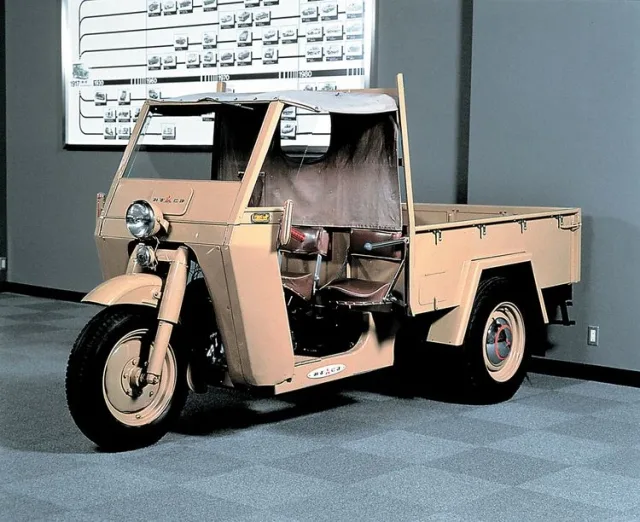
The three-wheeled motor pickup Mizushima with a 744-cc 15-horsepower "air-cooled" engine could carry
400 kg of cargo. Over 16 years of production, more than 90 thousand tricycles were made
The first "automotive" Mitsubishi pickup in 1967 was the small Colt Pickup, built on the basis of the first-generation Colt 1000F — this passenger-cargo subcompact was equipped with a 1.0-liter 51-horsepower engine and could carry half a ton of cargo. The partnership with Chrysler in the early 70s allowed the Japanese to enter the American market under the Dodge brand and engage in the joint development of a new pickup — in the US, demand for such vehicles was growing rapidly. The single-cab rear-wheel-drive Mitsubishi L200 appeared in 1978. It was offered with a 2.0-liter gasoline engine and a 2.3-liter 4D55 diesel, while for America a 2.6-liter carbureted engine was provided. In 1980, the L200 received an updated front end and a hard-connected four-wheel drive. At the same time, the chassis of rear- and four-wheel-drive pickups differed significantly — this practice would be preserved in all subsequent generations of the L200.
A little later, pickups began to be equipped with a three-speed automatic and a 2.5-liter 4D56 diesel. The success was overwhelming — the first-generation L200 with updates stayed in service until 1989 and sold 640 thousand units. Moreover, since 1988, L200 pickups began to be assembled at the Mitsubishi plant in Thailand.
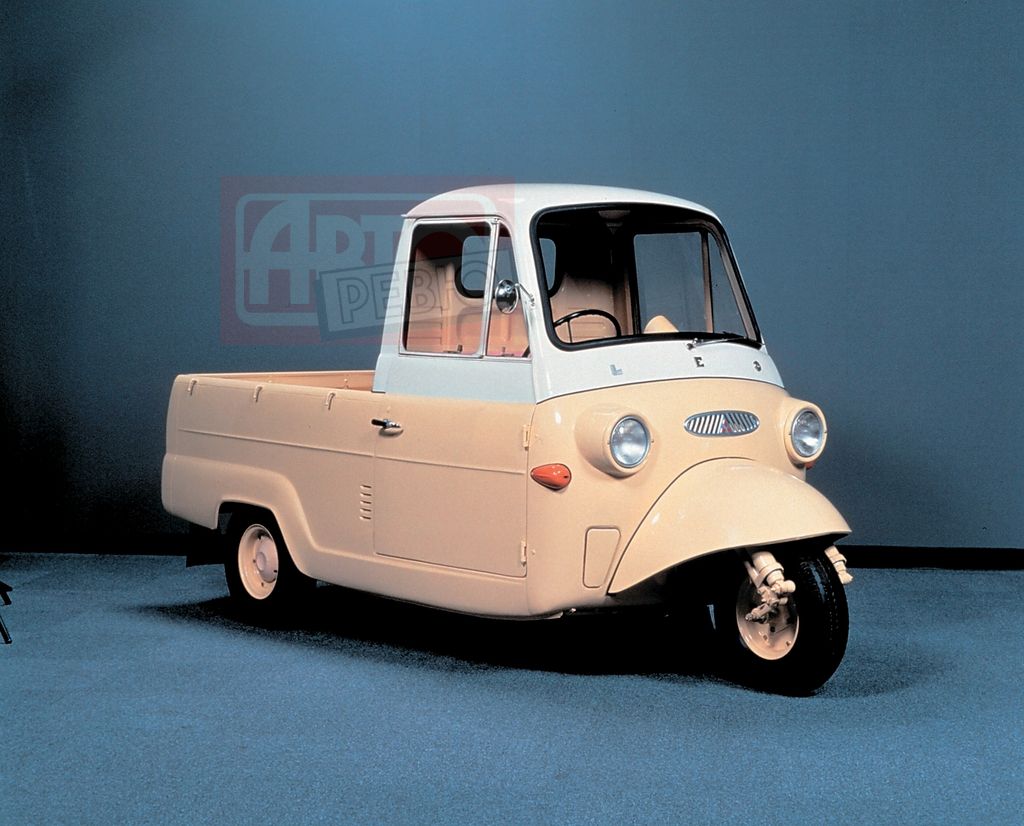 | 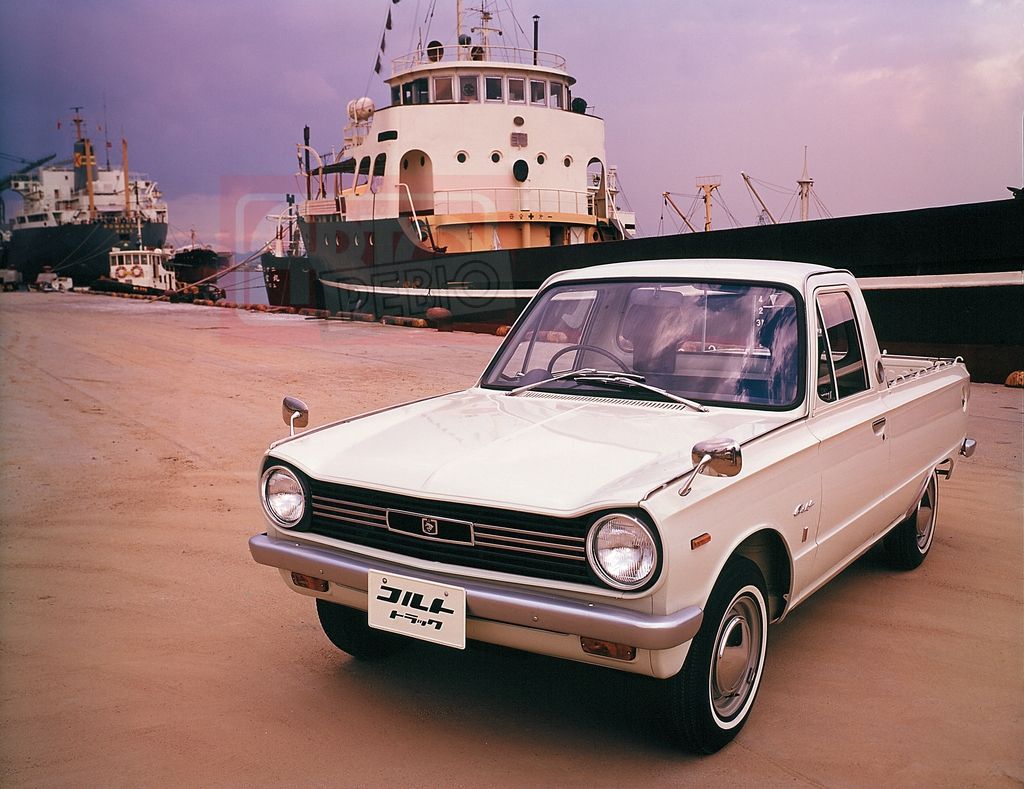 | 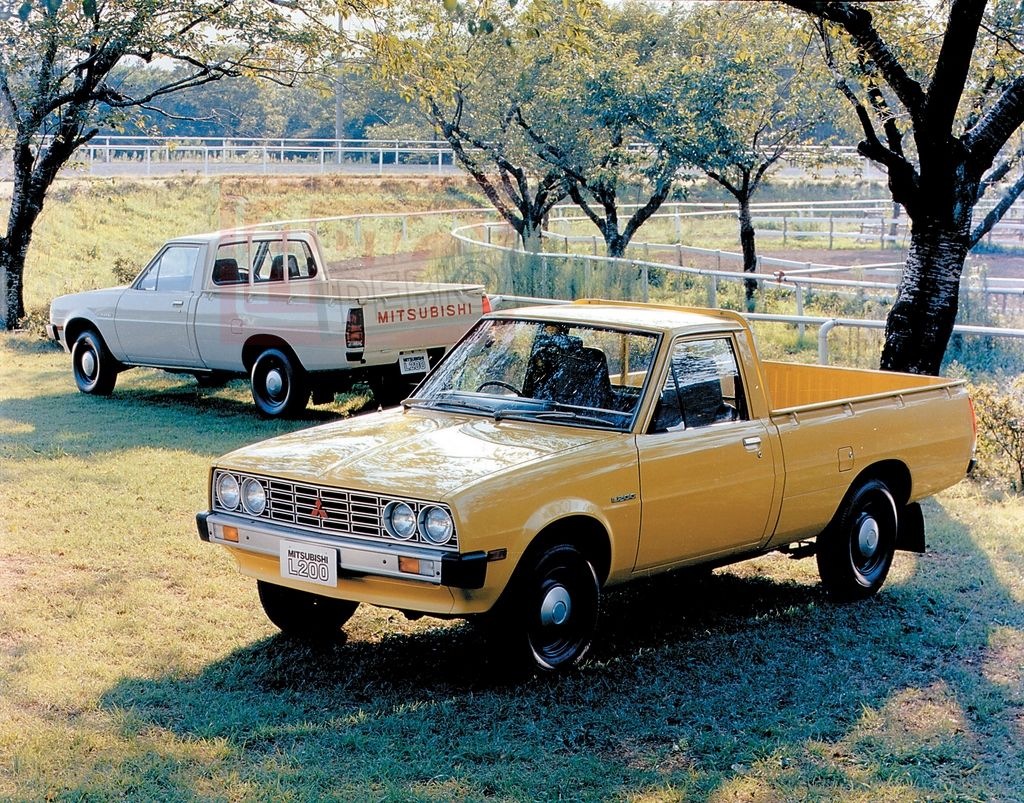 |
| Mitsubishi Leo was weaker (300-cc engine developed 12.5 hp) and carried only 300 kg of cargo. But it already looked like a car | Colt Pickup of 1967 — the first "automotive" Mitsubishi pickup | Mitsubishi L200 of the first generation (1978—1989) was developed jointly with Chrysler. In America it was sold as Dodge Ram D-60 and Plymouth Arrow Pickup, and in Europe and Japan — as Mitsubishi Forte |
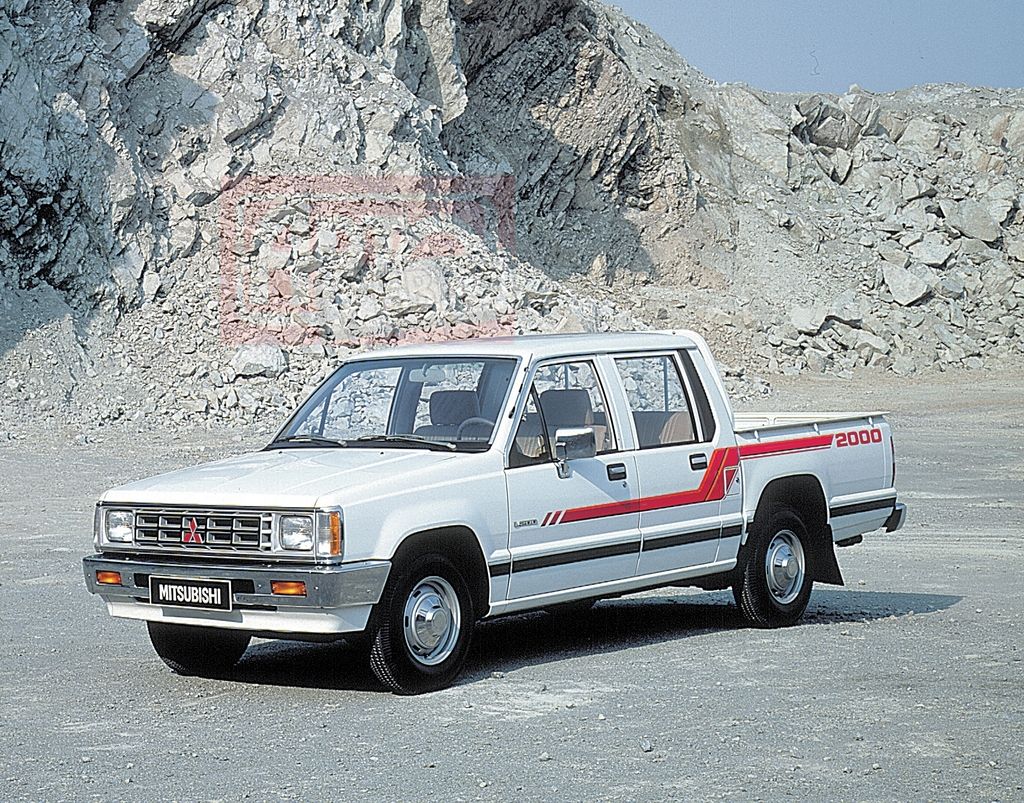 | 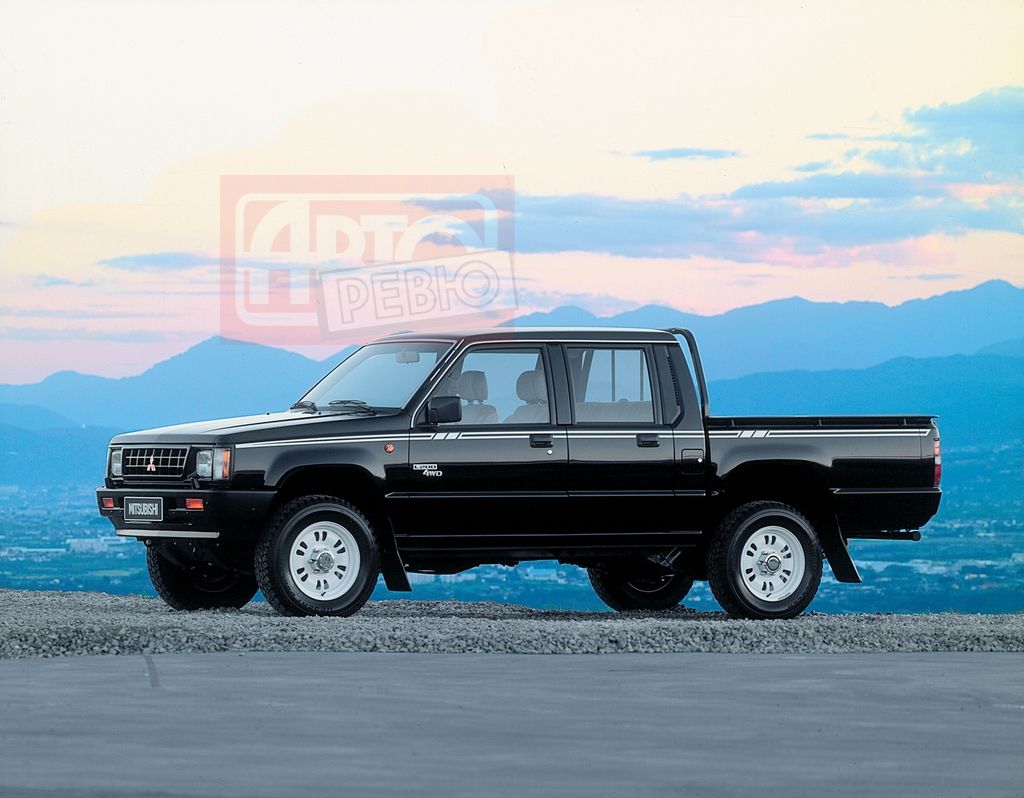 |  |
| After a deep restyling in 1986, the L200 received a new look and the first "double" cab | The second generation L200 (1991—2000) was developed by Mitsubishi independently | Mitsubishi L200 of the previous, third generation continues to be produced — demand in Latin America and Africa is still high |
The first generation change began in 1986 with the appearance of a new cab and ended in 1991 with the debut of the Mitsubishi Strada pickup — that's what the new L200 was called in Japan. The second-generation pickups were discontinued in 2000 — during this time, 1 million 110 thousand vehicles were produced.
The third-generation L200 pickup (Japanese name — Strada II) of 1995 was produced almost exclusively in Thailand. The vehicle featured completely new cab, body, frame, and interior. The diesel again gained power — up to 100 hp. Since the late 90s, the L200 with a 2.4-liter gasoline engine (136 hp) was also sold in Russia, but since 2002 such "gasoline" pickups were not supplied to Europe due to lack of demand. The total sales volume of third-generation vehicles also exceeded the million mark, and in Europe the L200 was second in popularity only to the Colt and Lancer models.
The new fourth-generation L200 has been produced in Thailand since 2005 and is sold on the local market with a 165-horsepower 3.2 Di-D diesel under the name Triton. In Japan, the pickup debuted under the same name, but only last autumn and with a gasoline V6 (3.5 l, 178 hp). European sales of the new L200 started last spring: the sales plan is 35 thousand vehicles annually. And from America, the L200 has left — there the niche will be filled by the Mitsubishi Raider pickup, a rebadged Dodge Dakota.
Pickups in Russia
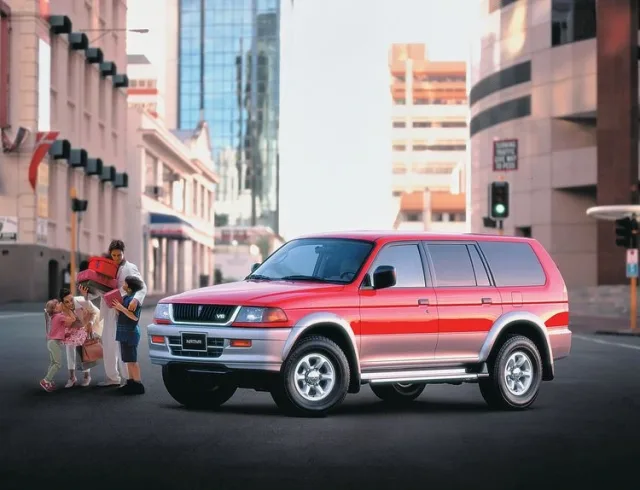
The Pajero Sport SUV (known as the Nativa outside Japan) of 1996 was conceived as a more affordable alternative to the Pajero. Engineers took the frame from the third-generation L200 pickup truck, refined it, installed torsion bars at the front and leaf springs at the rear, which gave way to coil springs in 2000. The drive here is Easy Select, meaning the front axle is engaged rigidly. Essentially, it is a simplified version of the Super Select 4WD transmission from the Pajero II, with the expensive center differential removed. The interior of the Pajero Sport and L200 was shared. And in 2008, a new Pajero Sport, built on the chassis of the then-current L200, was to go into production.
In Russia, pickup trucks are a niche product. For the entire year of 2006, only ten thousand units were sold — that's less than half a percent of the total market volume of two million cars. For commercial use in our climate, inexpensive vans with all-metal bodies, such as the Gazelles and Sobols, are far more practical. So, a pickup truck is still a curiosity for the domestic buyer.
Leading this modest market is the Chinese Great Wall with the Deer and Sailor models. The second place is consistently held by the Mitsubishi L200, although if you count the Ford Ranger and Mazda B-series together, their combined sales surpass Mitsubishi. It was the Ranger and L200 that scored the most points in our comparative test. The expensive and flashy Nissan Navara is chosen only by a few snowmobile enthusiasts. Closing the list are the exotic SsangYong Musso Sports, the little-known Chinese Tianma and Admiral, as well as small-scale four-wheel-drive pickups based on the Niva.