
The recipe for an adventure cocktail turned out to be simple. We took a dozen Mitsubishi SUVs — Pajero, Outlander XL, and L200, seasoned them with 750 kilometers of road with bumps, fords, and hillsides, and added a rich cultural and educational program for flavor.
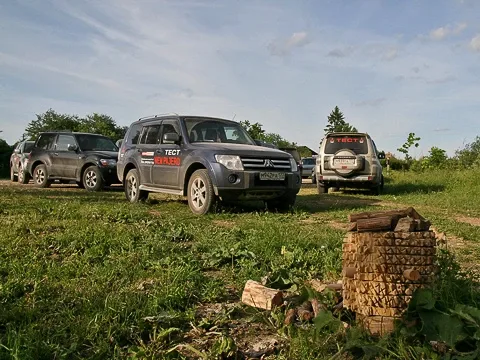
Finally, the start! A dozen and a half journalists ready to thoroughly "chew" the fresh Mitsubishi SUVs. We wait for the stragglers, settle into the cars, and off we go!
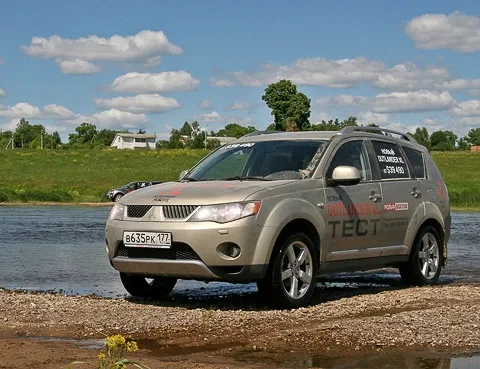
Where exactly — it doesn't matter. The main thing is that I'm behind the wheel of the Outlander again, which I've long liked. We're already well acquainted, and I knew in advance that the road to the first stop — the Prioksko-Terrasny Nature Reserve near Serpukhov — would fly by in an instant. In city traffic and on the highway, the capabilities of the three-liter "Excel" engine paired with a responsive six-speed automatic are more than enough. The car has become noticeably more comfortable than its predecessor, and this has clearly benefited it: on broken roads and light off-road, you can now move with much more pleasure, and on asphalt, the new Outlander delights with excellent handling.
The first stop is the Prioksko-Terrasny Nature Reserve, about eighty kilometers from the capital. It was founded back in the forties of the last century to restore the bison population, which had then shrunk to about fifty individuals. Now the herd is slowly growing... But we didn't come for that at all.
Our goal is to "adopt" a bison calf that is only two weeks old. Sounds unusual, right? Let me explain. The reserve, together with the World Wildlife Fund (WWF), launched the "Adopt a Bison" program, and we decided to participate. True, this pleasure is not cheap — a year of such "fatherhood" costs about 40 thousand rubles. Yes, bison are quite the food lovers. And they can get sick, just like you and me.
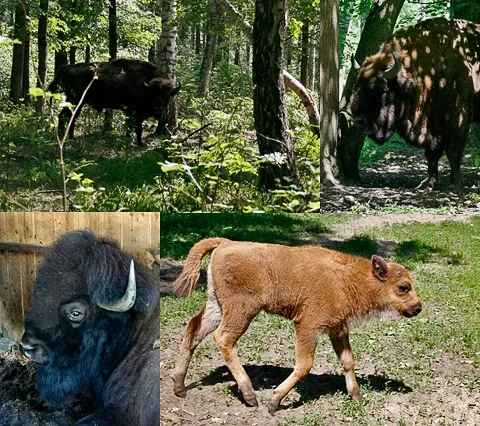
The newborn was named MuMiRolf (from Mitsubishi and Rolf). By the way, the animals are easy to distinguish by their names — all bison born in the Prioksko-Terrasny Reserve have names starting with the prefix "Mu". And this, it seems, is the baby's dad (in the lower left corner).
We adopted, of course, but they naturally didn't allow us to take the bison calf home. Nothing to be done — the animal is rare. But now we can always visit our ward, find out how its health is, chat, and treat it to something tasty. If "adoption" is not within your budget — no problem, you can simply come for a tour and observe the wild animals from the side. Your kids will definitely appreciate such a day in the fresh air in the reserve forest. We will definitely come back here.
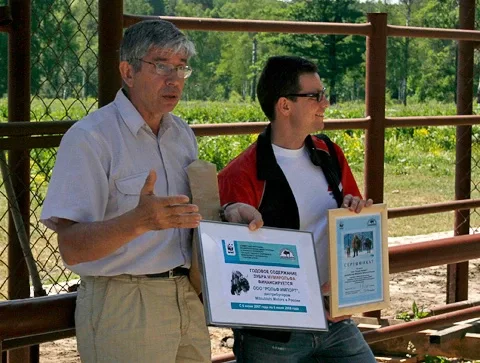
Director of the Prioksko-Terrasny Biosphere Reserve Mikhail Nikolaevich Brynskikh presents the certificate of participation in the WWF program "Adopt a Bison" to one of the guardians — Alexey Zernov, head of public relations at Rolf company.
As we moved away from Moscow, the roads got worse. And the organizers also plotted the route so that we increasingly turned off onto off-road. Here, more serious equipment would be needed. Don't think that the XL gives up before a soaked country road or a forgotten forest path. Its geometry is excellent. But if it does get stuck — you'll be walking to the tractor for a long time.
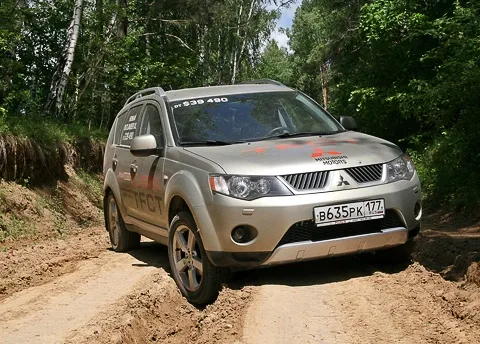
The XL is the king of moderately bad roads. It swallows medium-sized bumps with pleasure, doesn't let you down on high-speed highways and in the city, but it's not designed for serious off-road. During the run, there were losses among the XLs. On several cars, the covers protecting the spare tire under the bottom were significantly damaged.
And yet, despite the decent geometric cross-country ability of the "Excel" and a good 22 centimeters of ground clearance, the longer I bounced over bumps, the less I wanted to feel every uneven section of the road with my back. Increasingly, I wanted bigger wheels, a soft suspension, and a serious transmission. Having finally realized this, I swap the XL, which I liked on asphalt, for the Pajero.
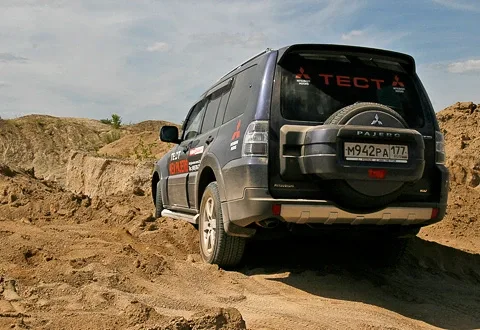
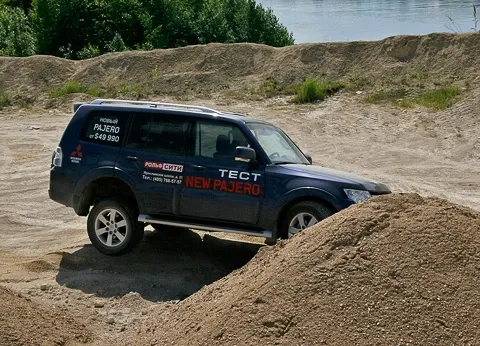
Although the suspension provides decent behavior on asphalt, the true element of the good old Pajero is off-road. It's a full-fledged SUV with a serious transmission. And the new 3.8-liter engine is just right. In the SUV hit parade, the Pajero takes first place.
An armored personnel carrier! There's no other way to say it. The suspension that's impenetrable on bumps, the new 3.8-liter 250-horsepower engine, the "smart" Super Select 4WD transmission with an automatic gearbox. This is what's needed! Compared to the previous version, the "four" has noticeably freshened up. It looks more modern on the outside, and it's more pleasant inside, but at its core — it's still the same good old "Pajerik". Real, iron, not like today's "soap boxes".
While we were shaking over gravel roads, ditches, and berms, we imperceptibly reached the "Polenovo" estate. The museum-reserve is an integral part of the surrounding landscape. On the territory around the estate, there are several places connected in one way or another with the life and work of Vasily Dmitrievich Polenov. These include the village of Bekhovo with the Trinity Church, the rural cemetery where the artist is buried, and the "Old Bekhovo" estate awaiting restoration. The exhibition amazes with its diversity: here are household items and fascinating collections gathered by Polenov himself and his family. And, of course, paintings, paintings, paintings... You probably remember his famous "Christ and the Sinner", "Golden Autumn", "Moscow Courtyard". Also presented here are canvases by Repin, Shishkin, Ivanov, Vasnetsov, and Korovin.
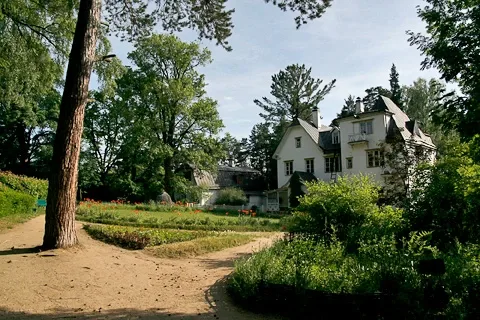
Vasily Dmitrievich Polenov devoted much effort to public education. He built two schools in the surrounding villages. By the way, his last works were also dedicated to children: in the 20s of the last century, he created a diorama about a round-the-world trip. These peculiar filmstrips with magical color pictures, which were a real holiday for peasant kids back then, still surprise visitors with their unusualness today. We liked it too.
It was getting dark. We left the dusty SUVs on the museum grounds and set off by motor ship to rest up the Oka River. But in the morning, the journey continued, and this time I decided to part with the fine fellow Pajero and test the new L200.
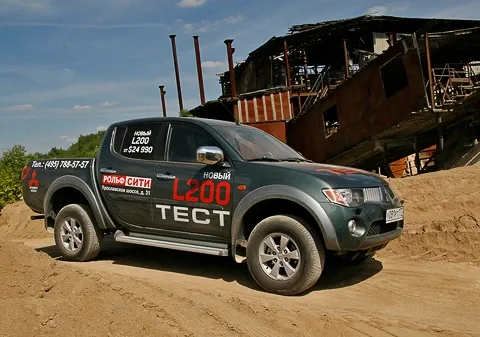
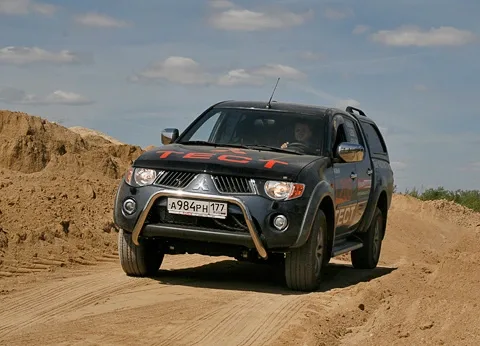
The diesel L200 doesn't shine with driving talents. But you can't find a better option for hunting and fishing. The big "barge" with a rear leaf spring suspension is unwieldy at high speed and clumsy in dense city traffic. But the spacious body with a "cap" allows you to carry anything from bricks to roofing felt. And off-road, the "two hundredth" with its complex transmission feels confident.
On a straight road and in long turns, the heavy "two hundredth", as I expected, strongly resembles that very motor ship we recently sailed on. On uneven surfaces, it rocks, the steering wheel gives almost no feedback, and a constant vibration from the 150-horsepower diesel runs through the body. On a good road, the L200 feels like a mix of a tractor and a bus. But the attitude toward the pickup changes dramatically when a field or a broken country road appears under the wheels. The cargo-passenger "Elka" glides over potholes and hummocks as if they don't exist at all. And I won't discover America if I say that the "two hundredth" is the ideal car for a dacha, hunting, and fishing. The L200's motto remains the same: "I take a lot, I haul far."
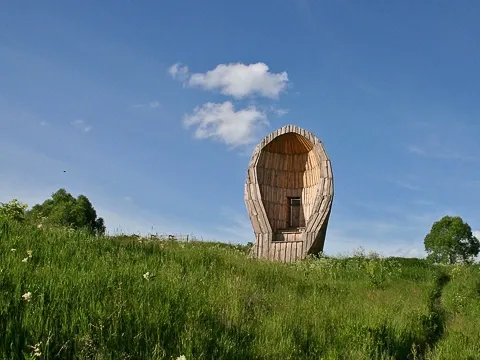
We also visited the Chekhov district and the Tula region. We stopped by Polenovo, Tarusa, and Aleksin, but in the Kaluga region, a special surprise awaited us. It's located four hours' drive from Moscow, on the territory of the Ugra National Park, and is called the village of Nikola-Lenivets.
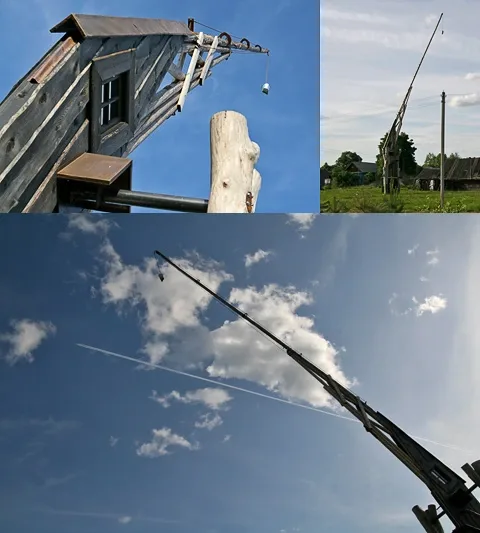
There's a fool for every wise man. A senseless giant "Crane" looks at the sky. At the end of the "fishing rod" — a small bucket of water. Interpret it as you like...
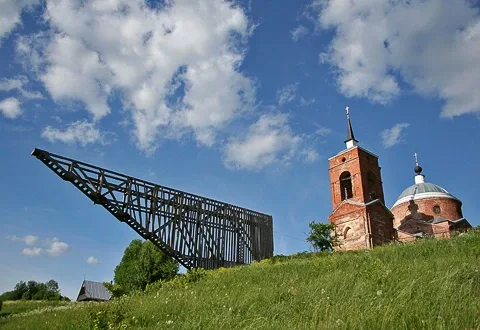
Timur Bashkaev's "Half-Bridge of Hope" defies the laws of physics, hanging over a cliff. The project, created as part of the "ARCHstoyanie" festival, symbolizes the impossibility of building a bridge in a conflict of banks, but you can create your own half-bridge — in the hope of unification.
The village for capital's creatives was founded in 1989 by Moscow architect Vasily Shchetinin. He came to the Ugra River in search of a place where he could create a small artistic settlement with houses-workshops. In the early nineties, artists began to move to this place cut off from the world, including participants of the St. Petersburg group "Mitki." One of the first to believe in the idea of such a "creative" village was Nikolay Polissky. It was he who defined the artistic direction of Nikola-Lenivets — land art.
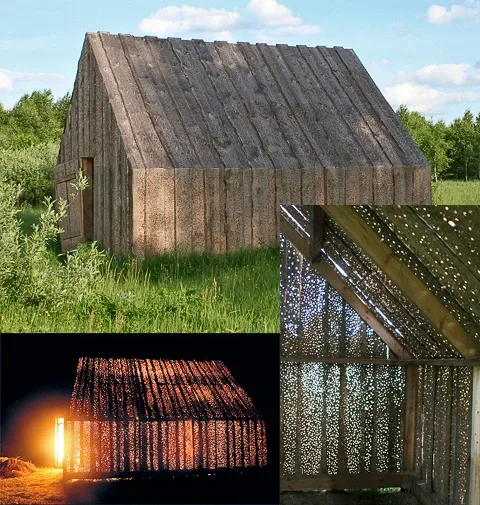
Perforated "Barn." Hundreds of thousands of holes in the walls and roof imitate the starry sky during the day. The surroundings through the walls appear in an interesting mosaic-lace form. At night, when the light is on inside, the barn resembles an ancient heated iron.
What's the trick here? Just look at the photos. Polissky, together with like-minded people and local residents, creates incredible things. They erect whimsical towers from trunks and hay, weave huge baskets, dig swings for fifty people into the ground... In winter, they make hundreds of snowmen and build giant ice slides. You can't list everything. But one thing I understood for sure — it's definitely worth visiting this unusual place and seeing the wooden giants with your own eyes.
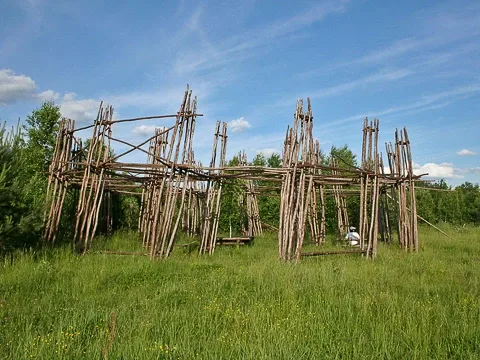
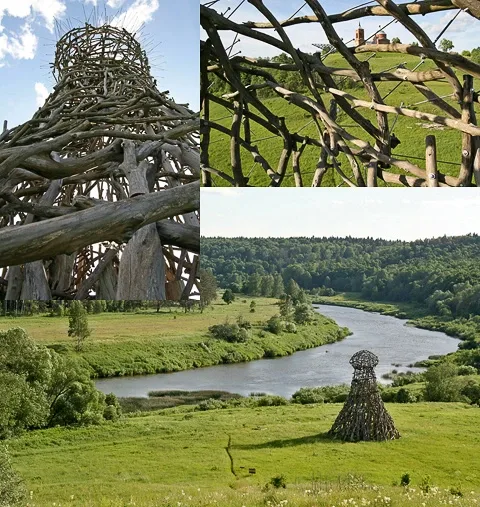
A concept of the Eiffel Tower? You didn't guess. A river lighthouse that works only during the day. Materials used: trees, branches, screws, bolts, mounting studs. You can climb to the upper tier via a spiral staircase (although it's called a staircase only conditionally) — of course, wooden.
The third day of our trip is coming to an end, and we are heading to the capital. It's a bit sad to say goodbye to these almost untouched places (except for the artists' village). Sad, but at the same time pleasant. It's pleasant to realize that in our surroundings there are caring people full of optimism and determination who care about our nature. It's pleasant that there are those who preserve the spirit of time and place. And it's just wonderful that there are people who, in search of new forms of self-expression, remain devoted to their cause and try to make our souls cleaner. Thank them. And special thanks to the cars that carried us through all these amazing corners. Thanks for their endurance and patience — they heroically withstood all the hardships of our 750-kilometer marathon on challenging Russian roads.
Behind the scenes
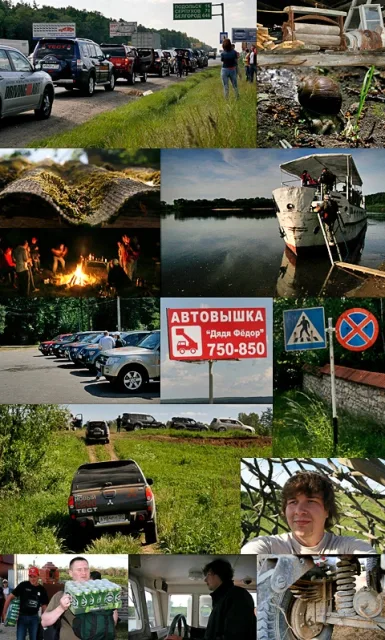
Impressions from our three-day journey will last for a year. If there's a chance, I'll immediately head to one of these places.
It was very interesting to feel like the captain of the river tanker "Ulay" and discover that the reaction to turning the wheel, phew, that is, the helm, and the maneuverability of the vessel completely depend on the pressure of the jet created by the propeller. With an increase in the speed of the "common rail" working in the hold and the speed of the vessel, the feedback force on the "wheel" noticeably increases. It's a pity ABS and ESP are not provided here. Otherwise, we would have lit them up.
The only thing we regretted was that during our entire 750-kilometer marathon, it never rained. And how we wanted to fully enjoy the capabilities of the SUVs that were part of our caravan.
Impressions from our three-day journey will last for a year. If there's a chance, I'll immediately head to one of these places.
It was very interesting to feel like the captain of the river tanker "Ulay" and discover that the reaction to turning the wheel, phew, that is, the helm, and the maneuverability of the vessel completely depend on the pressure of the jet created by the propeller. With an increase in the speed of the "common rail" working in the hold and the speed of the vessel, the feedback force on the "wheel" noticeably increases. It's a pity ABS and ESP are not provided here. Otherwise, we would have lit them up.
The only thing we regretted was that during our entire 750-kilometer marathon, it never rained. And how we wanted to fully enjoy the capabilities of the SUVs that were part of our caravan.