
«Mitsubishi Galant returns to Russia. Pronounced sporty style, utmost respectability, advanced technologies and impeccable quality...»
However, the advertising campaign could have been far more memorable. For example, in the spirit of: "Kill a beaver — save a tree."
"Want to become part of history? Buy a new Galant for $29,990 — and get a personalized certificate as a savior of Mitsubishi Motors!"
Harsh? But honest.
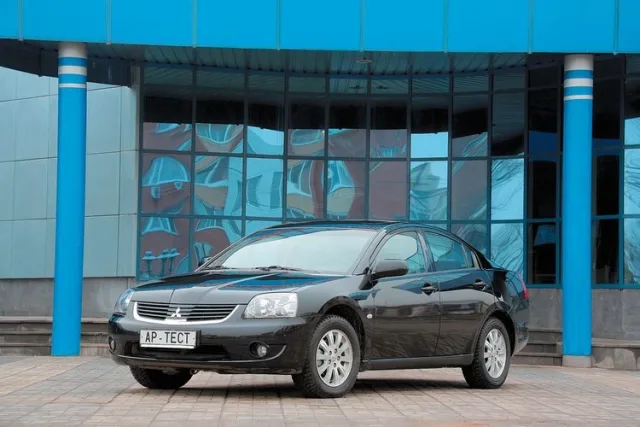
So, the new Galant. Recognize it?
This dull overgrown crucian carp has absolutely nothing in common with the previous "Galants." Isn't that right, Nakanishi-san?
I met Akinori Nakanishi, who now heads design at Mitsubishi, in 2002. Back then, he was out of favor — serving an honorable exile at the company's German design center in Trebur. While he, the author of the striking "faceted" eighth-generation Galant and the Diamante flagship, quietly worked near Frankfurt on the future Colt (see AR No. 8, 2002), the new Galant was being made by completely different people. And in a completely different country.
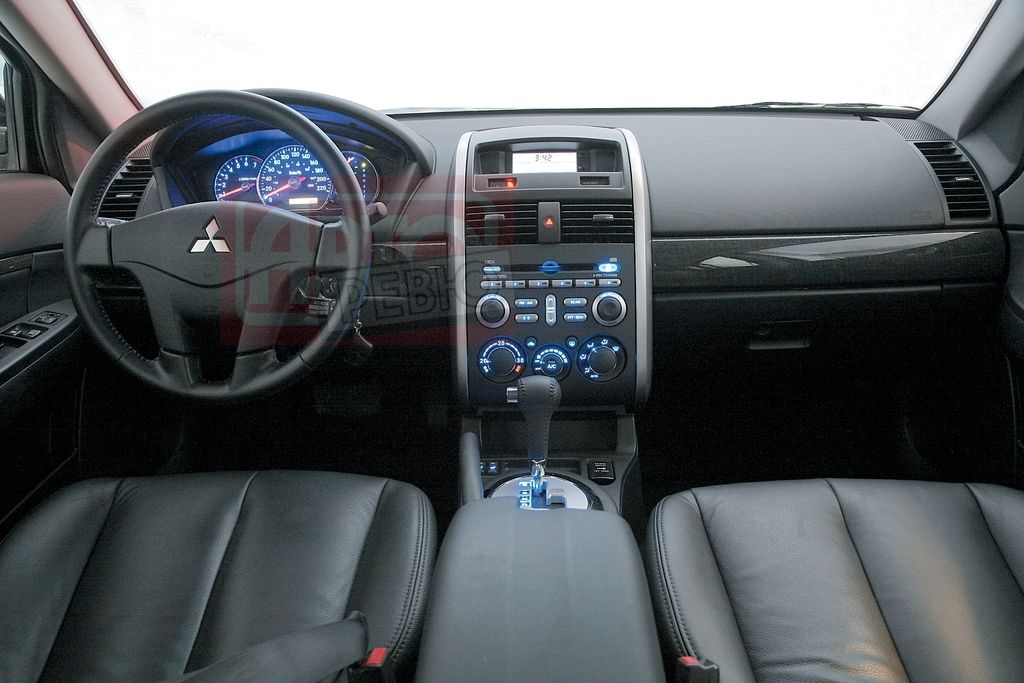 |
| The cabin is ergonomically comfortable, but the design and quality of the plastic leave much to be desired, and in the dark, the poisonous blue backlighting irritates the eyes. The "automatic" has a manual gearshift option |
Perhaps there was some logic in making the ninth-generation Galant specifically for America. In Europe, even established brands struggle in the D and E segments — buyers there are capricious: they demand both a name, prestige, the latest electronics, and a "driver-oriented" chassis. But the United States is a completely different matter. Offer more car for moderate money, make it reliable, and even provide credit with no down payment — they'll take it without a second thought!
In short, the "ninth" Galant was decided to be designed in America — and for America.
Had Nakanishi had the final say, he would surely have made it in his favored Japanese-Italian style, with predatory facets. Look at the new Lancer — that's Nakanishi's handwriting!
But back then, design and policy at Mitsubishi were determined by other people — those who drove the company into crisis. And those who later clumsily tried to get out of it.
Their decision to style the new Galant after "Americans" was another mistake. Although in the model's 37-year history, there had already been "purely American" variants — recall at least the chunky dreadnoughts of the fourth and fifth generations. But this time, the trick didn't work...
The new Galant was created under the "Project America" — on the shared PS platform with two other "purely American" models: the large crossover Endeavor and the coupe/convertible Eclipse. The body is completely new and rigid, with MacPherson struts on a subframe at the front and a "multi-link" at the rear. Engines and gearboxes are old but refined. The design was entrusted to Americans — the team at Mitsubishi's California studio in Cypress, led by Dan Sims.
What came of it? Judge for yourself...
Length — 4865 mm. That's the main thing about this "Galant": it's 23 centimeters longer than its predecessor! It's longer than the former Diamante flagship and even the Mercedes E-Class. Yet the price starts at $20,000! In America, of course — on its "historical homeland."
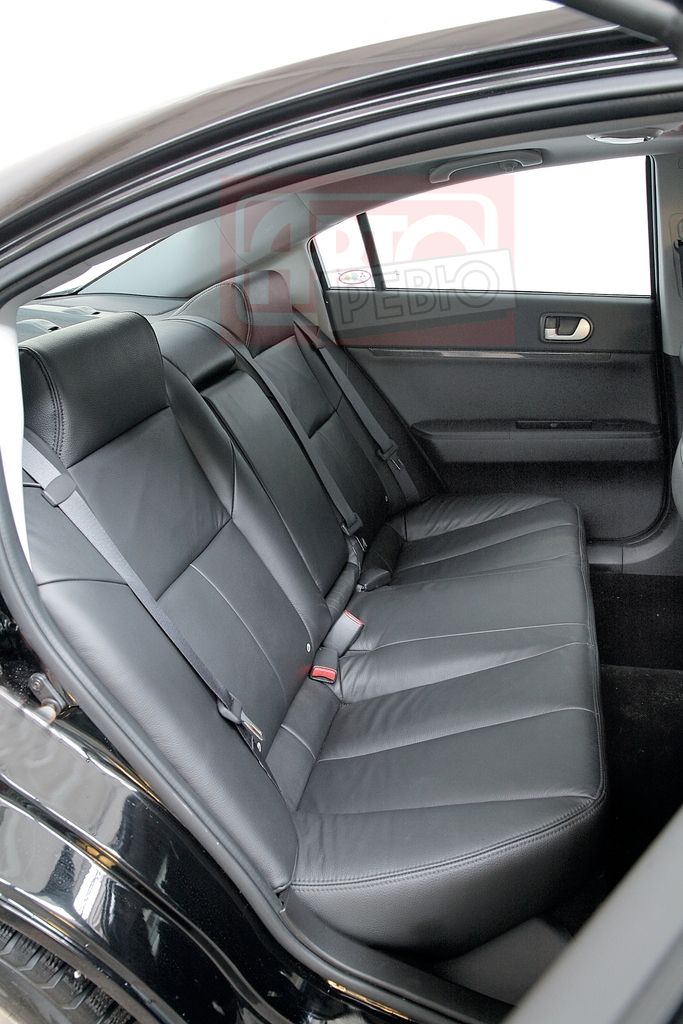 | |
| Plenty of space in the back, but apart from a fold-down armrest with cup holders — no frills | |
However, even this didn't save the "American" Galant on its home market: sales plummeted roughly threefold! The "eighth" Galant sold a hundred thousand a year, while the "ninth" — despite being larger and more solid — doesn't even reach 30,000...
Meanwhile, in Russia, the large sedan segment was growing rapidly: according to Mitsubishi marketers, it doubled in two years. It would have been a sin not to grab a piece of such a pie. And so, about two years ago, Mitsubishi decided to bring the "American" Galant to Russia and Ukraine. Also, to load up the local plant where it's assembled.
I first got behind the wheel of this car a year and a half ago at the Mitsubishi proving ground in Okazaki (see AR No. 16, 2005). But then I gave my word not to photograph it or write anything — the car was still undergoing "Russification." Keeping that promise wasn't hard: there wasn't much urge to talk about the new "Galant" anyway...
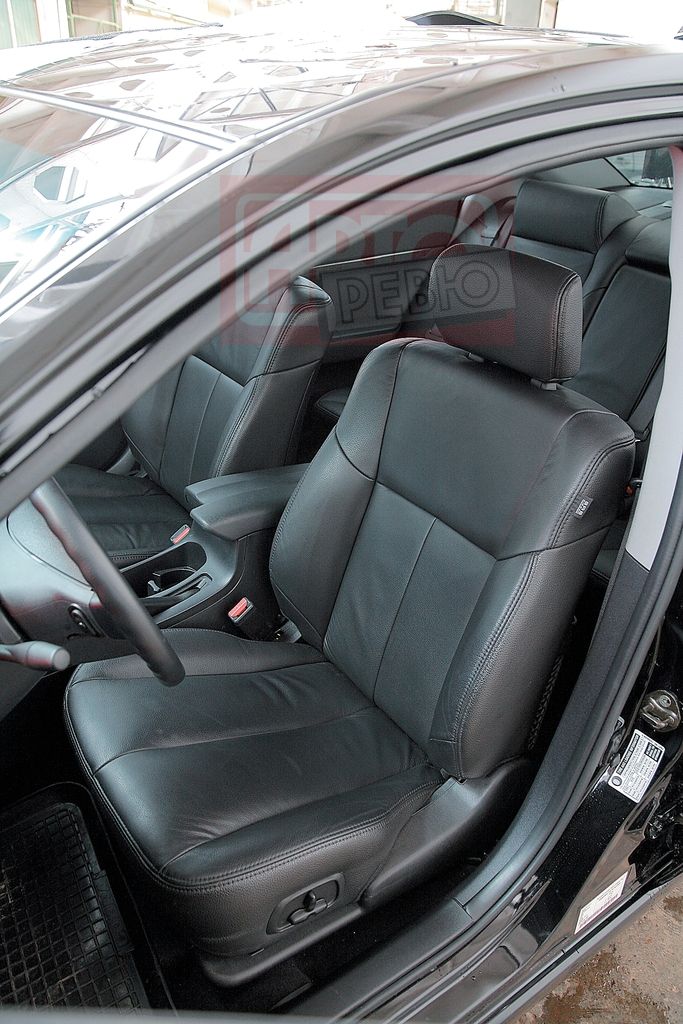 | 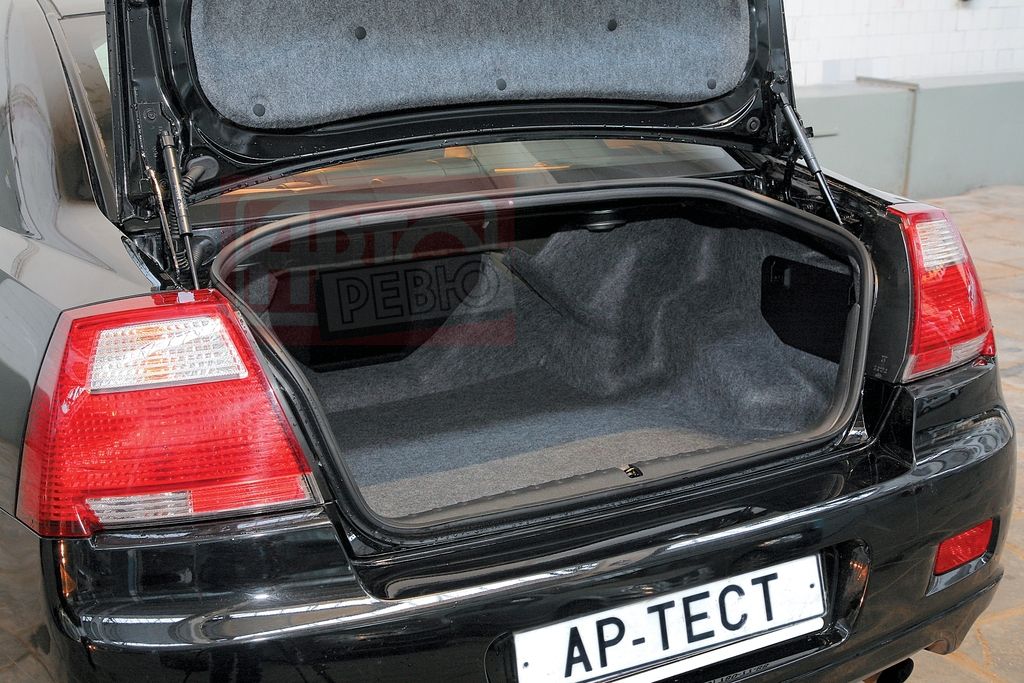 | |
| The seats with power drives are decent, though the height adjustment is "half-hearted" — only the cushion moves | The trunk is modest, the opening is tight, and in the backrest — only a hatch for long items. But there's upholstery and a full-size "spare" | The wire from the mirror and the fringe on the cut of the headliner — sloppy... |
Just a big sedan. Just another car. Back then, it seemed unattractive to me. Spacious — yes. But with a shabby "plastic" interior and a somewhat noisy inline "four" of 2.4 liters. In America and Australia, there's also a V6 version, but they decided not to bring it to Russia and Ukraine: marketers reasonably deemed it unprofitable.
Though, I remember, the engine pleased with its torque. And the old four-speed "automatic" — as is customary for Mitsubishi — didn't let down. The chassis, however, turned out to be surprisingly decent: both in handling and ride comfort. "Wait, we'll refine the Galant for Russia — then you'll appreciate it," the Japanese promised.
And so...
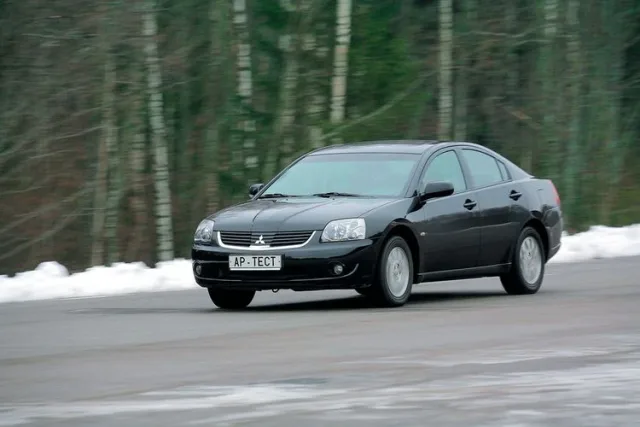
The front end of the 2007 model year for America bares a fishy grin. Interior? Hush, sorrow, hush: cheap plastic, primitive layout. What a pity you couldn't have intervened then, Nakanishi-san...
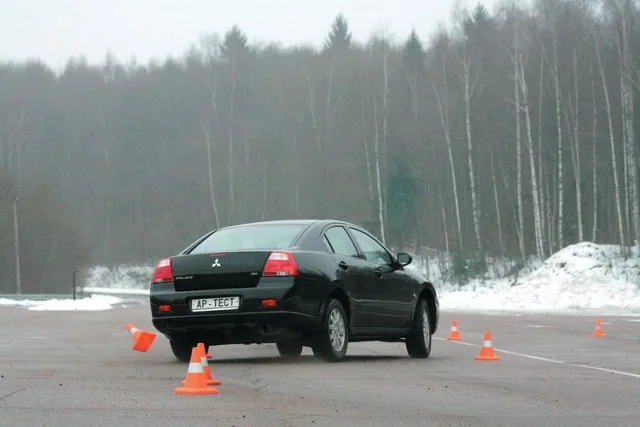
The chassis is tuned well, even spiritedly, but such a tendency to oversteer without ESP is a crime! Especially for a car claiming to be business class
Three interior details are particularly disheartening. The triangular plugs on the front doors, hiding the mounts of the exterior mirrors, are made of shiny black plastic and press in under your fingers. From the interior "auto-dimming" mirror, a thick electrical wire runs crudely under the headliner. And the edge of the headliner panel is frayed, as if hastily cut with dull garden scissors.
Rain and light sensors, dual-zone climate control, parking sensors — none are available and never will be. The steering wheel adjusts only vertically. The height of the driver's seat cushion is power-adjustable, but the backrest remains fixed — you won't find that even in small European and Japanese cars nowadays.
Trunk — 435 liters. The previous "Galant" had 470 liters. But the lid now has inner upholstery — added specifically for Russia, since in America, buyers of such cars don't care. And the "Russian" fuel filler cap now locks. But when refueling, you'll have to hold it in your hands — there's nowhere to hang it.
For $20,000, perhaps that's forgivable. But for $29,990?
Though that's the price for the base Galant Intense. And my car is the Instyle version at $33,700. For an extra $3,701, they offer a power sunroof, seats in inexpensive leather, and a 650-watt Rockford audio system with eight speakers and very loud sound in the "boom-boom-boom" style. For karaoke bar enthusiasts.
But sitting in the driver's seat is comfortable, despite the sparse adjustments. The seat is moderately soft, everything is at hand, the "climate" is controlled by simple rotary knobs... It's just a pity that the set temperature isn't visible — you sit as if in a big Lancer. And in the back, though spacious, there are no special comforts besides the armrest with cup holders.
On the other hand, if you set aside all the superficial and remember the main thing... What is a car? Not a luxury, but a means of transportation. And the Galant moves far more "nimbly" than its appearance might suggest!
The old horse won't spoil the furrow — that's about the wonderful 4G69 engine of 2.4 liters from the historic Sirius series, which appeared on "Galants" back in 1988. And about the four-speed "automatic" INVECS-II. True, there's no hint of any "pronounced sporty style" here: if the Honda Accord's engine of the same displacement develops 190 hp, then squeezing more than 158 hp out of the Mitsubishi engine wasn't helped even by the MIVEC variable valve lift system (a copy of Honda's VTEC), which switches to "power" lobes of the single camshaft at 3500 rpm. But the engine is unpretentious — it's content with AI-92 gasoline.
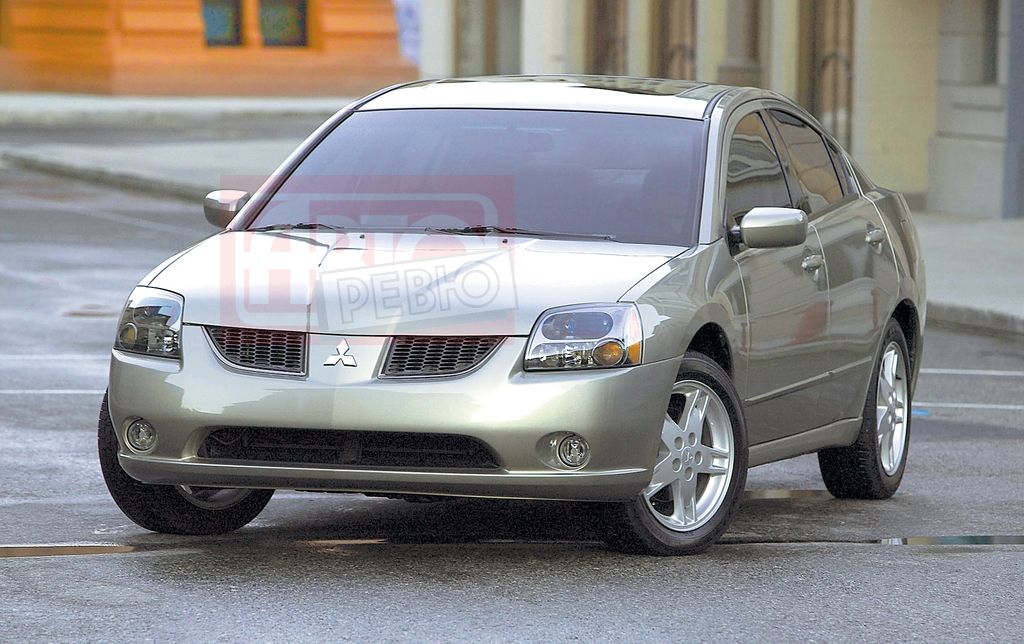 | 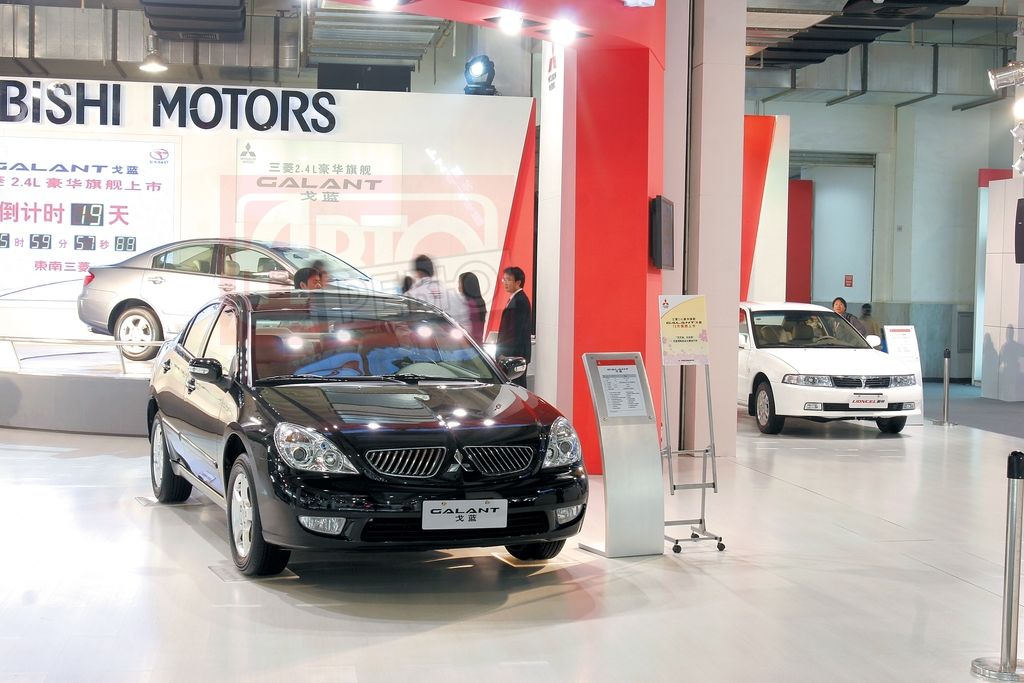 |
| This is how the American Galant of the 2007 model year looks in the most expensive Ralliart version. Regular cars have the same front end as the "Russian" ones, but the rear lights differ | And this is the Chinese Galant with a front end by Olivier Boulay and a slightly different interior. In 2004, it began production in Taiwan, and now it's also made in China |
The Galant's dynamics are exactly what you'd expect from a sedan of this class — no jerks, but no sluggishness either. The main secret lies in the calibrations: both the electronic accelerator and the logic of the four-speed automatic are tuned impeccably. No pauses when pressing the gas, the gearbox shifts precisely on time. The braking system deserves special praise: there's nothing to fault, everything works flawlessly. And the handling pleased: the car follows its course clearly, body roll is moderate, and there's informative effort on the steering wheel. And this is despite the fact that the suspension was adapted for our roads, increasing ground clearance to 165 mm — a significant plus for Russian realities.
Ride comfort also didn't disappoint: the suspension is composed, quite resilient, yet comfortable, without unpleasant pitching on waves. Sound insulation for cars assembled in Okazaki has been seriously improved — the cabin is now noticeably quieter than a year and a half ago.
What about safety? Six airbags, seatbelts with pretensioners and load limiters, a body with programmed deformation zones — all this earned the Galant the highest five stars in the US NHTSA crash tests. However, there's no stability control system in the equipment list. And on winter tires, this sedan breaks into a slide surprisingly readily when you lift off the throttle. For us experienced drivers, it's even amusing. But for a novice, it's a surprise that could turn out unpleasant.
However, don't forget: in late-90s America, when the ninth-generation Galant was designed, ESP wasn't standard on such utilitarian sedans. The US market lived by different rules back then — and only later did they begin to appreciate both distinctive design and modern electronics.
Some managed to see these changes in advance — and are now reaping the benefits. Others — not.
Surely those hapless marketers who formulated the technical specifications for the ninth Galant, both in Japan and America, have already lost their seats. But the engineers responsible for the chassis and powertrain tuning clearly kept their positions. At least, one would like to believe so.
Will these mistakes be taken into account when they tackle the tenth-generation Galant? And will it even appear?
Now the answer depends on us as well. On you, specifically! If you buy a new Galant right now for $29,900, you'll help Mitsubishi out of its crisis. The company's plans are modest — 3,500 cars a year in Russia and 500 in Ukraine. But even such sales will fill the thin piggy bank and aid financial recovery. And at the same time, they'll instill hope in management for the future of large sedans with the three-diamond emblem on the grille.
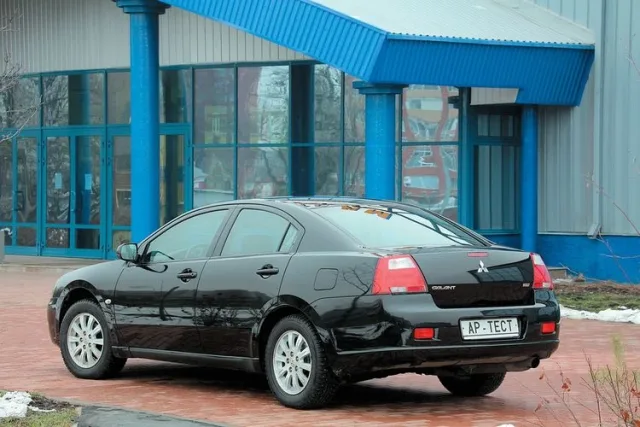
The rear of the Galant looks more attractive than the front. Aerodynamics are also up to par — the drag coefficient Cx is reduced to 0.31
And if you don't buy... There's a choice, though: the Toyota Camry and Nissan Teana are more expensive but better equipped. Which of this trio is better? We'll answer in one of the upcoming issues of Autoreview.
| Specifications | |
| Vehicle | Mitsubishi Galant |
| Body type | 4-door sedan |
| Number of seats | 5 |
| Length, mm | 4865 |
| Width, mm | 1840 |
| Height, mm | 1485 |
| Wheelbase, mm | 2750 |
| Track front/rear, mm | 1570/1570 |
| Trunk volume, l | 435 |
| Curb weight, kg | 1585 |
| Gross weight, kg | 1985 |
| Engine | petrol, with distributed injection |
| Location | front, transverse |
| Number and arrangement of cylinders | 4, in-line |
| Displacement, cm³ | 2378 |
| Cylinder bore/piston stroke, mm | 87.0/100.0 |
| Compression ratio | 9.5:1 |
| Number of valves | 16 |
| Max power, hp/kW/rpm | 158/116/5500 |
| Max torque, Nm/rpm | 213/4000 |
| Gearbox | automatic, 4-speed |
| Gear ratios | |
| I | 2.84 |
| II | 1.57 |
| III | 1.00 |
| IV | 0.69 |
| reverse | 2.21 |
| final drive | 4.21 |
| Drive | front |
| Front suspension | independent, coil spring, McPherson |
| Rear suspension | independent, coil spring, multi-link |
| Front brakes | disc, ventilated |
| Rear brakes | disc |
| Tires | 215/60 R16 |
| Maximum speed, km/h | 200 |
| Acceleration time 0—100 km/h, s | 11.5 |
| Fuel consumption, l/100 km | |
| urban cycle | 13.5 |
| extra-urban cycle | 7.2 |
| combined cycle | 9.5 |
| Fuel tank capacity, l | 627 |
| Fuel | petrol AI-92 |
List of main changes in Mitsubishi Galant cars for Russia
- Increased ground clearance
- Full-size spare wheel
- Anti-corrosion body treatment
- Silicone coating on wiper blades
- Rear bumper with a platform for a Russian-standard license plate
- Mounting for a Russian-standard license plate on the front bumper
- Front/rear mud flaps
- Headlight leveler
- Head lighting in accordance with Russian standards
- Rear fog light on the rear bumper
- Stamping of the trunk floor panel for a full-size spare wheel (which
- led to a change in the production process)
- Interior trunk trim
- Digitization of climate control in degrees Celsius
- Digitization of speedometer in km/h
- Heated front seats
- Locking fuel filler cap
- Enhanced sound insulation
What it was like
Igor VLADIMIRSKYThe name Galant first appeared in Mitsubishi's model lineup in December 1969 — it was the name of one of the versions of the compact rear-wheel-drive Colt sedan. It was with this car that Mitsubishi's American offensive began, as well as a long collaboration with the Chrysler corporation: the Colt Galant was sold overseas as the Dodge Colt.
In 1970, a station wagon and a two-door hardtop without a central pillar appeared — a first in Japan! A little later, the Colt Galant GTO coupe came out — sleek, with a sloping rear and a self-locking differential (cars were still rear-wheel-drive then). The most powerful MR version was equipped with a twin-cam 4G32 engine of 1.6 liters, producing 125 hp — a very advanced design for its time, by the way, the first such engine in Mitsubishi's history.
In June 1973, the second-generation Galant debuted — already as an independent model. There were two body styles: a four-door sedan and a two-door hardtop. In different countries, the car was called differently: Mitsubishi Sapporo, Colt Galant in Europe, Dodge Colt in the USA. The top version was equipped with a two-liter Astron engine producing 125 hp. And in 1975, a new GTO came out — with an engine that had two balance shafts, the same ones that are still familiar today from Mitsubishi's inline fours.
1976 — the third generation, with a chiseled design in the "American" style and a coil-spring rear suspension instead of leaf springs. Sedans and station wagons were called Galant Sigma on some markets, and the coupe was called Galant Lambda or Sapporo. In Australia, assembly was set up at the Chrysler plant, where the car was called Chrysler Sigma. Interesting fact: in the USA, the coupe was sold under the very "American" name Dodge Challenger.
In 1980, after a deep restyling, the fourth generation appeared — the Galant grew and acquired an independent rear suspension. The base engine became the legendary 4G63 from the Sirius family — a two-liter engine with electronic injection, producing 110 hp. A couple of years later, a turbo version appeared. Another new feature was Japan's first "passenger car" turbodiesel with a displacement of 2.3 liters.
In September 1983, a completely new fifth-generation Galant was presented in Japan. It was a front-wheel-drive mid-size sedan with electric power steering (EPS) and a suspension that could automatically maintain the body level (ECS). It was from this generation that Galants split into "American" and "European" versions: in Europe, versions with inline fours of 2.0 and 2.4 liters were sold, while in the USA — with a V-shaped three-liter "six". Besides the sedan, there was also a hardtop without a central pillar. There was also a modification with a two-liter turbo engine producing 150 hp.
The sixth generation of the Galant debuted in the fall of 1987. It was based on a platform familiar from its predecessor (which, by the way, was produced until 1990), but technically it was a much more advanced car. The smaller engines received multi-valve heads, and the brake system was equipped with ABS. A four-wheel-drive version VR4 also appeared, equipped with a self-locking center differential and a two-liter turbo engine producing 240 hp. For an additional cost, one could order a rear differential lock. Moreover, the rear wheels of the "four" could steer: a hydraulic mechanism was responsible for this, turning them at a small angle. From 1988 to 1992, the Galant VR4 fought for victories in international rallying, and then it was replaced by the Lancer Evolution. In 1988, the sedan was joined by a five-door hatchback, created specifically for Europe, although on the domestic market it was sold as the Mitsubishi Eterna. The Japanese were also offered the Eterna Sava hardtop, and the very first Mitsubishi Eclipse was built on the basis of the "sixth" Galant.
In May 1992, the seventh-generation Galant saw the light of day. The car became slightly larger and heavier than its predecessor, received a more streamlined body and a wide selection of powertrains. The chassis became even more complex: more arms and joints were added to the suspensions, and the all-wheel drive and all-wheel steering systems underwent modernization. Under the hood of the VR4 was now a two-liter V6 with two turbochargers, developing the same 240 hp. The Galant was still offered as a sedan and hatchback (Eterna), but the hardtop, known as the Emeraude, remained exclusively Japanese. In 1993, assembly of the Galant for the American market was established in Illinois.
The seventh generation did not stay on the assembly line for long — already in August 1996, it was replaced by the eighth Galant. Designer Akino Nakanishi gave the car a characteristic "predatory" silhouette and a front end with angles beveled for aerodynamics. There was no longer a hatchback in the body range, but after a long break, a station wagon appeared, which was called Legnum in Japan. The VR4, available only for the domestic market, became more powerful: its 2.5-liter V6 with two turbochargers already produced 280 hp. Since 1998, the Galant began to be equipped with gasoline engines with direct injection GDI. American production started in July 1998, and only there was the GTZ version offered with a three-liter V6 producing 195 hp, while Europeans had to make do with a 2.5-liter "six" (163 hp).
In 2003, Mitsubishi ceased sales of the "eighth" Galant in all regions except Japan, where the sedan with a two-liter GDI engine (145 hp) was produced until 2006.
And finally, since 2003, the ninth-generation Galant has been assembled at the American enterprise Diamond Star Motors in Illinois. It is built on the front-wheel-drive PS platform, which also formed the basis of the current Eclipse coupe, Endeavor crossover, and Grandis minivan. In the States, two engines are available: an inline "four" 4G69 with a displacement of 2.4 liters (160 hp) and a V6 6G75 with a displacement of 3.8 liters (230 hp). Recently, a version from the Ralliart division was added: a V6 engine from the Eclipse coupe boosted to 258 hp, a stiffer suspension, and a sporty body kit. The gearbox is a four-speed automatic, although since 2006, cars with the V6 have received a new five-speed automatic transmission.
American Galants are exported to Mexico and Puerto Rico, and since this year — to Russia and Ukraine. In addition, the "ninth" Galant is assembled in Australia under the name Mitsubishi 380 (V6 3.8, "manual" or "automatic"). In Taiwan, the Mitsubishi Grunder is produced with a different body and interior (in the Philippines it is sold as the Galant 240M), and since this year, the "Chinese" Galant is also produced in the PRC.