
Spring 2002, Lisbon, the debut of the most powerful Mini — the Cooper S version. It was unforgettable. We flew at crazy speeds along the serpentines near Cabo da Roca. That article was published under the headline "The Perfect Toy" (see AR No. 8, 2001).
Now — Barcelona, and the debut of the second-generation Mini.
And again — in the most powerful Cooper S version.
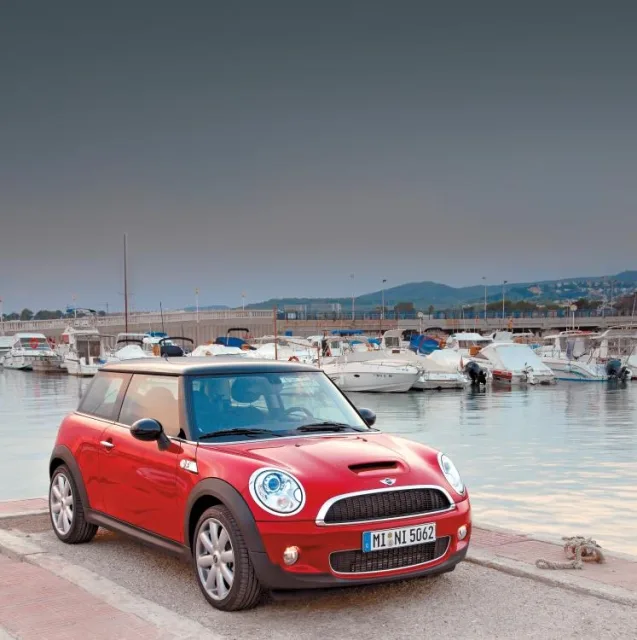
I had been eagerly awaiting this trip back home in Moscow. That supercharged 163-horsepower engine, the kart-like grip in sharp corners, the G-forces on the high-speed curves of Portuguese roads — it all stands before my eyes as if it were yesterday. Yes, the Mini is a toy, a beloved toy!
And finally, the plane, the airport — and there it is, the Mini Cooper S.
Second generation? Excuse me, but where are the differences? The exterior, dimensions, wheelbase, suspension layout — almost everything remains the same. Yes, the new Mini is 6 cm longer, but that's solely due to the bumpers. Yes, the hood line has been raised due to new pedestrian safety regulations. The orange "eyes" of the turn signals have moved directly into the headlights. The "mouth" of the fake radiator grille is styled slightly differently, the window line has become steeper by 1.8 cm, and the badges have changed subtly. But all this is a play of nuances. This isn't even a restyling, but a facelift, a cosmetic "tightening" of the face to... no, in the case of the Mini — to remain forever young!
 | |
| Inside the funny stylish key fob is hidden a "spare" key | The key fob can be left in your pocket entirely — or inserted into the slot to the right of the steering wheel |
And how good it is that the design wasn't touched. A masterpiece is so easy to ruin, and almost impossible to improve. They didn't ruin it!
The chrome door handles now have not only the lock "trigger" but also keyless entry buttons. The funny key fob, resembling a flying saucer, can be left in your pocket. You approach, open the door, sit behind the wheel…
But inside, the changes are much more serious.
 |  |
| This is how the interior of the first-generation Mini Cooper S looked in one of its variants — with the speedometer in a separate housing on the steering column. The new car has the speedometer only in the center | New interior. The steering wheel adjusts in two planes, the console has become narrower, the speedometer — larger. The "glove box" opens with a chrome button on the panel |
It's still a toy, but already more expensive and serious. The glossy plastic, huge chrome housings of the tachometer and speedometer, funny steering column stalks resembling toy rockets — all that is in the past. Now the Mini has soft dashboard trim, the tachometer housing on the steering column has become black, and the chrome rims are more modest and elegant. The center console has become narrower, making noticeably more room for your legs. The steering wheel now adjusts not only for height but also for reach. Accordingly, sitting in the new Mini is much more comfortable.
And where have the famous toggle switches, the retro-style switch levers, gone? They're in place, haven't gone anywhere. But they're styled differently: they're recessed into a common silver block on the console. And above them is a round climate control display with buttons, styled after the winged Mini emblem. A very successful solution!
It's a pity only that the silver keys "breathe" under your fingers. But that's perhaps the only "frivolous" detail in the entire interior. All other buttons and knobs work even more "thoroughbred" than in the previous Mini. The steering column stalks are no longer so dashingly cheerful, but black and non-latching — like on all current BMWs. Air from the large ventilation deflectors blows almost silently. And the Mini Boost CD audio system not only sounds noticeably better than the previous one but also has an iPod connector.
 |  |  |
| The seats are still magnificent — you simply don't notice their embrace | There's no more space in the back; the backrests fold easily, increasing the trunk volume | The displays in the tachometer are now larger — the top one can show the speed digits |
 |  | |
| On the ceiling there are now also lever toggles, one of which switches the color of the ceiling and door "ambient" lighting | The climate control unit is styled after the Mini emblem. On the sides are temperature and fan control handles: they don't rotate but rock up and down | And this is a variant with a built-in navigation system: only the tip of the needle travels along the narrow speedometer scale |
Finally, the engine starts with the Start button to the right of the steering wheel. The key fob can be left in your pocket or inserted into the slot next to the button.
I like this Mini! Yes, it has become more serious and mature. But I haven't gotten any younger over these years either. And if the new car hasn't lost its former zest but has gained comfort, then…
 |
| The control unit for the Boost CD road audio system is integrated into the speedometer: volume is adjusted either from the steering wheel or with the knob under the CD slot. The sound is powerful and beautiful |
Comfort has indeed become an order of magnitude better. The engine is quiet, the suspension isn't jittery — even in the Sport version with stiffer springs, dampers, and stabilizers. Complained about bottoming out on bumps? The front McPherson struts have increased travel. Remember how tightly the steering wheel turned on the previous Mini even in parking lots? On the new car, the wheel is helped by an electric motor, not a hydraulic booster — and it does so noticeably more diligently.
Finally, the supercharged engine was easy to stall at launch. But the new Mini Cooper S pulls away easily and willingly. You start, stomp on the pedal — and the Cooper S unexpectedly smoothly and powerfully surges forward. The new car is even 10 kg lighter than the previous one — 1130 kg without the driver. And the engine is now more powerful — it's a turbocharged 1600cc completely new unit. A masterpiece of modern engineering!
The Germans were somewhat embarrassed by the old engine called Pentagon: archaic, with a cast-iron cylinder block, produced at the Chrysler plant in Curitiba, Brazil, it was a compromise. And when it came to engines for the Mini, people from BMW always emphasized: for the new cars we're preparing a hundred percent "our" engine, it will be a completely different matter…
Now the Mini Cooper S engine is an aluminum block, turbocharging instead of the Roots supercharger, and direct gasoline injection. The turbocharger develops maximum 0.8 atm of boost already at 1600 rpm — then the valve releases excess compressed air. By the way, at these revs other turbo engines are still "asleep." But here boost works literally from idle: already at 1100 rpm the torque reaches those 160 newton-meters that the atmospheric engine of the Cooper version develops at its peak at 4250 rpm!
Fantastic traction from the very "bottom," incredible elasticity. Moreover, under full throttle, the Overboost mode engages — the wastegate opens a little later, allowing a temporary increase in the torque "shelf" from 240 to 260 Nm. True, there's no point in "revving" the turbo engine to the limiter at 6400 rpm: after 5000 rpm you can shift. But the old supercharged engine was a "revver," it loved high revs — the higher, the better…
But the new Cooper S professes a different religion. It's more powerful, easier to drive, and faster: it hits 100 km/h in 7.1 seconds, 0.2 seconds earlier than its predecessor. What more could you dream of: a 175-horsepower Mini Cooper S — and the winding roads north of the Costa Daurada beaches?
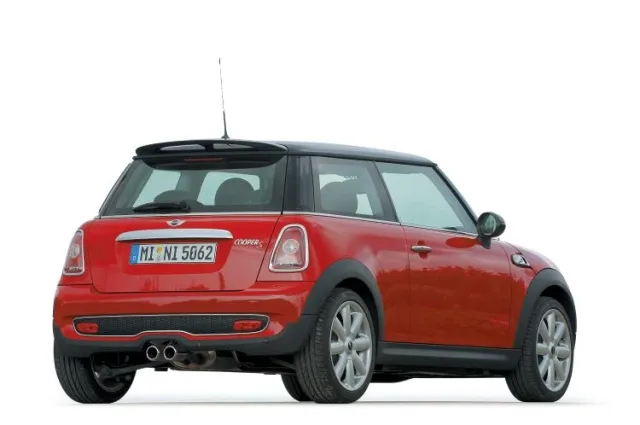
I took off. Hold me back, all seven of you!
The unloaded drive wheel spins on dry asphalt in literally every corner — just open the throttle fully. Too bad my car doesn't have the differential with 25-percent locking — as for the previous Mini, it's offered for an extra charge.
The six-speed manual works precisely, although sometimes when braking, second gear doesn't want to engage on the first try. The chassis is simply top-notch. The car reacts instantly to the slightest steering input and dives into a corner right away. If you yank the wheel more sharply, the rear multi-link suspension starts to help, using the elastokinematics of the joints, and literally screws the Cooper S into the arc, allowing you to take it on nearly neutral throttle, without understeer or oversteer. The brakes bite powerfully and reliably, the electronics work quickly and neatly — you barely feel the ABS working through the pedal. Even if you miss the turn-in point and brake already in the corner (which is against all racing rules), the car still stays on the intended line.
 |
 |
| Previous Mini Cooper S: the intercooler of the supercharged engine was located above the engine. The headlights on first-generation cars rise with the hood — slamming it shut can knock the headlight beam out of adjustment | New Mini Cooper S: the intercooler has moved down, so the "nostril" on the hood is now purely decorative. The headlights are now attached to the body |
 |
 |
| Previous Mini Cooper S (factory code R53) | New Mini Cooper S (R56) |
The Hill Assist system is a simply brilliant solution! After a brief stop on an incline, the automatic system keeps holding brake pressure for a couple more seconds, so you can calmly engage a gear and pull away. Perfect for blondes!
I try to switch off the stability control with the tiny DSC button near the gear lever — but the Mini's character doesn't change. If you overdo the speed in a corner, the front just slips slightly, and that's it. I try to provoke a slide — the Mini stubbornly resists.
Another pleasant surprise — the new engines are remarkably economical. After fast driving on winding Spanish roads, the onboard computer of the 175-horsepower Cooper S showed 11.7 l/100 km. An excellent figure!
And everything would be great, but... something is off. Something is missing.
What?
Thrill. Pleasure. Excitement. Delight.
Speed — here it is. Safety — also there. But the soul has grown sad, ruffled, and is silent, like an offended child. I recall an old joke about defective Christmas tree ornaments — those that don't bring joy.
What's the reason?
First, the engine sound. It used to be dense, rich, and the Roots supercharger added its unique whine. Now the Cooper S just hums — muted at low revs and slightly intrusive at high revs.
Second, the new steering rack with electric power assist. Here it's far from the worst — the effort and its build-up in corners are quite adequate. But not the best either. That very "transparency," that honesty of the steering that the predecessor had, is gone. The wheel has become lighter, the responses softer... It's a bit boring, without a zest.
The Germans assure that a Sport button is available by special order for the Cooper S, which will sharpen the accelerator and make the steering heavier. Personally, I don't believe in these tricks...
After all, the overall chassis tuning has become "calm." Where is the former sharpness, where is the comparison to a kart that begged to be said after the first corner?
By the way, the old Cooper S hardly wandered under power. But the new one has a more pronounced "torque steer" effect, typical for front-wheel-drive cars.
— More torque steer? — the chief chassis tuner, a young German named Andreas Pecker, asked me back. — More torque — more steer! More power — more steering pull! And as for sharpness — the new second-generation Mini on the Nürburgring Nordschleife is about 20 seconds faster than its predecessor, that is, almost a second per kilometer. And not only thanks to a more powerful and torquier engine. We reduced understeer at corner entry, with initial steering input, achieved better tire grip...
 |
|
| The front McPherson suspension has increased travel, and instead of hydraulic power steering, there's now an electric power steering unit JTECT (shown by the arrow), which saves 0.1 l of gasoline per 100 km and softens vibrations from the road. The electric motor is mounted on the steering column but as close as possible to the "rack." Alas, the "transparency" of the drive could be better. But the steering has become "shorter" — 2.3 turns lock-to-lock instead of the previous 2.5 | The only significant change in the rear suspension design is that the lower arms are now aluminum, saving 6 kg. The "sport" suspension is about 15% stiffer — with unchanged ground clearance. Shock absorbers for the Mini are supplied by the Polish plant Crosno (Delphi concern) |
Nürburgring? Interesting, with whom exactly was the Mini Cooper S compared on the Nordschleife? Pecker mysteriously stays silent. I try to prompt.
— Clio Renault Sport?
— Oh yes, that's an excellent car.
— Peugeot 206 RC?
— We've had rides. But with it on the Nordschleife, it's hard to pick drivers: every other time we returned without adventures. One mistake — and you're in the barrier. We and the Peugeot suspension guys have completely different approaches to tuning handling...
 |
| Andreas Pecker is responsible for testing all front-wheel-drive cars based on the Mini. "The unloaded front wheel spins under power? No problem — the Mini keeps accelerating!" |
Pecker and I got talking. We took a ride together — first he drove, then I did. This time the car had not the "sport" but the regular, softer suspension. Body roll is higher here, responses are even softer, and there's a pleasant tendency to oversteer on lift-off. Ride comfort is very similar: if the "sport" on 17-inch wheels swallows small bumps perfectly and shakes on large ones, the "regular" suspension with 16-inch tires seemed a bit more comfortable on serious potholes. But overall — the same. Fast, reliable, safe, bland.
But the previous Cooper S was completely different!
— Oh yes. — Pecker briefly indulged in pleasant memories. — We also tore around like crazy in the "first" Mini. But the motto of the new car is different: more speed — less work at the wheel! The Mini has simply become more mature, more solid. After all, that's exactly what buyers wanted...
Everyone at this presentation talked about customer desires. And especially — gray-haired Detlef Welters, one of the "fathers" of the new Mini.
Welters, a "general product manager," is one of the key figures in creating the new Mini of both generations. Having deliberately obtained two educations (engineering and financial, to work in automotive marketing), he joined Opel in the late 70s, and BMW in 1987.
— Remember BMW's transition from chrome window trim to matte in the late 80s? That was my idea. And for the new Mini, on the contrary, I proposed to the board of directors to add more chrome to the interior. Because the Mini is a classic English car. Only Mini, Jaguar, and Rolls-Royce — three brands in the world can wear abundant chrome jewelry with dignity! Studying Mini buyers' requests, we realized they love to care for their pet, wipe the chrome with a cloth... And I also "pushed through" the switchable interior lighting. See the second toggle switch from the right on the overhead console? You press it — and the LEDs that illuminate the gear lever from above, along with the "ambient" lighting of the door panels, change color. From blue — to orange. From orange — to red... Great idea, isn't it?
 |
 |
| The tiny trunk — only 160 liters; at the bottom — just a jack for changing "safe" Run Flat tires | The stylish fuel filler flap used to be metal, but now it's plastic |
Trim, lighting... A serious person deals with such trifles, pushes them through the board of directors? And that's what automotive marketing is. To take into account, anticipate customer desires — and embody them in a new model.
— We took into account in the new second-generation Mini all complaints about previous cars. What did they complain about? Excessive sharpness of reactions, stiff suspension — especially women. You say there's less excitement now. But nobody demanded it! We'll launch the new model, listen to owner feedback. If they ask to bring back the sharpness — we'll bring it back. And for enthusiasts like you, journalists, we'll offer the "hot" version John Cooper Works. This, by the way, was also my idea — to have JCW kits installed on the Mini at the factory, not at dealers...
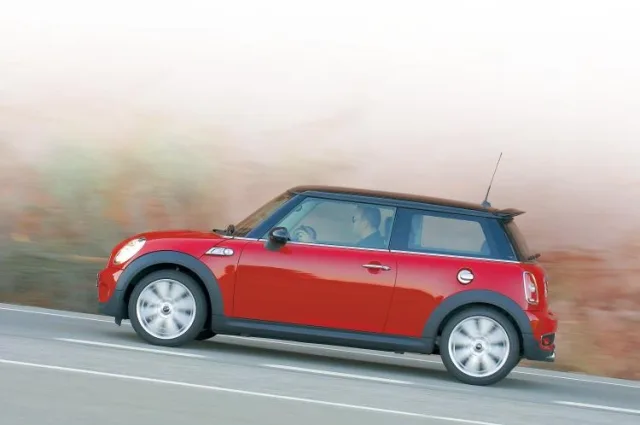
The new second-generation Mini is, in essence, a mold made from customer surveys and marketing research. This is how global fashion interferes with the history of the automotive industry. BMW engineers created an excellent front-wheel-drive "hot" hatchback, but it was immediately snapped up by fans of gloss... It is this audience that made the Mini a bestseller — and it is on them that the creators of the second generation focused. They approached the matter with all seriousness: the car deserves it.
— When we conceived the new Mini in the mid-90s, we prayed to reach at least 100 thousand cars a year, — says Welters. — We set the bar at half a million, no more. And now we produce 200 thousand annually: the first generation's total output has already exceeded 877 thousand, and this is not the limit. The convertible will live in the old body with old engines for at least another year — that's another 40 thousand or so. But for the new car, we are planning 240 thousand a year...
They did everything right. Absolutely right!
Let's recall the conditions under which the Mini project started — during a very difficult period for BMW. The purchase of Rover and Rolls-Royce — and the bold attempt by the Germans to rethink legendary models. Both the Rover 75, the Range Rover, and the Mini, not to mention the Phantom, challenged the whole world. And all four cars turned out brilliantly!
 |  |  |
| The Mini body has changed almost completely: from the old model, only the floor, the rear door opening, and the roof remain | One of the "fathers" of the Mini, Detlef Welters, clicks the ceiling toggle: "You change the lighting according to your mood — not a bad idea, is it?" | For those who doubt: the Mini is an English car! At least, it is assembled in England — at three plants that the Germans call the "production triangle." Engines are made in Hams Hall (where other four-cylinder BMW engines are also produced), body panels are stamped in Swindon, and final assembly is in Oxford. Preparing for the second-generation Mini cost BMW 200 million pounds sterling (about 300 million euros). And when the "triangle" reaches full capacity of 240 thousand cars next year, 6,800 people will be employed in production. The photo shows robotic painting of the "striped" Mini in Oxford |
The new Mini turned out especially successful. Even skeptics, even fans of the "original" Mini, accepted it. Because the car was made by enthusiasts for enthusiasts. Remember the headline of our first article about it — "Child of Love"?
The same people worked on the second-generation Mini. But now it is a child of marketing. After all, of all the "English balls," it was the Mini that landed in the pocket — and the production of funny front-wheel-drive cars turned into a serious commercial project for BMW.
The car has become a legend? Time for a reprint. Along the beaten path. Customer surveys, design and construction tweaks, cost reduction...
Since front-wheel-drive cars are a "non-core" business for BMW, part of the costs have to be shared with partners. If earlier engines were made together with DaimlerChrysler, now they are made with the French from PSA. Moreover, all engineering is purely German, and Peugeot and Citroen simply provide volumes to bring down the price. After all, it's one thing to order 240 thousand blocks and crankshafts a year only for the Mini, and quite another — 600 thousand, taking into account engines for Peugeot and Citroen. That's where you can seriously save!
And also, Italians worked on the new Mini...: the engineering firm IDG, a subsidiary of Italdesign Giugiaro, built prototypes, coordinated components from various suppliers, and adapted the "shared" engines for the Mini. The engine sound tuning, engine mounts, cable shift mechanism — all this was done by Giugiaro's subordinates. Why? According to Welters, BMW simply does not have enough of its own engineering resources for front-wheel-drive cars. They have to resort to outsourcing — giving part of the work to the side to avoid delaying the generational change.
 |
| And this is what the "regular" Mini Cooper with a 120-horsepower engine looks like. Later, the Cooper One with a 1.4 engine (95 hp) and a turbodiesel version will appear |
So, the Mini Cooper S — as we knew and loved it before — is dead. Long live the new Mini Cooper S! Almost unchanged in appearance, but much more comfortable, solid, and easy to drive. The way current owners wanted to see it. By the way, the cramped interior was also among the complaints — and therefore, soon, an extended five-door car based on the Mini will appear with rear "half-doors" opening against the direction of travel, like the Mazda RX-8 coupe. But a four-wheel-drive Mini crossover, as Welters assures, will not be — so as not to create internal competition with the future BMW X1 analogue. A pity.
And what about enthusiasts who want to see the Mini still as spirited and fun? First, buy up the old Cooper S — this is still possible until the new year. And then — rely on the magic Sport button, wait for the John Cooper Works version, which, according to rumors, will be boosted to 220 hp. And hope for tuning studios that are already excitedly rubbing their hands in anticipation of a flood of orders from dissatisfied enthusiasts.
But such people are a minority. And the character of the new Mini was "sculpted" for the majority. In politics, this is called democracy — the power of the demos, the people. And in commerce — just common sense. Isn't it?
The four-cylinder engines of the new family are designed at BMW but also used by the PSA Peugeot Citroen concern — a large volume of total orders allows reducing the cost. Engines for BMW and PSA differ only in intake-exhaust systems and control electronics, but assembly is carried out separately: for the Mini — at the English plant in Hams Hall.
 |  |  |
| The Bosch direct injection system is not third-generation, but "second and a half" generation, still with side injectors: the Mini engine is not designed for lean-burn operation in principle | Mini Cooper S engine (1.6 L, 175 hp, up to 260 Nm): oil-cooled pistons, direct gasoline injection, intake camshaft phaser, Borg Warner turbocharger. The intercooler radiator is at the bottom in front of the engine | Mini Cooper engine (1.6 L, 120 hp, 160 Nm) — port injection, two phasers (on intake and exhaust) and a throttleless Valvetronic mechanism that varies intake valve lift from 0.2 to 9.5 mm |
Both engines are advanced in design. During warm-up, the water pump is switched off, and a variable-displacement oil pump helps save up to 1.7 hp and reduces fuel consumption by 1%. Overall, all innovations have improved efficiency compared to the previous Pentagon series engines by 16% for the 120-hp Cooper engine and by 18% for the turbocharged Cooper S engine!
 |  |
| External speed characteristics of the Mini Cooper S engine | External speed characteristics of the Mini Cooper engine |
For unification with French cars, the engines are now turned 180° — with the exhaust manifold facing forward. The mechanical "two-and-a-half-shaft" Getrag gearbox is new. And the six-speed Aisin "automatic" remains the same — except that paddle shifters for manual gear selection have been added.
| Specifications | ||
| Model | Mini Cooper | Mini Cooper S |
| Body type | three-door hatchback | three-door hatchback |
| Number of seats | 4 | 4 |
| Length, mm | 3699 | 3714 |
| Width, mm | 1683 | 1683 |
| Height, mm | 1407 | 1407 |
| Wheelbase, mm | 2467 | 2467 |
| Track front/rear, mm | 1459/1467 | 1453/1461 |
| Drag coefficient | 0.33 | 0.36 |
| Trunk volume, l | 160—680* | 160—680* |
| Curb weight, kg | 1065 | 1130 |
| Gross vehicle weight, kg | 1515 | 1580 |
| Engine | petrol, with multipoint injection | petrol, with direct injection and turbocharging |
| Location | front, transverse | front, transverse |
| Number and arrangement of cylinders | 4, in-line | 4, in-line |
| Displacement, cm³ | 1598 | 1598 |
| Cylinder bore/piston stroke, mm | 77.0/85.8 | 77.0/85.8 |
| Compression ratio | 11.0:1 | 10.5:1 |
| Number of valves | 16 | 16 |
| Max. power, hp/kW/rpm | 120/88/6000 | 175/128/5500 |
| Max. torque, Nm/rpm | 160/4250 | 240/1600—5000 (260/1700—4500)** |
| Gearbox | M6/A6*** | M6/A6*** |
| Drive | front | front |
| Front suspension | independent, coil spring, McPherson type | independent, coil spring, McPherson type |
| Rear suspension | independent, coil spring, multi-link | independent, coil spring, multi-link |
| Front brakes | disc, ventilated | disc, ventilated |
| Front disc diameter, mm | 280 | 294 |
| Rear brakes | disc | disc |
| Rear disc diameter, mm | 259 | 259 |
| Tires | 175/65 R15 H | 195/55 R16 87V RSC |
| Maximum speed, km/h | 203 | 225 |
| Acceleration 0—100 km/h, s | 9.1 | 7.1 |
| Fuel consumption, l/100 km | ||
| city | 7.8 | 8.9 |
| highway | 4.6 | 5.7 |
| combined cycle | 5.8 | 6.9 |
| Fuel tank capacity, l | 40 | 50 |
| Fuel | petrol AI-91—95 | petrol AI-91—95 |
| * With rear seats folded | ||
| ** Data in parentheses — in overboost mode | ||
| *** M6 — manual 6-speed gearbox, A6 — automatic 6-speed gearbox | ||